


How Much Caviar per Person? Plan Tastings, Canapés and Events

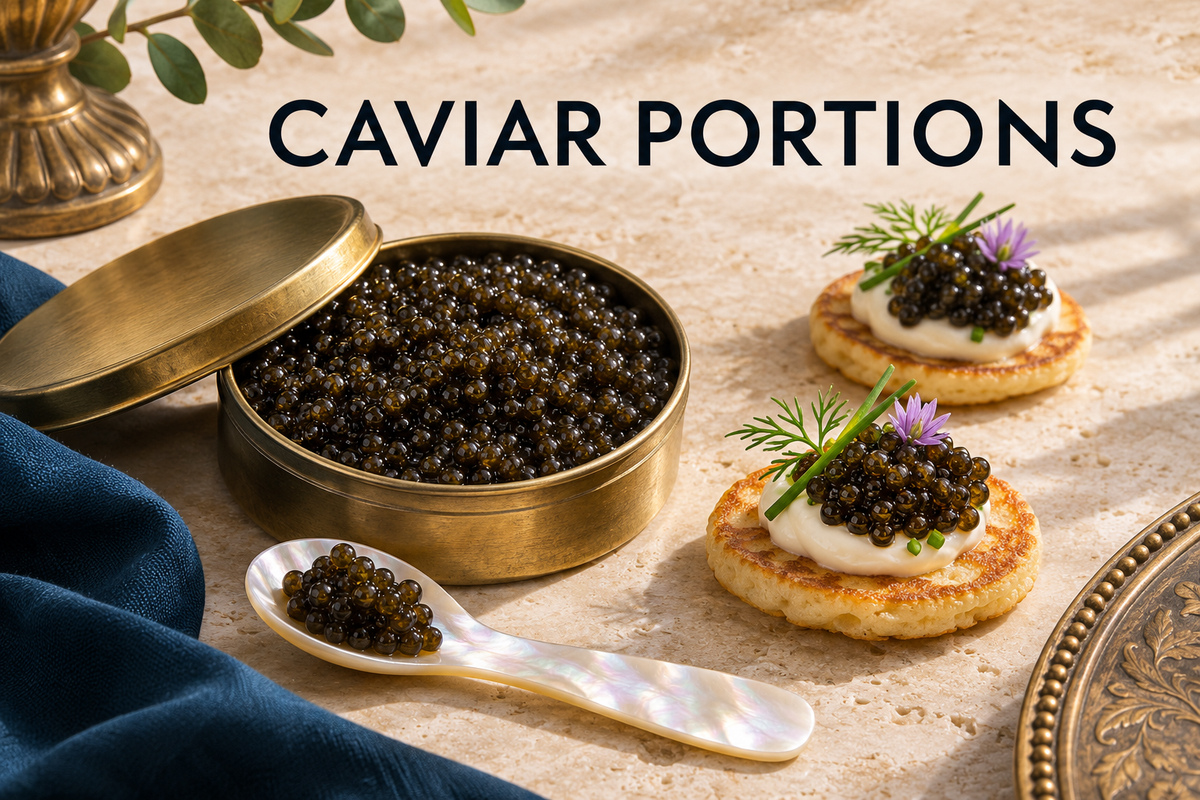
How much caviar per person depends on how it is served. Plan about 10–15 g per guest for a garnish-led service, 30 g for a dedicated course, or 30–50 g for a substantial tasting. For passed canapés, start with the number of pieces instead: 1–2 g per piece is a practical starting point. Multiply the planned portion by the number of guests, samples or bites, then round up to available net tin weights.
| Service | Starting allocation | How to order |
|---|---|---|
| Garnish-led service | 10–15 g per guest | Multiply by the guests receiving the garnish; a single small bite may need less |
| Passed canapé | 1–2 g per piece | Multiply by total pieces, including repeat rounds |
| Dedicated course | About 30 g per guest | Count guaranteed plated portions |
| Substantial tasting | 30–50 g per guest in total | Divide the total among the samples and check each species separately |
| Long reception | Based on planned bites or attendance at the station | Stage several sealed tins instead of opening everything at once |
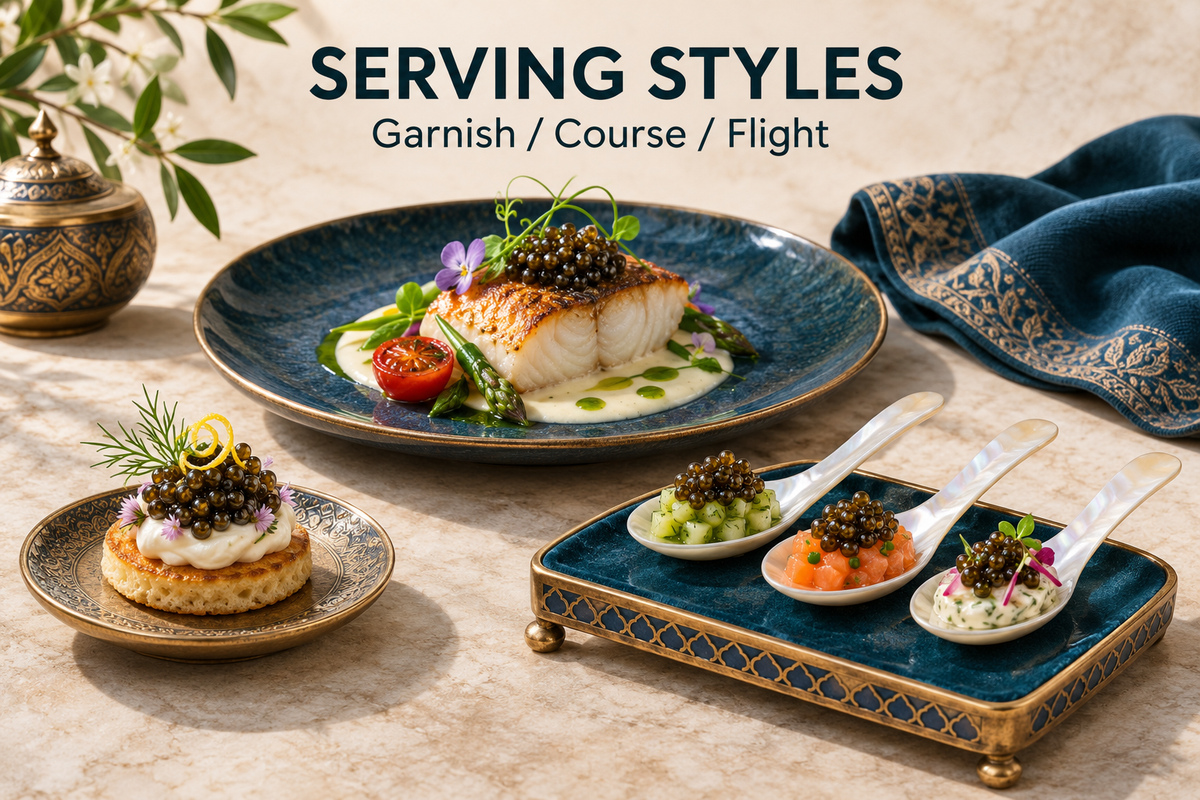
How Much Caviar per Person for Each Service?
First decide what guests will actually receive: a garnish, a repeatable bite, a plated portion or a flight. Attilus’s guide for hosts and The Caviar Guy’s serving-size guide offer useful starting quantities, but they describe different service formats.
A garnish or a passed canapé
A per-guest allocation works when each person receives a known plate or a set of bites. A per-piece allocation works when servers carry trays and guests might take more than one. The distinction matters because a 10 g guest allocation is five times the weight of a 2 g canapé; applying 10 g to every canapé when several rounds are planned would change the character of the dish and the total order.
Test the assembled bite before fixing the allocation. On a blini with crème fraîche, caviar needs to stay visible and discernible against the dairy and bread. On a thin potato crisp, a compact mound may be easier to carry than a broad smear. Weigh a representative topping, taste the bite at its intended serving temperature and check whether it can be lifted without losing pearls. If the caviar is almost invisible or disappears behind a strong sauce, adjust the base as well as the portion.
Separate the garnish weight from the amount of caviar actually on the plate. A spoonful of a prepared topping that includes dairy is not a spoonful of caviar. Weigh the roe on its own and use the same utensil, placement and topping size across the batch. A test plate prepared by one cook should be repeatable by another during service.
A seated course or a tasting flight
A dedicated course usually calls for more than a garnish because guests are meant to eat the caviar across several bites. Just Caviar’s occasion guide uses 30 g as a dinner course benchmark. Treat that as a starting point, then consider where the course sits in the meal. A short plate served as one stop in a longer menu can have a different brief from a course introduced as the highlight of the evening.
For a flight, decide whether the advertised weight refers to the whole flight or to each sample. A 30 g flight with three equally sized samples is 10 g of each, per guest. Three samples of 30 g are 90 g in total. If one style is the featured product, you can deliberately give it a larger share, but document that split before ordering.
Make each sample recognisable. Offer the first taste plain or on a neutral base, keep service temperature similar across tins and put the stronger accompaniments on the side. For a guided tasting, a small note identifying each variety is more useful than assuming guests can identify it from colour. When a tin changes mid-service, check that it is the intended variety before replenishing the flight.
An open reception or a station
At a reception, the useful headcount is the number expected to eat the item, not automatically the invitation count. If everyone is promised one bite, plan one for every confirmed attendee who can eat it. If caviar is an optional station beside other food, use likely participation and a planned allowance for return visits. Mark these figures as assumptions so they can change when the event brief changes.
A station needs two separate decisions: how much to hold in reserve and when to open that reserve. Too much caviar in the display at the beginning makes it harder to keep chilled and leaves less flexibility later. A smaller first batch helps the service lead observe take-up. A replenishment plan is particularly useful when an early reception crowd differs from the group that arrives later.
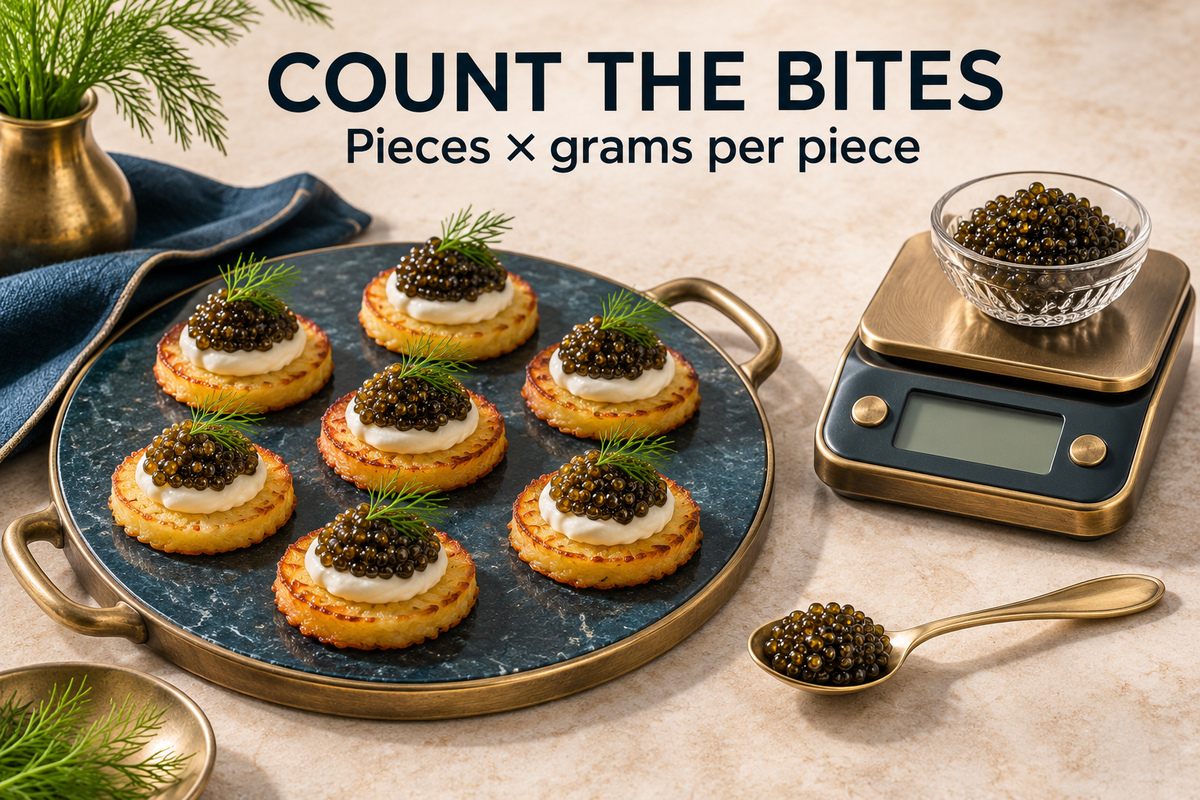
From Guest Count to Tin Count
Calculate the serving requirement before looking at pack sizes. A tin is a packaging unit; a plated serving or completed bite is the unit you promise to a guest.
The calculation that works for any format
For a plate, multiply portions by grams per portion. For canapés, multiply the number of completed pieces by grams per piece. For a flight, calculate demand for each caviar separately. Then add any explicitly planned reserve and choose tins whose net weights meet or exceed those amounts. If one variety runs short, extra grams of another variety do not complete a promised flight.
| Example planning unit | Calculation | Net weight needed |
|---|---|---|
| Two people sharing a first taste | 2 × 15 g | 30 g |
| Four guests receiving a caviar course | 4 × 30 g | 120 g |
| Twelve guests receiving two 2 g canapés each | 12 × 2 × 2 g | 48 g |
| Six guests receiving three 10 g samples | 6 × 3 × 10 g | 180 g overall; 60 g per variety |
| Ten guests receiving a 40 g flight split equally in two | 10 × 20 g per variety | 200 g per variety |
These are worked calculations from selected service assumptions, not reported consumption averages. In the canapé example a 50 g tin covers the theoretical 48 g, leaving 2 g. If the kitchen wants a separate reserve or must make extra demonstration plates, include those pieces in the calculation instead of treating the tiny surplus as a service buffer.
A mixed-service event from order to plating
Imagine a reception for 24 confirmed guests. Everyone is promised two 2 g caviar canapés, and eight guests have booked a separate tasting of two varieties at 15 g each. The passed service needs 96 g. The flight needs 120 g of the first variety and 120 g of the second. Total planned service is 336 g, allocated to three separate jobs.
Suppose the supplier confirms 50 g tins for the canapés and 125 g tins for each flight variety. Two 50 g tins cover the passed service. A 125 g tin of each variety covers its flight allocation. The order is 350 g, of which 14 g is rounding surplus. The banquet sheet should show where each tin is assigned so that one team does not use the tasting allocation to make more canapés.
On service day, a lead cook verifies the pack weights and labels against the event sheet. The canapé team sets aside the second tin until the first tray is underway and uses a test bite to check the topping. The tasting team portions by variety and marks each position on the tray. If the organiser adds a ninth tasting guest, the flight needs 135 g of each variety, so a 125 g tin is no longer enough. The team must confirm a suitable reserve or agree a different flight plan before making that promise.
One large tin or several smaller ones?
Use one large tin when the same variety is going to a single team for one concentrated seating and the quantity will be used promptly. Smaller tins make more sense when there are separate rooms, waves or teams, or when expected participation is uncertain. They also make it easier to hold an unopened reserve. Confirm available packs rather than assuming a particular supplier stocks the example sizes.
Use a tray or plate count to reconcile the reserve. For passed service, completed bites and remaining unplated roe tell you more than a visual glance at a partly used tin. If your estimate changes, calculate the extra pieces you can make at the original topping weight before opening another pack.
Serving Caviar Through a Long Event
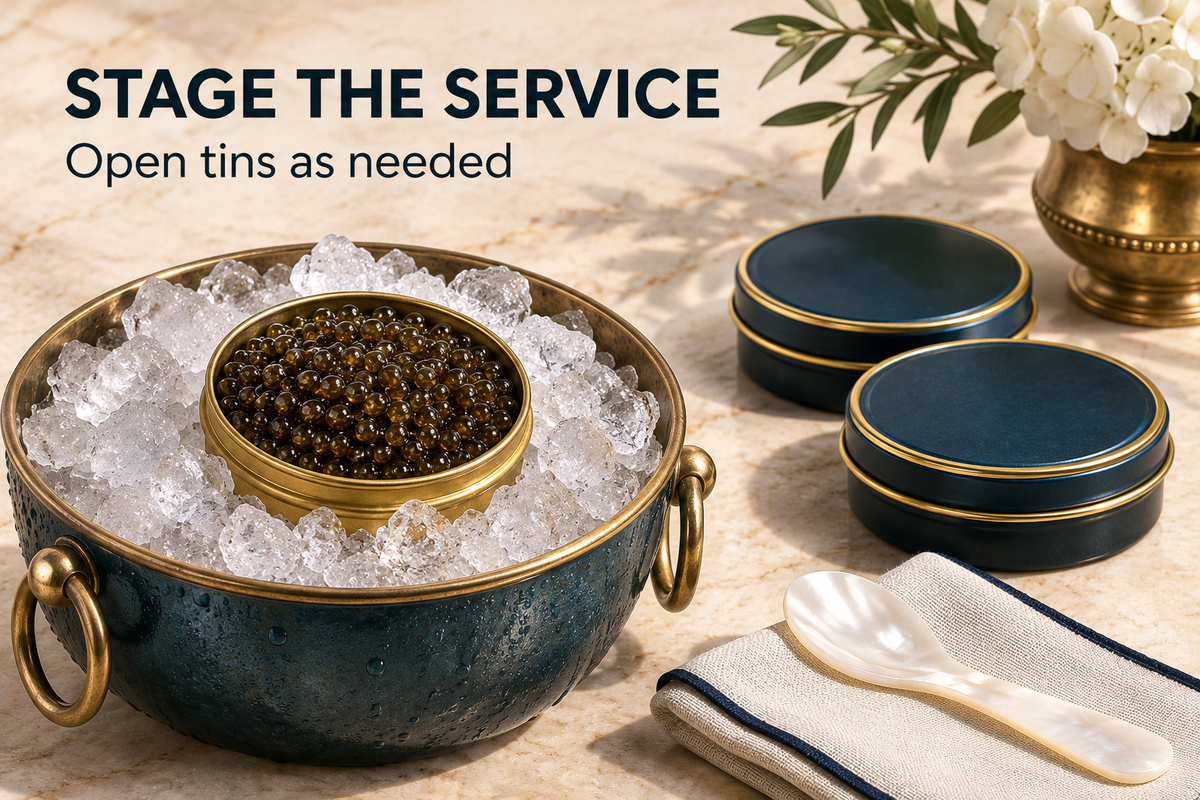
Keep unopened stock under the conditions printed on the product and follow the producer’s instructions after opening. The FDA’s guidance on safe buffet service recommends keeping cold buffet foods at 40°F or colder and using small platters or cold holding when appropriate. Treat this as general guidance, and follow any stricter product requirements and local food-safety procedures. A display over ice is a service aid; it does not remove the need to monitor holding conditions or keep reserve stock properly refrigerated.
Set up a simple handoff between the kitchen and the room. Label prepared batches with the variety and keep the serving utensil assigned to that item. Keep plain bases and cold toppings ready separately when the final assembly can be done just before each round. The crisp base stays in better condition, and fewer finished bites sit waiting. At a self-serve station, send a fresh small platter when the first is depleted rather than topping new portions onto an older display. The FDA’s advice on handling chilled seafood explains why time and temperature matter even when the food still looks fine.
Ask for fish allergies and other dietary restrictions before setting promised portions. A guest who cannot eat fish roe needs a separate alternative, not a canapé scraped clean; the kitchen should follow its allergen procedure and use a separately prepared plate. At the end, distinguish sealed refrigerated stock from opened or displayed food. Record what was opened and follow the product instructions and applicable food-safety policy before deciding what to retain. This makes the next event easier to plan: the number of completed bites and sealed tins remaining shows which assumption was accurate and which needs adjustment.
Frequently Asked Questions
Tin size questions usually have more than one correct answer because the serving format varies. Calculate from the planned portion first.
Is 30 g of caviar enough for two people?
Yes for a 15 g first taste each or a shared garnish. It does not cover two 30 g courses. If the two diners want to compare two varieties, confirm the allocation for each variety rather than treating a single 30 g tin as a two-variety flight.
How many canapés can I make from 50 g?
At 2 g each, the theoretical yield is 25 pieces; at 1 g each, it is 50. The realised yield depends on portion consistency and what remains on tools. Test a few pieces and allow for any demonstration or backup bites in the plan.
How much do I need for ten guests?
At 30 g per guest, you need 300 g for a dedicated course. At two 2 g canapés each, you need 40 g. A tasting at 40 g per guest needs 400 g total, divided among the chosen varieties.
Can I substitute a larger tin for several small ones?
Yes if the net weight, product and service plan match. For two rooms or a long reception, separate sealed packs are easier to allocate and open as needed.
Should I open every tin before guests arrive?
Open only the amount needed for the first service. Keep the reserve sealed and refrigerated according to its label until required. For an event with multiple stations, agree who releases the reserve so two teams do not open it at once.
Plan Your Caviar Service with Iran Fish
Send the service format, guest count and date when enquiring about Iran Fish’s caviar range.
List the weight for each variety and say whether it is for a tasting, plated course or passed bites. Include the net tin sizes you prefer and whether you need sealed stock for later waves.
Ask the supplier to confirm pack availability and handling instructions for the intended delivery before finalising the banquet sheet.