


Caviar Tin vs Jar: Packaging Choices for Retail and Food Service

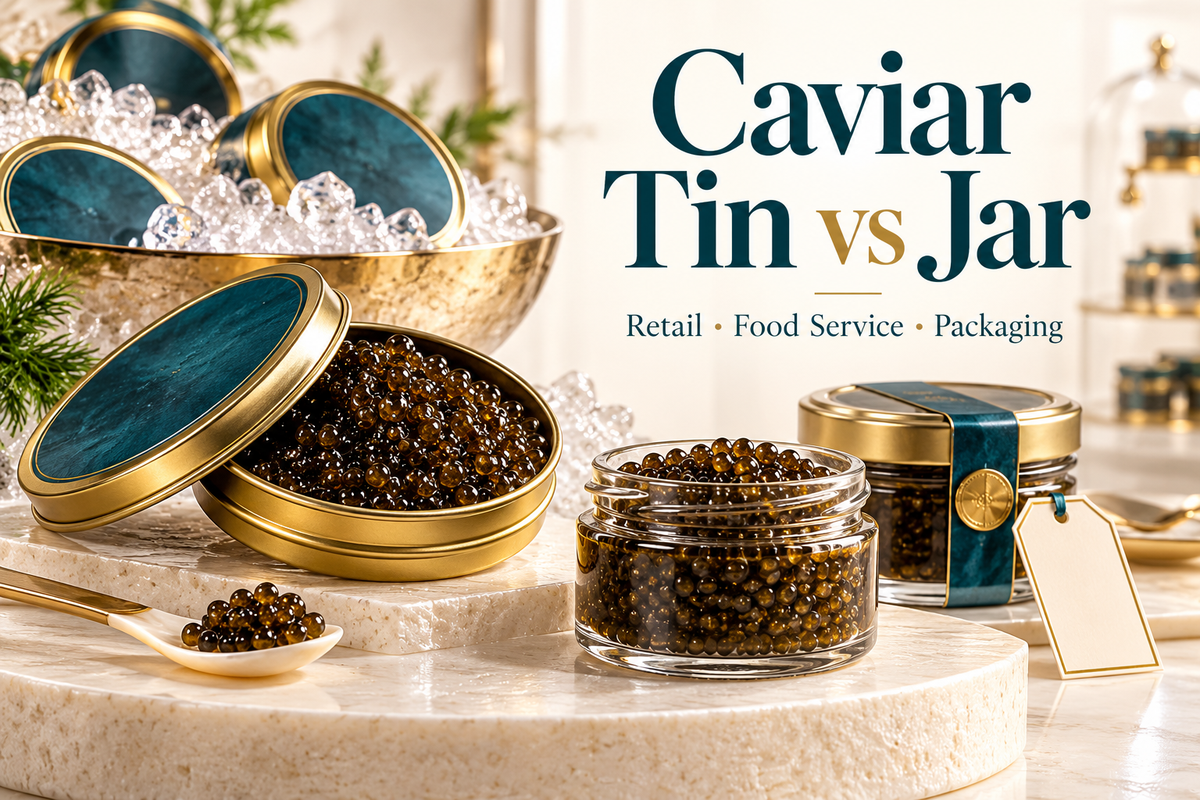
The caviar tin vs jar decision depends on the product, seal and intended use, not a universal quality ranking. Tins shield the contents from light; clear jars let buyers see the roe. Neither format proves that caviar is pasteurized, shelf-stable or safe. Choose a supplier-approved pack that protects the product, carries traceable labels and fits the way it will be stored, opened and served.
| Decision | Practical answer |
|---|---|
| Which protects against light? | An opaque tin blocks light; a clear jar needs protection through its display and outer packaging. |
| Which shows the product? | Clear glass makes the roe visible, but appearance cannot establish safety. |
| Which keeps longer? | Use the shelf life validated for that specific product and pack; material alone does not determine it. |
| Which suits a restaurant? | A pack that can be handled hygienically and used within its labelled after-opening window. |
| Which suits retail? | A clearly labelled, tamper-evident pack compatible with the chilled display and customer handling. |
| Does a sealed pack need refrigeration? | Follow its label; neither a tin nor a jar establishes ambient stability. |
| What matters for sturgeon caviar? | Correct identity, traceability, suitable packaging and applicable CITES requirements. |
Caviar Tin vs Jar: What Actually Changes?
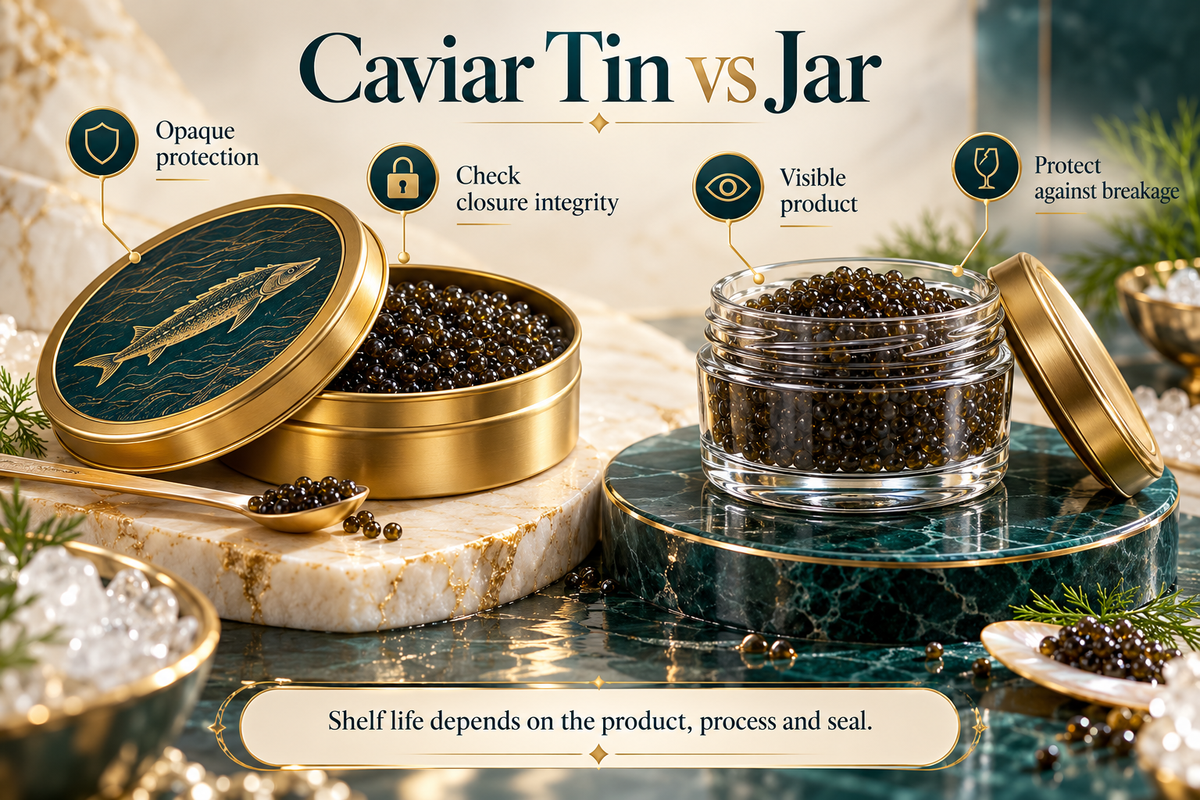
Packaging changes how caviar is protected, inspected and handled. Compare the complete container, including its lid and closure, rather than treating metal and glass as competing grades of roe.
Light protection and visibility
An opaque tin prevents direct light from reaching the product. A clear glass jar exposes its contents to view, which can help a customer understand grain colour and presentation without opening the pack. That visibility is a merchandising feature, not a freshness test. Lighting, glass thickness and the product itself can change how roe appears.
For either format, keep the product in the approved storage environment. A brightly lit retail shelf or decorative display should not replace refrigeration. Ask how the supplier intends the outer carton, sleeve and primary container to work together.
Physical handling
Glass can break or chip. Metal can dent, and damage around a closure or seam deserves particular attention. Receiving staff should understand which parts of the actual package protect the seal and which marks are merely cosmetic. A sound-looking container does not compensate for an unacceptable temperature history.
Contact surfaces and closures
The food-contact surface, lid liner, gasket and closure are part of the packaging specification. A food-grade caviar tin should not be judged as though the roe necessarily touches bare, reactive metal. Likewise, glass walls do not establish that the lid or seal is appropriate.
The supplier should confirm compatibility with the product and intended storage conditions. Do not substitute a generic jar or refill a branded tin and assume the original specifications still apply.
Why Processing and Sealing Matter More Than Shape
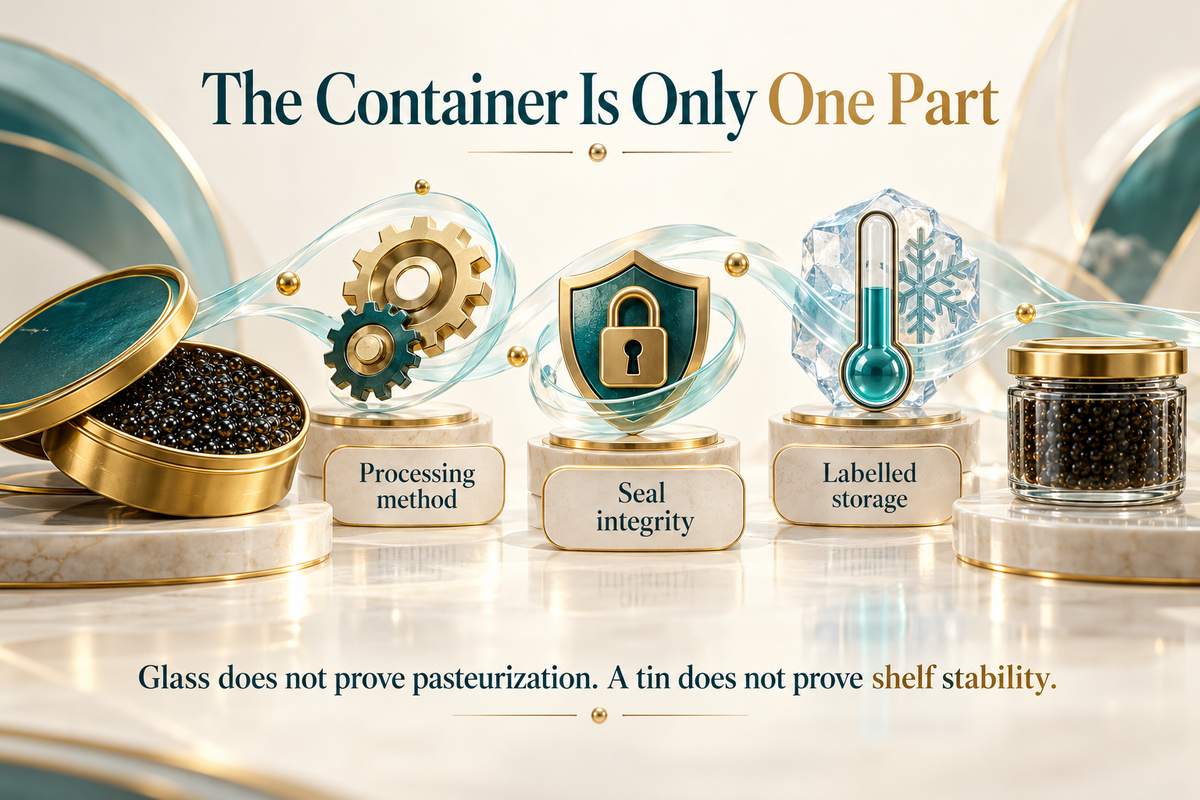
A jar does not mean pasteurized caviar, and a tin does not mean unpasteurized caviar. Heat treatment, formulation, packaging and storage instructions need to be established separately. When comparing products, check the exact specification rather than inferring the process from a photograph. The distinction between pasteurized and unpasteurized caviar helps explain why two apparently similar packs can have different handling requirements.
A maturation container is also different from a finished retail pack. In its description of controlled caviar maturation, Petrossian explains the role of original or mother tins in its own process. That is a specialist production system, not permission to store opened retail caviar in contact with air or to copy a producer’s maturation schedule in a restaurant refrigerator.
Shelf life belongs to the combination of product, process, seal and validated storage conditions. Caviar Tresor describes packing into glass, slip-on tins and vacuum tins within its own operation. Such supplier-specific information illustrates available formats; it does not establish a shelf life for a different business’s roe. Ask for unopened and after-opening instructions for the exact item under discussion.
Choose Packaging for Retail Display and Handling
Retail packaging must remain understandable after the product leaves the shop. A customer should not need to guess how to store it or whether the label has been disturbed.
- Check that the product name, net weight, storage conditions and date marking remain readable on the finished pack.
- Confirm how opening or tampering becomes visible before deciding on a sleeve, sticker or gift presentation.
- Make chilled storage instructions visible rather than hiding them beneath decorative packaging.
- For glass, examine how jars are separated and protected during transport and shelf handling.
- For tins, check closure protection and the fit of stacked packs in the display.
- Choose a pack size that matches the intended occasion and the supplier’s after-opening guidance.
- Keep consumer instructions with the product, including when an outer gift box is removed.
Request a finished sample, not only artwork. Staff can then assess label legibility, opening instructions and storage space using the actual package. A container that photographs well may be awkward to retrieve from a chilled cabinet or difficult to identify once several similar products are stored together.
Choose Pack Formats for Restaurant Service
Restaurant packaging needs to fit preparation, service and traceability. The useful comparison is how each pack performs in the kitchen’s real workflow.
Match opening frequency to demand
A larger pack is not automatically a better fit for a quiet service. Estimate how much the kitchen expects to use after opening and compare that with the producer’s instructions. Smaller sealed units can make it easier to leave reserve stock unopened, while a busier operation may have a different pattern of use.
There is no universal restaurant portion that determines the right tin. A tasting spoon, a garnish and a shared presentation use caviar differently. Write the intended menu role into the specification before choosing the pack.
Test the serving setup
Check that the container sits securely in the intended chilled holder. Keep ice and meltwater out of the roe. If the original package is presented at the table, its base should be supported and its label should remain identifiable.
Keep reserve stock separate
An active service container and unopened stock need different controls. Record opening information and retain the batch identity. Use clean serving utensils and avoid returning guest-exposed portions to reserve stock. The principles in the caviar storage guide apply regardless of whether the container is glass or metal.

Check Labels, Traceability and Repacking
For sturgeon and paddlefish caviar, packaging is also a traceability matter. The European Commission’s explanation of caviar labelling requirements covers non-reusable labels on primary containers, including jars and tins. The container material does not remove the requirement to establish product identity and lawful trade documentation applicable to the shipment.
A gift box is secondary packaging; the primary container directly holds the caviar. Check which label belongs to the actual food container and how evidence of opening is maintained. Use the CITES caviar label guide to understand the difference between species, origin and batch information. A traceability label is not a microbiological safety certificate or a substitute for cold-chain control.
Commercial repacking should not be treated as simply moving roe into an attractive smaller jar. Applicable registration, hygiene, labelling and record requirements need checking with the relevant authorities. Internal kitchen portioning for immediate service is a different activity from creating sealed retail products for sale. Do not copy the original date onto a newly filled container without an appropriate basis.
Inspect Deliveries and Protect the Cold Chain
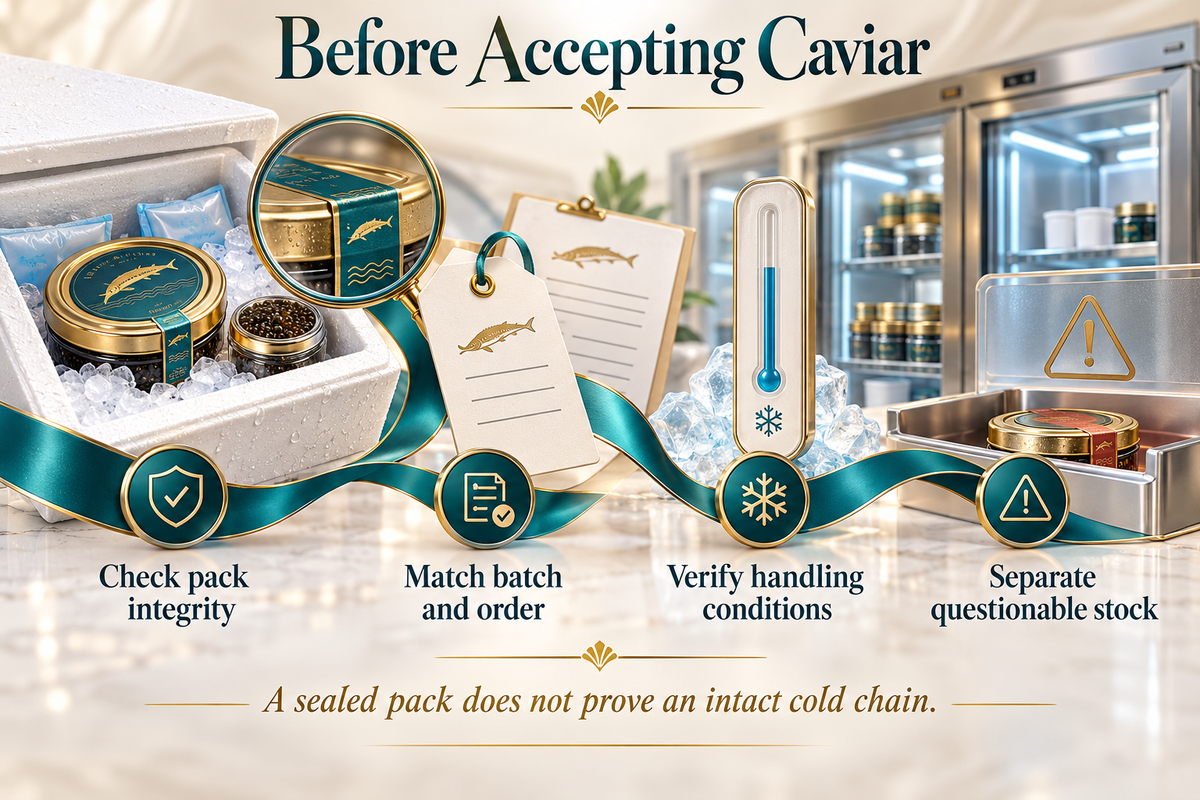
Both formats need an agreed receiving procedure. Decide before delivery which observations trigger acceptance, a hold or rejection.
- Compare the delivered product, pack size and batch details with the order.
- Inspect glass, metal, lids and tamper-evident features for damage.
- Check product temperatures and any supplied monitoring records against the agreed specification using an appropriate receiving method.
- Photograph discrepancies and retain identifying information for the supplier.
- Move acceptable stock promptly to its specified chilled storage location.
- Keep questionable stock clearly separated from food available for service.
The FDA’s seafood handling guidance reinforces prompt refrigeration and attention to handling conditions. A generic refrigerator setting should not override a narrower temperature instruction on the caviar label. Nor does putting a warm delivery back into a refrigerator demonstrate that its earlier handling was acceptable.

Questions to Include in a Packaging Specification
A written specification makes repeat orders easier to compare. It should describe what the supplier is actually offering, rather than relying on the words premium or vacuum packed.
- What species or roe type is supplied, and what processing has it undergone?
- What are the primary container, closure and food-contact materials?
- How is opening or tampering made evident?
- What unopened and after-opening instructions apply?
- What net weights and outer-pack arrangements are available?
- How are batch identity, date marking and storage instructions displayed?
- What receiving checks and transport conditions are agreed?
- Who is responsible for artwork, destination-language labels and any commercial repacking?
For environmental comparisons, ask for the complete packaging composition and disposal instructions for the receiving market. A glass jar with a metal lid, sleeve and insulated transit box is not a single-material system. Neither glass nor metal is universally the more sustainable choice without considering the actual supply chain and local collection arrangements.
Frequently Asked Questions
These questions concern the packaging decision rather than a particular producer’s shelf-life promise. The label and confirmed specification remain the instructions for the actual product.
Does caviar in a glass jar last longer than caviar in a tin?
Not necessarily. Processing, formulation, closure, storage conditions and whether the pack has been opened determine the applicable shelf life. Compare the instructions for the specific products, not general claims about glass and metal.
Is caviar in a jar always pasteurized?
No. Packaging appearance does not establish heat treatment. Ask for the product specification and read the label before drawing that conclusion.
Can a caviar tin be stored in a cupboard?
Only if the particular product is explicitly supplied and labelled for that storage. A sealed metal container does not establish that refrigerated caviar is shelf-stable.
Should opened caviar always be transferred out of its tin?
There is no universal transfer rule for every pack. Follow the producer’s instructions. Unnecessary decanting introduces handling and can separate the product from its batch and opening information.
Can a retailer divide a large tin into smaller jars?
That requires assessment of applicable commercial repacking, hygiene, traceability and labelling obligations. It should not be presented as an ordinary extension of serving caviar from an opened pack.
Discuss Caviar Packaging With Iran Fish
For a retail range or restaurant supply programme, start with the product and intended use. Review the Iran Fish caviar range and identify the roe type, service pattern and destination market.
The Beluga caviar page and trout roe page provide separate starting points for different products.
Send those requirements through the Iran Fish enquiry page and request confirmation of available formats, handling instructions and documentation before finalising the packaging specification.