


Trout Roe vs Salmon Roe: Size, Flavour and Culinary Uses

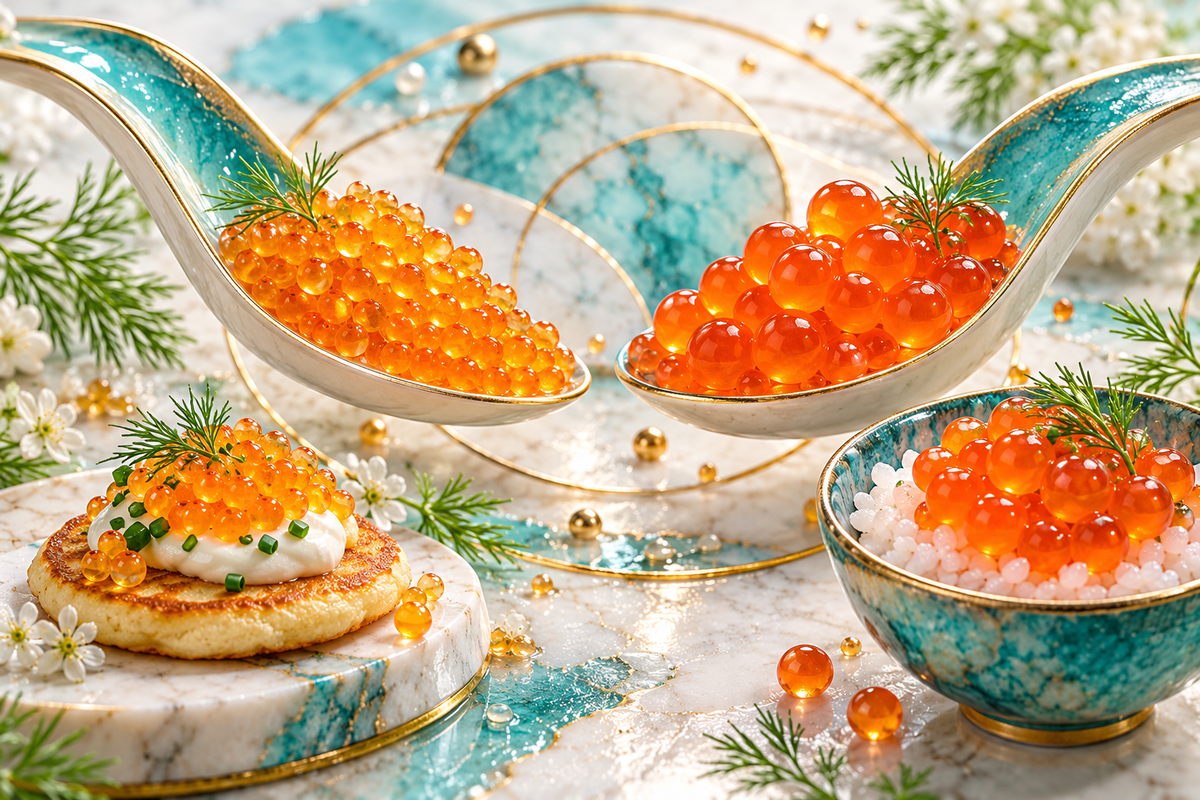
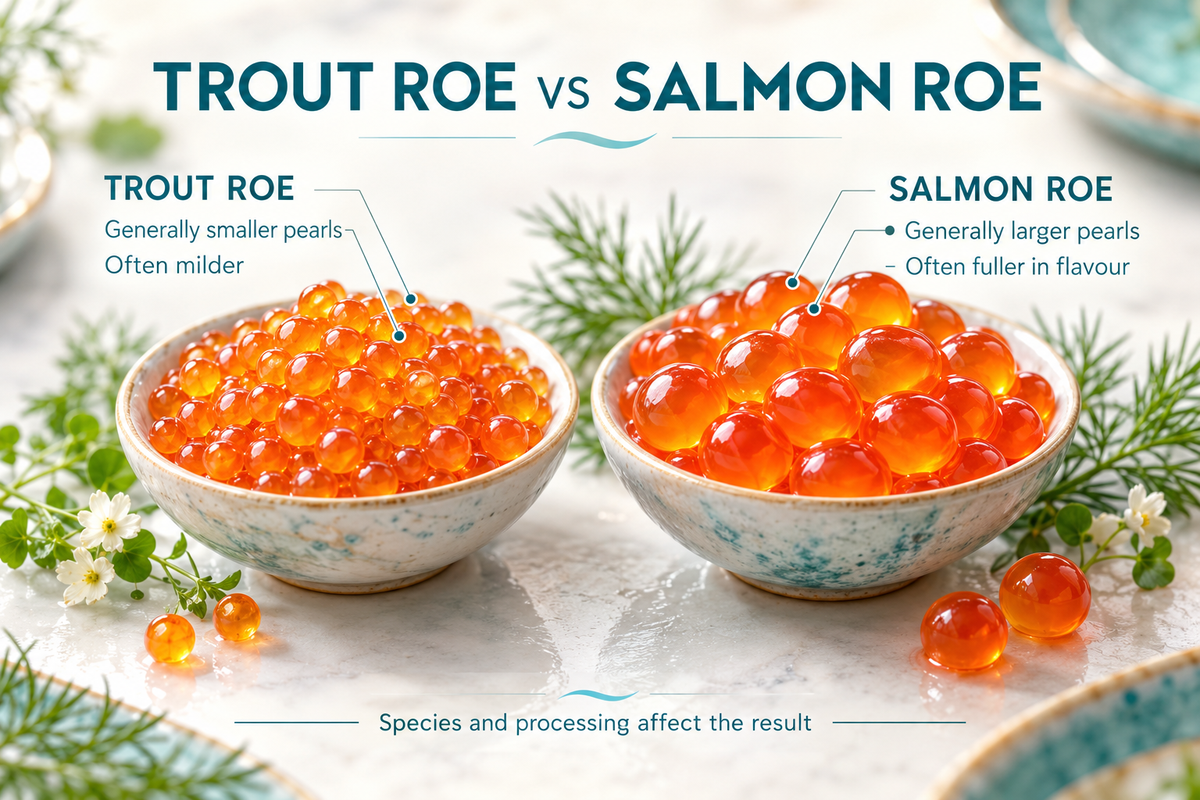
Trout roe vs salmon roe usually comes down to smaller, milder pearls versus larger pearls with a more pronounced juicy burst. Choose trout roe for a fine garnish on delicate bites, and salmon roe when the eggs should stand out on rice, eggs or blinis. Both can suit either role: species, cure and processing affect the result, so compare the finished products rather than relying on their names alone.
| What matters | Trout roe | Salmon roe |
|---|---|---|
| Source | Often rainbow trout; confirm the species | Several salmon species; confirm which one |
| Typical size | Generally smaller pearls | Generally larger pearls, varying by species |
| Flavour tendency | Often milder, with a restrained briny finish | Often fuller, with juicy sweetness and brine |
| Texture | A finer, smaller burst | A more prominent burst of liquid |
| Appearance | Commonly orange or golden orange | Commonly orange to reddish orange |
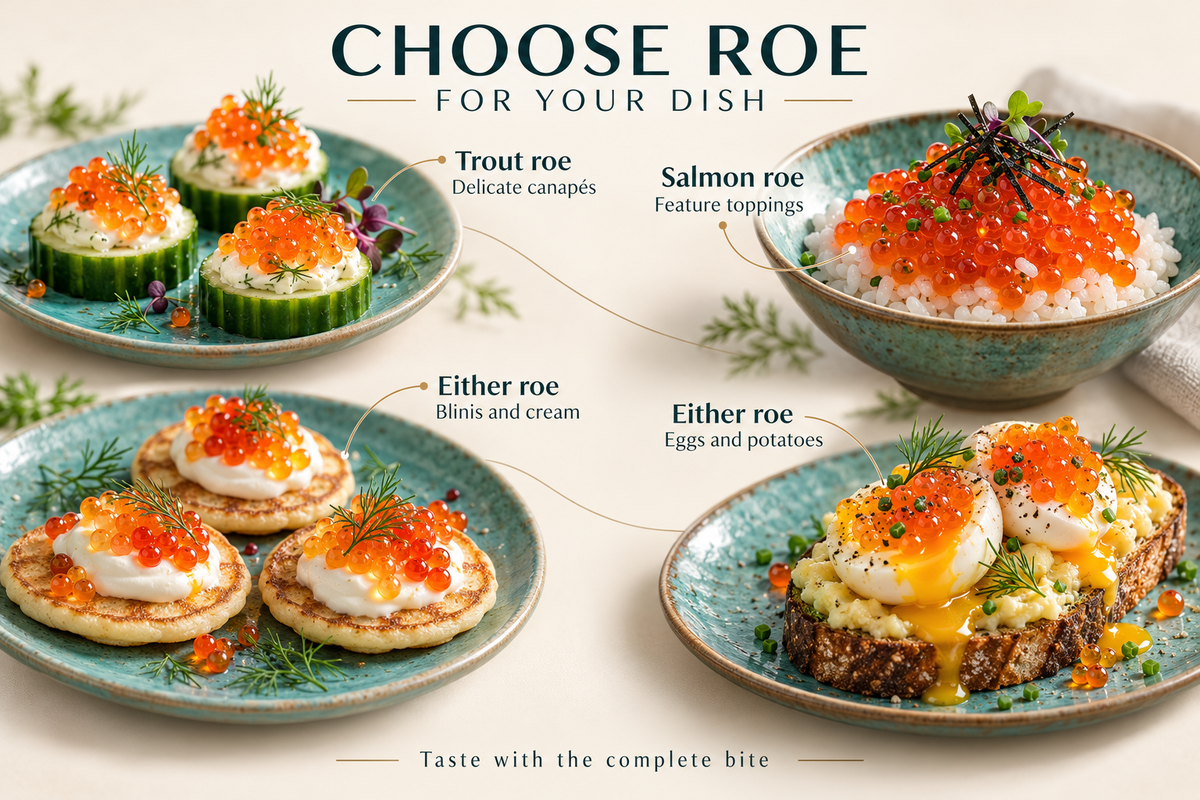
| Best starting point | Small canapés, cucumber, delicate starters | Rice bowls, blinis, eggs and feature garnishes |
| Substitution | Works when smaller pearls suit the dish | Works when a larger garnish fits the bite |
| Nutrition comparison | Use the finished product’s nutrition declaration | Use the finished product’s nutrition declaration |
| Storage | Follow the pack’s temperature and opening instructions | Follow the pack’s temperature and opening instructions |
| Buying decision | Check species, cure, integrity and intended use | Check species, cure, integrity and intended use |
Trout Roe vs Salmon Roe: What Actually Differs?
These products share the appeal of individual eggs that release flavour as they break. Their usefulness in a dish depends on the fish species and on what happens between harvest and service.
Source species
Commercial trout roe commonly comes from rainbow trout, Oncorhynchus mykiss. Salmon roe covers eggs from several salmon species, so a specification stating only “salmon” leaves an important part of the comparison unanswered. Ask for the scientific name when consistent results matter.
Trout and salmon belong to the same fish family, Salmonidae, but the products are not interchangeable descriptions of one species. Iran Fish’s guide to rainbow trout and salmon explains the broader fish comparison; a roe order still needs its own species and processing details.
Shared characteristics
Both roes can supply colour, salt and a distinct burst of texture without needing a large garnish. This makes them useful on plain bases that leave space for the eggs to register: a spoonful of rice, a potato bite or a small piece of toast.
The common ground matters when choosing between them. A dish designed around orange fish roe often has room for either product, provided the garnish fits the size of the bite and the seasoning is adjusted to the actual cure.
Why processing changes the comparison
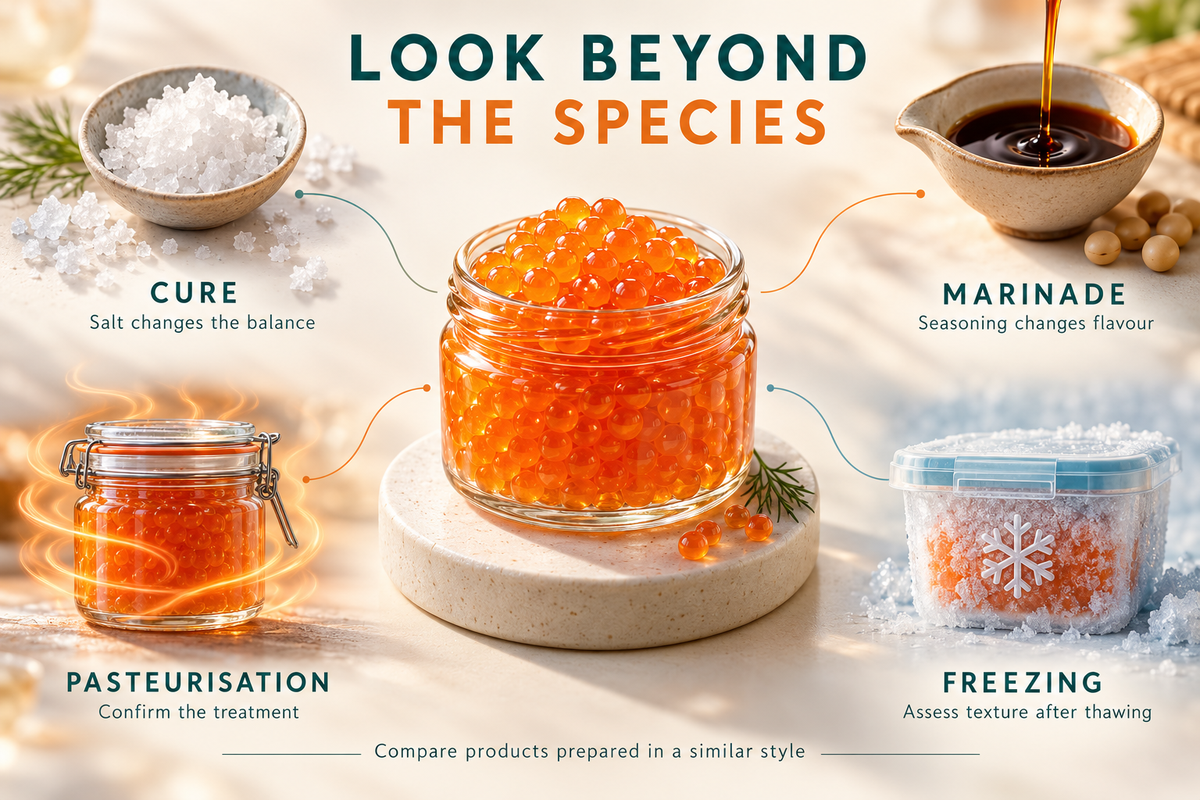
Salt curing, soy-based seasoning, smoking, pasteurisation and freezing create different products. Comparing a plain trout roe with heavily seasoned salmon roe mixes a species comparison with a recipe comparison.
For a useful evaluation, compare products intended for the same use and prepared in a similar style. If one is smoked or marinated, judge that characteristic separately. A change in brand or processing method can matter as much as changing from trout to salmon.
How Size, Colour and Texture Affect the Bite
Size changes the distribution of roe across a mouthful. Appearance and texture then determine whether the garnish feels integrated or becomes the focus of the dish.
Bead size
The review Roe gastronomy describes trout eggs at approximately 3.5–4.5 mm, while reporting much larger eggs for some salmon species. These are reference observations, not a universal grading specification for every processed jar.
Smaller pearls can spread across the surface of a narrow canapé. Larger pearls create more distinct points of texture and may roll away from a small or uneven base. For menu development, test whether the eggs stay in place when the complete bite is lifted.
Colour and appearance
Orange, amber and reddish tones can overlap between products. The same review notes that feed can influence trout roe colour and taste, so a brighter shade alone cannot establish species or eating quality.
Check the ingredient list for colourings and photograph samples under the same lighting if presentation is part of the specification. A product image is useful for planning a plate, but it cannot replace a species declaration or a physical sample.
Skin, pop and mouthfeel
Larger eggs often make the release of liquid more noticeable. Membrane firmness, however, should be assessed on the supplied product rather than predicted from size alone.
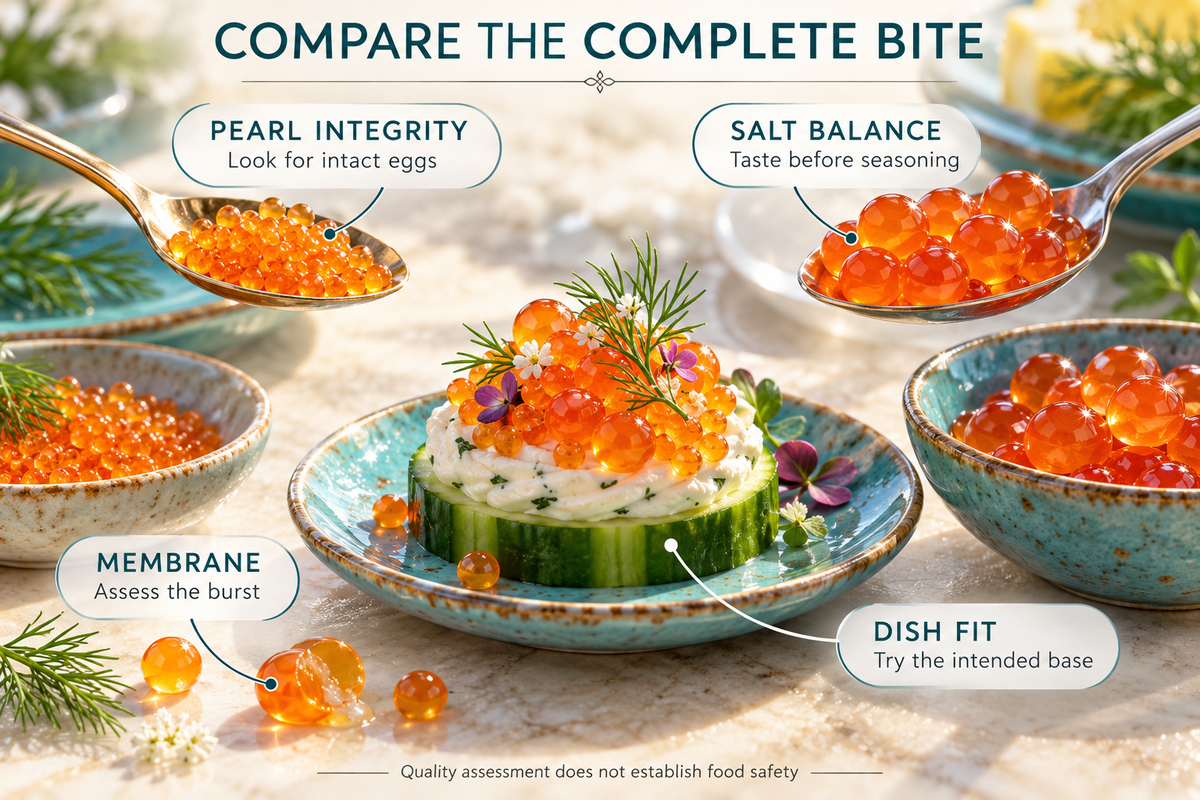
Taste for how readily the skin breaks, how much liquid is released and whether a noticeable membrane remains. Then repeat the test with the intended base. An egg that feels pleasant on a tasting spoon may be less suitable on a very soft or slippery canapé.
Which Roe Has the Flavour Your Dish Needs?
Trout roe is often chosen for a gentler contribution, while salmon roe commonly brings a more assertive sweet-briny impression. Specialist producer Petrossian describes its salmon roe through its larger bead and juicy sweetness, and describes its trout roe as lighter pearls with tangy brine. These descriptions are useful examples of particular products, rather than a promise that every producer’s roe tastes the same.
For a delicate cucumber bite, start by testing whether the roe leaves the cucumber and dairy distinguishable. For a richer egg or potato dish, test whether it still provides a clear finish after the base is included. This is a practical pairing approach: choose the product that creates the balance you want in the complete mouthful, rather than ranking intensity by itself.
Saltiness deserves its own comparison. A milder fish flavour does not guarantee less salt, and a strong salmon character does not establish sodium content. Taste plain samples before adding salty accompaniments, then season the finished dish. If the base already contains smoked fish, pickles or soy sauce, leave room for the roe’s contribution before making the final adjustment.
Ikura, Sujiko and Caviar: Read the Product Name Correctly
On a menu, ikura usually brings individual orange salmonid eggs to mind, often salted or soy-seasoned. Japanese food supplier TSUJISHO distinguishes salmon roe from trout roe within its ikura offering. When ordering, ask which fish supplied the eggs instead of treating the word ikura as a complete species specification.
Sujiko refers to roe retained in the sac, whereas loose individual eggs are the familiar format for ikura-style toppings. That difference changes preparation and presentation. A product intended to be portioned from a sac is a different starting point from a tub of separated pearls ready for garnishing. Establish the format before comparing serving methods or placing an order.
“Trout caviar”, “salmon caviar” and “red caviar” appear in commercial descriptions of non-sturgeon roe. These names do not make the products sturgeon caviar. For product selection, keep the source fish explicit; for a label, check the destination market’s naming requirements. Iran Fish lists its trout caviar product separately from its broader caviar range, helping buyers start with the appropriate product category.
The Best Culinary Uses for Each Roe
The following pairings are menu-development starting points, not results from a claimed tasting trial. Use the finished dish to decide which pearl size, flavour and texture work together.
Sushi and rice bowls
Try salmon roe when a visible cluster of larger eggs is central to the presentation. Trout roe can work when smaller pearls fit the portion more neatly or when a subtler topping is preferred.
With seasoned rice, account for the salt and acidity already present. Soy-marinated roe may supply enough seasoning without an additional drizzle. Spoon the roe on gently once the rice has cooled enough for the intended service, rather than folding it vigorously through hot rice.
Canapés and blinis
A stable base and a small layer of crème fraîche help hold the garnish in place. Trout roe is a useful first trial for narrow cucumber rounds or small tartlets; salmon roe can become the visual focus of a broader blini.
Build a complete bite before deciding on garnish quantity. Too much cream can hide the roe, while an overloaded base can spill the eggs. Chives or dill can add contrast without needing an elaborate topping.
Eggs and potatoes
For eggs, place the roe over the finished dish so the pearls remain distinct. Taste the egg mixture before its final seasoning, particularly when other salty ingredients are included.
On potatoes, consider the surface as well as the flavour. A flat potato cake offers a different platform from a split baked potato. Test whether a small amount of dairy gives the eggs enough support and whether the potato still contributes to the mouthful.
Pasta and warm dishes
Use ready-to-eat roe as a finishing ingredient when the aim is to retain separate pearls. Plate the pasta, add the roe and distribute it with minimal handling. Stirring it into a bubbling sauce produces a different texture and can obscure the individual eggs.
A simple sauce makes the comparison easier. If a sample tastes too salty on finished pasta, adjust the sauce and other seasonings before changing the amount of roe. The garnish should remain recognisable without having to dominate the whole plate.
Seafood and vegetable starters
Cucumber, lightly dressed vegetables and suitable prepared seafood provide opportunities to compare a restrained garnish with a more prominent burst. Place acidic dressings on the base first and add the roe near service, allowing more control over the finished balance.
For a small starter, choose accompaniments that make a coherent bite rather than adding several strong flavours. The roe should have a clear role: a finishing texture, a concentrated seasoning or the central ingredient.
| Dish | First product to trial | What to assess |
|---|---|---|
| Small cucumber canapé | Trout roe | Whether the smaller pearls stay on the base |
| Rice bowl with a feature topping | Salmon roe | Whether its burst balances the seasoned rice |
| Blini with crème fraîche | Either | The relationship between cream, base and roe |
| Soft eggs | Either | Final salt balance and pearl integrity |
| Potato cake | Either | Support for the garnish and contrast in texture |
| Delicate vegetable starter | Trout roe | Whether the vegetables remain distinct |
| Simply dressed pasta | Either | Whether the roe remains separate after plating |
How to Substitute Trout Roe for Salmon Roe
Trout roe can replace salmon roe when the recipe needs orange fish eggs rather than a particular salmon flavour or bead size. Begin with a comparable amount for the test dish, then adjust to the complete bite instead of applying a fixed universal ratio.
- Match the preparation style. Plain salted roe provides a more useful comparison with another plain salted product than with a soy-marinated one.
- Match the footprint on the plate. Smaller pearls may distribute differently even when the weight is similar.
- Taste before adding soy sauce, salt, smoked fish or pickles. The replacement may change the total seasoning.
- Keep the intended texture in mind. A visually important cluster of large eggs will look different when replaced with smaller pearls.
- Add the replacement at the same finishing stage if the dish depends on intact eggs.
- Describe the ingredient accurately on a menu. A substitution should still identify the supplied fish correctly.
The same method works in reverse. If salmon roe replaces trout roe, check that the larger pearls fit the serving surface and that their flavour leaves enough room for the other ingredients.
How to Compare Samples Before Choosing a Product
A useful sample assessment separates the product’s own character from the effect of its accompaniments. Evaluate comparable samples under the same serving conditions, then repeat the comparison in the intended dish.
- Record the species, batch, processing style and storage instructions before opening.
- Use clean, separate utensils and the same neutral serving surface for each sample.
- Compare aroma, pearl integrity, liquid in the pack, salt balance, membrane resistance and finish.
- Taste a plain sample before trying it with rice, dairy or another base.
- Photograph the completed serving under consistent lighting to assess appearance.
- Record observations in practical language, such as “stays on cucumber” or “overpowers the egg”, rather than relying on “premium”.
| Observation | What to record | How it helps the decision |
|---|---|---|
| Pearl integrity | Intact versus visibly broken eggs | Shows how the garnish will present |
| Liquid | Amount and appearance in the container | Helps assess consistency between samples |
| Salt balance | Restrained, balanced or dominant in the dish | Guides changes to the base seasoning |
| Membrane | Easy burst or persistent skin | Establishes whether the mouthfeel suits the dish |
| Placement | Stable topping or rolling pearls | Identifies a suitable serving surface |
| Finish | What remains after the complete bite | Shows which ingredients dominate |
This is a quality and suitability assessment, not a microbiological safety test. A pleasant appearance or smell cannot establish that the product has been handled safely.
Nutrition: Compare the Finished Product
Fish roe can contribute protein and marine fats, including omega-3 fatty acids, as discussed in research on roe as a food ingredient. That does not establish a single nutritional profile for every trout or salmon roe product. Species, feed, formulation and processing can produce different results, so a generic roe entry is a poor basis for declaring one finished product superior.
For a meaningful comparison, use each pack’s nutrition declaration on the same weight basis. Check protein, fat and sodium or salt, and compare the amount actually served. A small garnish and a bowl topped generously with roe contribute different quantities even when the underlying product is identical.
Read the ingredients alongside the nutrition panel. A seasoned product may include soy sauce, sweeteners or other ingredients absent from a plain salted roe. Confirm the fish species and the finished product’s allergen declaration with the supplier, including any additional allergens introduced by the marinade. Build dietary information from that specification rather than from the colour or common name of the eggs.
Storage, Thawing and Serving
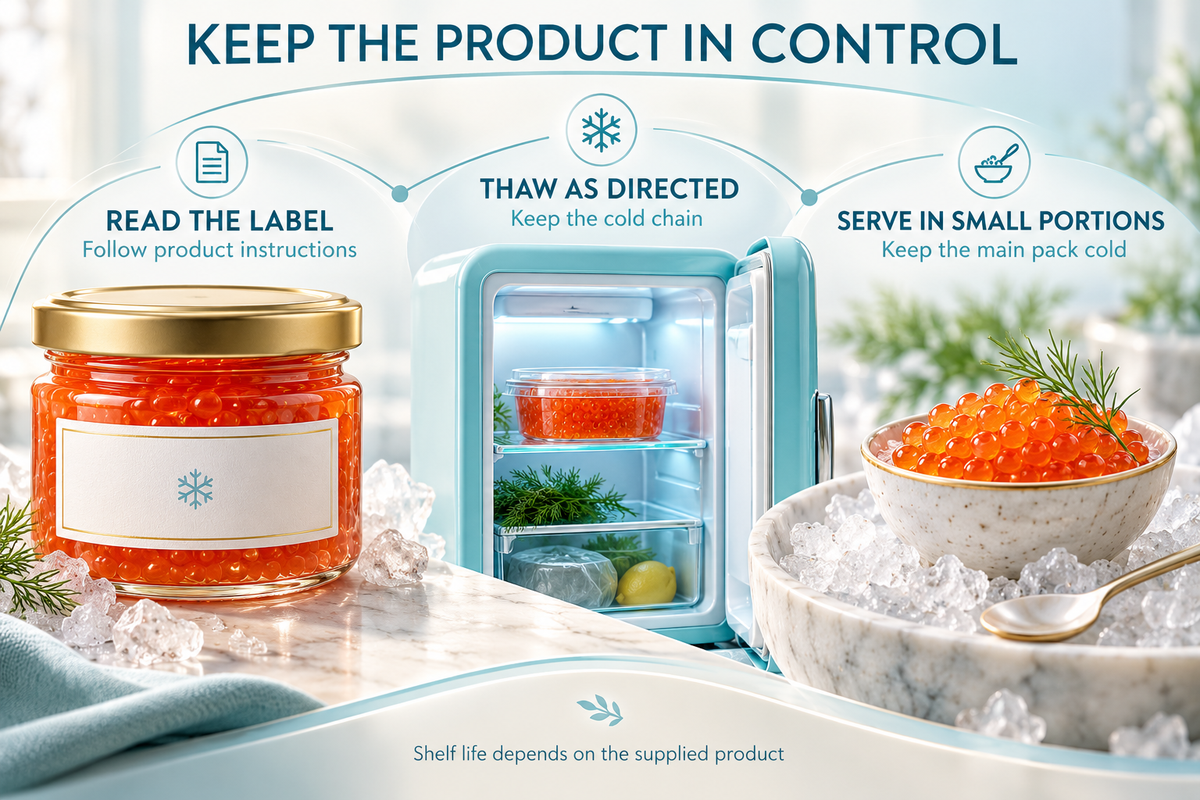
Roe products have different processing histories and storage requirements. Use the instructions for the supplied pack, including its opening and thawing directions, instead of assigning one shelf life to the entire category.
Refrigerated products
Keep the product at its labelled temperature and record when it is opened. An unopened use-by date does not establish how long the remaining contents can be kept after opening.
Pasteurised and shelf-stable are different product descriptions, so confirm whether refrigeration is required. Keep the original label or specification accessible during service rather than transferring the roe into an unidentified container.
Frozen products
Confirm that the product is supplied for frozen storage before freezing it yourself. Follow its thawing instructions; the FDA’s seafood handling guidance recommends gradual refrigerator thawing for seafood and notes that freezing does not kill all harmful germs.
For a trial, inspect the thawed sample as well as its pre-thaw specification. Record broken pearls and released liquid so the buying decision reflects the format that will actually reach the plate.
Handling during service
Portion with clean utensils and keep the main pack cold while preparing the servings. Small working portions make it easier to replenish a presentation without repeatedly warming the whole container.
Do not treat fresh uncured eggs as equivalent to a product specifically prepared for ready-to-eat use. FDA guidance also advises people at greater risk of foodborne illness to avoid raw or undercooked seafood. For a menu intended for such diners, establish product suitability through the appropriate food-safety guidance and the supplier’s specification.
Sourcing and Specifications for Wholesale Buyers
A repeat order needs more detail than a product name and an attractive photograph. The same specification should connect the sample you approve with the batches you receive.
- Species: common and scientific names, with no ambiguity between trout and salmon.
- Origin: harvest or farming source and processing location, recorded separately where relevant.
- Format: loose eggs or roe in the sac; chilled, frozen or another documented supply format.
- Processing: salt-cured, marinated, smoked or pasteurised, as applicable.
- Ingredients: full formulation, allergen information and nutrition declaration.
- Physical characteristics: agreed pearl appearance and size information where supplied.
- Handling: storage temperature, opening instructions, thawing directions and shelf life.
- Traceability: batch identification and documents relevant to the destination and product.
| Specification area | Request from the supplier | Use in approval |
|---|---|---|
| Identity | Species and product format | Confirms the product being compared |
| Processing | Cure and treatment description | Makes sample comparisons more meaningful |
| Handling | Storage and thawing instructions | Connects supply format with kitchen use |
| Consistency | Batch information and agreed sample criteria | Supports repeat-order evaluation |
| Sourcing | Origin and supporting documentation | Allows product-specific sourcing checks |
For sustainability, ask what supports the claim for the particular fishery or farm. A broad “wild” or “farmed” label does not answer every sourcing question. Evaluate any certification against its actual scope and the product being offered.
Buyers can begin with Iran Fish’s trout roe supply information and request the current specification for their application. Establish availability, format and documentation directly before treating a sample as representative of a future shipment.
Frequently Asked Questions
These questions address common choices at the point of serving or ordering. The finished product’s label and specification remain the reference for its identity and handling.
Is trout roe the same as salmon roe?
They come from different fish, although both are salmonid roes and may have overlapping appearances and uses. Trout roe is generally smaller and often milder. Confirm the species because “salmon roe” itself can describe products from several salmon species.
Can trout roe replace salmon roe in sushi?
Yes, where a smaller pearl and a different flavour balance suit the dish. Match the cure as closely as practical, taste with the seasoned rice and adjust other salty ingredients. Identify the replacement accurately when describing the dish.
Does ikura always mean salmon roe?
Do not use the name alone to establish species. Trout-based products are also offered in the ikura category. For an order or menu description, confirm the fish species and whether the roe is plain salted or seasoned.
Which is saltier, trout roe or salmon roe?
There is no dependable species-only answer. The cure and formulation influence saltiness, while the accompanying food changes its perception. Compare the finished products’ nutrition declarations and taste them on the same base before deciding.
Can you freeze trout roe or salmon roe?
Some products are supplied frozen; others have instructions that do not support home freezing. Follow the manufacturer’s directions for that pack, including thawing and use after thawing. Freezing can change texture and should not be treated as a way to make an unsuitable product safe.
Discuss Your Trout Roe Requirements with Iran Fish
Choose the intended use first: a delicate canapé, a rice topping, a retail pack or a food-service ingredient. That gives the sample evaluation a clear purpose.
Review Iran Fish’s trout caviar offering and identify the format, processing style and documentation your operation needs.
Then contact Iran Fish with your trout roe requirements, including your destination, application and packaging needs. Ask for the current product specification and sample availability so your trout roe vs salmon roe decision rests on the product you can actually assess.