

Understanding the Global Frozen Salmon Supply Chain

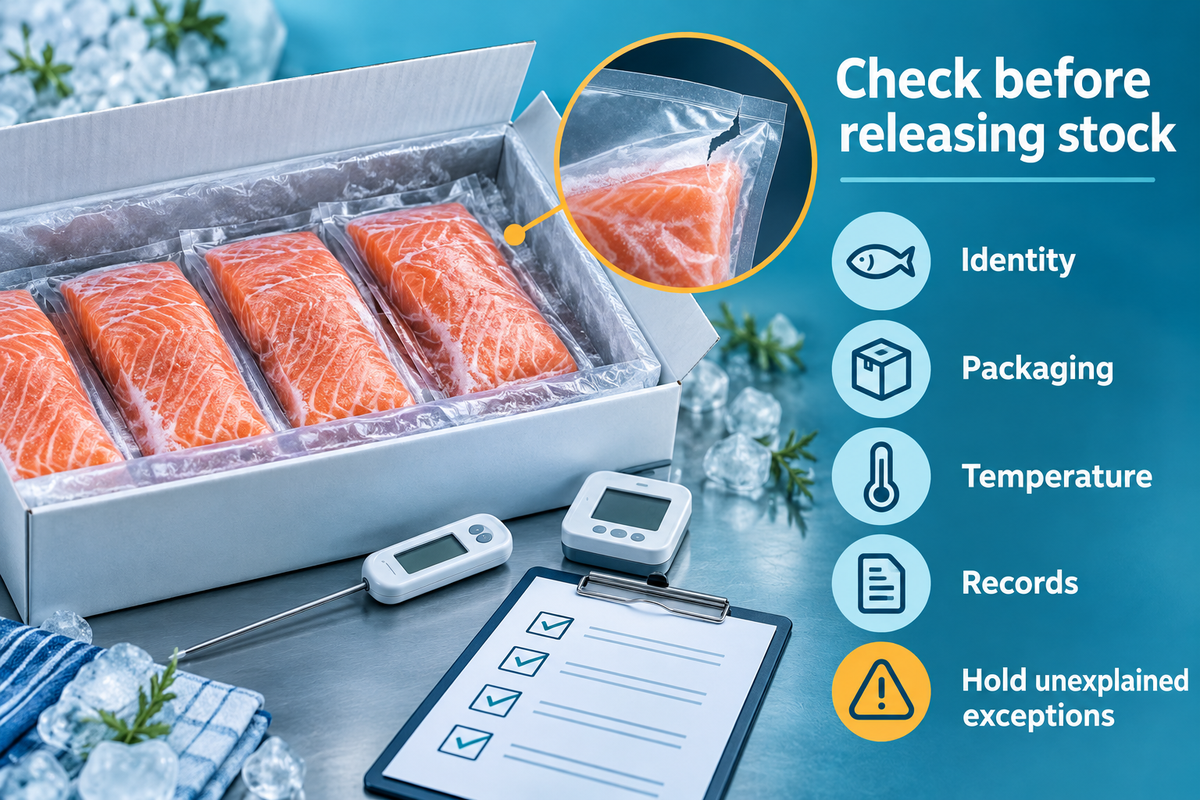
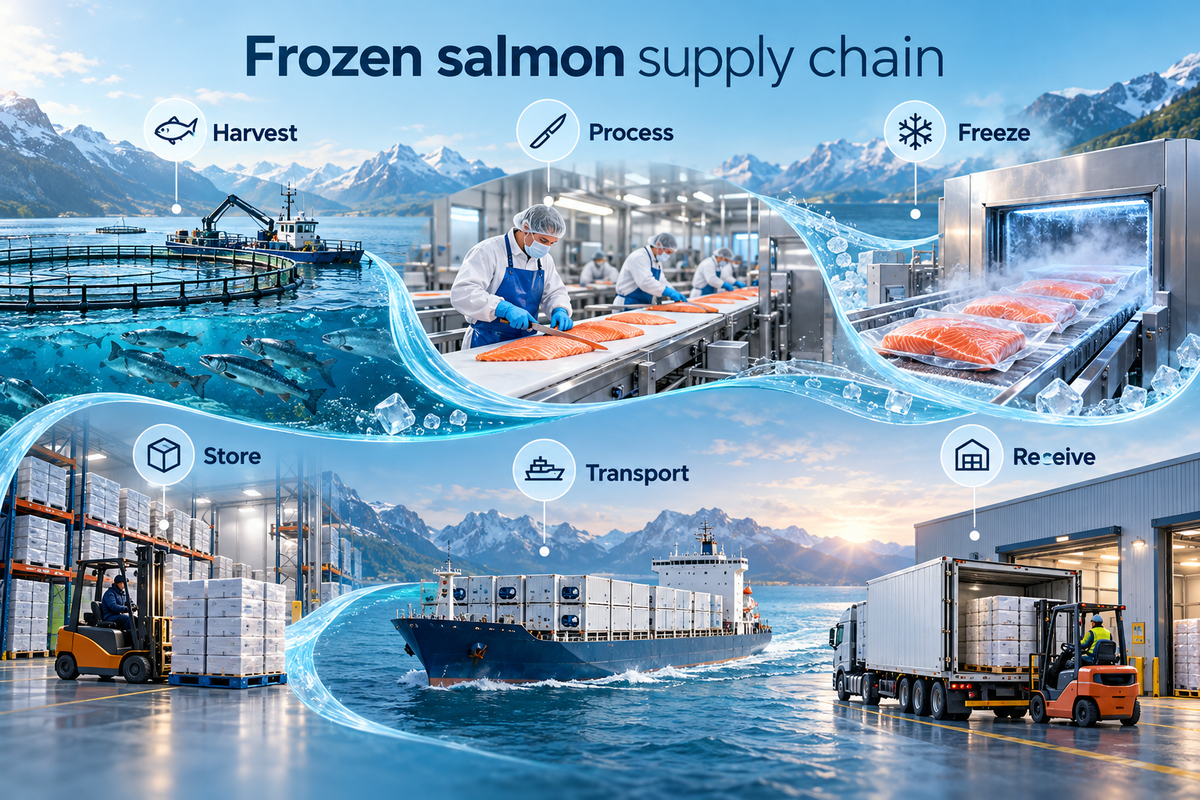
The frozen salmon supply chain connects harvesting, processing, rapid freezing, protected storage and temperature-controlled transport to the buyer. Reliable supply depends on more than a frozen-looking fillet: the species, product specification, batch history and temperature records must match. For importers and distributors, the practical priorities are to agree the product before production, protect it at every handover and verify its condition before releasing the shipment into stock.
| Supply decision | What a buyer should establish |
|---|---|
| Product identity | Scientific species, farmed or wild origin, harvest location and processing country |
| Processing | Agreed cut, trim, bone status, size grading and intended use |
| Freezing | A validated process, documented production dates and verified finished-product temperature |
| Packaging | Intact food-contact packaging, agreed glaze, net fish weight and readable batch labels |
| Storage and transport | Product-specific temperature limits, continuous records and protected transfers |
| Import readiness | Destination eligibility and consistent product, establishment and shipment documents |
| Arrival acceptance | A documented inspection, representative temperature checks and a clear hold-and-release procedure |
| Supply continuity | Confirmed production capacity, suitable alternative routes and traceable inventory |
How the Frozen Salmon Supply Chain Works
A shipment travels through several businesses even when it is sold by a single supplier. Each change of custody needs a clear record of what moved, its condition and who became responsible for it.
Sourcing and harvest
Farmed Atlantic salmon and wild Pacific salmon enter different production systems. Farmed supply is linked to production plans, fish health and harvest scheduling; wild supply is linked to fisheries, landings and seasonal availability. Neither description alone establishes the condition of a particular batch.
The buyer should identify the species before discussing a shipment. Atlantic salmon is Salmo salar, while Pacific salmon includes several Oncorhynchus species. Rainbow trout is Oncorhynchus mykiss and may be marketed as salmon trout in some trading contexts. A commercial name cannot replace scientific identification.
Primary and secondary processing
Fish may be gutted and frozen as whole product, or processed into fillets and portions before freezing. Other operations may later thaw or temper it for cutting and refreeze the finished product. That processing history should be disclosed rather than hidden behind the word “frozen”.
The TraceMyFish Atlantic salmon value-chain description illustrates how farming, harvesting, processing and finished-product distribution are connected. For buyers, the useful lesson is to trace transformations as well as transport: a new product format must remain linked to its incoming raw-material batch.
Storage, export and delivery
After freezing, finished cartons move into controlled storage, then through export handling, transport, clearance and the receiving warehouse. The chain may include a consolidator, freight forwarder, carrier and local distributor.
A delivery plan should identify every transfer rather than just the main international journey. Loading a truck, waiting at a terminal and unloading at the destination can expose product even when the vessel leg is well controlled.
Species, Origin and Product Specifications Come First
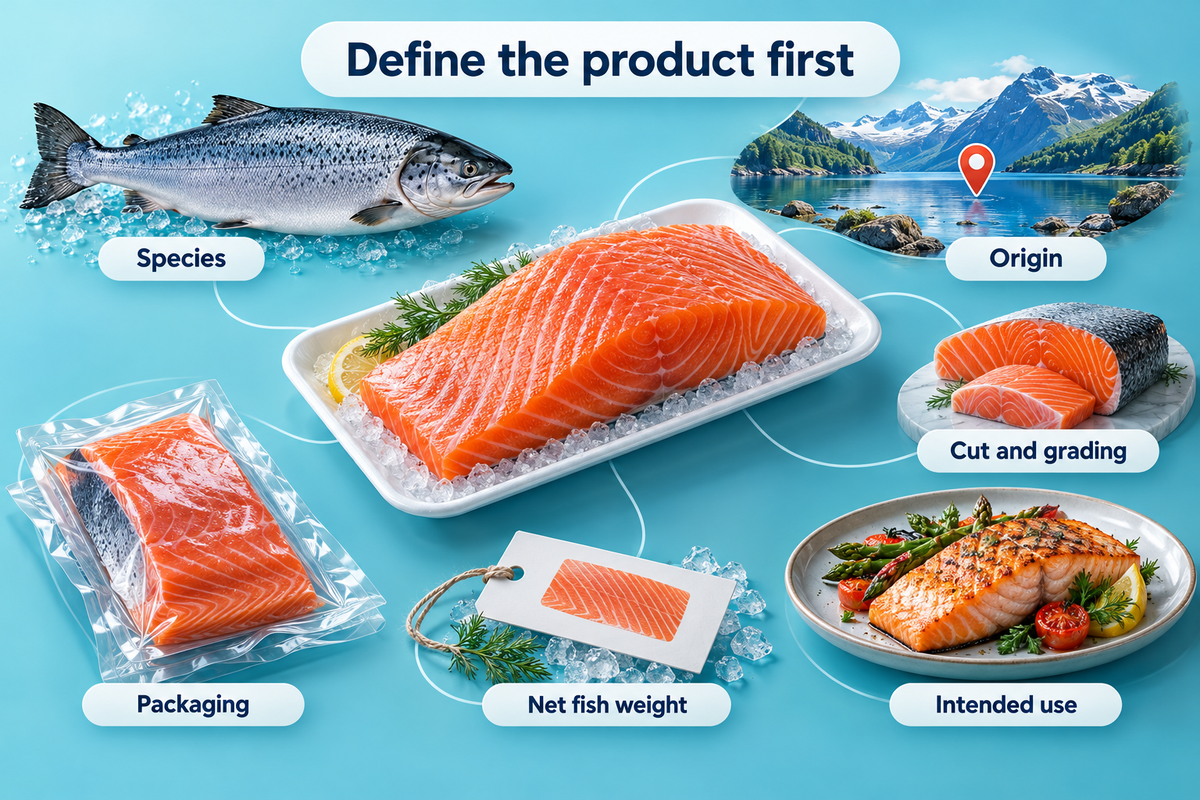
“Frozen salmon” is too broad to function as a purchase specification. Write down the product identity and acceptance criteria before approving production or allocating stock.
- Species: the scientific name and the commercial name used in the destination market.
- Production method: farmed or wild, supported by the relevant sourcing records.
- Origin: harvest country or area, with the processing country identified separately.
- Format: whole, gutted, headed and gutted, fillet, loin, steak or portion.
- Preparation: skin status, bone requirements and an agreed trim description.
- Grading: the size range, how it is measured and the permitted variation.
- Composition: ingredients, declared additives where applicable, and glaze arrangements.
- Quantity: net fish weight, pack weight, carton count and pallet configuration.
- Intended use: cooking, further processing or a separately assessed raw-consumption application.
- Acceptance: the inspection method, sampling plan and handling of non-conforming product.
For trout purchasing, review the Iran Fish salmon trout product range and request confirmation of the exact species and current formats. Do not substitute trout for a named salmon species without the buyer’s agreement and suitable labelling.
A signed specification also prevents misunderstandings about fillet appearance. A skin-on fillet and a skinless portion may share a species but differ in handling, packaging and end use. Photographs help illustrate the agreement; they do not replace written tolerances or batch evidence.
Harvesting and Processing Determine Starting Quality
Freezing preserves the condition achieved before freezing; it does not reverse deterioration. Harvest handling, prompt chilling, hygiene and the time spent in processing therefore matter throughout the finished product’s life. A product can remain frozen during shipment and still arrive with disappointing texture if the starting material or processing was poorly controlled.
Handling should limit bruising and physical damage. Processing controls should address clean equipment, suitable water, separation of operations and the hazards relevant to the product. Ask how production records link the incoming fish to finished cartons and how deviations are recorded. A factory photograph or general assurance of cleanliness provides less useful evidence than the records for the batch being supplied.
Quality and food safety need separate checks. Texture, colour and visible defects affect commercial acceptance, while hazards require the controls identified by a product-specific assessment. The FDA seafood hazards and controls guidance provides a technical framework for identifying hazards and suitable controls; it is not evidence that a particular supplier or shipment complies with every importing market’s requirements.
Freezing, Packaging and Shelf Life
The freezer, package and storage regime work together. Asking only whether the fish is “IQF” leaves important questions unanswered about process performance, moisture protection and the remaining usable life of the batch.
What quick freezing establishes
For quick-frozen fish fillets, the Codex CXS 190 standard specifies that the process is not complete until the thermal centre reaches −18°C or colder after thermal stabilisation. This is a product-temperature criterion, not simply a freezer display reading.
Individually quick frozen products are frozen as separate pieces. Other formats may be frozen in blocks or individual packs. The method should suit the product thickness, throughput and handling needs. Request the supplier’s validated process and finished-product verification rather than assuming one format always guarantees better quality.
What protective packaging does
Packaging limits dehydration, oxidation and physical damage while keeping the batch identifiable. A glaze can protect the fish surface, while suitable sealed packaging reduces exposure to air. These controls require intact seals and appropriate storage; neither makes a shipment immune to deterioration.
| Packaging element | Buyer check |
|---|---|
| Individual wrap or pouch | Material suitability, seal integrity and product identification |
| Glaze | Agreed application and a clear method for determining net fish weight |
| Master carton | Protection during stacking, moisture resistance and readable labels |
| Pallet arrangement | Stable loading, traceable cartons and compatibility with transport instructions |
| Handling label | Storage requirements, batch code and necessary use or thawing instructions |
The FAO explanation of frozen-fish cold storage describes dehydration and oxidation as quality concerns during storage. This explains why packaging condition and temperature stability deserve attention alongside the freezing method.
Why shelf life is product-specific
Do not apply a universal month count to every frozen salmon product. Shelf life depends on the species, initial condition, processing history, packaging, storage temperature and the supplier’s validation. The date printed on the carton should correspond to the product and stated storage conditions.
Agree the minimum remaining shelf life required at arrival. Use stock rotation based on expiry and suitability, and retain the original freezing and processing history when product is repacked. Repacking does not create a new starting point for its history. The Iran Fish frozen salmon storage guide discusses these purchasing and storage checks in more detail.
Temperature Control: Product Core, Container Air and Records
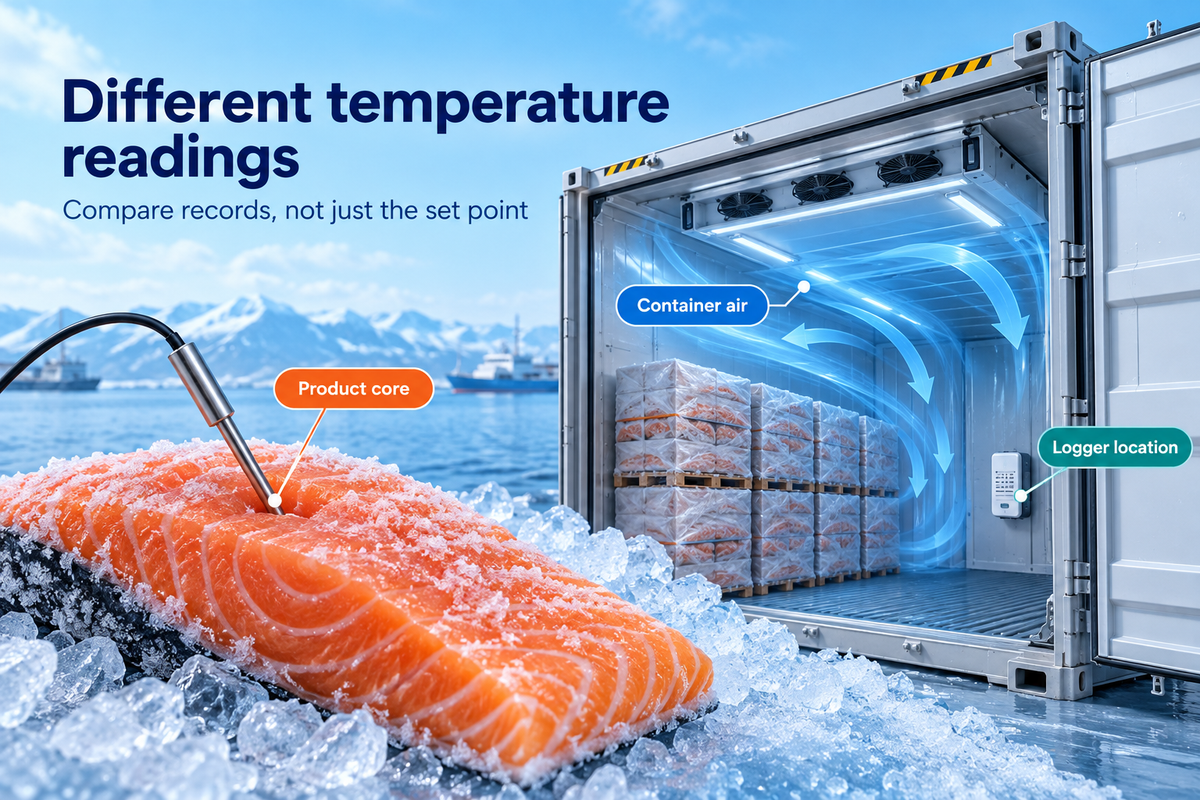
A reefer set point describes the equipment instruction; it does not prove the temperature of every carton. Product measurements and transport records answer related but different questions.
Understand what was measured
Core temperature concerns the fish itself. Supply-air and return-air temperatures describe air moving through the refrigeration system. A logger records conditions at its location, which may not represent the warmest product in a load.
Specify the measurement method, instrument accuracy checks and sampling locations. Record whether a value came from a product probe, an air sensor or a surface reading. Treating these as interchangeable can hide a loading problem or exaggerate the significance of a short air-temperature change.
Agree the actual operating limits
The storage and shipment specification should state the required product condition and operating temperature, including any colder target needed to protect quality. A baseline freezing criterion should not automatically become the transport instruction for every product.
Avoid inventing a universal allowable excursion. Its significance depends on duration, product temperature, packaging, previous exposure and the validated food-safety plan. Agree alarm escalation and decision-making responsibilities before dispatch.
Protect loading and unloading
Use prepared, suitable equipment and a loading procedure consistent with the carrier’s instructions. Keep transfers organised, minimise avoidable exposure and load fully frozen product. Follow the reefer’s loading limits and air-circulation requirements rather than packing around them.
Retain pre-dispatch checks, handover times, equipment identification and temperature records. The condition at the start of transport matters: a container intended to maintain frozen cargo should not be treated as a substitute for the production freezing process.
Sea Freight, Air Freight and Distribution Handovers
Sea freight is commonly used for frozen seafood movements, while air transport can serve particular delivery or continuity needs. Neither mode guarantees an intact cold chain. The decision should consider the available temperature-controlled facilities, total elapsed journey, transfer points, clearance arrangements and readiness of the receiving warehouse.
Air shipments also need protection outside the aircraft: screening, build-up, terminal waiting and collection all belong in the plan. Kuehne+Nagel’s salmon chill-chain account distinguishes chilled air movements from frozen sea movements. A route suitable for chilled salmon should not simply be copied for frozen product without checking its thermal protection.
For either mode, allocate responsibility for monitoring and responding during each handover. Confirm terminal cold storage or reefer power arrangements, suitable onward transport and contingency contacts. Incoterms allocate defined delivery responsibilities, but the parties still need specific instructions for temperature evidence, inspections and quality exceptions. Those operational details should appear in the shipment agreement.
Traceability and Export Documents Must Tell the Same Story
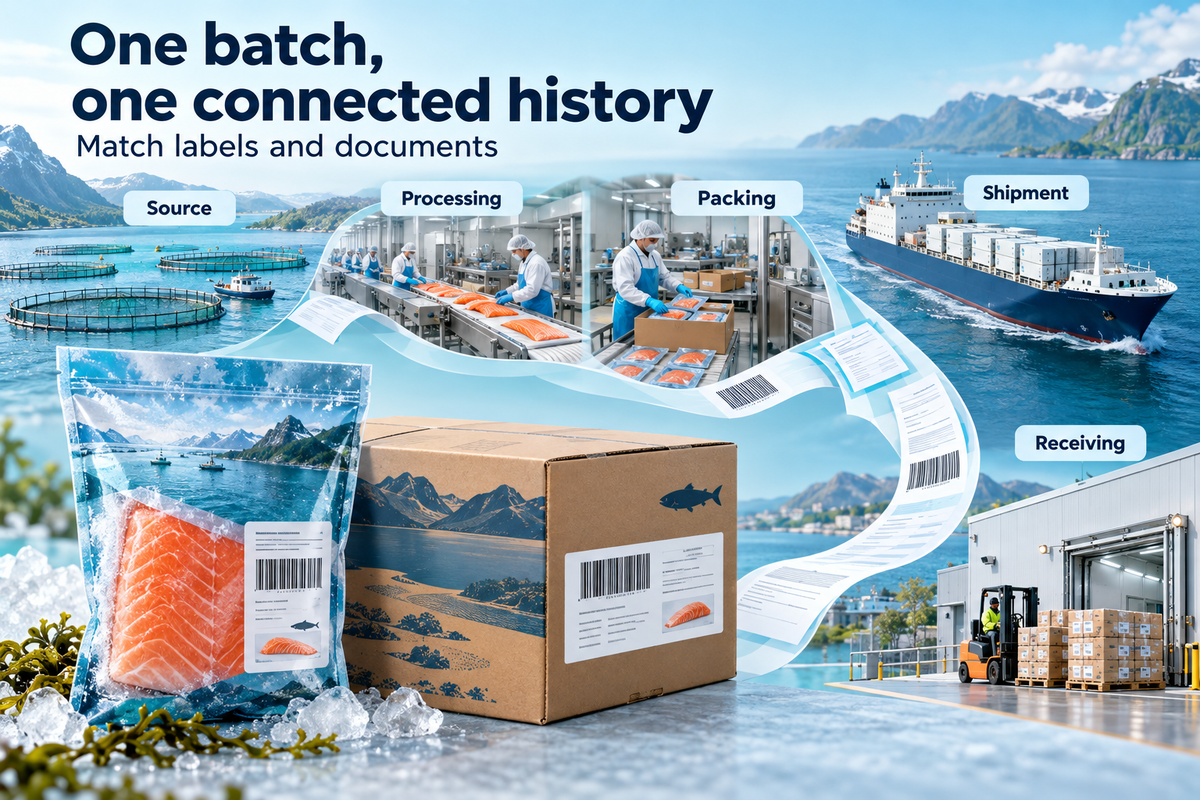
Traceability connects a carton to its source and processing history. It should also connect that carton to the documents used to clear and receive the shipment.
- Link harvest or source records to the raw-material batch received by the processor.
- Link finished lots to processing, freezing, packing and storage records.
- Identify establishments and their relevant approval details where required.
- Match species, origin, product description and quantities across labels and shipment documents.
- Retain the commercial invoice, packing list and transport document applicable to the movement.
- Obtain the health certificate, import permission or other official documents required by the destination and product.
- Check whether wild-capture products require catch-related documentation for the intended market.
- Keep temperature records associated with the actual shipment, not merely a general monthly warehouse report.
- Record changes of custody and retain enough information to locate affected stock in a recall.
Requirements vary by destination, species, production method and processing country. Confirm them with the importing authority and the responsible importer before production or dispatch. A document valid for one route is not automatically sufficient for another.
Certification also needs careful reading. A certificate should be checked for its issuer, validity, scope, named site and relevant product. A farm certification does not automatically cover a separate processor; a supplier’s general certificate does not establish the history of every consignment.
Digital records can make information easier to share, but the underlying information must still be correct. A barcode is useful only if its lot reference resolves to accurate records and remains connected to repacked or transformed product.
Receiving Frozen Salmon and Managing Exceptions
Inspect the shipment before mixing it with accepted stock. The aim is to establish whether the goods meet the agreed specification and whether anything requires a documented hold.
Inspect condition and identity
Check the seal where applicable, vehicle condition, carton count, labels and packaging damage. Compare the species, format, dates and lot codes with the order and documents. Obtain representative temperature readings through the agreed procedure and record where and how they were taken.
Look for damaged pouches, dehydration, unexpected frost, compressed cartons and signs that individual pieces have thawed and refrozen together. These observations warrant investigation; they do not independently reconstruct the full temperature history or prove safety.
Investigate temperature deviations
Preserve the logger data, equipment records and handover information. Note the duration and location of any deviation, then assess the product’s actual condition and the applicable controls. An air-temperature spike during a documented operation may have a different significance from sustained warming of the fish.
| Arrival finding | Appropriate next step |
|---|---|
| Correct labels, intact packaging and conforming records | Complete the agreed checks and document the release decision |
| Missing or inconsistent lot information | Hold affected stock until its identity and records are resolved |
| Temperature discrepancy | Segregate and assess the exposure against the product-specific plan |
| Damaged packs or suspected thawing | Document the affected units and request a qualified disposition decision |
| Unexplained quality defects | Preserve samples where appropriate and compare with agreed acceptance criteria |
Release only after the exception is resolved
The authorised quality or food-safety person should decide the disposition of held stock. Possible outcomes depend on the findings and applicable requirements; they should not be reduced to a blanket rule that refreezing makes any shipment acceptable.
Photograph defects, keep the relevant batch evidence and communicate the findings promptly. Record the final decision and corrective action so the same failure can be prevented on the next movement.
Supply Resilience and Responsible Sourcing
Reliable supply requires a realistic production and delivery plan. Ask about available formats, harvest scheduling, processing capacity and the lead time for the specific order. Check whether the proposed quantity is confirmed stock or future production, and agree how changes will be communicated.
Prepare alternatives that preserve the specification. A different transport route, loading date or approved processing site may solve a disruption; an undisclosed species substitution does not. Alternative arrangements still need traceability, suitable temperature control and destination eligibility.
Responsible sourcing claims should be supported by relevant evidence rather than a generic sustainability statement. Review the sourcing method and any independently verifiable certification within its actual scope. Environmental comparisons between transport options should use an appropriate assessment; frozen shipping is not automatically the lowest-impact choice in every situation.
Frequently Asked Questions
These questions address common purchasing uncertainties. The answers distinguish what can be established generally from what needs evidence for the individual product.
What are the main stages of the frozen salmon supply chain?
They are sourcing and harvest, processing, freezing, packaging, cold storage, export transport and receiving distribution. Traceability and temperature controls must connect all stages, including transfers between businesses.
Is −18°C the right shipping temperature for every frozen salmon product?
Not automatically. Codex uses −18°C or colder at the thermal centre as a completion criterion for quick-frozen fillets after stabilisation. The actual storage and transport specification may require colder conditions to protect the product’s validated quality and shelf life.
Can a reefer temperature report replace product-temperature checks?
No. It reports conditions measured by the equipment’s sensors, not necessarily the temperature of the fish. Use it alongside the agreed product checks, logger information and loading history.
Does frozen salmon mean it is suitable for sushi?
No. Ordinary freezing is not proof of a validated parasite-control treatment or suitability for raw consumption. The intended use, relevant hazards, handling and applicable controls must be assessed separately. Freezing also does not eliminate every microbial hazard.
Is salmon trout interchangeable with Atlantic salmon?
No. Salmon trout may refer to rainbow trout, while Atlantic salmon is Salmo salar. Confirm the scientific name and labelling requirements, then obtain agreement before changing a species in an order.
Discuss Your Frozen Fish Supply Requirements with Iran Fish
Start with the product your business needs, rather than a broad request for “salmon”. Specify the scientific species, cut, grading, packaging, intended use and destination.
Explore the Iran Fish farmed-fish range and ask which products and formats are currently available. Request batch, processing and shipment information relevant to your intended purchase.
Contact Iran Fish to discuss your supply requirements with the destination, required quantity and delivery window so the team can confirm product availability and the information needed for the proposed shipment.