

Farmed vs Wild Salmon: Which Is Better?


Farmed vs wild salmon has no universal winner. Both provide protein and marine omega-3 fats. Farmed Atlantic salmon often suits buyers seeking buttery flavor, consistent portions and regular supply; wild salmon offers species-specific choices, from rich Chinook to firm, strongly flavored sockeye. For nutrition, compare the actual species and preparation. For safety and sustainability, check the source and supporting evidence. Choose the product that fits your dish and sourcing requirements, rather than the label alone.
| Consideration | Farmed salmon | Wild salmon | Practical choice |
|---|---|---|---|
| Production | Raised to harvest size in aquaculture | Harvested from natural waters; some fisheries include hatchery-origin fish | Record the production method separately from the species |
| Common species | Often Atlantic; farmed Chinook and coho also exist | Common commercial choices include Chinook, sockeye, coho, pink and chum | Request a named species |
| Flavor and texture | Farmed Atlantic is commonly buttery and relatively mild | Varies widely: Chinook is rich, sockeye assertive, and other species can be milder | Compare samples in your intended recipe |
| Calories and fat | Farmed Atlantic reference samples often contain more total fat | Many reference products are leaner, but species differences matter | Compare equal edible weights and preparation states |
| Omega-3 | Supplies EPA and DHA; amounts depend partly on feed | Supplies EPA and DHA; amounts vary with species and diet | Check grams per serving, not just a fat ratio |
| Color | Dietary pigments are included in formulated feed | Dietary pigments come through the natural food chain | Color does not prove safety or production method |
| Supply | Farming supports scheduled production and regular availability | Fresh availability follows fisheries; frozen and canned products extend supply | Confirm the supplier’s actual schedule |
| Contaminants | Depend on feed, environment and controls | Depend on environment, diet and the fishery | Assess source-specific evidence |
| Sustainability | Depends on farm practices, feed, welfare and environmental controls | Depends on stock condition, fishing practices and ecosystem effects | Verify the farm or fishery |
| Raw consumption | Requires documented suitability and applicable controls | Requires documented suitability and applicable controls | Neither label establishes that fish is sushi-ready |

Farmed vs Wild Salmon: The Differences That Matter
“Farmed” and “wild” explain how salmon reaches harvest size, not how every fillet will taste or perform. A useful comparison separates production, species, origin and processing history.
How the fish is produced
Farmed salmon is grown under managed conditions, including feed, stocking and health management. Production can involve sea pens or land-based systems, often with freshwater stages before marine grow-out.
Wild salmon is caught after growing in natural waters. Its food, migration and harvest timing differ from those of farmed fish, although wild-caught does not necessarily mean its entire life began without human involvement.
Species is a separate question
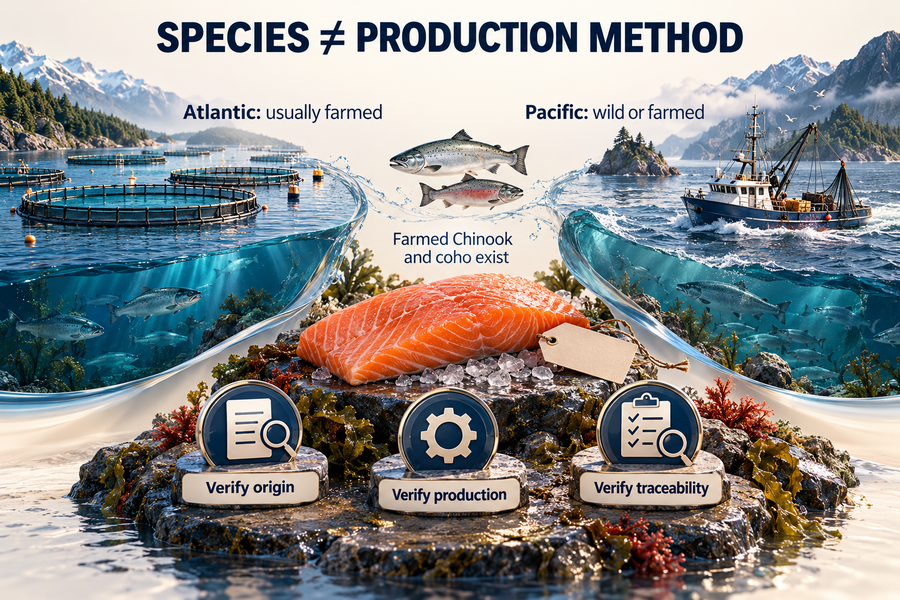
Atlantic salmon is Salmo salar, while the main commercial Pacific salmon include several Oncorhynchus species. A comparison between farmed Atlantic and wild sockeye changes both species and production method, so every difference cannot be attributed to farming.
Most commercial Atlantic salmon is farmed. NOAA’s Atlantic salmon profile explains that all Atlantic salmon sold in U.S. seafood markets is farm-raised; that statement concerns the U.S. market, not the existence of wild Atlantic fish worldwide. Pacific salmon can also be farmed: NIWA’s Chinook aquaculture information describes New Zealand’s farmed king salmon.
Hatcheries and geographic origin
Some wild fisheries include fish that started life in hatcheries, were released and grew in natural waters before capture. This differs from raising fish to harvest size on a farm, but it matters if your sourcing policy distinguishes hatchery-origin and naturally spawned fish.
Record the harvest or farming origin separately from the processing country. A familiar regional name or a processor’s address does not explain the full production history.
Nutrition: Compare Species, Portions and Preparation
Both farmed and wild salmon can contribute valuable nutrients to a varied diet. The comparison becomes more useful when the species, edible portion weight and raw or cooked state are made explicit.
Protein, calories and total fat
The table below compares 100 g of raw edible fish. The Atlantic examples come from the historical entries in USDA’s finfish nutrient reference, while NOAA’s sockeye nutrition profile supplies the sockeye example.
| Raw reference product | Energy | Protein | Total fat | Saturated fat |
|---|---|---|---|---|
| Farmed Atlantic salmon | 208 kcal | 20.42 g | 13.42 g | 3.05 g |
| Wild Atlantic salmon | 142 kcal | 19.84 g | 6.34 g | 0.981 g |
| Sockeye salmon, wild-caught species profile | 168 kcal | 21.30 g | 8.56 g | 1.495 g |
These published reference values were checked on October 3, 2026. The USDA entries are historical composition data, not a new analysis of salmon sold in 2026. Wild Atlantic salmon is included as a same-species reference, rather than a promise of ordinary commercial availability.
The farmed Atlantic example contains more fat and calories than the wild Atlantic example, but protein is similar. This illustrates a possible difference, not a fixed specification for every farm or catch. Cooked fish loses water, and smoked, brined or canned salmon has a different preparation history; those products need their own nutrition information.
EPA and DHA: compare amounts, not just ratios
Marine omega-3 content is usually discussed in terms of EPA and DHA. Farmed salmon can supply as much or more of these fats per portion than some wild products, even where omega-3 makes up a smaller share of its total fat.
An omega-3-to-omega-6 ratio cannot replace the amount of EPA and DHA you actually eat. A study comparing farmed and wild Norwegian Atlantic salmon illustrates why the percentage of these fats and their amount in a serving are different questions. More total fat also does not automatically mean more marine omega-3. Species, feeding and the reference serving all affect the result, so request product-specific figures when making a nutrition claim.
Vitamin D, B12 and minerals
Salmon can supply vitamin D, vitamin B12 and selenium, with amounts varying between products. No single production label guarantees the highest concentration of all three.
Choose the fish that fits the overall diet and intended preparation. For retail labeling, menu calculations or formulation, use a suitable verified declaration for the actual product rather than copying a generic farmed-versus-wild table.

What Farmed and Wild Salmon Eat
Wild salmon feed within natural food webs, eating organisms that vary with their species, size and habitat. Their flesh reflects that diet and the fish’s life stage. Seasonal and regional differences help explain why two wild products can have different fat content and flavor.
Farmed salmon receive formulated feed designed to meet their nutritional needs. Ingredients can include marine and plant-derived materials, oils, vitamins and minerals. Changes in feed can change the fatty-acid profile of the harvested fish. Oregon State University’s salmon guide explains the relationship between diet, nutrients and flesh pigmentation.
The feed question involves nutrition and responsible sourcing together. If your purchasing policy concerns marine ingredients, pigment sources or a specific feed standard, ask for the relevant farm documentation. An ingredient’s presence alone does not establish the finished fish’s nutrient concentration, contaminant level or environmental footprint.
Taste, Texture and Color: Choose for the Dish
The best-tasting salmon is the one that works in the preparation you enjoy. Production method influences the product, but species and handling prevent a simple “wild is stronger, farmed is softer” rule from fitting every fish.
Flavor and firmness
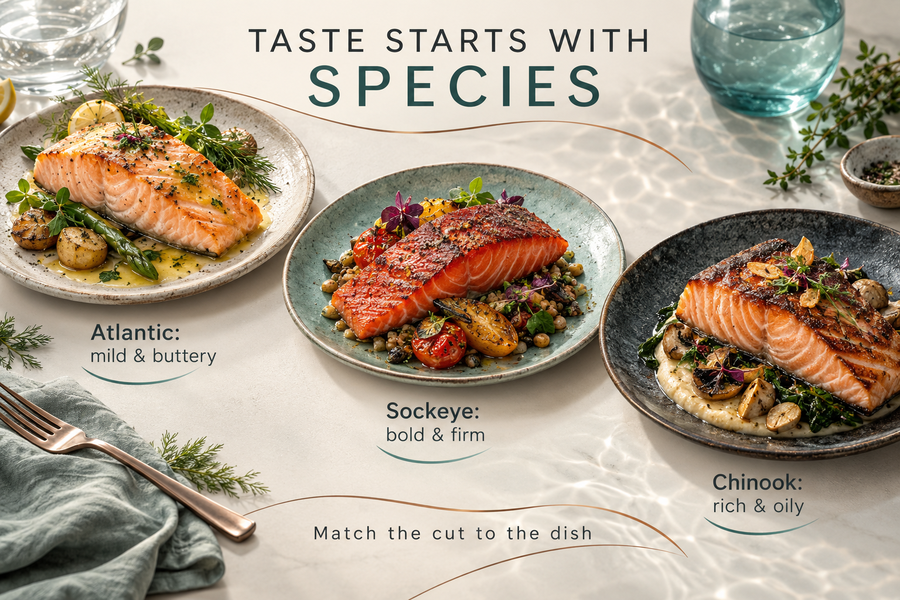
Farmed Atlantic salmon commonly has a rich, buttery profile with a relatively mild flavor. Sockeye offers a more assertive salmon taste and firm flesh, while Chinook can be notably rich and oily; coho, pink and chum provide other sensory options.
A small comparison cooked the same way can reveal more than a broad category ranking. Include the same cut and thickness, since a thin tail portion and a thick center cut behave differently even within one fish.
Why salmon is pink or red
Salmon’s color comes largely from dietary carotenoids, including astaxanthin. Wild fish obtain pigments through their food chain, while farmed fish receive pigments through feed. Feed supplementation is different from painting or injecting a finished fillet with dye.
Color can vary within both groups. A deep red fillet does not prove wild origin, higher omega-3 content or better freshness. Confirm the species and production declaration rather than identifying the fish by its color alone.
Cooking performance and white surface protein
Fattier portions tend to provide a richer eating texture, while leaner fish can dry out when heated too long. Adjust for thickness and use an appropriate verified cooking endpoint instead of automatically subtracting a fixed number of minutes for wild fish.
| Product characteristic | Suitable preparations | Detail to watch |
|---|---|---|
| Rich farmed Atlantic portion | Roasting, pan cooking, poaching | Thickness and the cooking endpoint |
| Oily Chinook portion | Grilling, roasting, validated smoking | Fat distribution and portion size |
| Firm sockeye fillet | Pan cooking, grilling, hot smoking | Excessive heat and moisture loss |
| Milder coho portion | Poaching, steaming, roasting | Consistent thickness |
| Pink or chum in prepared dishes | Fish cakes, salads, chowders | Product format and retained moisture |
The pale material sometimes released during cooking is coagulated protein, often described as albumin. It can occur with farmed or wild salmon and is not, by itself, a sign that the fish was spoiled or incorrectly sourced.
Contaminants, Mercury and Antibiotics
Safety claims need context about the fish, location and controls involved. Older comparisons, current monitoring and a particular supplier’s test results answer different questions.
Avoid blanket contaminant rankings
Both farmed and wild fish can accumulate environmental contaminants, including mercury and persistent pollutants such as PCBs and dioxins. Concentrations depend on the environment, food or feed and the product tested; one historical study cannot rank every salmon origin indefinitely.
Salmon appears in the Best Choices category of the FDA and EPA fish-consumption advice. For commercial purchasing, ask for the testing and compliance information required for the destination market instead of using “wild” as proof that a shipment is contaminant-free.
Antibiotic use is different from residues
Antibiotic use, residues in edible fish and antimicrobial resistance are related but distinct issues. A treatment declaration describes management practice; a residue test describes what the specified method detected in a sample. A result below a reporting threshold is not proof that treatment never occurred.
As a source-specific example, Norway’s 2024 farmed-fish monitoring report, published in 2025, reported no antibacterial-agent residues above the limits of quantification in the samples analyzed. This supports a statement about that monitoring programme, not every farm worldwide. Buyers can ask about health management, medicine controls and any supported “raised without antibiotics” claim separately.
Pregnancy and breastfeeding
FDA and EPA advise people who are pregnant or breastfeeding to eat two to three servings a week from the Best Choices list, with an adult serving defined as four ounces. Salmon is included, so the production label alone does not determine whether it belongs in that guidance.
Raw or undercooked seafood presents a separate foodborne-illness concern. Choose appropriately cooked fish and follow relevant local advice, especially for self-caught fish subject to location-specific advisories.
Sustainability: Assess the Farm or Fishery
Neither “wild” nor “farmed” guarantees the smaller environmental impact. Responsible sourcing requires information about the actual production operation and the route the product takes to reach the buyer.
What to examine at a salmon farm
Farm assessment can include feed sourcing, waste discharge, disease management, sea lice, escapes and animal welfare. In open-water systems, the relationship with surrounding ecosystems and wild fish is particularly relevant.
Land-based and recirculating systems can reduce some interactions with the sea, but they also require energy, water management and waste treatment. A different system changes the trade-offs; it does not eliminate the need to assess them. ASC’s aquaculture standards provide a framework covering environmental and social practices, with associated farm and feed requirements.
What to examine in a wild fishery
For wild salmon, assess the stock, harvest controls, fishing method and effects on the wider ecosystem. Salmon also depends on freshwater habitat, so marine harvest statistics alone do not explain every pressure on a population.
Hatchery support may matter to a buyer’s environmental policy. Request the fishery identity and appropriate sourcing records; a broad claim such as “Pacific wild salmon” does not identify a particular stock or management system.
Include distribution in the comparison
Processing, refrigeration, freezing, transport and product loss can affect the environmental picture. Local origin does not by itself prove a lower footprint, and a fishery-versus-farm comparison should use comparable system boundaries.
Avoid assigning one universal carbon number to all farmed or all wild salmon. A useful comparison names the source, product format, transport assumptions and evidence behind the claim.
Labels, Certification and Traceability
Labels help when they describe something verifiable. Read production, certification and marketing claims separately so that one does not silently stand in for another.
- Confirm species and method. “Atlantic” is a species designation, while “farmed” describes production; neither substitutes for the other.
- Verify certification scope. Check the applicable source, certificate validity and whether the product and supply-chain transaction are covered.
- Read organic claims carefully. Applicable standards differ between markets, and organic certification should not be treated as a synonym for wild-caught or universally medicine-free.
- Check supporting declarations. “Natural,” “premium” and “responsibly sourced” need meaningful evidence if they influence your purchasing decision.
- Match the lot. Labels, invoices and supporting records should identify the same product batch.
| Label or record | What it helps establish | What it does not establish alone |
|---|---|---|
| Farmed or wild-caught | Declared production method | Species, raw-use suitability or sustainability |
| Scientific name | Species identity | Harvest origin or handling history |
| MSC claim | Applicable wild-fishery certification and supply-chain claim | Certification for farmed fish or every product a supplier sells |
| ASC claim | Applicable aquaculture certification and supply-chain claim | Identical quality across all batches |
| Organic claim | Compliance with the identified organic standard | Wild origin or the absence of every possible treatment |
| Lot code and source records | Connection between a batch and its documented source | Safety unless the required controls are also demonstrated |
The MSC wild salmon programme applies to wild-caught fisheries, so its role differs from aquaculture certification. Neither scheme replaces receiving checks or the evidence needed for a food-safety requirement.

Fresh, Frozen and Canned Salmon
Farming can support regular harvest schedules, while fresh wild salmon follows species-specific fisheries and seasons. Frozen supply extends the use of seasonal catches, and canning provides another product format. Confirm current availability rather than assuming that a general description applies to your supplier.
Good freezing and storage can preserve a useful product; “fresh” is not an automatic quality advantage. Check freezing history, packaging, thawed firmness, drip loss and odor against agreed receiving criteria. These factors can explain differences that would otherwise be blamed on farming or wild capture.
Canned salmon needs its own species and ingredient declaration. Some products include edible softened bones that contribute calcium, while salt or added ingredients change the nutrition information. Smoked products also differ from plain raw fish, particularly in sodium and processing controls. Compare like formats before deciding which production method you prefer.
Raw Salmon, Storage and Safe Preparation
The intended use determines the documentation and handling needed. Neither a wild-caught label nor a farmed origin makes a product automatically suitable for sushi, curing or cold smoking.
- Specify raw use before ordering. Request the supplier’s documented suitability and the controls required in the destination jurisdiction.
- Confirm parasite controls. The FDA Food Code’s fish provisions describe freezing requirements and an exemption for qualifying aquacultured fish raised and fed under specified conditions; being farmed alone does not establish the exemption.
- Keep other hazards in view. Parasite-control freezing does not remove all bacterial risks, and curing or cold smoking should not be assumed to replace the required safety process.
- Refrigerate promptly. FDA’s seafood-handling advice recommends a refrigerator at 40°F or below and freezing seafood that will not be used within two days; follow stricter product instructions where applicable.
- Follow vacuum-package instructions. If a product must remain frozen until use or requires package removal before thawing, remove the fish completely before thawing, as explained in Wisconsin’s vacuum-packaged fish guidance.
- Thaw under controlled conditions. Refrigerator thawing is a practical option; keep fish juices away from ready-to-eat foods and avoid a warm countertop.
- Verify cooking. FDA recommends 145°F, approximately 63°C, as the internal temperature for most seafood. Measure the thickest part instead of relying on one cooking time for every cut.
Buying Salmon for Restaurants, Retail or Processing
The strongest buying brief describes what must arrive, not just whether the fish should be farmed or wild. Use the same specification to compare offers and assess any proposed substitution.
- Identify the species, production method and source separately.
- Specify whole, gutted, fillet, steak or portion, including skin, trim and pin-bone requirements.
- Set a size range and acceptable grading tolerance for the product you need.
- Agree on frozen-product net weight and any glaze declaration.
- Confirm packaging, labeling, relevant dates and lot identification.
- Record your intended use and required compliance documents.
| Purchasing requirement | Detail to confirm |
|---|---|
| Identity | Scientific name, commercial name and production method |
| Source | Farming or harvest origin; processing location |
| Cut | Product form, skin status, trimming and pin-bone standard |
| Grading | Fillet or portion weight range and agreed variation |
| Product condition | Chilled or frozen, plus relevant freezing history |
| Weight | Net fish weight and the treatment of glaze |
| Packing | Unit packs, cartons and handling instructions |
| Traceability | Lot code and dates linked to source records |
| Claims | Evidence for certification, nutrition or production claims |
| Acceptance | Sample approval, documents and receiving criteria |
For yield-sensitive uses, compare samples through the same thawing, trimming and cooking procedure. A change in cut or glaze can affect usable product even when the farmed-versus-wild preference stays the same.
Which Salmon Should You Choose?
Choose for a defined priority rather than trying to award one label a permanent first place. These six checks turn the comparison into a decision about the product you will actually use.
- Flavor: consider farmed Atlantic for a commonly mild, buttery profile, sockeye for a stronger character, or another named species after sampling.
- Nutrition: compare equal servings of the actual product, including preparation state and EPA-plus-DHA information where relevant.
- Supply: confirm the supplier’s replenishment schedule and acceptable chilled or frozen formats.
- Sourcing: verify the identified farm or fishery against your environmental requirements.
- Intended use: approve the cut, portion performance and appropriate safety documentation.
- Evidence: match identity, origin and any claim to records that cover the product delivered.
If you are considering another salmonid, evaluate it as a separate product. Rainbow trout products can be relevant to some preparations, but a trade name such as salmon trout does not establish that the fish is Atlantic salmon.
Frequently Asked Questions
The most common questions mix nutrition, production and safety. Separating those questions makes the answers more useful than a blanket recommendation to buy only one type.
Is wild salmon healthier than farmed salmon?
Not in every respect or for every product. Both supply protein and marine omega-3 fats. Some wild reference products are leaner, while some farmed products provide more EPA and DHA per portion. Compare the named species, serving and preparation, then consider the wider diet.
Does farmed salmon have more omega-3?
It can, but that is not a universal rule. Feed, species and total fat affect the amount, while the percentage of omega-3 within total fat is a different measurement. Use EPA-plus-DHA amounts per comparable serving when that nutrient is your priority.
Is farmed salmon dyed pink?
Its flesh color commonly comes from pigments supplied through the feed, including astaxanthin. Wild salmon obtains similar dietary pigments through its food chain. This is different from coloring a finished fillet, and the shade alone cannot identify how a fish was produced.
Can farmed salmon be eaten raw without freezing?
Only where the relevant controls and any applicable exemption are properly established and documented. Under the FDA Food Code, qualifying aquacultured fish must meet specified rearing and feed conditions. “Farmed” or “sushi-grade” on its own is insufficient; follow the rules applicable to your business and destination.
Is wild salmon always more sustainable?
No. A wild product depends on its fishery, stock and harvesting practices, while a farmed product depends on its operation, feed and environmental controls. Distribution and product loss also matter. Verify the actual source and any certification claim rather than treating the production label as the answer.
Discuss Your Fish Requirements with Iran Fish
Bring a clear product brief to the sourcing conversation: species, production preference, cut, size range, packaging and intended use. Explore Iran Fish’s farmed fish range to review the products described on the website.
When comparing salmon trout products with salmon, confirm the scientific name and specifications before approving a substitution. Check current availability and the documents relevant to your destination.
Use the Iran Fish contact page to send your requirements and ask which available products match them.