

Atlantic vs Pacific Salmon: Key Differences for Buyers

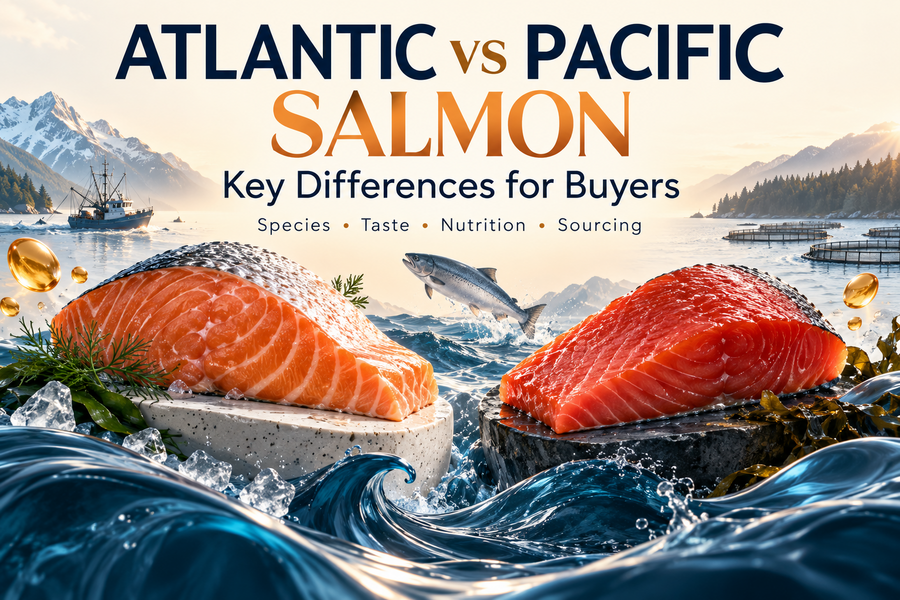
Atlantic vs Pacific salmon is a comparison between one species and a group of species. Commercial Atlantic salmon is usually farmed, with a rich, buttery profile and predictable supply. Pacific salmon ranges from rich Chinook to firm, strongly flavored sockeye and milder coho, pink and chum; some Pacific salmon is farmed too. Choose by species, production method, product condition and intended use, rather than treating either ocean name as a quality guarantee.
| Buying consideration | Atlantic salmon | Pacific salmon |
|---|---|---|
| Species | Salmo salar | Several Oncorhynchus species; specify the individual species |
| Typical commercial production | Usually farmed | Often wild-caught; farmed Chinook and coho also exist |
| Flavor | Usually rich, buttery and relatively mild | Chinook is rich; sockeye is assertive; coho, pink and chum offer milder options |
| Texture | Typically fatty, with moist flakes when cooked carefully | Varies by species: sockeye is firm; Chinook is oily and meaty; leaner species need careful cooking |
| Nutrition | Supplies protein and marine omega-3 fats; composition varies with feed and product | Supplies protein and marine omega-3 fats; composition varies substantially by species and harvest |
| Supply planning | Farming supports year-round availability | Fresh wild supply is seasonal; frozen products extend availability |
| Cooking choice | Versatile for roasting, pan cooking and smoking | Match the species to grilling, poaching, smoking or processed products |
| Responsible sourcing | Evaluate the farm and any verified aquaculture certification | Evaluate the specific fishery, stock and any verified fishery certification |
| Raw consumption | Requires documented controls; “farmed” alone is insufficient | Requires documented controls; “wild” or “frozen” alone is insufficient |
| Best purchasing approach | Confirm origin, trim, portion grade and lot documentation | Confirm those details plus the exact species and harvest identity |
Atlantic vs Pacific Salmon: The Buyer’s Comparison
The most useful comparison starts with what the fish needs to do in your kitchen or product line. An ocean label cannot tell you how a particular fillet will portion, cook or perform after thawing.
- For repeatable portions and ongoing supply, evaluate farmed Atlantic salmon against the specific farmed or frozen Pacific product available.
- For an assertive salmon flavor and deep red presentation, consider sockeye rather than requesting unspecified Pacific salmon.
- For a rich, buttery eating experience, compare Atlantic salmon with Chinook, not with every Pacific species combined.
- For a milder dish, coho or pink may suit the recipe, depending on the cut and processing method.
- For bulk purchasing, request a specification sheet and representative sample before approving a substitution.
A sound comparison keeps the format constant: skin-on fillet against skin-on fillet, or frozen portion against frozen portion. Comparing a fresh center-cut Atlantic fillet with a thawed Pacific tail portion tells you as much about processing and handling as it does about species.
Which Salmon Species Are You Actually Buying?
Atlantic salmon and Pacific salmon belong to the same family, Salmonidae, but they are not interchangeable species names. The scientific name on the product specification is the clearest starting point for identification.
Atlantic salmon: one species
Atlantic salmon is Salmo salar. “Atlantic” describes the species, not a promise that the fish was harvested from the Atlantic Ocean: farms also raise it outside its native range.
Most commercial Atlantic salmon is farmed. In the United States, NOAA’s Atlantic salmon profile explains that commercial fishing for Atlantic salmon is prohibited and that U.S. seafood markets sell farm-raised Atlantic salmon. That U.S. rule should not be presented as a worldwide ban.
Pacific salmon: specify the species
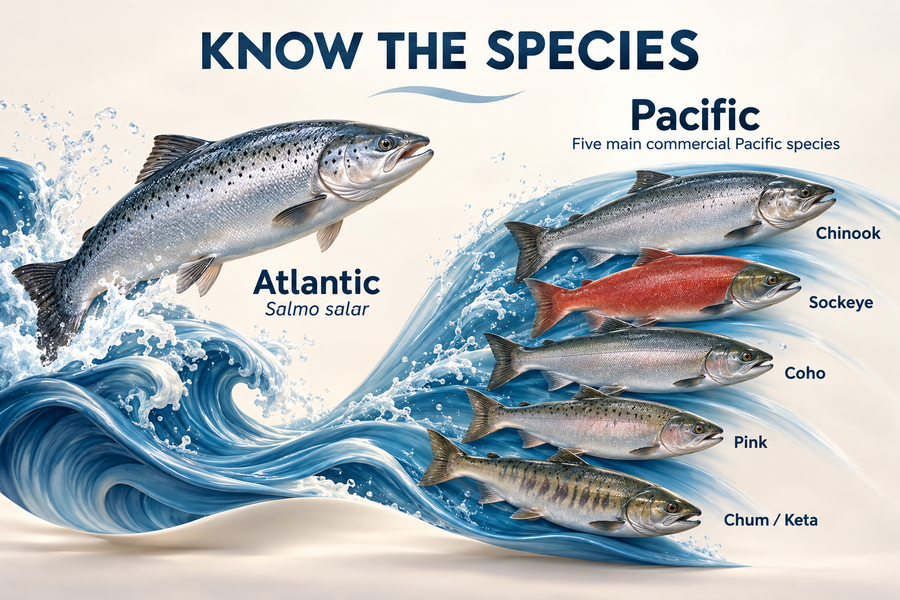
The five species below are the main North American commercial Pacific salmon. Pacific Asia also has salmon such as masu, so “five” is a commercial shortlist rather than a complete global species count.
| Commercial name | Scientific name | Useful buying distinction |
|---|---|---|
| Chinook or king | Oncorhynchus tshawytscha | Rich, oily flesh; available from wild fisheries and aquaculture |
| Sockeye or red | Oncorhynchus nerka | Strong flavor, firm flesh and pronounced red color |
| Coho or silver | Oncorhynchus kisutch | Milder flavor; sold wild-caught and farmed |
| Pink or humpback | Oncorhynchus gorbuscha | Mild flavor; commonly used in canned and processed products |
| Chum or keta | Oncorhynchus keta | Generally leaner flesh; also valued for roe |
Steelhead and salmon trout need separate identification
Steelhead is the sea-run form of rainbow trout, Oncorhynchus mykiss. It is closely related to Pacific salmon but is a different species from those listed above.
“Salmon trout” is a trade name that needs clarification from the supplier. For products described as Iranian rainbow trout, compare the documented species and product specifications rather than assuming that pink flesh makes the fish Atlantic salmon.
Farmed vs Wild Salmon: Why the Ocean Name Is Not Enough
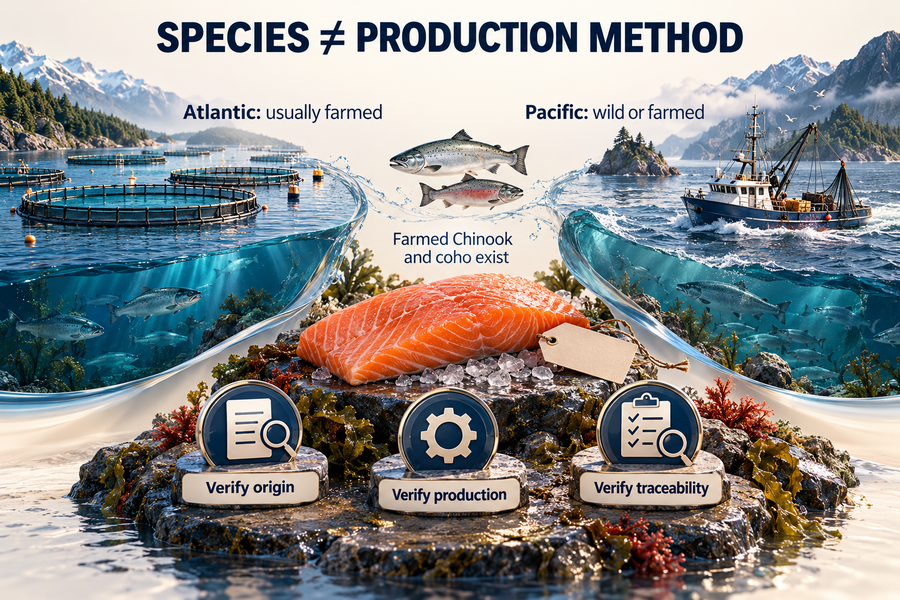
“Atlantic” and “Pacific” identify biological groups; “farmed” and “wild-caught” describe production. Those are separate questions. Atlantic salmon is widely farmed in countries including Norway and Chile, while Pacific aquaculture includes Chinook and coho. New Zealand’s Ministry for Primary Industries lists king salmon among its main farmed marine species, and FAO documents coho salmon aquaculture. A Pacific species can therefore arrive with a farmed production declaration.
Wild-caught salmon may also originate from a hatchery-supported fishery. Juveniles can be raised in a hatchery, released and later harvested after growing in the wild. That history differs from fish grown to harvest size in aquaculture. For buyers whose sourcing policy distinguishes hatchery-origin fish from naturally spawned fish, a general wild-caught label may not answer every question.
Atlantic salmon can survive spawning and reproduce again, while the five main Pacific salmon species generally die after spawning. This biological difference helps explain their life histories but does not grade a finished fillet. For purchasing, record the species, country of harvest or farming, production method and processing location separately; a processor’s address is not necessarily the fish’s origin.
Taste, Texture and Color: Match the Fish to the Dish
There is no single Pacific salmon taste. Species choice matters, and storage history, freshness and cooking can alter the result enough to outweigh a broad Atlantic-versus-Pacific preference.
Mild flavor or a richer salmon character?
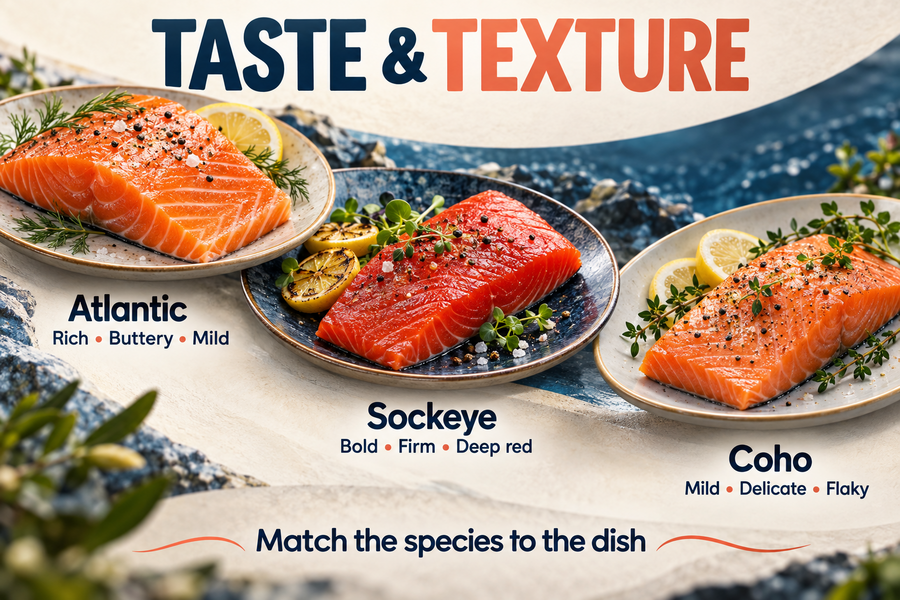
Farmed Atlantic salmon commonly offers a buttery, relatively mild flavor that works with herbs, citrus and sauces. Chinook is another rich option: NOAA’s Chinook seafood profile describes a buttery taste with oily, meaty flakes.
Sockeye has a pronounced salmon character and suits dishes where the fish remains the main flavor. Coho offers a gentler option; pink and chum also tend toward milder profiles. These descriptions guide selection, but a tasting sample is more useful than treating flavor as a universal ranking.
Firmness, fat and cooking performance
Fat contributes to richness and helps the flesh retain an appealing eating texture, although fatty salmon can still be overcooked. Leaner portions need attention to thickness and heat, especially when the tail and center cut share a tray.
| Product or species | Practical preparation choices | What to watch |
|---|---|---|
| Farmed Atlantic | Roasting, pan cooking, poaching and smoking | Consistent thickness; avoid overcooking |
| Chinook | Grilling, roasting and smoking | Richness and portion size |
| Sockeye | Pan cooking, grilling and hot smoking | Firm flesh can dry with excessive heat |
| Coho | Poaching, steaming and roasting | Match heat exposure to the portion thickness |
| Pink | Fish cakes, salads and canned preparations | Product format and moisture retention |
| Chum/keta | Gentle cooking, chowders and processed preparations | Leaner flesh; roe is a separate product specification |
Smoking requires its own validated process. A species that tastes good smoked is not automatically suitable for an improvised cold-smoking method.
Flesh color is not a quality certificate
Salmon’s pink and red tones come largely from carotenoid pigments obtained through the diet, including astaxanthin. Wild fish acquire pigments through their food chain; farmed fish receive them through formulated feed.
Sockeye usually has deeply colored flesh, while other species can be lighter. Color alone cannot prove freshness, wild origin, omega-3 content or food safety. Evaluate it alongside species identification, handling records and physical condition.
Atlantic vs Pacific Salmon Nutrition: Compare Like with Like
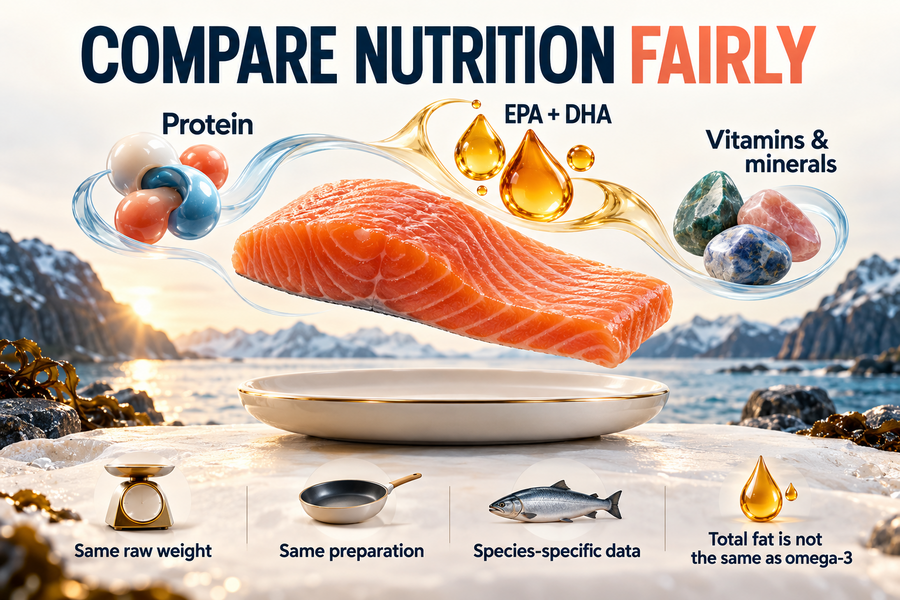
Both groups supply protein and marine omega-3 fatty acids, but a single “Pacific salmon nutrition” value hides differences between species. Compare equal edible weights in the same preparation state before drawing conclusions about calories, protein or fat.
Protein, energy and total fat
The examples below use 100 g of raw edible fish. The Atlantic figures come from the specified raw farmed entry in USDA’s salmon nutrient report; the Pacific figures are published in NOAA’s individual species profiles, including its sockeye nutrition information and coho nutrition information.
| Reference product, raw | Energy per 100 g | Protein per 100 g | Total fat per 100 g | Saturated fat per 100 g |
|---|---|---|---|---|
| Atlantic salmon, farmed | 208 kcal | 20.42 g | 13.42 g | 3.05 g |
| Chinook salmon | 179 kcal | 19.93 g | 10.43 g | 3.10 g |
| Sockeye salmon | 168 kcal | 21.30 g | 8.56 g | 1.495 g |
| Coho salmon | 146 kcal | 21.62 g | 5.93 g | 1.260 g |
These are published reference values, checked on October 1, 2026, not measurements of a supplier’s current shipment. The USDA report is historical reference data; it should not be mistaken for a new 2026 laboratory analysis. Feed, season, fish size and individual lots can change composition.
Cooking changes water content, so 100 g of cooked salmon is not directly equivalent to 100 g raw. Smoked, brined and canned products also need their own nutrition declarations, particularly when sodium matters.
Omega-3: total fat does not tell the whole story
EPA and DHA are the marine omega-3 fats usually relevant to a salmon comparison. Total fat includes other fatty acids, so the fattier sample does not automatically have the highest EPA-plus-DHA concentration.
Farmed feed composition and wild feeding patterns affect the result. For a nutrition claim or product formulation, obtain product-specific EPA and DHA information instead of declaring every wild fish superior to every farmed fish.
Vitamins and minerals
Salmon can contribute vitamin B12, vitamin D and selenium alongside protein. The amounts depend on the reference product, and one species need not lead across every nutrient.
For retail labels or institutional menu calculations, use the verified declaration for the actual raw material and processing method. A general comparison article is a starting point for selection, not a substitute for lot-specific or product-specific labeling information.
Fresh, Frozen and Seasonal Supply
Farmed Atlantic salmon supports planned year-round sourcing, although individual suppliers still have production schedules and logistical constraints. Wild Pacific availability follows the fishery, species, region and season. NOAA describes fresh Chinook and sockeye supply mainly around summer and early fall, while fresh coho can extend later into autumn. Those descriptions are not a universal harvest calendar for every origin.
Frozen supply allows seasonal catches to serve buyers beyond the harvest window. A properly handled frozen fillet can perform better than a nominally fresh product that has spent too long in distribution. Request the harvest or production date, freezing date, storage conditions and whether a product marketed as fresh was previously frozen.
For procurement, assess quality after controlled thawing as well as while frozen. Check drip loss, flesh firmness, gaping, odor and cooking performance against the agreed sample. Large ice crystals, damaged packaging or thaw-and-refreeze signs deserve investigation. “Fresh” and “frozen” describe product condition; neither word replaces a cold-chain assessment.
Sustainability, Certification and Traceability
Responsible sourcing is specific to a farm or fishery, not guaranteed by an ocean name. A useful purchasing policy pairs an environmental requirement with traceability that can be checked for the product delivered.
- Identify the source. For wild salmon, request the fishery and harvest area; for farmed salmon, request the farm or production source.
- Verify the certification type. The MSC salmon guide discusses certified wild fisheries, while ASC’s standards cover responsible aquaculture practices.
- Check scope and validity. A supplier displaying a logo does not establish that every product, facility or transaction is covered.
- Follow the chain of custody. Confirm that an applicable certification claim can be maintained through processing and sale, rather than stopping at the original farm or fishery.
- Keep batch records. Link the product label and lot code to the invoice, source declaration and relevant documentation.
- Assess the actual operation. Wild fisheries can face stock and habitat pressures; farming can involve feed, waste, disease, escape and welfare issues. Ask how the identified source addresses the relevant risks.
Certification supports a defined sourcing claim. It does not replace food-safety checks or guarantee identical sensory quality across batches.
Contaminants and Raw Consumption: Ask for Evidence
For mercury, salmon appears on the Best Choices list in the FDA and EPA advice about eating fish. That advice does not establish that every Atlantic product has more contaminants than every Pacific product. Claims about mercury, PCBs, dioxins or residues should identify the product, testing basis and relevant limits. Buyers with testing requirements should request suitable documentation rather than relying on “wild is cleaner” marketing.
Raw consumption is a separate safety decision. Neither farmed Atlantic nor wild Pacific salmon becomes suitable for sushi merely because of its species, appearance or a “sushi-grade” description. The FDA Food Code’s parasite-control provisions address freezing treatments and a documented exemption for qualifying aquacultured fish raised and fed under specified conditions. “Farmed” by itself does not establish that exemption. Businesses must meet the requirements applicable in their own jurisdiction.
Freezing for parasite control does not eliminate all bacterial hazards. Cold-chain management, hygienic preparation and approved sourcing remain necessary, and curing or cold smoking should not be assumed to replace a required parasite-control process. Specify raw use before purchasing so the supplier can provide the relevant product declaration and supporting records.
Storage, Thawing and Cooking Without Losing Quality
Handling affects both safety and the eating quality you purchased. Use the supplier’s product instructions alongside the food-safety procedures applicable to your kitchen or facility.
- Maintain cold storage. For household handling, FDA seafood storage advice recommends refrigeration at 40°F or below and freezing seafood that will not be used within two days; stricter product instructions take precedence.
- Follow vacuum-packaging instructions. Where a vacuum-packed product must remain frozen until use or requires removal before thawing, remove it completely from the packaging first, as explained in Wisconsin’s vacuum-packaged fish guidance.
- Thaw under controlled conditions. Refrigerator thawing is a practical approach; do not thaw fish on a warm countertop.
- Prevent cross-contamination. Keep raw fish and its juices away from ready-to-eat food, and clean preparation surfaces and utensils.
- Cook to a verified endpoint. FDA recommends an internal temperature of 145°F, approximately 63°C, for most seafood. Measure the thickest part instead of applying one fixed cooking time to all fillets.
- Preserve the intended texture. Group portions by thickness, monitor the endpoint and avoid prolonged heating after the fish is cooked.

Wholesale Salmon Specifications That Belong in Your Order
A clear order specification turns a preference into a product a supplier can identify and deliver. It also makes substitutions easier to assess before the shipment is approved.
- Name the species. Use the scientific name alongside the commercial name, especially for Pacific salmon and salmon trout.
- Separate origin and processing. Record where the fish was harvested or farmed and where it was processed.
- Define the cut. Specify whole, gutted, fillet, steak or portion, together with skin, trimming and pin-bone requirements.
- Agree on grading. Set the desired weight range and acceptable variation for fillets or portions.
- Define frozen-product weight. Agree on net fish weight and how any glaze is measured and declared.
- Confirm packaging. Record individual or bulk packing, vacuum or other packaging, carton configuration and label details.
- Attach documentation requirements. Include lot identification, dates, handling information and the documents needed for the destination market.
| Order field | What to specify | Why it matters |
|---|---|---|
| Species and production | Scientific name; wild-caught or farmed | Prevents an unsuitable species substitution |
| Source | Country, farm or fishery; processing location | Supports origin and sourcing checks |
| Product condition | Chilled or frozen; freezing method where relevant | Sets handling and production expectations |
| Cut and trim | Skin status, belly trim, pin-bone standard | Affects preparation and usable yield |
| Size grading | Agreed fillet or portion weight range and tolerance | Supports consistent plating and processing |
| Weight and glaze | Net fish weight; agreed glaze declaration | Makes frozen specifications comparable |
| Packing | Unit pack, carton details and storage instructions | Supports receiving and stock control |
| Dates and lot code | Production, freezing and durability information | Enables stock rotation and traceability |
| Intended use | Cooked, smoked or raw; required supporting records | Aligns the product with the planned process |
| Verification | Documents, sample approval and receiving criteria | Creates an objective basis for acceptance |
Where yield is important, test the same cut through the same thawing, trimming and cooking process. A quoted fillet weight cannot tell you the final usable yield without that context.
Six Checks Before Choosing Atlantic or Pacific Salmon
The better choice is the fish that meets your sensory, operational and sourcing requirements. Use these six checks to compare actual offers without allowing the Atlantic or Pacific label to decide everything.
- Intended use: choose the product for the dish or processing method, and flag raw use at the start.
- Flavor and texture: compare the named Pacific species with Atlantic salmon through a representative sample.
- Portion consistency: review cut, thickness, weight range, skin and pin-bone requirements.
- Supply continuity: confirm current availability and replenishment plans rather than assuming a broad seasonal description applies to the supplier.
- Handling performance: check packaging, thawed condition, drip loss and cooking results against the agreed standard.
- Evidence: match species, origin, lot identity and any certification or safety claim to supporting documents.
If a substitution is proposed, repeat the checks. Replacing sockeye with coho may be acceptable for one preparation and noticeably change another, even though both products are Pacific salmon.
Frequently Asked Questions
These are practical questions that often arise when selecting a salmon product. The answers depend on the identified species and handling requirements, rather than a blanket ranking of the two groups.
Does Atlantic or Pacific salmon taste better?
There is no universal winner. Atlantic salmon commonly suits buyers who want a rich but relatively mild flavor, while sockeye provides a stronger salmon character and Chinook offers a rich, buttery alternative. Compare the specific product in the intended preparation.
Is Pacific salmon always wild-caught?
No. Pacific salmon includes farmed Chinook and coho as well as wild-caught products. Request the species and production declaration separately; “Pacific” alone does not prove a wild origin.
Which has more omega-3: Atlantic or Pacific salmon?
It depends on the species and product. Feed, season and preparation affect EPA and DHA content, and total fat is not the same measurement as omega-3. Use matched nutrition data or the supplier’s verified product information for a meaningful comparison.
Can frozen salmon be used for sushi?
Not automatically. Frozen salmon needs documented suitability for raw consumption, including the applicable parasite-control process or a supported exemption and appropriate handling. Ordinary freezing, a fresh appearance or a “sushi-grade” description alone does not establish safety.
Is salmon trout the same as Atlantic salmon?
No, the trade name does not establish that identity. Atlantic salmon is Salmo salar; rainbow trout and steelhead are Oncorhynchus mykiss. Ask the supplier to state the scientific name so that the product matches your recipe, labeling and purchasing requirements.
Discuss Your Fish Specifications with Iran Fish
Start with the species and product format your business needs. Iran Fish’s farmed fish range and rainbow trout products provide a starting point for exploring the products described on the website.
For a comparison involving salmon trout, ask for the scientific name and specifications before treating it as a substitute for Atlantic or Pacific salmon. Confirm current availability, origin and the documents relevant to your intended use.
Send your preferred cut, size grade, packing format and destination requirements through the Iran Fish contact page so the discussion can begin with a clear product brief.