

Vannamei Shrimp Market: Demand, Supply and Buying Trends

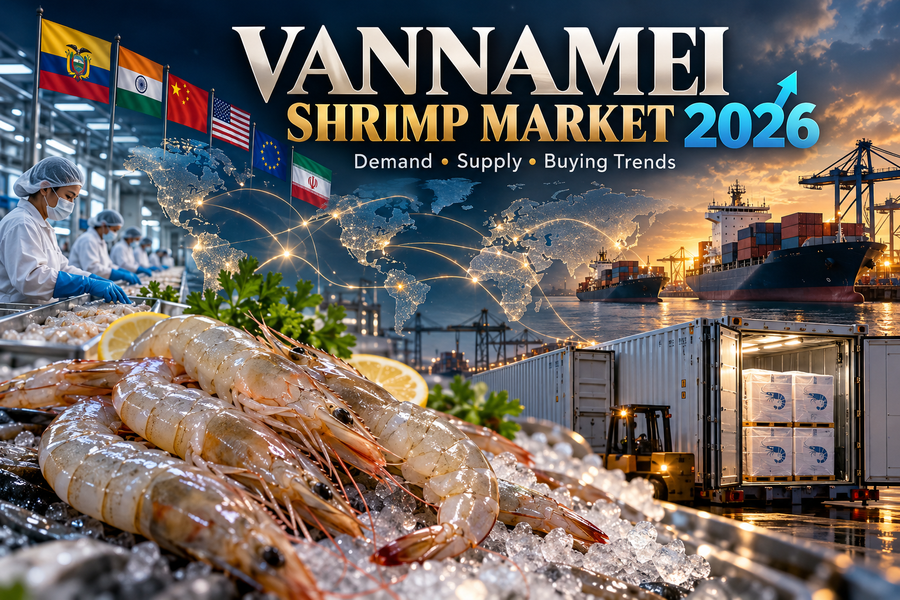
The Vannamei shrimp market in 2026 is being shaped by fast supply growth, uneven demand across major import markets, changing product preferences, and more selective B2B buying. Ecuador is expanding exports rapidly, China is importing more, while the US and EU have shown softer year-to-date volumes. For wholesale buyers, the practical takeaway is clear: origin, product form, count size, inventory, timing, documentation, and supply consistency now matter as much as headline market volume.
| Market factor | 2026 position | What it means for buyers |
|---|---|---|
| Global supply | Ecuador is expanding quickly while Asian origins are growing at different rates | Multi-origin sourcing is becoming more important |
| China demand | Imports are strongly higher year to date | Inventory and seasonal buying must be checked alongside import growth |
| US demand | Imports are lower year to date through July | Product form and origin selection matter more |
| EU demand | Imports are lower year to date through July | HOSO demand coexists with rising interest in value-added products |
| Product mix | HOSO, HLSO, peeled, PD, PDTO, cooked and breaded formats serve different channels | Buyers should define end use before requesting quotations |
| Procurement | Traceability, size count, glaze, net weight, cold chain and documents are critical | A complete written specification should come before production |

Vannamei Shrimp Market in 2026: The Key Global Signals
The market is not moving in one direction. Supply is expanding in some producing countries, but import demand and consumption are not rising at the same pace everywhere.
Supply Growth Is Outpacing Demand in Some Markets
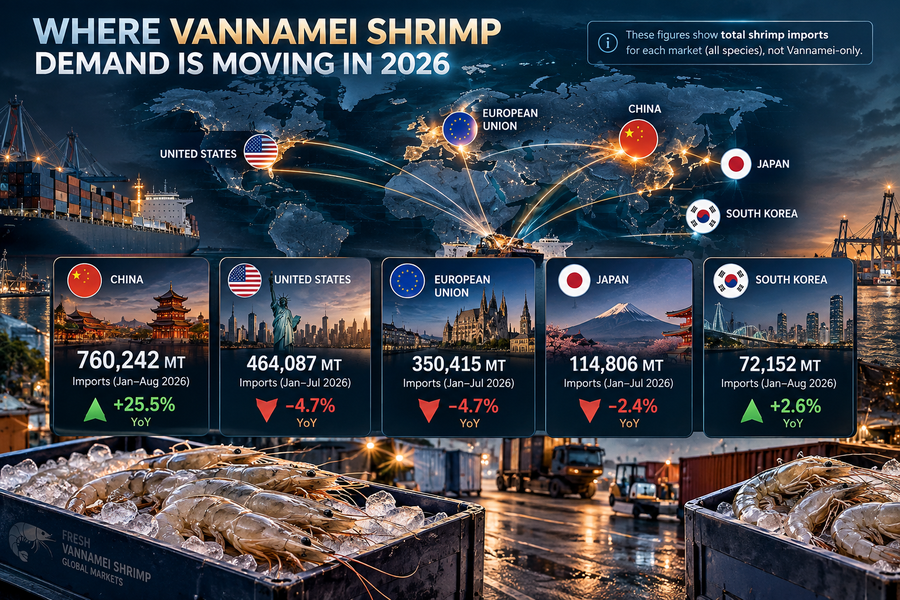
The latest Shrimp Insights global trade dashboard shows a clear divergence. China imported 760,242 metric tonnes of shrimp from January through August 2026, up 25.5% from the same period a year earlier. The United States imported 464,087 metric tonnes through July, down 4.7%, while extra-EU imports reached 350,415 metric tonnes through July, also down 4.7%.
On the supply side, Ecuador exported 987,423 metric tonnes through July 2026, up 19.1% year on year. India exported 460,949 metric tonnes over the same period, up 1.2%, while Vietnam exported 159,141 metric tonnes through June, up 10.1%.
These figures do not represent one perfectly matched global balance sheet because reporting periods and product classifications differ by market. They do, however, show why buyers should avoid treating “global shrimp demand” as a single trend.
Why Vannamei Remains Central to Global Farmed Shrimp Trade
Vannamei remains the dominant commercial species in farmed shrimp because it supports large-scale aquaculture, a broad size range, and many processing formats. In its 2026 market report, Grand View Research states that L. vannamei held 44.3% of global shrimp market revenue in 2025, while aquaculture accounted for 60.1% of the market and B2B distribution represented about 55.9%.
For importers and distributors, the practical advantage is product flexibility. The same species can be sold as HOSO, HLSO, peeled undeveined, peeled and deveined, PDTO, cooked, breaded, IQF, or block frozen.
Why Import Growth Does Not Always Mean Stronger Consumption
Import statistics can rise faster than actual consumption. SeafoodSource reported in September 2026 that Chinese shrimp imports reached record levels in the first two quarters of 2026, while consumption remained broadly flat in the first half of the year.
That gap can reflect inventory rebuilding, early seasonal buying, changes in sourcing origin, or shrimp entering cold storage before reaching the final consumer. Buyers should therefore read import data together with inventory conditions, retail movement, foodservice demand, and seasonal timing.

Global Vannamei Shrimp Supply: Which Origins Are Leading the Market?
Vannamei supply comes from several major producing regions, but their strengths are different. Production scale, processing capacity, product form, market access, and customer mix all influence where a buyer should source.
| Origin | Main market role | Typical sourcing consideration |
|---|---|---|
| Ecuador | Large-scale exporter with rapid 2026 growth | Strong whole-shrimp supply and expanding processed capacity |
| India | Major Vannamei producer and processor | Strong peeled and value-added capability |
| Vietnam | Producer and advanced processor | Broad processed and retail-ready formats |
| Indonesia | Important Asian supplier | Processed and peeled products for international markets |
| China | Major producer and importer | Domestic harvest and inventory influence import demand |
| Iran | Complementary regional origin | Useful for origin diversification and Persian Gulf supply |
Ecuador: Rapid Export Growth and Expanding Market Share
Ecuador is the strongest current growth story among the major export origins. According to Shrimp Insights data through July 2026, the country exported 987,422.81 metric tonnes in the first seven months of the year, 19.1% more than during the same months of 2025. July alone reached 164,769 metric tonnes.
Ecuador has traditionally been particularly strong in raw HOSO shrimp, especially for China and European whole-shrimp markets. At the same time, the industry is investing more heavily in processed formats. SeafoodSource reported in July 2026 that Ecuadorian suppliers are expanding value-added production as they seek to place higher export volumes across more markets.
India: A Major Origin for Peeled and Processed Shrimp
India remains one of the largest suppliers of farmed Vannamei. Shrimp Insights reports 460,948.78 metric tonnes of shrimp exports from January through July 2026, up 1.22% year on year.
India’s competitive position is closely linked to its processing base. Peeled, deveined, tail-on, and other labour-intensive formats are important parts of its export mix. S&P Global’s 2026 market outlook also highlights the effect of US trade policy on Indian shrimp flows, showing why market access can alter sourcing even when farm production remains high.
Vietnam and Indonesia: Processing and Value-Added Strength
Vietnam combines domestic shrimp production with substantial processing capability. Shrimp Insights data through June 2026 show exports of 159,141 metric tonnes, up 10.05% from the same period of 2025.
Indonesia remains another important Asian origin. Its export volume was lower year on year through July 2026, according to Shrimp Insights, but it still plays a meaningful role in international peeled and processed shrimp supply.
For buyers, these origins often become relevant when end customers require more processing than simple whole frozen shrimp.
China: Both a Major Producer and Importer
China is unusual because it is both a major shrimp producer and the largest tracked import market in 2026. Domestic production can reduce import demand in some periods, while seasonal consumption, inventory rebuilding, and preferences for imported HOSO shrimp can lift demand in others.
This dual role is why China should never be analysed from import figures alone. Local harvest conditions and warehouse stocks can materially change buying behaviour.
Iran: A Complementary Origin for Diversified Sourcing
Iran is smaller than Ecuador or India, but it can serve buyers looking to diversify their sourcing base, particularly in regional markets. Iran Fish offers farmed Iranian Vannamei shrimp and provides export supply through its shrimp exporter page.
For an international buyer, Iran can be considered alongside larger origins when the required size, product form, documentation, packaging, and destination-market eligibility can all be confirmed before production.
Vannamei Shrimp Demand in the Main Import Markets
Demand varies sharply by destination. A product that is easy to place in China may not match a Northern European retail programme, and a peeled format suitable for the United States may not fit a buyer looking for whole-shrimp presentation.
| Import market | Latest 2026 reported volume | Year-on-year direction | Main buying consideration |
|---|---|---|---|
| China | 760,242 MT through August | +25.5% | Inventory, HOSO demand, seasonal timing |
| United States | 464,087 MT through July | -4.7% | Peeled formats, origin mix, foodservice and retail |
| European Union | 350,415 MT through July | -4.7% | Whole shrimp vs semi-processed/value-added demand |
| Japan | 114,806 MT through July | -2.4% | Tight specifications and processing consistency |
| South Korea | 72,152 MT through August | +2.6% | Consistent quality and regular supply |
China: High Import Volumes, Inventory and Seasonal Buying
China is the most important demand-side growth story of 2026 so far. The China import series from Shrimp Insights records 760,242.1 metric tonnes through August, 25.48% above the same period of 2025.
However, the market has also shown a disconnect between imports and consumption. Seasonal stock building around Chinese New Year, inventory accumulation, domestic production, and purchasing by large importers can all alter monthly trade flows.
For suppliers, China remains a major HOSO destination, but the buyer’s preferred count size, head quality, shell condition, packing, and arrival timing must be confirmed rather than assumed.
United States: Origin Shifts and Strong Demand for Peeled Formats
The US shrimp import series shows 464,086.9 metric tonnes imported through July 2026, down 4.72% year on year. Ecuador was the largest listed supplier in that period, followed by India and Indonesia.
The US market has strong demand for peeled, deveined, tail-on, and other convenient formats used by retail and foodservice buyers. Origin shares can move rapidly when tariffs, supply availability, or importer programmes change.
That means an exporter should not simply ask whether US demand is “up” or “down.” The more useful question is which product forms and origins are gaining buyer acceptance.
European Union: HOSO Demand vs Value-Added Growth
Extra-EU shrimp imports reached 350,415.4 metric tonnes through July 2026, according to Shrimp Insights EU data, down 4.68% year on year.
Europe is not one uniform market. Southern European countries retain strong demand for whole shrimp, while retail-led markets in Northern and Central Europe tend to use more semi-processed and value-added formats. S&P Global reported in June 2026 that European buyers were increasingly favouring cooked, breaded, peeled, and deveined shrimp over raw HOSO in some channels.
The gap between abundant HOSO supply and demand for processed products is one of the most important structural issues in the current market.
Japan and South Korea: Specification-Driven Buying
Japan imported 114,806 metric tonnes through July 2026, down 2.35% year on year, while South Korea imported 72,152 metric tonnes through August, up 2.62%, according to Shrimp Insights.
Both markets can be demanding on consistency. Product appearance, count accuracy, processing quality, packaging, and repeatability across shipments often matter as much as headline availability.
Middle East: Opportunities Across HOSO, HLSO and Frozen Formats
Middle Eastern demand spans wholesale, retail, hotels, restaurants, catering, and further processing. That creates room for HOSO, HLSO, peeled, and IQF products rather than one dominant specification.
For Iranian exporters, nearby Gulf markets can be particularly relevant, but every shipment still depends on destination-specific health documents, labelling, establishment approval, and buyer specifications.

Which Vannamei Shrimp Forms and Sizes Are Buyers Looking For?
There is no single best-selling product form across the whole market. End use determines whether the buyer needs a whole shrimp, a versatile raw material, or a highly processed product.
| Product form | What the buyer receives | Typical use |
|---|---|---|
| HOSO | Head-on, shell-on | Whole-shrimp retail, restaurants, traditional markets |
| HLSO | Headless, shell-on | Wholesale, foodservice, further processing |
| PD | Peeled and deveined | Retail, foodservice, ready preparation |
| PDTO | Peeled, deveined, tail-on | Restaurants, retail presentation, value-added products |
| IQF | Individually frozen pieces | Flexible portioning and retail packs |
| Block frozen | Product frozen as a block | Bulk processing and selected wholesale applications |
HOSO and Its Core Markets
HOSO is attractive where full presentation and shell-on cooking matter. Head condition becomes a key quality issue, so buyers should define limits for melanosis, loose heads, damaged shells, discolouration, and size uniformity.
Iran Fish’s guide to HOSO vs HLSO shrimp explains why the two forms should not be compared using count numbers alone.
HLSO, PD, PDTO and Peeled/Deveined Products
Removing the head or shell changes both usable yield and the inspection points that matter. For peeled products, buyers should specify acceptable levels of remaining shell, vein removal, back cut, tail damage, broken pieces, and trimming.
These formats are increasingly important for customers that want to reduce preparation labour at destination.
IQF vs Block Frozen
IQF keeps individual pieces separate, allowing users to remove only the quantity needed. Block freezing can work well for processors or buyers that thaw larger batches.
Neither method is automatically better. The correct choice depends on packaging, storage, thawing workflow, customer type, and final application.
How Count Size Changes the Buying Decision
A size code is incomplete unless the unit and product form are stated. “30/40” may mean pieces per kilogram or pieces per pound, and the finished weight changes when the head, shell, or tail is removed.
The Iran Fish Vannamei shrimp size guide explains how count ranges, product form, deglazing, and net weight should be read together.
How Vannamei Shrimp Buying Trends Are Changing
Wholesale shrimp procurement is moving away from simple volume buying toward specification-driven sourcing. Buyers increasingly want a product that fits a specific retail, foodservice, or processing programme. A supplier may have abundant raw HOSO available, but that volume does not solve a buyer’s need for PD, PDTO, cooked, or breaded shrimp. The growing European focus on value-added products is a clear example of this change.
Inventory awareness is also becoming more important. China’s 2026 import surge shows why high inbound volume does not automatically equal stronger end consumption. Importers are looking more closely at warehouse stock, shipments already on the water, seasonal demand, and replacement needs before committing to new orders.
The third shift is toward tighter documentation and quality control. Buyers increasingly define scientific name, origin, count basis, glaze, net weight, processing tolerances, packaging, labelling, traceability, health documents, and inspection criteria in writing. Iran Fish’s Vannamei shrimp buying guide provides a detailed framework for building that specification before an order is confirmed.
How Inventory, Seasonality and Harvest Timing Affect Demand
Monthly shrimp trade can move sharply even when underlying annual consumption changes very little. Stock levels, holidays, and harvest timing can all move orders forward or backward.
Cold-Storage Inventory and Replacement Demand
If importers enter a quarter with high cold-store inventory, they may reduce buying until stock moves through retail and foodservice channels. That slowdown does not necessarily mean consumer demand has disappeared.
For market analysis, inventory should therefore be read alongside imports rather than treated as a separate issue.
Lunar New Year Buying
Chinese New Year has a major effect on shipment timing. Importers may buy well in advance so that shrimp is cleared, stored, and distributed before the holiday period.
This can shift import volume between December, January, and February, making single-month comparisons misleading.
Holiday Demand in the US and Europe
Retail promotions and foodservice programmes around year-end holidays can also pull orders forward. Once importers have built sufficient stock, replacement orders may temporarily slow.
Harvest Timing and Size Availability
Harvest conditions affect not only total supply but also the size mix available to buyers. Weather, farm management, growth rates, and harvest decisions can make larger or smaller counts temporarily tighter even when overall production remains high.
How Tariffs, Import Rules and Logistics Reshape Global Shrimp Trade
Shrimp trade responds quickly to policy and logistics. A competitive product can lose access to a market because of tariffs, plant restrictions, documentation problems, or cold-chain risk.
Tariffs and Origin Switching
Trade measures can change the preferred sourcing country even when the underlying product has not changed. The 2026 discussion around Indian access to the US market is one example of how tariff exposure can redirect purchasing toward other origins.
Plant Eligibility and Import Restrictions
Country approval is not always enough. The individual processing establishment may also need to be eligible for the destination market. S&P Global reported in July 2026 that Chinese restrictions on some Ecuadorian plants created concern about trade diversion to other markets.
Cold-Chain Risk
Frozen shrimp depends on uninterrupted temperature control. Reefer condition, loading, sealing, temperature records, transshipment handling, and delivery timing should be part of shipment control.
Trade Diversion Between Major Markets
When one destination becomes less accessible or less active, exporters may redirect supply elsewhere. This can change availability quickly in the US, China, Europe, or the Middle East even when global farm production is unchanged.
What Wholesale Buyers Should Check Before Ordering Vannamei Shrimp
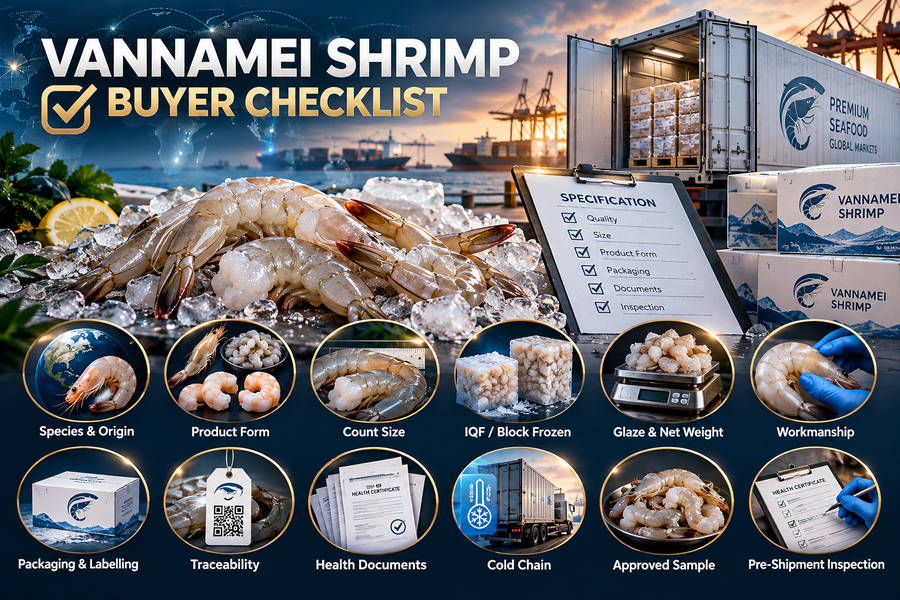
A complete enquiry should allow the buyer, supplier, production team, and inspector to understand exactly the same product. A request that says only “Vannamei 30/40” leaves too many variables undefined.
- Scientific name: Penaeus vannamei or Litopenaeus vannamei
- Farmed origin and country of origin
- Product form: HOSO, HLSO, PUD, PD, PTO, PDTO, cooked, or another defined format
- Count range and whether it is measured per kilogram or per pound
- Raw, cooked, or value-added status
- IQF, semi-IQF, or block frozen
- Declared glaze and method for checking net contents
- Workmanship tolerances for broken pieces, vein removal, shell remnants, trimming, and tail damage
- Inner-pack and master-carton configuration
- Destination-market labelling
- Traceability requirements
- Health certificate and certificate of origin
- Any destination-specific import documents
- Cold-storage and transport requirements
- Approved sample
- Pre-shipment sampling and inspection criteria
- Ability to repeat the same specification across future shipments
| Buying stage | What to define | What to verify |
|---|---|---|
| Enquiry | Species, form, count, freezing, packaging | Actual production availability |
| Sample | Size, appearance, workmanship | Match with written specification |
| Production | Tolerances and label details | Correct execution on the line |
| Pre-shipment | Count, net weight, defects, documents | Lot acceptance before loading |
| Shipment | Reefer, seal, paperwork | Cold-chain integrity to destination |
Why Demand Is Shifting Toward Value-Added Shrimp
Value-added shrimp moves part of the preparation work from the buyer to the processor. Peeled, deveined, PDTO, cooked, breaded, and retail-ready products can simplify operations for supermarkets, restaurants, caterers, and food manufacturers.
This is becoming particularly important in Europe. S&P Global’s 2026 reporting describes a structural mismatch between high raw HOSO availability and stronger buyer interest in processed formats in some European channels. Asian processors have traditionally been strong in labour-intensive processing, while Ecuador is now investing more heavily in the same space.
For buyers, more processing also means more variables to control. Deveining quality, cut depth, cooking level, coating, tail condition, breakage, uniformity, and packaging all need measurable tolerances. Value-added demand rewards suppliers that can repeat a detailed specification consistently, not simply those that can produce the largest raw volume.
Where Iranian Vannamei Shrimp Fits Into the Export Market
Iran is not positioned as a substitute for every major global origin. Its more practical role is as an additional sourcing option for buyers that want geographic diversification, regional supply, or a specification that can be produced from Iranian farmed Vannamei.
Origin Diversification for Importers
Depending on one origin creates exposure to harvest changes, regulations, logistics, and trade restrictions. Qualifying an additional origin can give importers more flexibility when supply conditions shift.
Product Forms Available From Iran
Iran Fish presents frozen Vannamei in multiple export formats through its shrimp supply programme, including HOSO, HLSO, peeled and deveined shrimp, IQF, block frozen, and selected value-added options subject to order requirements.
Regional and International Market Fit
Iranian shrimp can be relevant for buyers in the Persian Gulf, wider Middle East, Asia, and other approved destinations. The commercial fit depends on size availability, processing form, documentation, and establishment eligibility for the destination.
Why Specifications and Documents Must Be Confirmed Before Shipment
Every order should confirm product specifications and import documentation before production begins. Buyers can use the Iran Fish contact page to submit destination, product form, count, freezing method, packaging, and document requirements for review.
Vannamei Shrimp Market Outlook for the Rest of 2026
The clearest feature of the market in late September 2026 is the gap between expanding supply and uneven demand. Buyers should expect product form, inventory, and origin access to remain as important as total production.
Ecuador’s Expanding Supply
Ecuador’s 19.1% year-on-year export growth through July shows that large volumes will continue to influence the global market. Its expansion into semi-processed and value-added products will also increase competition beyond traditional HOSO channels.
Asian Competition in Processed Products
India, Vietnam, Indonesia, and other Asian origins retain an important advantage in labour-intensive processing. Their competitive position is therefore stronger in product categories where peeling, deveining, cooking, coating, or retail preparation matter.
China, US and EU Demand Signals
China’s imports are strongly higher, but consumption indicators are less dynamic. US and EU imports remain lower year to date through July. These trends should be interpreted by product form rather than as one simple global demand signal.
Inventory and Buyer Behaviour
Warehouse stock can delay new orders even when consumer demand remains stable. Importers that monitor inventory alongside trade data can make better purchasing decisions than those relying only on monthly import totals.
The Variables Importers Should Monitor
For the rest of 2026, five variables deserve particular attention: origin, product form, size availability, inventory in the destination market, and trade restrictions. Together, they provide a more useful view of Vannamei shrimp buying trends than any single headline number.
Frequently Asked Questions About the Vannamei Shrimp Market
These are the questions wholesale buyers most often need to answer before they move from market research to a purchase specification.
Which Countries Are the Largest Vannamei Shrimp Producers and Exporters?
Ecuador, India, China, Vietnam, and Indonesia are among the most important Vannamei-producing countries. Their export roles differ. Ecuador has exceptional scale and strong whole-shrimp supply, while India and Vietnam have major processing capability. Through July 2026, Ecuador had exported about 987,423 metric tonnes of shrimp, compared with about 460,949 metric tonnes from India. Vietnam exported about 159,141 metric tonnes through June.
Which Markets Import the Most Vannamei Shrimp?
China and the United States are two of the largest shrimp import markets, with the European Union also absorbing substantial volume. In the latest 2026 data, China imported 760,242 metric tonnes through August, the US imported 464,087 metric tonnes through July, and the EU imported 350,415 metric tonnes through July. These series include broader shrimp classifications, so they should be used as trade-market indicators rather than treated as Vannamei-only totals.
Is Demand Stronger for HOSO or Peeled Shrimp?
It depends on the destination and end use. HOSO remains important in China and whole-shrimp markets, including parts of Southern Europe. Peeled, PD, PDTO, and other processed forms are particularly important in the US, foodservice, retail, and increasingly in European programmes. The correct product should be chosen from the customer’s workflow rather than from global supply alone.
What Causes Vannamei Shrimp Demand to Change During the Year?
Seasonal holidays, Lunar New Year, retail programmes, foodservice activity, warehouse inventory, domestic production in importing countries, harvest timing, logistics, and trade rules can all change buying patterns. Importers often purchase before the period of final consumption, so monthly import data may move earlier than retail demand.
What Should Wholesale Buyers Confirm Before Sourcing Vannamei Shrimp?
At minimum, confirm the scientific name, origin, product form, count size and count unit, freezing method, glaze, net weight, workmanship limits, packaging, labelling, traceability, certificates, cold-chain requirements, approved sample, and inspection criteria. These details should be written into the purchase specification before the shipment is produced.
Source Export-Ready Vannamei Shrimp With Iran Fish
If you are sourcing Vannamei shrimp for wholesale, foodservice, retail, or processing, start by defining the product form, count size, freezing method, packaging, destination, and required documents.
Review Iran Fish’s farmed Vannamei shrimp and broader shrimp export options to identify the specification that fits your programme.
Then contact Iran Fish with your destination and purchasing requirements so current availability, processing options, packaging, documentation, and shipment requirements can be checked before production.