

Understanding the Global Frozen Shrimp Supply Chain

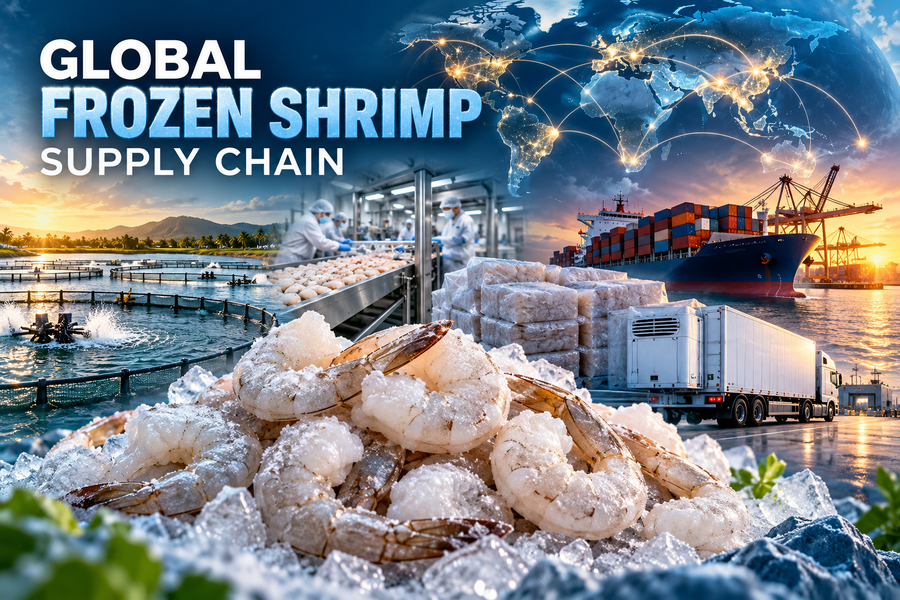
The frozen shrimp supply chain connects hatcheries or fishing grounds with farms, processors, cold stores, reefer transport, importers and final buyers. Shrimp quality depends on much more than freezing: rapid chilling after harvest, correct processing, stable frozen temperatures, traceable lots, accurate documentation and controlled handoffs all matter. For importers, the safest supply chain is one where product specifications and custody records remain clear from origin to destination.
| Supply-chain stage | What happens | Main control point |
|---|---|---|
| Source | Farmed shrimp begins with broodstock, hatcheries and grow-out farms; wild shrimp begins with fishing vessels and landing sites | Origin, species and source identification |
| Harvest | Shrimp is removed from ponds or landed from vessels | Rapid handling and chilling |
| Processing | Shrimp is washed, graded, processed and prepared for freezing | Hygiene, workmanship and specification control |
| Freezing | Product is frozen as IQF, block frozen or another approved format | Fast freezing and correct core temperature |
| Packing | Glaze, inner packs, labels and master cartons are applied | Net content, lot coding and pack integrity |
| Cold storage | Finished cartons are held before shipment | Stable frozen conditions |
| Export logistics | Product moves by refrigerated truck and reefer container | Continuous cold chain and shipment records |
| Import | Authorities and buyers verify documents and may inspect or test product | Compliance and identity checks |
| Distribution | Importers redistribute to wholesalers, retailers, foodservice or manufacturers | Frozen storage and stock rotation |
| Buyer verification | Shipment is checked against the approved specification | Traceability, quality and documentation match |
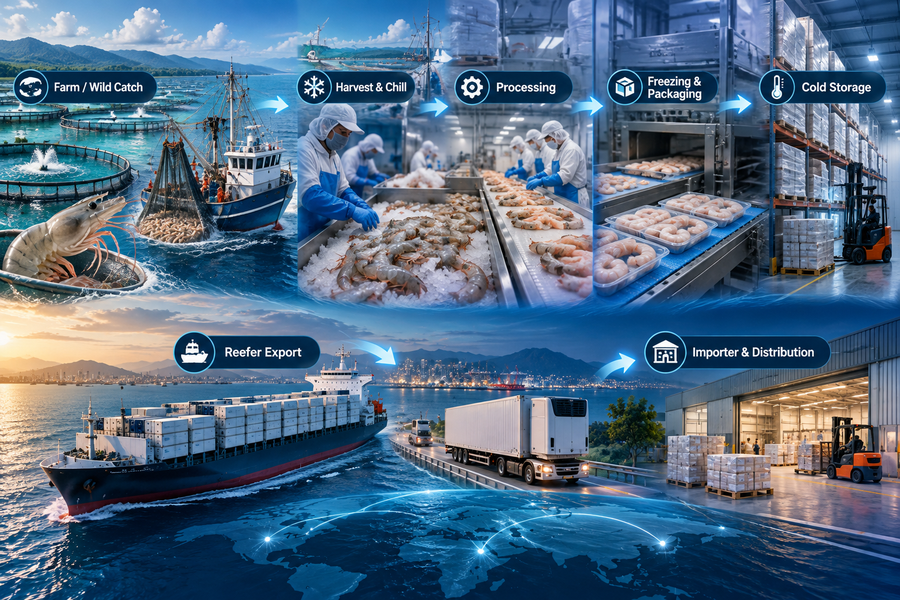
Frozen Shrimp Supply Chain: The Complete Farm-to-Market Flow
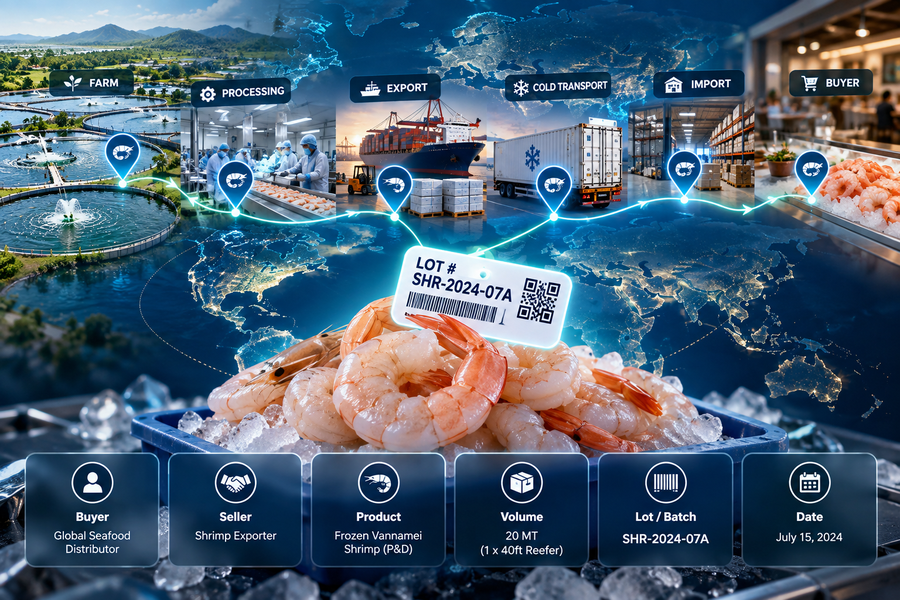
A frozen shrimp supply chain is both a physical flow and an information flow. The physical product moves from farm or fishing vessel to processor, freezer, cold store, port, vessel, importer and distributor. At the same time, information should move with it: species, production origin, lot number, product form, count size, packing date, net content, certificates and shipment documents. When one side of that system fails, buyers may receive shrimp that is physically acceptable but difficult to verify, or well-documented shrimp that has suffered poor handling.
Most internationally traded warmwater shrimp comes from aquaculture. A 2026 review in npj Science of Food reports that farmed shrimp accounts for about 70% of the global shrimp market and that Pacific whiteleg shrimp and Black Tiger shrimp together represent about 80% of shrimp aquaculture output. Farmed and wild-caught shrimp therefore enter the chain differently, but both eventually depend on the same downstream controls: prompt chilling, hygienic processing, freezing, frozen storage and traceable distribution.
International trade adds more handoffs. FAO’s latest GLOBEFISH shrimp analysis describes a market where major producing regions in Asia and Latin America supply large import markets around the world. Every extra transfer between farmer, collector, processor, freight handler, exporter, importer and distributor creates another point where identity, temperature or documentation can be lost. Strong frozen seafood supply chains are designed to make those handoffs visible rather than assuming freezing alone protects the product.
Stage 1: Hatcheries, Shrimp Farms and Wild-Capture Sources
The upstream end of the chain determines much of what processors can deliver later. Consistent frozen shrimp starts with controlled biological inputs, reliable harvest planning and clear origin records.
Hatcheries, Broodstock and Post-Larvae
Farmed shrimp production begins with broodstock and hatcheries that produce larvae and post-larvae for grow-out farms. Hatchery health, biosecurity and the quality of post-larvae can influence survival, disease risk and harvest consistency. Farms sourcing stronger post-larvae are better positioned to plan stocking cycles and deliver predictable quantities to processors.
For a buyer, this stage may seem far removed from a frozen carton, but it matters for traceability. A robust farmed shrimp supply chain should be able to connect a finished lot back to the production source rather than starting its record only at the processing plant.
Grow-Out Farms and Vannamei Production
At the grow-out stage, farms manage stocking density, feed, aeration, water quality, health monitoring and harvest timing. Pacific whiteleg shrimp, commonly called Vannamei, is widely used in commercial aquaculture because it suits standardized production systems and can be supplied in a wide range of commercial sizes and processing forms.
Buyers looking specifically for this species can review Iran Fish’s Vannamei shrimp product page and its broader frozen shrimp supply options. For procurement purposes, species should be written into the specification with the scientific name where required, rather than relying only on a common trade name.
Wild-Caught Shrimp Supply
Wild shrimp enters through fishing vessels, landing sites and seasonal fisheries instead of hatcheries and ponds. Because harvest timing and fishing conditions vary, wild supply may be more seasonal and heterogeneous by species, size and appearance. The critical early-stage requirement is rapid handling after capture. Shrimp that remains warm too long can lose quality before a processor has any opportunity to freeze it.
The origin record for wild shrimp therefore looks different from that of farmed shrimp. Vessel, fishing area, landing point and lot identity may replace farm and pond information, depending on the fishery and destination requirements.
Farmers, Collectors, Brokers and Aggregators
Small farms do not always sell directly to a processor. Collectors, brokers or local traders may combine harvests, arrange transport or perform preliminary sorting. These intermediaries can make supply more efficient, but they can also make traceability harder if individual farm lots are mixed without disciplined recordkeeping.
The issue is not the existence of intermediaries. It is whether custody, origin and lot identity remain documented as the shrimp changes hands. This is why modern shrimp supply chain transparency depends on transaction records as well as physical labels.
Stage 2: Harvesting, Rapid Chilling and Transport to the Processing Plant
The period between harvest and processing is one of the most sensitive parts of the chain. A freezer cannot reverse deterioration that occurred because harvested shrimp was handled slowly or held too warm.
- Harvest at the planned commercial size and move shrimp out of ponds or from vessels efficiently.
- Remove obvious debris and handle the product in a way that limits physical damage.
- Chill shrimp promptly using an appropriate ice or chilled-water system.
- Assign or preserve a lot identity that connects the harvest to its origin.
- Keep separate lots separate when the buyer or certification program requires it.
- Move product in insulated or refrigerated transport suitable for the journey.
- Record receiving time, condition and temperature at the processing plant.
- Reject, segregate or investigate material that does not meet the agreed raw-material specification.
This is also where the farm-to-factory cold chain begins. The product is not yet frozen, so time and temperature control are especially important. Good processors do not treat receiving as a formality; they use it as the first gate in the processing plant’s quality system.
Stage 3: Processing, Grading, Freezing and Export Packaging
Once shrimp reaches the plant, the supply chain becomes more specification-driven. The processor turns variable raw material into a standardized export product that must match the buyer’s agreed form, size, freezing method and pack.
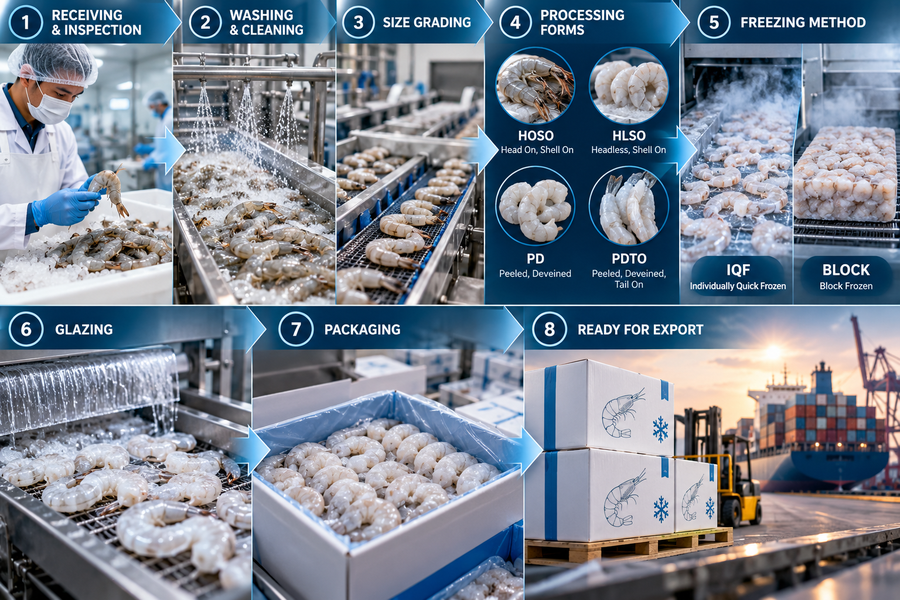
Receiving and Raw-Material Inspection
Receiving checks may include lot identity, physical condition, odour, appearance, temperature and conformity with the processor’s approved raw-material criteria. The purpose is to prevent unsuitable material from entering the production line and to preserve traceability before lots are divided into multiple finished products.
A buyer comparing suppliers should ask how incoming lots are identified and how finished cartons are linked back to them. This is more useful than a general claim that the facility has “quality control.”
Washing, Sorting and Commercial Size Grading
Shrimp is washed, sorted and graded according to the product specification. Commercial shrimp sizes are normally expressed as a count range per stated unit of weight. A lower count generally means a larger shrimp when the product form and count unit are the same.
Because head-on, headless and peeled products retain different amounts of the original shrimp, counts are not safely interchangeable across forms. Iran Fish’s Vannamei shrimp size guide explains why the count unit, product form and deglazed basis should be stated together.
HOSO, HLSO, PD, PDTO and Other Processing Forms
Processors may sell the same species in several forms depending on the destination market.
| Form | Meaning | What the buyer should define |
|---|---|---|
| HOSO | Head-on, shell-on | Count unit, appearance, head condition and freezing format |
| HLSO | Headless, shell-on | Count, shell condition, glaze and net content |
| PUD | Peeled, undeveined | Peel quality, vein status and size |
| PD | Peeled and deveined | Deveining workmanship, tail status and count |
| PDTO | Peeled, deveined, tail-on | Tail condition, cut depth, count and presentation |
| Cooked/value-added | Further processed product | Cooking level, ingredients, pack format and destination rules |
The safest purchase order spells out the full description instead of assuming abbreviations mean exactly the same thing to every supplier.
IQF vs Block Freezing
Individually quick frozen shrimp is frozen as separate pieces so the user can remove portions without thawing an entire block. Block-frozen shrimp is arranged and frozen into a solid unit, often with water or protective ice around the product. Neither format is automatically superior for every application.
IQF is useful where portion flexibility and free-flowing pieces matter. Block freezing can suit bulk processing and certain wholesale programs. Buyers can compare the practical differences in Iran Fish’s guide to IQF vs block frozen shrimp.
The current Codex Standard for Quick-Frozen Shrimps or Prawns, CXS 92-1981, amended in 2024 and republished in 2026, states that the quick-freezing process is not complete until the product has reached -18°C or colder at the thermal centre after thermal stabilization. It also requires the product to remain deep frozen during transport, storage and distribution.
Glazing, Net Weight and Moisture Protection
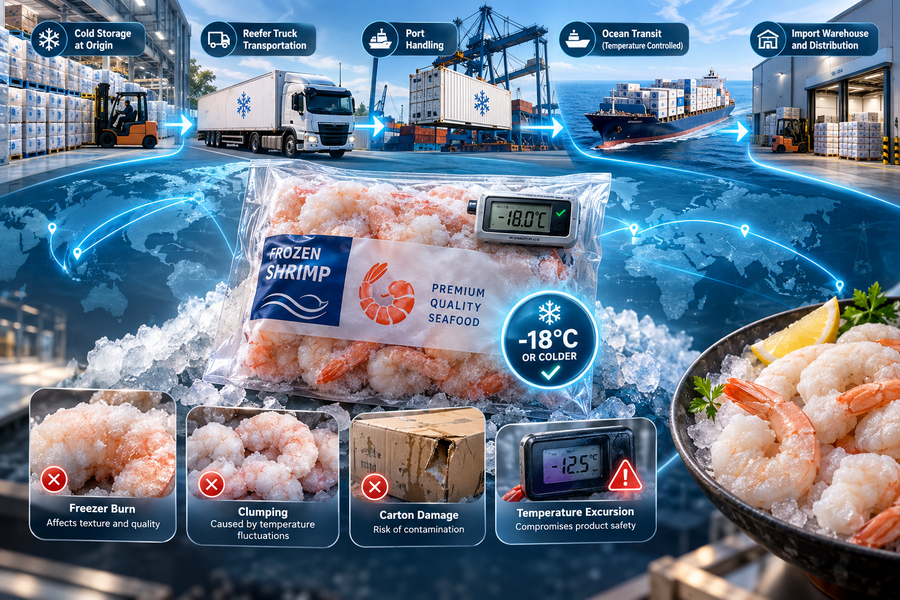
Glaze is a controlled layer of ice that helps protect frozen shrimp from dehydration and oxidation. It is not the same thing as loose frost or uncontrolled ice inside damaged packaging. Excessive frost, clumping or irregular ice can be a warning that the product has experienced moisture migration or temperature fluctuation.
Codex also distinguishes glaze from net contents: for glazed shrimp, declared net contents exclude the glaze. When a count is declared, Codex determines it using the actual deglazed weight. Those details are commercially important because buyers are purchasing shrimp, not protective water.
Inner Packs, Master Cartons and Private-Label Packaging
After freezing and glazing where applicable, shrimp is packed into inner bags, retail packs, foodservice packs or blocks, then placed in master cartons. Labels should make the product identifiable without opening every box. Depending on the market, the pack may show species or product name, processing form, count, net weight, lot code, storage instructions, origin and other legally required information.
Strong export packaging also protects the product mechanically. A technically correct frozen lot can still arrive in poor condition if cartons collapse, seals fail or inner bags are punctured during handling.
Stage 4: Cold Storage and Reefer Logistics in the Frozen Shrimp Supply Chain
Freezing is not a one-time event; it begins a temperature-controlled phase that continues until the product is thawed for use. Codex states that quick-frozen shrimp should be stored at -18°C or colder. The practical objective is not simply to make the shrimp hard, but to keep its temperature stable enough to limit dehydration, oxidation, texture damage and other quality changes.
Finished cartons normally move from the processing plant into frozen storage, then into refrigerated transport and eventually a reefer container for international shipment. Every loading operation is a handoff. Doors are opened, pallets are moved and product may pass between rooms, trucks, terminals and containers. Good logistics planning reduces unnecessary exposure and confirms that the reefer is operating correctly before and during transport.
Temperature history matters because repeated warming and re-cooling can affect product quality even if the shipment is frozen when inspected later. Research on frozen shrimp cold chains has repeatedly linked temperature fluctuation with faster quality loss. Buyers should therefore distinguish between a single temperature reading at delivery and evidence that the cold chain was controlled throughout the journey.
| Cold-chain checkpoint | What to verify | Warning signs |
|---|---|---|
| Processor freezer | Product reaches required frozen condition | Slow freeze, incomplete freezing |
| Frozen warehouse | Stable storage and organized lots | Heavy frost, damaged cartons, poor stock control |
| Truck loading | Short, controlled transfer | Long dock exposure, warm loading area |
| Reefer container | Pre-trip condition and correct set-up | Unverified unit, blocked airflow |
| Port terminal | Refrigerated power maintained | Extended unplugged period |
| Ocean transit | Reefer performance and shipment records | Temperature alarms or unexplained gaps |
| Import warehouse | Frozen receiving inspection | Soft cartons, clumping, moisture damage |
For practical receiving checks, Iran Fish’s guide to frozen shrimp quality covers packaging condition, frost, clumping, appearance and post-thaw observations that can help buyers identify possible handling problems.
Stage 5: Export, Import Inspection, Warehousing and Final Distribution
Once a shipment leaves the processor, the product enters a regulatory and logistics chain as well as a temperature chain. Export documents, customs information and import requirements must match the physical cargo.
Export Clearance and Port Handling
Before departure, exporters prepare the commercial and regulatory documents required for the destination and the agreed transaction. Depending on the country and product, these may include health certification, origin documentation, packing information, invoice details and other shipment records.
At the same time, the physical cargo must remain frozen while customs and terminal procedures are completed. Administrative delay should never become an excuse for leaving seafood outside controlled conditions.
Ocean Freight and Transit
Frozen shrimp commonly moves internationally in reefer containers. The container does not improve poor product; its role is to maintain the required environment for already frozen cargo. Correct loading, airflow, container condition, temperature settings and monitoring are therefore part of the product specification in practice, even when they are managed by a logistics provider rather than the seafood processor.
Import Inspection and Border Controls
Destination authorities may review documentation, verify identity and select consignments for inspection or testing. Requirements vary by jurisdiction. In the United States, for example, the NOAA Seafood Import Monitoring Program applies traceability and recordkeeping requirements to shrimp from the point of harvest to entry into U.S. commerce.
Importers should confirm destination rules before the order is packed, not after the container arrives. Corrective changes are far easier at specification stage than at the border.
Importer and Distributor Warehousing
After customs release, shrimp generally moves to a frozen warehouse operated by the importer, distributor, retailer or food manufacturer. Lot identity should remain intact through storage, picking and redistribution so that a specific batch can be traced if a quality issue or recall occurs.
Retail, Foodservice and Food-Manufacturing Channels
The final B2B customer may be a supermarket, restaurant distributor, hotel supplier, seafood wholesaler or food manufacturer. Their needs differ. A food processor may prioritize block-frozen raw material and predictable yield; a retailer may prioritize IQF pieces, branded packs and consumer-facing label compliance. The supply chain should therefore be built around the final product specification rather than treating all frozen shrimp as interchangeable.

Traceability, Certifications and Documents That Travel with Shrimp
Traceability is the information backbone of the shrimp export supply chain. It should allow a finished batch to be followed backward to its relevant source and forward through processing and shipment records.
- Species or product description
- Farm, pond, vessel or production origin where applicable
- Harvest, landing or production lot
- Seller and buyer identity at key transactions
- Processor identity
- Batch or lot number
- Quantity or volume
- Transaction or processing date
- Product form and size count
- Net weight and glaze declaration where relevant
- Packing date and storage instructions
- Health certificate where required
- Certificate of origin where required
- HACCP or other food-safety documentation applicable to the processor
- Buyer-requested certification records
- Export, customs and shipping documents
- Container or shipment reference that connects the cargo to its commercial documents
The Seafood Task Force Shrimp Traceability Code of Conduct provides a useful example of transaction-level traceability. Its six key data elements are buyer identification, seller identification, product description, volume, lot or batch number and transaction date. Its framework also traces farmed shrimp beyond the processor to farms, ponds and brokers, and then further upstream into feed-related supply chains.
Documentation requirements vary by destination, so no universal certificate list should be copied into every purchase order. The importer should define the destination market first, then confirm what the exporter and processing plant must provide. A trustworthy supplier should be able to explain which documents apply to the specific shipment instead of presenting a generic certificate bundle.
Where Quality Can Be Lost: Major Frozen Shrimp Supply Chain Risks
A supply chain can look strong on paper and still fail at one weak handoff. The most important risks are often concentrated where time, temperature, custody or specifications change.
Disease and Farm-Level Supply Disruption
Aquaculture is biological production, so disease and environmental stress can affect survival, harvest size and timing. Supply shortages may encourage processors to source from additional farms or regions. That is not necessarily a problem, but it makes approved-supplier controls and lot segregation more important.
Slow Chilling Before Processing
One of the most preventable risks occurs immediately after harvest. Delayed chilling can reduce freshness before freezing. Once the product reaches the plant, a fast freezer cannot restore the condition it had at harvest.
Processing and Specification Errors
Incorrect size grading, inconsistent peeling or deveining, physical damage, labeling errors and mismatched glaze or net-content specifications can turn otherwise sound shrimp into a commercial claim. Detailed specifications reduce ambiguity because the buyer and processor are judging the same measurable product.
Temperature Excursions in Storage or Transport
Temperature abuse can lead to dehydration, ice recrystallization, drip loss after thawing and changes in texture or appearance. Severe clumping in an IQF pack, heavy free ice or damaged cartons should trigger closer investigation, although visual signs alone cannot reconstruct the entire temperature history.
Traceability Gaps and Too Many Intermediaries
More intermediaries mean more chances for information to be separated from the product. A strong traceability system preserves lot identity when shrimp is aggregated, split, processed and repacked. If a processor cannot explain how a finished carton links to incoming material, the chain becomes difficult to audit.
Port, Container and International Logistics Disruptions
Port congestion, reefer malfunction, documentation errors and shipment rerouting can extend transit. The key question is not whether delays occur, but whether the system can maintain frozen conditions and preserve records when plans change. Supply-chain resilience depends on contingency procedures as much as normal operating procedures.
How Importers Should Evaluate a Frozen Shrimp Supplier and Supply Chain
Supplier evaluation should turn general quality promises into checkable requirements. The goal is to know what will be delivered, how it will be controlled and what evidence will accompany it.
- Confirm the exact species, scientific name where necessary and country or production origin.
- Define HOSO, HLSO, PUD, PD, PDTO or another processing form in full.
- State the size count and whether it is per pound, kilogram or package.
- Specify IQF, block frozen or another agreed freezing format.
- Define glaze, deglazing method and net-content basis.
- Review the processing plant’s food-safety controls and relevant approvals.
- Request lot-level traceability that connects finished cartons to source material.
- Confirm health, origin and other destination-market documentation before production.
- Approve inner packaging, master cartons, labels and private-label artwork where applicable.
- Define frozen-storage and transport requirements.
- Confirm reefer loading and shipment identification procedures.
- Compare the received shipment with the approved specification, documents and sample rather than judging only by brand or origin.
Iran Fish’s Vannamei shrimp buying guide for importers and distributors provides a useful companion checklist for product form, count, glaze, packaging, documents and shipment verification.
Frequently Asked Questions About the Global Frozen Shrimp Supply Chain
What are the main stages of the frozen shrimp supply chain?
The main stages are source production or capture, harvest, chilling, transport to the processor, processing and grading, freezing, packaging, frozen storage, export logistics, import clearance, frozen warehousing and final distribution. Traceability records and product specifications should move alongside the physical shrimp through all of these stages.
Why is the cold chain so important for frozen shrimp?
Freezing slows the reactions that damage seafood quality, but only if the frozen state is maintained. Codex requires quick-frozen shrimp to reach -18°C or colder at the thermal centre after thermal stabilization and to remain deep frozen during transport, storage and distribution. Stable temperature also helps limit dehydration, ice recrystallization and texture damage.
What happens to shrimp at a processing plant before freezing?
The plant typically receives and inspects the raw shrimp, washes it, sorts or grades it, and processes it into the required form such as HOSO, HLSO, peeled or deveined. The product may then be frozen individually or in blocks, glazed where applicable, packed, labelled, coded by lot and transferred to frozen storage.
How can importers verify frozen shrimp traceability?
Importers should request a lot or batch system that connects finished cartons to the processor and relevant source records. Transaction data should identify the product, parties, quantity, date and lot number. Depending on the market and program, traceability may extend to farms, ponds, vessels, brokers and even feed-related inputs.
What should buyers check before ordering frozen shrimp internationally?
Buyers should define species, product form, size count, count unit, freezing method, glaze, net weight, packaging, label requirements, quality tolerances, traceability and destination documents before confirming production. They should also agree on frozen transport requirements and a receiving inspection method so that the delivered cargo can be checked against the same specification used at origin.
Source Export-Ready Frozen Shrimp with Iran Fish
A dependable frozen shrimp supply chain begins with a clear specification and ends with a shipment that matches it. International buyers should be able to identify the species, form, size, freezing method, packaging, lot and supporting documents before the container leaves origin.
Iran Fish supplies frozen shrimp for international buyers, including farmed Vannamei and wild-caught options in multiple processing and freezing formats. Product requirements can be matched to wholesale, foodservice, retail or further-processing needs, with export packaging and shipment documentation prepared for the agreed destination.
If you are sourcing shrimp in bulk, send Iran Fish your required species, product form, size count, freezing method, packaging format and destination port. The trade team can review the specification and help organize an export-ready supply program around your buyer requirements.