


How to Identify High-Quality Frozen Salmon: Frozen Salmon Quality Checks


Good frozen salmon quality combines intact packaging, firm frozen flesh, minimal dehydration, colour appropriate to the species and a reliable cold chain. After controlled thawing, assess odour, flesh integrity and liquid loss. A glossy fillet or a “flash frozen” label cannot establish quality by itself. For commercial buying, compare representative samples with an agreed specification; assess food safety separately rather than treating appearance as proof.
| Quality check | What to look for | What needs closer attention |
|---|---|---|
| Packaging | Closed, undamaged packs and sound seals | Tears, leaking seals or exposed flesh |
| Frozen condition | Firm product with its intended shape | Soft areas, deformation or portions frozen into an unexpected mass |
| Surface protection | Even protective glaze where specified | Exposed dry patches or unexplained differences in ice coverage |
| Colour | Appearance consistent with the declared species and product | Unusual changes within comparable portions, especially alongside other defects |
| Flesh integrity | Cuts and portions that meet the specification | Deep damage, bruising, excessive separation or broken portions |
| Thawed sample | Acceptable odour and flesh that handles well | Rancid or sour odour, extensive gaping or unusually poor handling |
| Liquid loss | Comparable results under the same thawing procedure | Substantially different results between matched samples |
| Records | Matching batch identification, storage instructions and temperature records | Missing traceability, unexplained temperature excursions or conflicting labels |

Frozen Salmon Quality: What Good Product Should Deliver
A good fillet should suit the job you are buying it for. A distributor supplying individually packed portions needs consistent cuts and packaging. A processor may place greater emphasis on flesh integrity after thawing. Neither can judge a shipment from the most attractive fillet in a photograph. Set out the intended use before deciding which defects matter and how the product will be inspected.
Freezing preserves the condition of the fish entering the process; it does not turn poor raw material into excellent salmon. The University of Alaska Fairbanks explains in its guidance on freezing fish that initial quality, freezing conditions and protection during storage affect the result. Evaluate the finished product alongside evidence of how it was handled, rather than assuming the freezing method tells the whole story.
For repeat orders, write a short specification covering species, cut, portion range, skin and bone requirements, packaging, glaze where applicable and acceptable defects. Add a clear sample assessment procedure. “Premium” and “high quality” are useful descriptions only when both parties understand what they mean. A documented comparison gives you a better basis for acceptance than a general promise of excellent frozen salmon.
Fresh vs Frozen Salmon: Judge Handling, Not the Label
“Fresh” and “frozen” describe how a product is offered, not how well it was handled. Properly frozen salmon can be a sound choice, while a chilled fillet still needs careful assessment. Ask whether chilled fish was previously frozen and how it was handled after thawing. For a frozen order, establish the condition and identity of the actual lot rather than comparing a product photograph with a fresh counter display.
Assess the result you need after preparation. If the salmon will be portioned, its ability to hold a clean cut matters. If it will be supplied as a whole side, appearance and consistency across the fillet deserve attention. Freshness before freezing, protection in storage and the thawing procedure all contribute to that result. The most useful comparison is between products prepared under the same conditions.
Keep nutrition and sensory quality as separate questions too. A declared species or nutrition panel describes a different aspect of the product from a damaged seal or a dry edge. Do not use an appealing nutrition claim to excuse an observable defect. Decide whether the fish meets its intended use through inspection, specifications and supporting records.
Choose the Right Species, Cut and Sourcing Information
Know exactly which salmon product is being assessed before comparing quality. Species, processing format and origin should be clear enough to connect the sample with the order.
Identify species and production method
Ask for the species name, whether the fish is farmed or wild, its origin and the relevant production or processing dates. These details help you make like-for-like comparisons and plan stock rotation. A wild or farmed label is not an inspection result, and harvest season is not a substitute for the actual batch history.
Match the cut to the application
Fillets, whole sides, steaks and smaller portions have different shapes and handling requirements. Specify skin, pin bones, trim and size consistency instead of using one visual standard for every cut. Check the thin edges as well as the thick centre; a product should meet the ordered format across the sample, not only in its most attractive section.
Verify responsible sourcing separately
When responsible sourcing is part of the order, request verifiable evidence relevant to the product and supply chain. For example, the ASC salmon standards address aquaculture requirements. A sourcing certificate and a quality inspection serve different purposes: verify the claim, then inspect packaging, condition and sample performance independently.
Check Frozen Packaging, Seals and Ice
Begin with the unopened product, before opening samples or allowing them to thaw. Examine both the outer carton and the primary pack because each reveals a different part of the handling history.
Look at the seal, not just the bag
Check seal lines, corners and areas where bones or sharp edges could damage the film. On a vacuum pack, an unexpected loss of tightness deserves investigation, but pack appearance must be judged against its actual packaging design. Not every salmon product is vacuum packed.
Photograph defects before opening the pack. Record whether the problem affects one portion, one carton or products from several positions in the shipment. This makes follow-up more useful than an isolated complaint that “the packaging looked bad.”
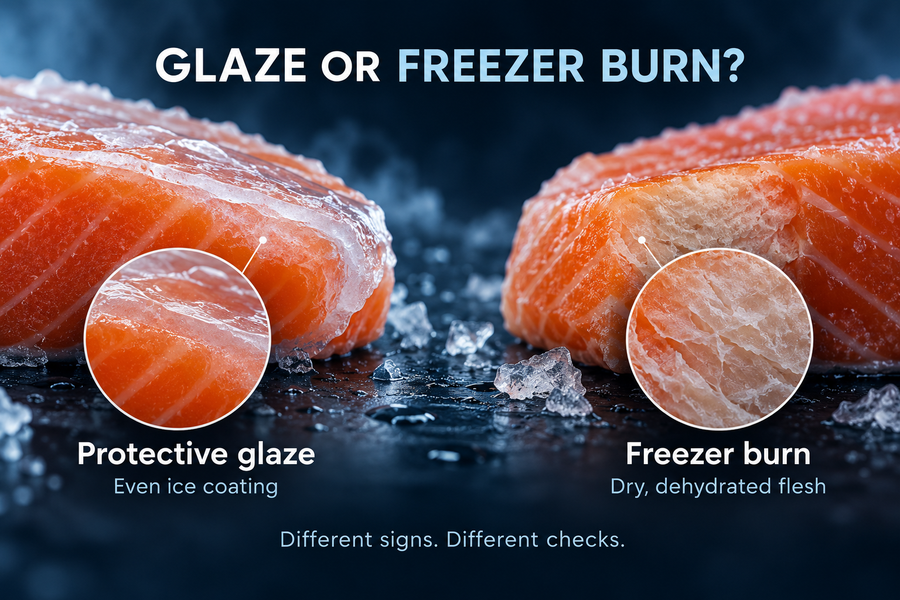
Distinguish surface glaze from loose frost
A smooth ice coating on a glazed fillet serves a different purpose from loose snow-like ice inside a bag. Check whether the coating matches the specification and protects the flesh evenly. Record heavy loose frost or large ice accumulations as reasons to investigate storage and handling, not as proof of a particular event.
NOAA’s seafood buying guidance identifies damaged packs, drying and undesirable frost or loose ice as warning signs when selecting frozen seafood. These are screening clues; temperature records and sample results help explain their significance.
Check the product’s original form
An individual portion should retain the form intended by the processor. Unexpected clumping, crushed edges or distorted fillets should be compared with the declared freezing format. A block-frozen product naturally looks different from individually frozen portions, so do not reject a legitimate block merely because it is not loose in the carton.
Read Salmon Colour Without Misjudging the Species
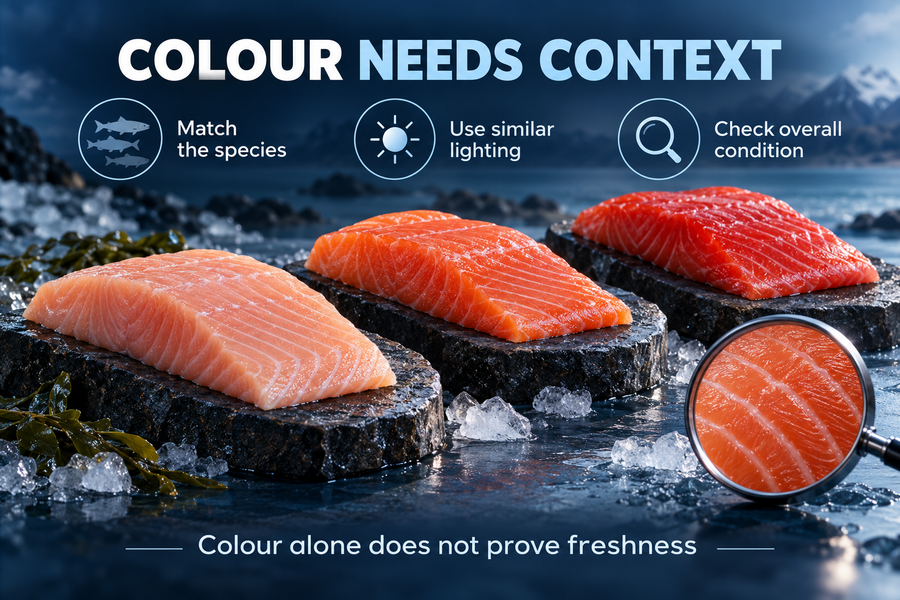
Choose a colour reference that matches the fish. A photograph of a strongly coloured sockeye fillet is a poor standard for another species. The Alaska Seafood Marketing Institute’s salmon quality specifications describe natural colour variation associated with species and harvest conditions. Their grading scheme applies to its specified products; it is not a universal grading system for all salmon.
Judge comparable portions under similar lighting, after accounting for ice, film and the frozen surface. Look for unusual patches or changes that occur with dryness, damaged flesh or off-odour. A single pale area calls for context, not an automatic conclusion that the salmon is spoiled. Skin, normal fat lines and different parts of a fillet can also change what a buyer sees.
Colour is most useful as one part of an assessment. The FDA notes in its seafood selection guidance that colour alone does not establish freshness. Consistent photography can help document a comparison, but it cannot replace inspection. If you use an approved reference sample, agree how it will be photographed and assessed so that different lighting does not become a product dispute.
Spot Freezer Burn, Oxidation and Physical Damage
Inspect exposed edges and thin sections as carefully as the middle of the fillet. Group defects by what you observe, then investigate their likely causes instead of assigning a diagnosis from one photograph.
Freezer burn and dehydration
Dry, rough or discoloured areas can indicate dehydration during frozen storage. Check how deeply the affected area extends and whether it interferes with the intended portion or presentation. Record its location and extent rather than simply writing “white marks.”
The FDA distinguishes freezer burn from a food safety problem in its food storage advice. That distinction does not make a badly dehydrated product commercially acceptable. A quality defect can still justify rejection against an agreed specification, even when it does not itself establish that the food is unsafe.
Oxidation and off-odour
Fat quality deserves attention as well as appearance. Evaluate odour after controlled thawing, without adding seasoning that might disguise a problem. Keep observations specific: the smell is rancid, sour, unusual or consistent with the reference product. Do not try to resolve an off-odour by washing the fish.
Ask whether comparable samples show the same defect. An isolated damaged pack and a recurring issue across a batch require different investigations. Preserve the link between each observation, sample and batch so that the supplier can assess the evidence.
Bruising, cuts and broken portions
Inspect the flesh for damage that changes its usable shape or presentation. Include belly edges, the underside and the skin where supplied. A small trim difference and a deeply damaged fillet are different defects; keep separate descriptions for them.
For skin-on or boneless orders, check those requirements directly. A product can look attractive while still failing the agreed trim or pin-bone specification. Your assessment should therefore include both its condition and its conformity to the order.
Glaze, IQF and “Flash Frozen”: What the Claims Mean
These terms describe aspects of protection or processing, not a complete quality result. Ask what each claim means for the product being offered and verify the result in the sample.
Protective glaze
FAO’s guidance on frozen fish handling explains that glazing helps protect fish against dehydration and oxidation. Even coverage matters; an attractive ice shell should not distract from exposed patches underneath or damaged flesh.
Separate the fish from its protective ice when assessing declared net quantity. The Codex standard for quick-frozen fish fillets specifies that net contents for glazed products exclude the glaze. For a commercial check, use the applicable method rather than weighing an ice-covered portion and calling the result fish weight.
Individually quick frozen salmon
IQF means individually quick frozen. The format should suit buyers who need separate pieces, but the label does not confirm acceptable texture, seal integrity or storage history. Check that portions separate as intended and match the declared cut.
Do not interpret all sticking as evidence of thawing. First establish whether the product was meant to be individually frozen or supplied as a block, then assess the actual condition and records.
Flash frozen and frozen at sea
Ask for a practical description of the process rather than relying on the phrase alone. Where and when was the fish frozen? What product form entered the freezer, and how was it protected afterwards?
These questions support traceability and explain the product. The final decision still depends on what the sample delivers. A persuasive processing claim cannot override torn packaging, unacceptable thawed texture or an unresolved temperature excursion.
Assess Thawed Salmon Texture, Odour and Drip Loss
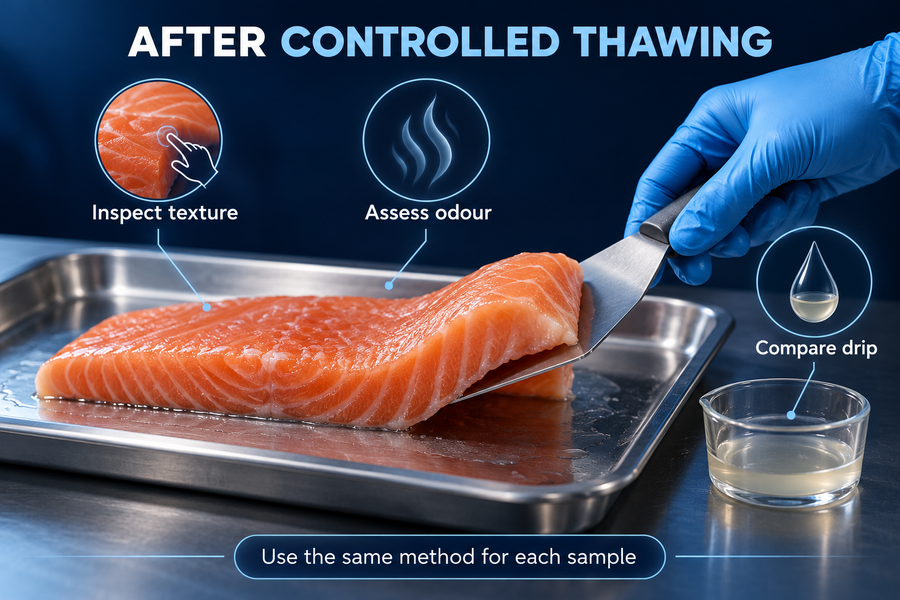
Frozen inspection reveals only part of the picture. Thaw a representative sample under a repeatable procedure so that differences in preparation do not distort the comparison.
Use a consistent, safe thawing procedure
Keep each sample identified and collect liquid separately from the flesh. Use the same procedure for comparable cuts, including the endpoint for assessment. Avoid thawing one sample on a counter and another under refrigeration, then attributing every difference to the supplier.
For frozen fish in reduced-oxygen packaging labelled to remain frozen until use, remove it from that environment before refrigerator thawing. This handling requirement is described in the FDA Food Code’s thawing provisions. Place the fish in a clean, covered container and follow the applicable food safety procedure. Commercial validated processes require their own controls; improvised thawing should not replace them.
Examine flesh integrity and handling
Observe whether the portion stays together when lifted and whether separation between muscle segments affects use. Gaping describes those separations. Record the size and distribution of the gaps, especially if they interfere with slicing, portioning or presentation.
Distinguish naturally tender fish from flesh that falls apart during normal handling. Compare like cuts rather than expecting a thin belly section and a thick centre portion to behave identically. A cook test, where appropriate, can show whether the product meets its intended use, but it does not establish microbiological safety.
Interpret drip loss in context
Liquid after thawing is not automatically a defect. Document how much is collected using a defined method and compare matched samples. State whether glaze was removed before measurement; otherwise, melted protective ice can distort an assessment of liquid released from the flesh.
Research on freezing and thawing processes in Atlantic salmon examined changes in texture, colour and drip loss under different treatments. It supports assessing these features together, rather than treating one observation as a complete diagnosis. There is no universal acceptance percentage established by that study for every commercial salmon product.
Evaluate odour without tasting raw fish
Assess the sample before seasoning or cooking. Sour, rancid or ammonia-like odours are reasons to stop and investigate; the FDA’s advice on selecting and serving seafood describes unacceptable seafood odours. Never taste raw salmon to decide whether a questionable sample is safe.
| Thawed sample observation | Useful follow-up |
|---|---|
| Flesh separates during ordinary handling | Compare matched cuts and record the extent of gaping |
| Much more liquid than the reference sample | Repeat the defined procedure and separate glaze water from flesh drip |
| Dry surface remains after thawing | Document depth, location and effect on intended use |
| Unacceptable odour | Stop the assessment for consumption and escalate the finding |
| Product handles consistently | Continue checking specification and records; this alone does not establish safety |
Verify Temperature History and Preserve Quality
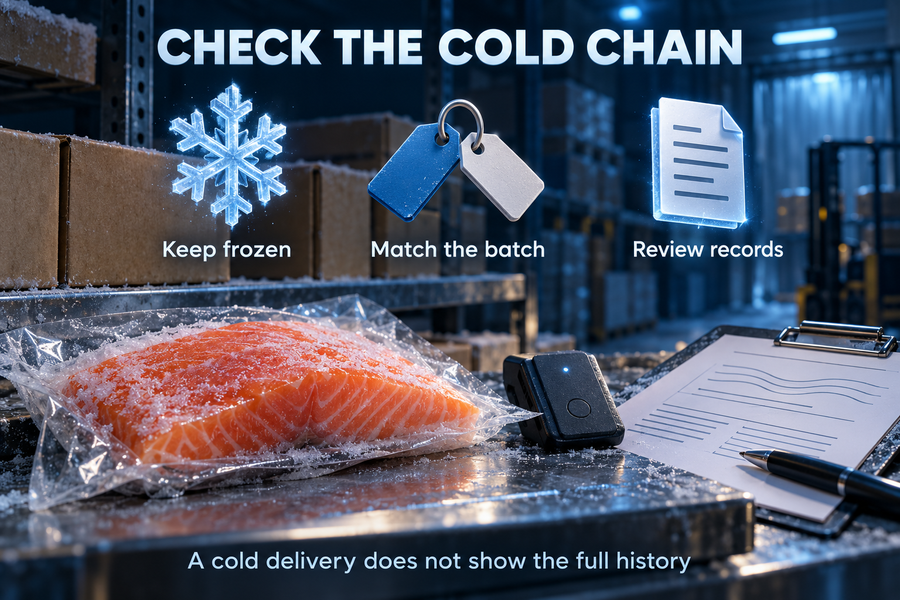
A cold product at delivery does not explain every earlier stage of its journey. Combine receiving measurements with the available temperature history and the supplier’s storage instructions.
- Use a defined temperature measurement procedure and calibrated equipment. Record where and how the measurement was taken; do not treat an outer-carton reading as the temperature throughout the fish.
- Keep frozen product under the specified conditions. The Codex quick-frozen fillet standard uses −18°C or colder as its frozen storage and distribution benchmark.
- Investigate unexplained excursions rather than assuming that returning a shipment to a freezer restores its previous quality or resolves safety concerns.
- Keep packs protected during handling and avoid leaving inspection samples out while completing paperwork.
- Follow the product’s stated shelf life and storage instructions. Do not apply one generic number of months to every species, packaging format and storage history.
- Connect photos and measurements to the batch, delivery and sample position. Records become useful when they can be matched to the actual product.
If you are evaluating a supplier as well as a shipment, use our frozen salmon buying guide to develop the broader procurement specification. Quality inspection works best when the acceptance criteria were agreed before dispatch.
A Practical Frozen Salmon Inspection Checklist
Use this as a working sequence for inspection, adapting sampling and acceptance limits to the product and applicable requirements. Decide who can release, hold or reject a batch before a disagreement occurs.
- Confirm identity: match the species, cut, batch, packaging and storage instructions to the order.
- Select representative samples: include different carton positions rather than letting a promotional sample represent the entire shipment.
- Inspect while frozen: document seals, surface protection, dehydration, shape and physical damage.
- Check the cold chain: review receiving measurements and relevant temperature records.
- Assess thawed samples: use the agreed procedure for odour, flesh integrity, handling and liquid loss.
- Compare against the specification: describe each deviation and its effect on intended use.
- Record the decision: retain photos, observations and the reason for acceptance, hold or rejection.
| Finding | Inspection response |
|---|---|
| Product, sample results and required records meet the specification | Accept through the authorised release process |
| Isolated quality deviation with a clear batch identity | Hold affected product while checking extent and agreed tolerances |
| Missing temperature history after a reported handling problem | Hold pending the appropriate quality and food safety assessment |
| Recurring damaged packs or unacceptable thawed samples | Document the affected lot and escalate for rejection or corrective action |
| Product looks good but identity or traceability is inconsistent | Resolve the discrepancy before release |
An agreed photographic record helps make these decisions repeatable. Show the pack before opening, the defect in context and the sample identification. Where the problem is visible only after thawing, document that stage separately. A clear account of what was observed is more persuasive than calling the whole shipment “bad fish.”
Frozen Salmon Quality vs Food Safety
Quality inspection asks whether the product has the condition, consistency and performance required for its intended use. Food safety assessment asks whether hazards have been controlled. These overlap in handling, but they are not interchangeable. A portion with an attractive colour and acceptable texture still needs the required safety controls and traceability.
Raw consumption makes that distinction particularly important. Do not approve salmon for sushi or other raw dishes because it looks clean, has been frozen or carries a marketing description. The FDA’s seafood hazard guidance explains parasite-control considerations and relevant exceptions. Suitability must be established for the specific product and process, alongside other applicable hazards.
Likewise, do not use cooking as a way to clear an unresolved handling or safety concern. Keep suspect product separate and involve the responsible food safety professional. A useful inspection report states what was checked, what remains unresolved and who authorised the decision. It does not turn a visual assessment into a guarantee that the fish is safe.
Frozen Salmon Quality FAQs
The following questions address common uncertainties when inspecting frozen salmon. Use the answers alongside product-specific instructions and your agreed acceptance criteria.
Is a darker salmon fillet always better quality?
No. Species and harvest conditions affect natural colour. Compare like products and judge colour alongside condition, packaging and sample performance rather than treating a darker shade as a quality grade.
Do ice crystals mean the salmon was thawed and refrozen?
They can justify investigating handling, but they do not identify one event with certainty. Distinguish protective glaze from loose frost, then review the product’s condition and temperature history.
Does freezer burn mean salmon is unsafe?
Freezer burn is a quality issue rather than proof of a safety hazard. It can still make salmon unsuitable for the agreed use. Assess food safety separately, particularly when its handling history is uncertain.
How should vacuum-packed salmon be thawed for inspection?
For reduced-oxygen packs labelled to stay frozen until use, remove the fish from that environment before refrigerator thawing. Keep it protected in a clean container and use a controlled procedure that preserves sample identity.
Is excess liquid after thawing a reason to reject salmon?
It is a reason to examine the result, not an automatic rejection rule. Compare matched samples using the same method, account for melted glaze and apply the agreed specification rather than an invented universal limit.
Request Product Specifications from Iran Fish
Tell us what you need to assess: the species, cut, packaging, intended use and delivery requirements. A precise enquiry helps establish which product information and sample checks are relevant before an order proceeds.
If you are considering trout products, explore our salmon trout range and identify the required product clearly. Salmon trout is a different product from Atlantic salmon, so keep the species explicit in your enquiry and specification.
Contact Iran Fish about your sourcing requirements to request product details and discuss the information needed for your assessment. Agree the quality criteria first, then use the same checks when evaluating samples and deliveries.