


Fresh vs Frozen Salmon: Which Offers Better Quality?

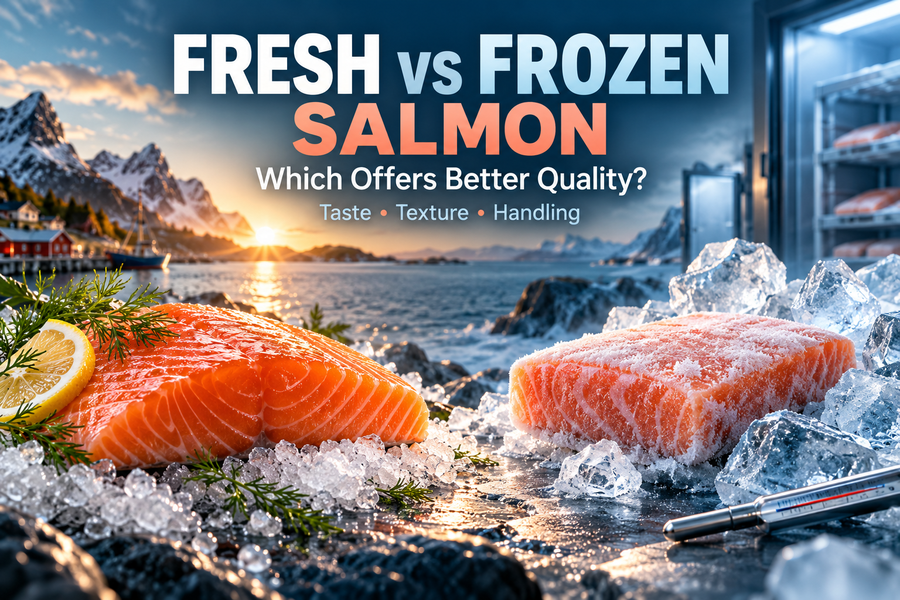
Fresh vs frozen salmon is a comparison of handling histories, not a guaranteed quality ranking. Recently harvested, carefully chilled salmon can be excellent; promptly frozen salmon with an intact cold chain can outperform fish that has spent longer on a chilled display. Compare the same species and cut, check packaging and dates, and thaw correctly. Choose chilled salmon for prompt use when its history is clear, or frozen portions when you need controlled storage and flexibility.
| Quality question | Fresh or chilled salmon | Frozen salmon | What to choose |
|---|---|---|---|
| Is the label enough? | Chilled display does not prove never-frozen status | Frozen status does not prove prompt freezing | Ask for the handling history |
| Best eating quality | Can be excellent with recent harvest and careful chilling | Can be excellent with suitable freezing, storage and thawing | Compare matched samples |
| Taste and texture | Depend on species, condition and preparation | Depend on the same factors plus frozen-storage history | Match species, cut and cooking method |
| Nutrition | Supplies protein and marine omega-3 | Remains a useful source of protein and marine omega-3 | Compare the actual product declaration |
| Main quality risks | Aging, dehydration and poor temperature control | Dehydration, oxidation and temperature fluctuations | Inspect condition and records |
| Packaging | Clean protection and appropriate chilling matter | Intact moisture and oxygen barriers matter | Reject damaged or unsuitable packs |
| Convenience | Ready for preparation without thawing if already chilled | Portions can remain frozen until needed | Match your preparation schedule |
| Raw use | Requires appropriate safety controls | Ordinary freezing alone does not establish raw-use suitability | Obtain documented suitability |
| Commercial supply | Requires dependable deliveries and rapid stock turnover | Supports planned inventory with suitable frozen storage | Specify receiving and storage conditions |
| Sustainability | Depends on source, distribution and waste | Depends on those factors plus freezing and storage | Assess the actual supply chain |

Fresh vs Frozen Salmon: What Determines Quality?
The word “fresh” can describe a display condition without telling you when the fish was harvested. Start by identifying what the seller actually means and how the salmon reached that condition.
Never-frozen, previously frozen and still frozen
Never-frozen salmon has remained unfrozen through its handling history. Previously frozen salmon has been thawed before sale, while a frozen portion is supplied for storage or preparation in that state. None of these descriptions, by itself, reports the product’s age, temperature exposure or eating quality.
For chilled counter fish, ask whether it was previously frozen and when it was thawed. For frozen salmon, ask about processing, freezing and storage. A recently packed product can still contain fish harvested or frozen earlier; the packing date is only one part of its history.
Quality and safety are different questions
Quality concerns flavor, texture, moisture and appearance. Safety depends on hazards and controls that cannot always be seen or smelled. A fillet can lose some moisture without becoming unsafe, while a pleasant-looking fillet can have an unacceptable handling history.
Assess both. Sensory checks help with product selection, but they cannot clear a shipment after an unexplained temperature excursion or prove that salmon is suitable for raw consumption.
What Rapid Freezing Can Preserve
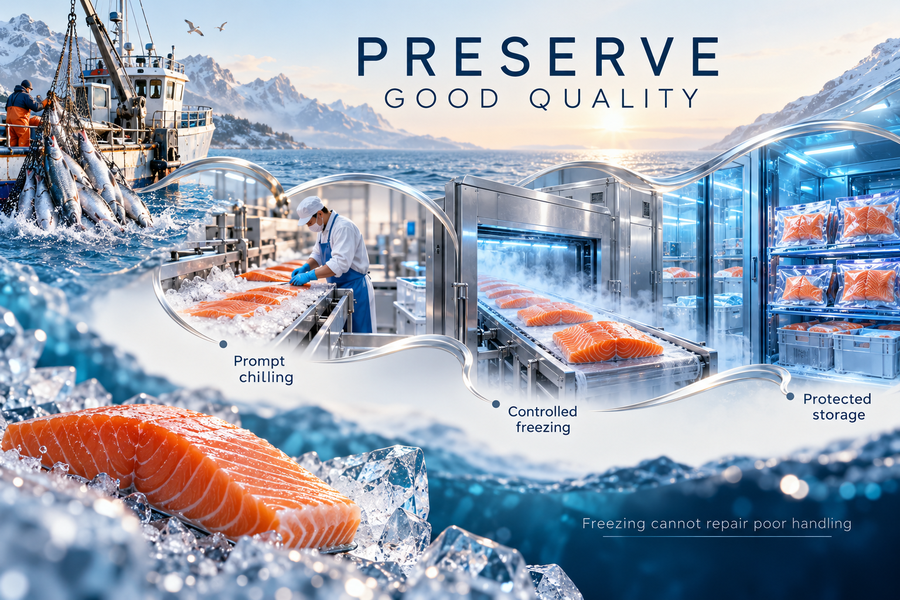
Freezing is most useful when it preserves fish that was already in good condition. It cannot reverse deterioration that happened before the freezer.
Freezing rate and the starting material
Rapid freezing generally helps preserve fish quality better than slow freezing. Ice formation matters, but changes in muscle proteins also affect moisture retention; the explanation is more complex than “small crystals cause no damage.” FAO’s explanation of fish freezing describes these mechanisms and the importance of pre-freezing quality.
Prompt chilling, hygienic processing and a controlled freezing operation work together. A frozen fillet made from deteriorated raw material remains a poor-quality product even when the packaging looks convincing.
Flash freezing, blast freezing and IQF
“Flash frozen” is a description to investigate, rather than a complete product specification. Blast freezing uses cold moving air; other systems use contact surfaces or cryogenic media. IQF means individually quick frozen, allowing separate portions to be taken from storage without thawing a whole block.
FAO’s fish-freezing equipment guidance distinguishes processing methods. For procurement, confirm the actual process and portion format instead of assuming that different marketing terms describe identical treatment.
Frozen at sea versus frozen on land
Freezing at sea can shorten the interval between capture and preservation. Land-based processors can also produce excellent frozen salmon when chilling, transport and processing are well controlled.
The location of the freezer is useful context, not a substitute for evidence. Ask how the fish was handled before freezing and how its frozen condition was maintained afterward.
Taste, Texture and Nutrition: Compare Like with Like
A fair tasting compares the same fish in comparable portions. Switching from a rich Atlantic portion to a leaner sockeye fillet changes more than the fresh-versus-frozen condition.
Species, cut and cooking
Species, fat distribution and portion thickness influence the result on the plate. Farmed Atlantic salmon commonly offers a mild, buttery profile, while sockeye typically has a stronger character and firmer texture. Compare fresh Atlantic with frozen Atlantic, or matched sockeye samples, before attributing differences to freezing.
Keep trimming, skin status, seasoning and the cooking endpoint consistent. A thin tail piece that dries out beside a thick center cut is not a useful test of preservation method.
Moisture retention and thawed texture
Some liquid release after thawing is expected, but excessive drip, soft flesh or separation between muscle segments can reduce usable yield and presentation quality. Gaping is not unique to frozen fish; handling and the condition of the muscle before freezing also matter.
A 2024 Atlantic salmon study found that chilling before freezing affected the quality of thawed fillets. Its results support assessing the complete process rather than treating all frozen salmon as one uniform product.
Protein, omega-3 and product declarations
Freezing does not make salmon nutritionally empty. The FDA’s food-storage guidance notes that freezing causes little change in protein value. Salmon still provides marine omega-3 fats, although prolonged or poorly protected storage can involve oxidation and other quality changes.
Avoid a universal percentage for omega-3 retention. Species, product composition, storage and preparation affect the comparison. For labeling or menu calculations, use information appropriate to the product supplied, including any brine, coating or other ingredients.
What taste tests can establish
Ecotrust’s consumer-testing report compared flash-frozen coho salmon and sablefish with never-frozen retail samples. Frozen samples received equal or higher acceptability ratings across the reported categories.
That finding challenges the assumption that consumers always prefer never-frozen fish. It does not establish that every frozen fillet beats freshly harvested salmon, or that the tested supply chains differed only in freezing.

How to Check Fresh and Frozen Salmon Before Buying
Inspection should combine the product’s condition with information from its label and supplier. Check the following points before accepting the fresh or frozen description as a quality promise.
- Establish identity: record the species, production method and origin.
- Clarify history: distinguish harvest, freezing, packing and thawing dates where available.
- Inspect the pack: look for intact seals, clean protection and legible storage instructions.
- Check frozen condition: investigate soft sections, unusual frost, damaged cartons or evidence of leakage.
- Examine thawed or chilled flesh: assess odor, surface condition, firmness and separation against the expected product specification.
- Ask about handling: resolve uncertainty over storage or thawing before purchase.
| Observation | Possible explanation | Practical response |
|---|---|---|
| Loose frost or large crystals in a pack | Extended storage or temperature fluctuation | Investigate history; avoid questionable retail packs |
| Smooth ice coating on the fish | Intentional protective glaze | Check the declaration and net fish weight |
| Dry, pale or leathery areas | Dehydration or freezer burn | Assess eating quality and pack protection |
| Liquid after thawing | Normal drip or reduced water-holding quality | Compare samples using the same thawing procedure |
| Sour, rancid or ammonia-like odor | Spoilage or unacceptable deterioration | Do not use the fish |
| Attractive pink or red color | Species, diet or processing effects | Do not use color alone to judge freshness |
The FoodSafety.gov seafood-selection advice identifies damaged packs, frost and soft frozen flesh as warning signs. Their absence still does not replace temperature records or appropriate food-safety controls.
Packaging, Glaze and Freezer Burn
Frozen storage needs protection from both moisture loss and exposure to air. Packaging can preserve quality, but it cannot repair a broken cold chain.
Seals and protective barriers
Inspect vacuum packs for punctures, loose seals and leakage. Check that the material and outer carton suit frozen storage and handling. A neat-looking vacuum pack is not proof of a sound freezing process, and its thawing instructions remain important.
Confirm portion separation as well. An individually frozen product should be usable in the agreed format; an unexplained solid clump can make portion control difficult and warrants checking against the specification.
Intentional glaze is different from unwanted frost
Glaze is a protective ice layer applied to frozen fish. FAO’s guidance on treatment after freezing explains its role in reducing dehydration and oxidation. A deliberate, declared coating differs from loose frost accumulating inside damaged or poorly controlled packaging.
For commercial buying, agree on net fish weight excluding the protective glaze, the declared glaze basis and the verification method. A carton weight that includes packaging and coating cannot substitute for an agreed edible-product specification.
Dehydration and oxidation
Freezer burn describes dehydration damage that can leave dry, pale or leathery areas. It is a quality defect rather than proof of unsafe fish. Oxidation can produce stale or rancid flavors, which is especially relevant to fatty products such as salmon.
Check packaging, storage duration and temperature history together. Removing a damaged surface does not establish safety when the product has also been mishandled.
Salmon Storage: Temperature Matters More Than a Calendar
Chilled fish continues changing after harvest, so refrigerate promptly and plan its use. FDA’s seafood-handling guidance advises storing seafood intended for use within two days of purchase at 40°F or below, approximately 4°C, and freezing it otherwise. This is household guidance, not a new two-day allowance for fish already old or improperly stored; follow any shorter product instructions.
For home frozen storage, FDA identifies 0°F, approximately −18°C, as the freezer reference temperature. Properly handled food kept continuously frozen can remain safe while its sensory quality declines. A specific salmon product’s best-before date depends on its processing, packaging and validated storage conditions, so an arbitrary number of freezer months would be misleading.
Commercial operators should use the agreed product temperature limits and documented shelf life. Record receiving and storage conditions, use suitable thermometers and manage stock by the applicable date instructions. A cold reading at delivery cannot, on its own, reconstruct everything that happened during transport.
| Situation | Storage reference or decision |
|---|---|
| Household seafood for prompt use | FDA: 40°F or below, about 4°C; use within two days of purchase or freeze, subject to shorter instructions |
| Household frozen storage | FDA: 0°F, about −18°C; protect the pack and follow product instructions |
| Vacuum-packed product | Follow its specific frozen-storage and thawing instructions |
| Commercial chilled or frozen shipment | Apply the agreed specification, monitoring and validated shelf life |
| Uncertain temperature history | Investigate before use; freezing again does not reset the history |
How to Thaw Frozen Salmon Safely
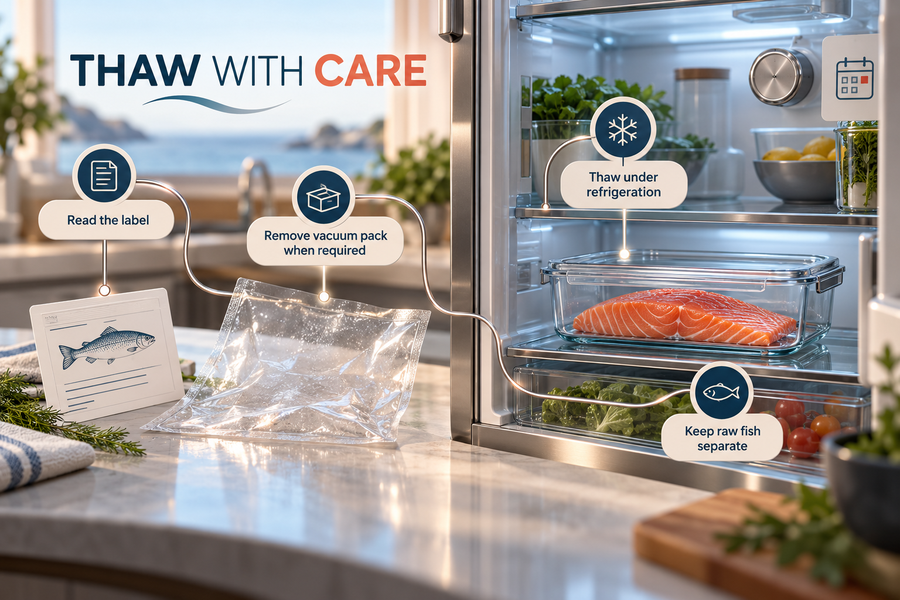
Thawing is part of the quality process, not an afterthought. Read the packaging instructions before moving a frozen portion into the refrigerator.
Remove vacuum packaging when required
Some vacuum-packed fish must remain frozen until use and must be removed from the package before thawing. Wisconsin’s vacuum-packaged fish guidance specifies complete removal when the label requires it; merely cutting a small opening is not the same instruction.
Reduced-oxygen packaging needs particular controls because unsuitable storage and thawing can permit toxin formation. Follow the product’s directions and the rules applicable to your operation rather than assuming that all sealed salmon can thaw in its original pack.
Refrigerator thawing
Place the unpackaged fish, where required, in a clean container that catches liquid and keeps it separate from ready-to-eat foods. Thaw under refrigeration and retain the lot details if the fish is being prepared commercially.
FDA’s thawing advice recommends gradual refrigerator thawing, commonly overnight. Large pieces and different pack formats may need a different preparation schedule, so check the actual condition rather than promising an exact thawing time for every fillet.
Faster thawing methods
When suitable for the product, cold-water thawing uses a clean leakproof bag after any required original vacuum-pack removal. Keep the water cold and follow the relevant handling instructions; prepare the fish promptly. Microwave defrosting is an option only when cooking immediately afterward, and can produce uneven texture.
Do not thaw salmon on a warm countertop or in hot water. The outside can warm while the center remains frozen, creating an avoidable handling problem. A faster method should never bypass the product’s packaging controls.
Refreezing Salmon and Freezing It at Home
Refreezing and quality loss are separate issues. USDA’s freezing guidance allows refreezing food thawed under refrigeration, while noting possible moisture-related quality loss. That advice assumes safe handling; it does not approve refreezing spoiled salmon or fish with an unknown warm-temperature exposure.
Repeated freeze-thaw cycles can affect the result, even where the handling was safe. For commercial products, clarify whether processing included thawing and refreezing, then evaluate samples against your specification. Do not assume every double-frozen product is unusable, or that a second quick freeze recreates the original condition.
When freezing fresh salmon at home, do it promptly while the fish is suitable for use. Divide it into practical portions, use freezer-appropriate protection and label it clearly. A household freezer is not necessarily equivalent to a controlled industrial freezing process. For fish thawed by faster methods, follow method-specific cooking and refreezing guidance rather than applying the refrigerator rule automatically.
Cooking Fresh, Thawed and Frozen Salmon
Cooking should account for thickness, product condition and the intended recipe. A preservation label does not provide one reliable cooking time for every portion.
- For searing, suitably thawed salmon with a dry surface generally gives more control over browning.
- For roasting or poaching, choose similarly sized portions and check the thickest section.
- Cooking from frozen can work with suitable products and instructions, but needs a method that heats the center adequately.
- Follow package cooking directions and verify the endpoint with a food thermometer.
- FDA recommends 145°F, approximately 63°C, for most seafood; this applies to the center of the fish, not the oven setting.
- Prevent raw fish and its juices from contacting ready-to-eat foods during preparation.
Fresh or Frozen Salmon for Sushi and Raw Dishes?
Neither “fresh,” “flash frozen” nor “sushi-grade” is enough to establish raw-use suitability. A freezing method intended to preserve texture is not automatically a documented parasite-control process; FDA’s seafood hazards guidance explains the factors involved in parasite-control freezing. Commercial buyers should state the intended raw use before ordering and obtain evidence of the controls required in the destination market.
Appropriate parasite control depends on the product and applicable requirements, including any properly supported exemptions. Freezing does not eliminate all harmful microorganisms. Curing, marinating or cold smoking should not be assumed to replace the necessary food-safety process.
For home preparation, follow reliable local advice and product instructions; cooking remains the safer route for reducing foodborne-illness risks. A sensory check or a home freezer setting cannot verify a commercial raw-use claim. This safety question is separate from whether a cooked frozen portion tastes as good as a chilled one.
Buying Salmon for Restaurants, Retail and Export
A useful buying brief describes the product and its required performance. It lets the supplier propose a suitable chilled or frozen format without relying on a broad freshness claim.
- Name the species and production method separately from origin.
- Specify cut, skin, trim and pin-bone requirements.
- Agree on fillet or portion grading and acceptable variation.
- Identify the processing and frozen-storage history you require.
- Specify packing, labeling and net fish weight.
- State the intended use and destination-specific documentation.
| Specification | Detail to agree before shipment |
|---|---|
| Identity | Scientific name, commercial name, farmed or wild status |
| Product form | Whole, gutted, fillet, steak or portion |
| Grade | Size range, thickness and agreed tolerance |
| Finish | Skin, trimming and pin-bone standard |
| Preservation | Chilled or frozen; declared processing history |
| Weight | Net fish weight, glaze declaration and verification basis |
| Packing | Unit packs, carton format, seals and handling instructions |
| Dates and traceability | Relevant harvest, freezing, packing dates and lot connection |
| Cold chain | Receiving limits, transport records and storage instructions |
| Intended use | Cooking, further processing or documented raw-use suitability |
| Acceptance | Sample approval, defect criteria and receiving procedure |
Assess sample fillets using the same thawing, draining and cooking procedure. Record usable portion weight, drip and presentation; agreed test methods make these observations comparable. Investigate nonconforming deliveries instead of accepting a generic “premium” description.
If considering a related salmonid, review the scientific identity and product requirements first. Iran Fish’s rainbow trout products offer a separate category to evaluate; trout should not be treated as an identical substitute for a specified salmon species.
Choosing the Right Product and Reducing Waste
Choose the format that fits your handling capacity and preparation schedule. The better option is the one that arrives in suitable condition and stays that way until use.
- Choose chilled salmon for prompt preparation when the source, history and turnover are clear.
- Choose frozen portions when you need to take out only the quantity required and can maintain appropriate storage.
- Choose either format for cooked dishes after matched samples demonstrate the quality you need.
- For distribution, compare the complete route, including transport, storage, handling and losses.
- For environmental claims, consider the farm or fishery as well as refrigeration, packaging and waste.
- Rotate stock, protect packs and avoid thawing more product than your operation can use safely.
Frequently Asked Questions
These questions address the decisions that most often cause confusion at the seafood counter. The answers distinguish quality, nutrition and food safety.
Is frozen salmon as good as fresh salmon?
It can be. Salmon frozen promptly from good raw material, kept under suitable conditions and thawed correctly can deliver excellent eating quality. Recently harvested, carefully chilled salmon can also be excellent. Compare the same species and cut rather than assuming either label wins.
Does freezing salmon remove its protein or omega-3?
Freezing does not remove salmon’s protein or make it nutritionally worthless. It also remains a source of marine omega-3. Storage conditions, oxidation, species and preparation affect the actual composition, so use suitable product information instead of claiming complete nutrient retention in every pack.
Why is frozen salmon sometimes mushy or dry?
Possible causes include the raw material’s condition, freezing and storage history, moisture loss during thawing, species differences and cooking. One symptom does not identify the cause. Check packaging and handling, then compare matched portions using the same preparation.
Can I thaw salmon in its vacuum-sealed bag?
Follow the label. If it requires the fish to remain frozen until use or to be removed before thawing, remove it completely before thawing. Reduced-oxygen packs need specific controls; simply making a small hole is not equivalent to complete removal.
Can previously frozen salmon be refrozen?
It can be permissible after safe refrigerator thawing, although quality may decline. The refrigerator rule does not apply to every thawing method or an unknown temperature history. Follow product instructions, and do not refreeze fish to rescue spoilage or unsafe handling.
Discuss Your Fish Specifications with Iran Fish
Send a product brief covering species, cut, grading, packing, chilled or frozen preference and intended use. Explore Iran Fish’s farmed fish range to review the product categories described on the website.
If you are evaluating salmon trout products, confirm scientific identity, available formats and destination requirements before approving a substitution. Request the specifications relevant to your preparation and distribution plan.
Use the Iran Fish contact page to discuss current availability and ask which products match your requirements.