


Frozen Salmon Shelf Life and Storage Requirements


Frozen salmon shelf life depends on packaging, temperature and whether you mean safety or quality. For household storage, use raw salmon within 2–3 months for best quality at −18°C (0°F) or below. Properly handled fish kept continuously frozen can remain safe longer, but flavour and texture deteriorate. Commercial packs may carry different validated dates: follow their storage instructions. Thaw under refrigeration, removing ordinary vacuum packaging first, and use raw thawed salmon promptly.
| Storage question | Practical answer |
|---|---|
| Raw salmon in a household freezer | Aim for 2–3 months for best quality, continuously at −18°C (0°F) or below. |
| Commercial frozen salmon | Follow the producer’s validated shelf life, stated temperature and handling instructions; there is no universal commercial expiry period. |
| Raw salmon after refrigerator thawing | Use within 1–2 days, subject to a shorter label instruction and its earlier handling history. |
| Cooked salmon | Refrigerate for 3–4 days; freeze for up to 3 months for best quality. |
| Ordinary vacuum-packed frozen fish | Remove from the reduced-oxygen package before refrigerator thawing. |
| Refreezing | Refrigerator-thawed fish handled safely can be refrozen, with possible quality loss. Cook cold-water- or microwave-thawed fish before refreezing. |
| Freezer burn | A quality defect caused by dehydration; it does not by itself establish a safety problem. |
| Power outage | Fish with ice crystals or at 4°C (40°F) or below may be refrozen. Discard fish exposed above that threshold for more than 2 hours. |
| Smoked or cured salmon | Follow the specific product label; raw salmon guidance does not automatically apply. |
| Salmon intended for raw eating | Ordinary freezer storage does not establish suitability for raw consumption. |
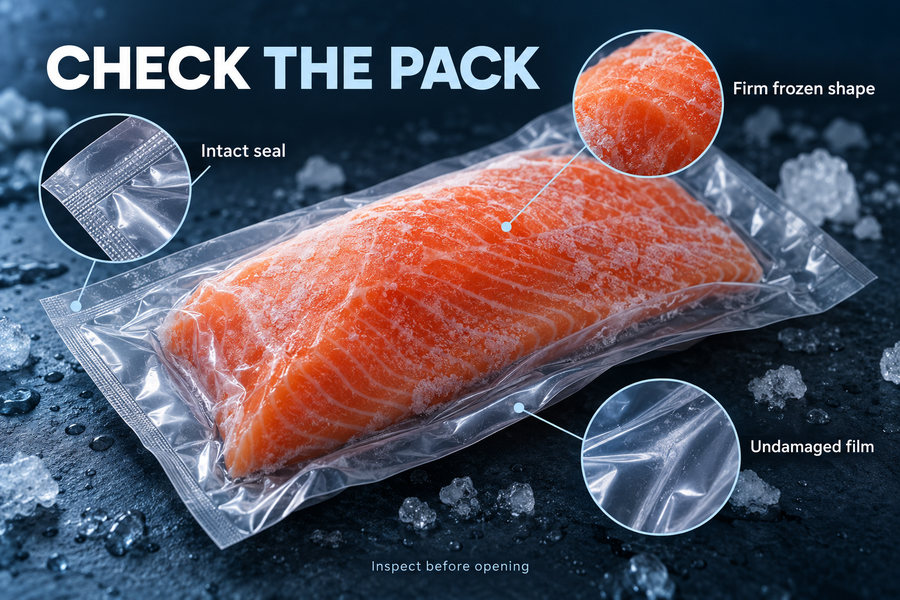
Frozen Salmon Shelf Life: How Long Does It Last?
A useful storage answer needs a condition attached to it. A household freezer guideline and a processor’s commercial shelf-life statement describe different situations.
The household quality window
The FoodSafety.gov cold-storage chart places salmon among fatty fish and gives a freezer quality window of 2–3 months. Its freezer guidance assumes continuous storage at −18°C (0°F) or below.
Use that range to plan home freezer turnover. It is not a claim that every fillet becomes unsafe as soon as the third month ends, or that a damaged package will retain good quality throughout that period.
Commercial shelf life needs product evidence
A commercially frozen product may have a different declared shelf life. The relevant evidence is the specification for that species, cut, packaging system and storage temperature, supported by the producer’s shelf-life assessment.
Do not assign every vacuum-sealed salmon pack the same extended storage period. Ask whether the declared duration begins at production, freezing or packing, and whether the supplied batch has remained within its specified conditions.
Safety and quality are separate questions
Continuous freezing preserves safety only when the fish was safe when frozen and remained properly handled. It does not repair earlier temperature abuse.
The calendar helps manage quality, while storage history helps assess safety. A fillet may become dry or unpleasant without becoming hazardous; another may have an unsafe history despite looking normal. Neither its age nor appearance can answer both questions alone.
Storage Temperatures and Cold-Chain Requirements
Keep household frozen salmon at −18°C (0°F) or below. For commercial stock, apply the stated product requirement and any stricter requirement governing your operation.
- Check an independent freezer thermometer rather than relying only on the control dial.
- Put packs where they remain consistently frozen; avoid repeated handling and warming during stock searches.
- Keep ventilation paths clear and follow the freezer manufacturer’s loading instructions.
- Transfer frozen purchases promptly using suitable insulated transport when necessary.
- Maintain identifiable batches rather than mixing loose, unlabelled portions.
- For distribution, agree temperature monitoring and handover responsibilities before dispatch.
- Investigate excursions instead of treating a later cold reading as proof that the entire journey was satisfactory.
A freezer display usually describes the temperature at its sensor. It does not reconstruct what happened to a carton during loading, unloading or an earlier equipment failure.
In commercial operations, distinguish room air, reefer set point and measured product temperature. Record which measurement you took and how you took it. That makes a receiving decision explainable when different readings disagree.
Why Frozen Salmon Loses Quality
Frozen storage slows deterioration, but salmon does not stay unchanged. Its fat, exposed surfaces and proteins all influence the eating quality of an older pack.
Oxidation and rancidity
Oxygen exposure can alter fish fats and produce unpleasant flavours. Salmon’s fatty composition makes protection from air particularly relevant. A pack that still feels frozen can therefore lose flavour even without an obvious thawing event.
As the FAO explanation of factors limiting frozen-fish storage life describes, lower storage temperatures slow changes in fat and protein, while glazing or suitable packaging offers protection.
Dehydration and freezer burn
Moisture loss leaves pale, dry or leathery areas on exposed flesh. Torn film, incomplete wrapping and damaged protective glaze can leave a surface vulnerable.
Do not confuse a thin, deliberately applied ice coating with a damaged, heavily frosted pack. They have different purposes and need different interpretation.
Texture changes
Frozen storage can affect firmness and moisture retention. Repeated warming and refreezing may make a portion less appealing when cooked, even where its handling has remained safe.
Evaluate appearance, odour and cooked performance together when assessing commercial quality. A frozen exterior gives only part of the picture; a representative thawed sample can reveal dryness, separation or other defects that are harder to see in the carton.
Packaging, Vacuum Sealing and Protective Glaze
Packaging protects fish from its storage environment. Its condition matters as much as the name of the packaging method.
Vacuum sealing and barrier films
A close-fitting vacuum pack reduces air around a portion, while suitable film helps limit moisture and oxygen transfer. The benefit depends on an intact seal and appropriate materials.
Keep ordinary vacuum-packed salmon frozen until you are ready to thaw it correctly. Vacuum packaging is not permission to keep thawed raw fish refrigerated for an extended period.
Glaze on frozen salmon
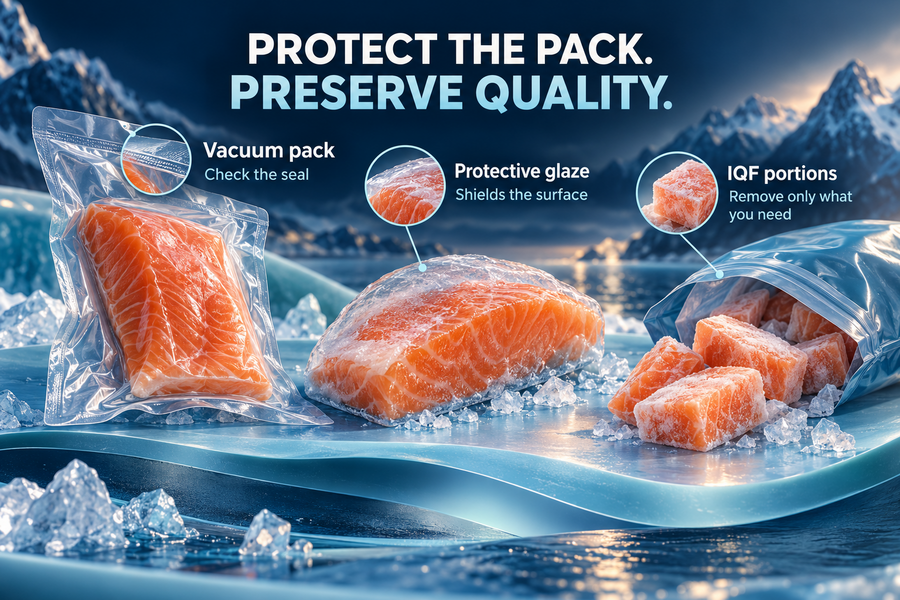
A protective glaze is a layer of ice applied to frozen fish. The FAO guide to treatment after freezing explains how it shields the surface against dehydration and oxidation.
For buying decisions, distinguish protective ice from the fish quantity supplied. Ask for the declared glaze information and net fish weight, and agree how these will be checked. Do not infer fish weight from the gross weight of an icy carton.
IQF, block-frozen and whole-fish formats
Individually quick-frozen portions can allow removal of the quantity needed while the remainder stays frozen. A block may require a different handling plan because its pieces are not individually accessible.
Whole fish, fillets and portions also differ in exposed surfaces and handling needs. Compare the actual product specification rather than assuming a format alone determines its shelf life.
| Packaging or format | What it helps manage | What still needs checking |
|---|---|---|
| Vacuum-packed portion | Air exposure and individual handling | Film condition, seal integrity and thawing instructions |
| Glazed fish | Surface dehydration and oxidation | Glaze coverage, pack protection and declared fish weight |
| Freezer-grade bag | Household wrapping and moisture protection | Trapped air, punctures and closure |
| IQF portions in an outer bag | Removal of separate portions | Resealing after opening and protection of remaining pieces |
| Block-frozen product | Bulk handling in a specified format | Controlled thawing plan and use of the opened block |
How to Freeze and Store Salmon at Home
Freeze fresh salmon while it is still in good condition. Waiting until fish is close to spoiling gives the freezer a poorer starting material.
- Divide the fish into practical meal portions before packing.
- Use wrapping designed for frozen food, with as little trapped air as practical.
- Protect the pack from sharp bones or other items that could puncture it.
- Mark the contents and freezing date where they remain readable.
- Keep the oldest suitable packs accessible so they get used first.
- Reseal opened outer bags promptly and keep the remaining pieces frozen.
- Thaw only the quantity you plan to prepare.
The University of Minnesota Extension guidance on home freezing recommends airtight containers or suitable wrapping and explains the value of smaller packages for freezing and portion control.
Check the freezer before adding a large amount of unfrozen food. Follow its stated freezing capacity rather than assuming every available space can be filled at once without affecting performance.
Reading Dates and Calculating Remaining Shelf Life
A production date identifies when a batch was made; a freezing or packing date identifies another step in its history. A best-before statement generally addresses quality under the specified conditions, while a use-by instruction requires the handling stated for that product and market. Read the wording with the storage statement. A date detached from its conditions is incomplete information.
For commercial purchases, request the basis of the declared shelf life and its starting point. Remaining shelf life is the time left until the applicable labelled end date at the point of assessment, assuming compliant storage. Purchasing, importing or repacking a batch does not automatically restart its original life. If a processor changes the product or packaging, any new declaration needs a justified basis.
Agree how much remaining life your operation needs at receipt. Allow for transport, warehouse storage, distribution and the customer’s use period without inventing a universal minimum. The Iran Fish frozen salmon buying guide provides related checks for specifications and shipment acceptance. Require the dates on carton labels, inner packs and shipment records to be consistent before releasing a questioned lot.
How to Thaw Frozen Salmon Safely
Choose a thawing method that keeps the fish controlled until cooking. Avoid leaving salmon on a kitchen counter or using warm water to speed the process.
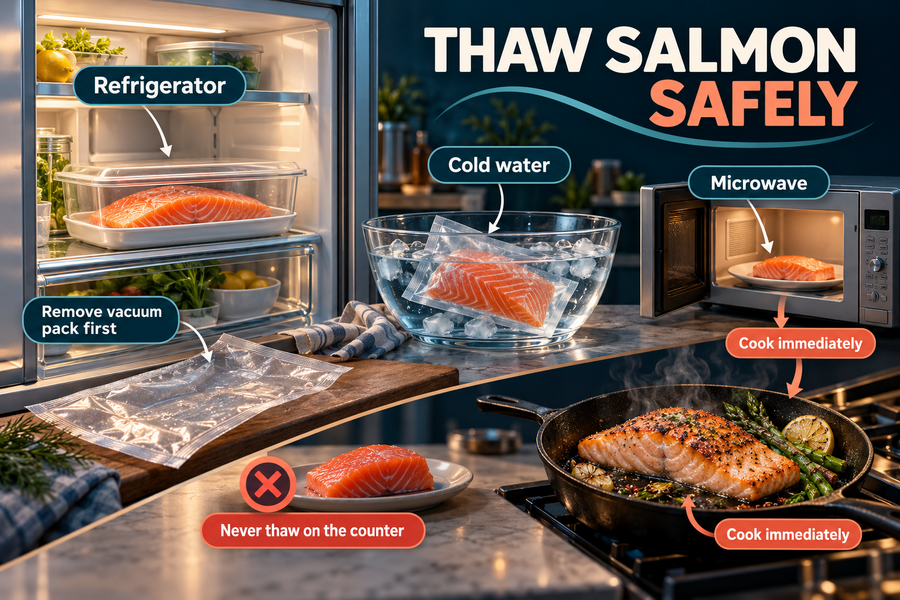
Refrigerator thawing
Place salmon in a clean container that catches drips and keeps it separate from ready-to-eat food. Allow enough time for the size and format; a thick block and a small portion will not thaw alike.
The FDA guidance on safe seafood preparation recommends refrigerator thawing and describes cold-water and microwave alternatives when faster preparation is needed.
Remove ordinary vacuum packaging first
For reduced-oxygen packaged fish labelled to remain frozen until use, remove the fish from that environment before refrigerator thawing. Put it into a clean covered container instead of leaving it sealed in its ordinary vacuum pouch.
This handling distinction appears in section 3-501.13 of the FDA Food Code. The FDA guidance on botulinum toxin formation explains why keeping relevant reduced-oxygen packaged fish frozen is an important control. Read the actual instructions, particularly for products designed to be cooked from frozen.
Cold-water thawing
For a quicker method, use a leakproof bag in cold water and cook the fish immediately after thawing. For ordinary vacuum-packed fish, removing the original pouch first and using a clean bag avoids carrying the sealed storage environment into the thawing step.
Microwave defrosting
Microwave defrosting can warm some areas before the rest has thawed. Cook immediately afterward. Do not microwave packaging unless it is expressly suitable for that use.
| Method | Packaging and handling | Next step |
|---|---|---|
| Refrigerator | Remove ordinary reduced-oxygen packaging first; use a covered drip-catching container | Keep cold and cook within the applicable short refrigerated period |
| Cold water | Use a suitable leakproof bag in cold water | Cook immediately after thawing |
| Microwave | Use microwave-safe equipment and follow appliance instructions | Cook immediately after defrosting |
| Countertop or warm water | Avoid uncontrolled warming | Do not use as a planned thawing method |
How Long Does Salmon Last After Thawing or Cooking?
Once salmon thaws, its frozen-storage period no longer describes how long it can sit in the refrigerator. Use the guidance for its new condition and account for its previous handling.
Raw thawed salmon
For home use, plan to cook raw refrigerator-thawed salmon within 1–2 days. Follow any shorter instruction on the pack, and do not assume thawing erases time already spent unfrozen.
The USDA fish-storage guidance gives this short refrigerated period for raw fish and recommends up to 3 months in the freezer for cooked fish quality.
Cooked salmon and leftovers
The USDA advice on cooked-fish refrigeration specifies 3–4 days. Refrigerate leftovers promptly in shallow containers rather than leaving a large warm dish out to cool for hours.
When reheating leftovers, follow the USDA leftovers safety guidance, which recommends an internal temperature of 74°C (165°F).
Smoked, cured and prepared products
Cold-smoked salmon, hot-smoked salmon and gravlax are distinct products. Their label instructions reflect their formulation, processing and packaging; do not apply one generic storage duration to all of them. Canned or shelf-stable products also require separate handling, especially after opening.
Can You Refreeze Salmon?
Salmon thawed safely in the refrigerator can be refrozen without cooking first, provided it has remained properly handled and within its refrigerated storage period. The USDA freezing and food safety guidance permits refreezing refrigerator-thawed food, while noting that quality may decline.
Fish thawed in cold water or a microwave should be cooked before refreezing. Refreezing is not a corrective action for fish left warm too long. If its storage history is unsafe or uncertain, putting it back into a freezer does not settle the problem.
Expect possible changes in texture and moisture retention even after safe refreezing. Portioning before the first freeze reduces the need for repeated cycles. For commercial batches, follow the approved product procedure and record any permitted processing or handling change rather than quietly returning thawed stock to its original inventory status.
Freezer Burn, Spoilage and Temperature Abuse
An older salmon pack may show a quality defect, a spoilage warning or evidence of poor handling. These findings need different responses.
Freezer burn and dry surfaces
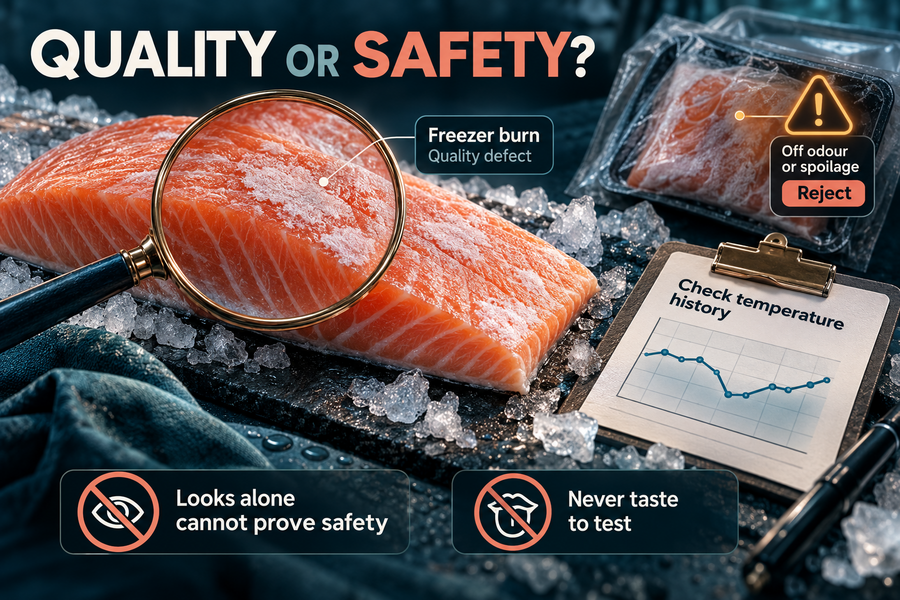
Dry, pale patches can reflect moisture loss. Freezer burn alone is a quality issue, but a torn pack may raise additional questions about exposure and handling. Assess the whole history rather than using one visible defect as a complete verdict.
Unpleasant odour or abnormal flesh
Sour, rancid or ammonia-like odours are reasons to reject fish. Unexpected slime, marked deterioration or contaminated packaging also warrants rejection. Do not taste a questionable fillet to investigate it.
Colour varies with species and production conditions. A strong pink appearance does not prove freshness, and a normal smell cannot demonstrate that harmful organisms or toxins are absent.
Evidence of warming
Soft flesh in a supposedly frozen pack, pooled fluid, damaged seals or unusual ice accumulation needs investigation. Such observations can flag a problem, but they do not reveal the duration or severity of every temperature excursion.
| Finding | What it may indicate | Practical response |
|---|---|---|
| Localised dry, pale areas | Dehydration and reduced eating quality | Assess quality alongside the pack and storage history |
| Sour, rancid or ammonia-like smell | Spoilage or unacceptable quality | Discard at home; reject or hold commercial stock |
| Torn film or failed seal | Loss of package protection | Investigate exposure and suitability before use |
| Soft fish sold as frozen | Inadequate freezing or warming | Do not accept it as normal frozen stock |
| Heavy frost or unusual ice buildup | Age, moisture movement or thaw/refreeze history | Check records and handling; appearance alone is inconclusive |
| Normal appearance with unknown warm exposure | Safety remains unresolved | Do not rely on appearance to clear it |
What to Do After a Power Outage
Keep the freezer closed while checking the situation. Make the decision from the condition and temperature of the food, rather than the outage duration alone.
- FoodSafety.gov estimates about 48 hours of temperature protection for a full closed freezer and 24 hours for a half-full one; actual conditions vary.
- Fish that still contains ice crystals or is at 4°C (40°F) or below may be refrozen, although its quality may suffer.
- Discard fish exposed above 4°C (40°F) for more than 2 hours.
- Never taste food to decide whether it is safe.
- If time and temperature cannot be established, take a conservative disposal decision at home.
Use the FoodSafety.gov power-outage chart for the relevant food category. In a business, segregate affected stock and let the responsible food-safety team assess it against the applicable procedure; a cold room returning to its normal set point does not automatically clear its contents.
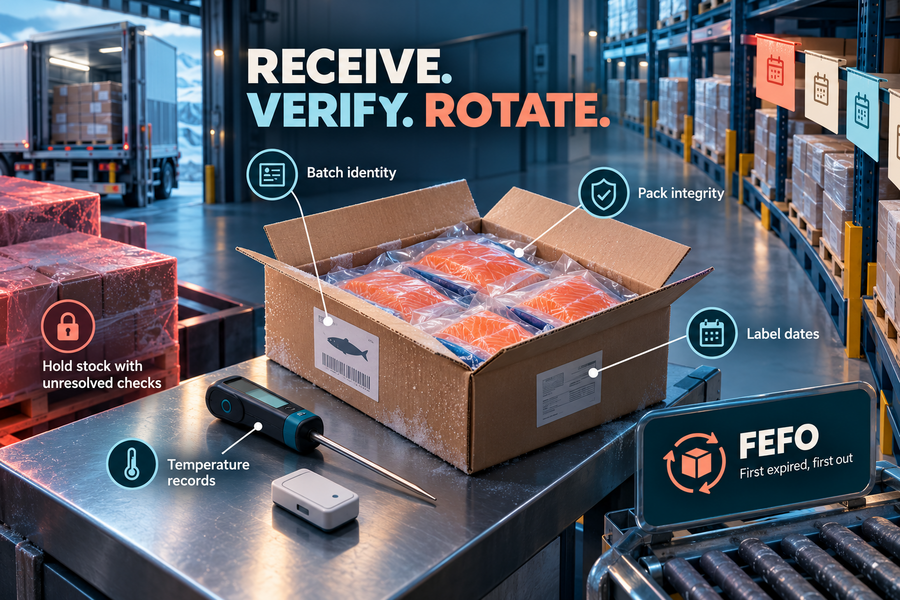
Commercial Receiving, Traceability and Stock Rotation
A shipment’s declared shelf life is useful only when its identity and storage conditions can be checked. Turn those checks into a repeatable receiving procedure.
Confirm the product and batch
Match species, cut, pack format, batch identification and dates to the order and documents. Inspect the outer cartons and representative inner packs using your agreed sampling method.
Iran Fish lists salmon trout products, so confirm the scientific species rather than assuming that a pink-fleshed product is Atlantic salmon. Storage declarations should relate to the product actually supplied.
Review temperature evidence
Request available transport and handover records and record product temperatures using a suitable method. Note the measuring equipment, location and inspection time so that the result is interpretable.
A reefer set point does not establish the temperature of every carton. Unexplained gaps, conflicting readings or visible warming should trigger a documented hold and assessment. Agree in advance who can release the stock and what evidence they need.
Rotate by the applicable end date
Use first-expired, first-out where batches have different end dates. First-in, first-out can support orderly storage, but the oldest arrival is not always the batch with the earliest expiry.
Keep held stock separate from released stock. Preserve lot identity through picking and dispatch so customers can be linked back to the supplied batch.
Request usable supplier documentation
Ask for a specification stating the storage temperature, shelf-life basis, packaging and thawing instructions. Also request the relevant date definitions, remaining life at dispatch and any agreed receiving criteria.
Compare those instructions with your distribution plan. A batch may comply at receipt yet have too little remaining life for its intended route. Resolve that mismatch before accepting the shipment for normal onward supply.
Does Freezing Make Salmon Suitable for Raw Consumption?
No. A frozen-storage date is not evidence that salmon is suitable for sushi or other raw dishes. Raw-use suitability requires relevant parasite controls, handling and product documentation; ordinary household freezing should not be treated as a validated process.
Freezing also does not remove every harmful germ. The FDA seafood safety advice favours thorough cooking and advises susceptible groups to avoid raw or undercooked seafood and certain refrigerated smoked products.
For cooked fish, the FoodSafety.gov minimum-temperature chart specifies 63°C (145°F). Use a food thermometer for measurement; cooking is not a rescue method for a product with an unsafe handling history.
Frequently Asked Questions
These questions address the decisions that often arise when a pack has been stored longer than expected. The answers assume that no shorter product instruction applies.
Can I eat salmon that has been frozen for a year?
Age alone cannot decide safety. Fish safe when frozen and continuously held at −18°C (0°F) or below may remain safe, but eating quality can deteriorate. Check the labelled instructions and handling history; do not use the indefinite-frozen-storage principle to dismiss earlier abuse.
Does vacuum-sealed salmon always last longer?
Suitable vacuum packaging can protect quality, but it does not guarantee a fixed extended life. Film, seals, initial fish condition and temperature all matter. Use the particular producer’s supported storage declaration, and remove ordinary vacuum packaging before refrigerator thawing.
Is ice around frozen salmon a bad sign?
A deliberate protective glaze is normal for some products. Heavy frost, large unexpected crystals or ice associated with damaged packaging needs closer inspection. Ice appearance alone cannot prove safety or reconstruct the cold chain.
Can I refreeze salmon after it has thawed overnight in the fridge?
Yes, if it thawed safely under refrigeration, remained properly cold and is within its applicable refrigerated period. Expect possible quality loss. This answer does not apply to fish left on the counter or to a vacuum pack thawed contrary to its safe-handling requirements.
Does buying a frozen pack restart its shelf life?
No. Commercial dates remain tied to the producer’s stated basis. Record the original dates and batch identity, then calculate remaining life at receipt. Purchase, import or movement into a different warehouse does not make an older batch newly produced.
Request Product-Specific Storage Information from Iran Fish
Before arranging supply, review the available Iran Fish salmon trout formats and identify the species, cut and packaging your operation needs.
Use the Iran Fish enquiry page to request the current specification, declared storage temperature, shelf-life information and handling instructions for the proposed product.
Include your destination, distribution plan and required remaining life at delivery. Ask for those requirements to be confirmed against the actual batch before dispatch so your receiving team can make a documented acceptance decision.