

Rainbow Trout vs Salmon: Taste, Texture and Nutrition


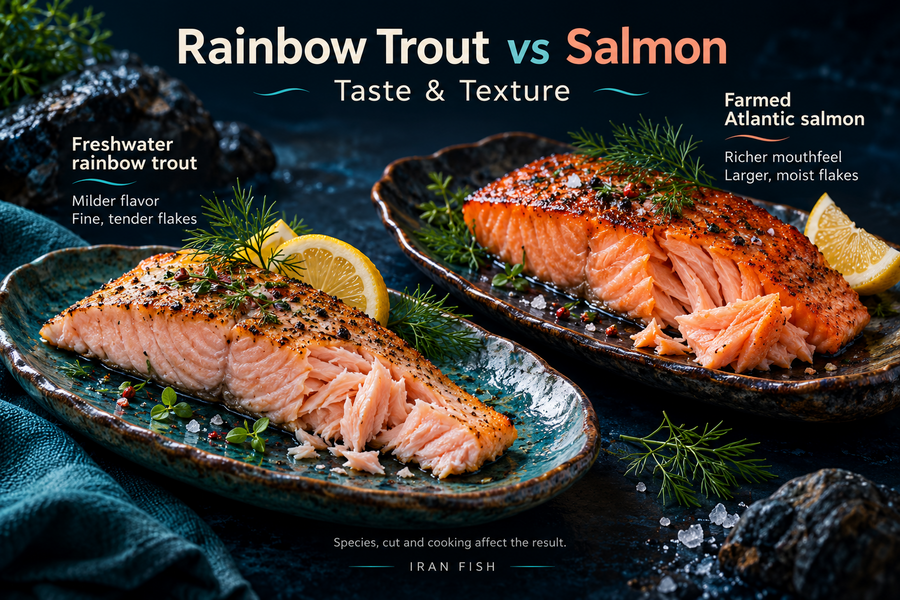
Rainbow trout vs salmon comes down to the meal you want: freshwater rainbow trout usually tastes milder and has delicate, fine flakes, while farmed Atlantic salmon offers a richer, fattier mouthfeel. Both supply substantial protein. In USDA reference records, raw farmed trout has fewer calories, while raw farmed Atlantic salmon has more EPA and DHA omega-3. Choose by species, cut and handling, rather than flesh color alone.
| Comparison | Freshwater rainbow trout | Farmed Atlantic salmon |
|---|---|---|
| Taste | Usually mild; sometimes described as slightly nutty | Richer mouthfeel, with a recognizable salmon flavor |
| Cooked texture | Tender, fine flakes; thin fillets need close attention | Generally larger, moist flakes; fatty cuts feel more buttery |
| Protein per 100 g raw | 19.94 g | 20.42 g |
| Calories per 100 g raw | 141 kcal | 208 kcal |
| Total fat per 100 g raw | 6.18 g | 13.42 g |
| EPA + DHA per 100 g raw | About 0.73 g | About 1.97 g |
| Vitamin D per 100 g raw | 15.9 µg | 11.0 µg |
| Practical cooking choice | Whole-fish baking, gentle pan-frying and lighter dishes | Roasting, pan-searing and dishes suited to richer fish |
| Bones and skin | Pin bones may remain; skin can be eaten when prepared properly | Pin bones may remain; skin can be eaten when prepared properly |
| Mercury category | FDA/EPA “Best Choice” for freshwater trout | FDA/EPA “Best Choice” for salmon |
| Raw consumption | Ordinary fillets should be cooked; raw use requires verified controls | Ordinary fillets should be cooked; raw use requires verified controls |
| Fresh or frozen | Quality depends on processing, storage and thawing | Quality depends on processing, storage and thawing |
| Responsible sourcing | Evaluate the actual farm and supply chain | Evaluate the actual farm and supply chain |
| Commercial selection | Specify species, size, cut, bone removal and packaging | Specify species, size, cut, bone removal and packaging |
The nutrition figures compare edible portions of raw farmed fish in USDA SR Legacy records, not every trout or salmon product. Wild salmon, steelhead, cooked portions and smoked fish can have different profiles.
Are Rainbow Trout and Salmon the Same Fish?
Rainbow trout and salmon are related, but they are not interchangeable species names. Knowing exactly what is being compared prevents mistakes in nutrition, recipe selection and commercial labeling.
Rainbow trout and Atlantic salmon
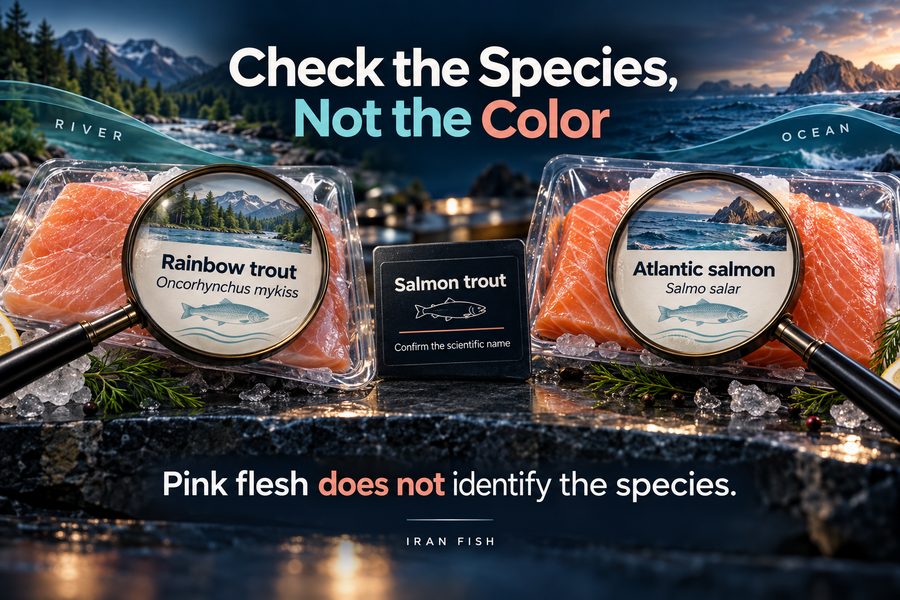
Rainbow trout is Oncorhynchus mykiss; Atlantic salmon is Salmo salar. Both belong to the salmonid family, but a pink trout fillet does not become Atlantic salmon because of its appearance. For buyers, the scientific name is more reliable than a photograph or an informal product description.
Freshwater rainbow trout is the main trout reference in this article. The numerical salmon comparison uses farmed Atlantic salmon, a specific product category rather than an average of all salmon species.
Steelhead and ocean-raised rainbow trout
As NOAA explains the relationship between steelhead and rainbow trout, steelhead is the ocean-migrating life-history form of the same species. It is not Atlantic salmon. Differences in growth, environment and feeding can make commercially sold steelhead resemble salmon more closely than a smaller freshwater trout does.
Ocean-raised rainbow trout is also sold under names such as ocean trout or fjord trout. These terms describe market categories or production settings; the species name still needs checking.
What “salmon trout” means
Salmon trout is a trade name whose usage varies between markets. It may describe pink-fleshed rainbow trout, including larger fish raised for a salmon-like product presentation. Do not assume it means a salmon–trout hybrid or a separate, universally defined species.
When comparing salmon trout products, request the scientific name, production origin and specification. This is especially useful when retail labels and import documents use different common names.
Why the salmon species matters
Atlantic, sockeye, Chinook, coho, pink and chum salmon do not all taste or cook alike. A lean wild salmon portion can behave very differently from a fatty farmed Atlantic salmon fillet. Statements such as “salmon always has more fat than trout” therefore need a defined comparison.

Rainbow Trout vs Salmon Taste: Mild or Rich?
Freshwater rainbow trout generally has a gentle flavor that works well with lemon, parsley and a light butter sauce. Some people describe a faint nutty note; others notice a flavor similar to mild salmon. It can be a good starting point for someone who enjoys seafood but dislikes a heavy, oily mouthfeel. That preference is individual, rather than proof that trout is objectively tastier.
Farmed Atlantic salmon usually feels richer on the palate. Its fat contributes to the buttery impression, although richness is not the same as a strong or unpleasant smell. A person may enjoy its moist texture while preferring a restrained seasoning. Wild salmon varies by species, and steelhead or sea-raised trout can narrow the flavor gap considerably.
Freshness and handling also influence what reaches the plate. A sour or ammonia-like odor is a quality warning, not a normal feature of either fish. An earthy taste in trout can be associated with production conditions, but should not be treated as an inevitable trout characteristic. When testing a new supplier, cook comparable cuts with the same simple seasoning: it is easier to judge the fish when one sample is not covered in a powerful sauce.
Texture, Flesh Color, Skin and Pin Bones
The most useful texture comparison is between similarly sized portions cooked to the same endpoint. Thickness, muscle structure, fat and handling all affect the result.
- Cooked flakes: Rainbow trout commonly separates into fine, tender flakes. Atlantic salmon often produces larger flakes with a fuller, moist mouthfeel; neither should be assumed to have a fixed firmness in every cut.
- Fillet thickness: A thin trout tail section can overcook while a thick salmon center portion is still heating. Match thickness before comparing recipe times.
- Flesh color: Trout can have pale, pink or orange flesh. Research on astaxanthin in rainbow trout feed shows how dietary pigments influence fillet coloration; color alone cannot establish species or nutrient content.
- Skin: Properly cleaned, scaled where necessary and cooked skin can be eaten on both fish. For a crisp finish, dry the surface and keep sauces away from the skin until serving.
- Pin bones: Both can contain small bones after filleting. Check the flesh carefully and request a pin-bone-removal specification when purchasing prepared portions.
- Cut description: Whole gutted fish, steaks and fillets require different preparation. “Fillet” does not automatically mean skinless or fully deboned.
Rainbow Trout vs Salmon Nutrition per 100 Grams
A useful nutrition comparison keeps species, production method and preparation state consistent. The following values come from raw farmed rainbow trout and raw farmed Atlantic salmon records in USDA FoodData Central.
| Nutrient per 100 g edible raw fish | Farmed rainbow trout, FDC 173717 | Farmed Atlantic salmon, FDC 175167 |
|---|---|---|
| Energy | 141 kcal | 208 kcal |
| Protein | 19.94 g | 20.42 g |
| Total fat | 6.18 g | 13.42 g |
| Saturated fat | 1.38 g | 3.05 g |
| EPA | 0.217 g | 0.862 g |
| DHA | 0.516 g | 1.104 g |
| EPA + DHA, calculated from the two rows above | 0.733 g | 1.966 g |
| Vitamin D, D2 + D3 | 15.9 µg | 11.0 µg |
| Vitamin B12 | 4.30 µg | 3.23 µg |
| Selenium | 23.6 µg | 24.0 µg |
These are reference composition values from USDA SR Legacy records published in 2019 and checked for this article in September 2026. They are not new laboratory tests of current Iran Fish batches. Feed, season, fish size and individual product specifications can change the actual composition.
Protein and calories
The protein amounts are close. The more noticeable difference in these records is energy: the trout entry provides 141 kcal and the salmon entry 208 kcal for the same raw edible weight. That distinction can help with meal planning, but the finished dish also includes any oil, butter, coating and sauce used in preparation.
Fat and EPA/DHA omega-3
Farmed Atlantic salmon contains more total fat and more EPA plus DHA in this matched comparison. Rainbow trout still provides both fatty acids. EPA and DHA are specific long-chain omega-3 fats, so their sum should not be confused with total polyunsaturated fat or every omega-3 compound in the fish.
Vitamin D, B12 and selenium
Trout has higher vitamin D and vitamin B12 values in these records, while selenium is similar. This is why choosing solely by omega-3 can miss other nutritional differences. Neither table should be used to promise the exact vitamin content of an unspecified retail fillet.
Raw versus cooked fish nutrition
Cooking changes water content and may release fat; added ingredients also change the meal. Consequently, 100 g of cooked fish is not directly equivalent to 100 g of raw fish. For a consistent dietary comparison, use cooked records for both fish or raw records for both, and include the cooking ingredients separately.
Which Fish Fits Your Diet?
If your priority is similar protein with less energy from the fish itself, the raw farmed rainbow trout reference is a useful option. A baked trout portion with vegetables produces a different meal from breaded, deep-fried trout, however. The species name is only part of the nutritional decision; preparation and the portion actually eaten also matter.
If you want a richer fish that supplies more EPA and DHA in the reference comparison, farmed Atlantic salmon fits that preference. Trout remains a worthwhile alternative rather than a nutritionally inferior substitute. Choosing between them can also reflect appetite, preferred texture and the way the fish fits into meals you enjoy regularly.
Both fish can contribute protein and micronutrients within a varied eating pattern. The FDA’s advice about eating fish emphasizes lower-mercury choices and dietary variety. Neither species should be presented as a treatment for illness or a guarantee of weight loss, and a single nutrient advantage does not make one fish universally healthier.
Cooking Trout and Salmon: Methods and Substitutions
Both fish work in a frying pan, oven, grill or air fryer. Adapt the technique to the portion in front of you rather than copying a cooking time from a different cut.
| Method or dish | Rainbow trout approach | Salmon approach |
|---|---|---|
| Pan-searing | Handle thin fillets gently and check the center early | Cook skin-on portions skin-side down first; monitor thick centers |
| Baking | Whole gutted trout or fillets work with herbs and a little moisture | Center-cut portions work well with herbs, mustard or a light glaze |
| Grilling | A basket or supported cooking surface helps delicate portions | Skin-on portions are useful, but require care when turning |
| Air-frying | Avoid crowding and watch thin edges | Use portions of similar thickness for even cooking |
| Recipe substitution | Replace salmon with trout, then adjust for thickness and fat | Replace trout with salmon, allowing for a richer result |
| Doneness | Check internal temperature in the thickest part | Check internal temperature in the thickest part |
Pan-searing without drying the fish
Pat the surface dry, use an appropriate pan and turn the fish carefully. Thin trout fillets usually need less cooking time than thick salmon portions, but this is a cut comparison, not an absolute species rule. Keep delicate pieces intact with a fish spatula rather than repeated flipping.
Baking, grilling and air-frying
Choose portions with consistent thickness where possible. A little added moisture can help a lean trout preparation; a fatty salmon cut may need less added richness. The FDA’s seafood preparation guidance recommends an internal temperature of 145°F, approximately 63°C, for most seafood. Measure the thickest part instead of relying on browning alone.
Seasonings and recipe substitutions
Lemon, dill, parsley and garlic suit both fish. Trout’s lighter flavor works with restrained seasoning, while salmon can stand up to mustard, ginger or a more pronounced glaze. When substituting trout for salmon, adjust the heat exposure and taste the sauce before adding extra butter or oil. A thinner replacement fillet should not be left cooking simply because the original recipe used a thicker fish.
Mercury, Pregnancy and Raw Fish Safety
Mercury exposure and microbial safety are separate questions. A low-mercury fish can still be unsafe if it is poorly handled or served raw without suitable controls.
Mercury in trout and salmon
The FDA/EPA lists salmon and freshwater trout in its “Best Choices” category. This is a mercury-based classification, not a claim that every fish contains no mercury. Locally caught fish may be subject to water-body-specific advisories, so recreational catches need separate checking.
Pregnancy and children
For pregnancy and breastfeeding, FDA/EPA guidance recommends 2–3 servings each week from the “Best Choices” list, with an adult serving defined as 4 ounces. Its advice for children uses smaller, age-appropriate portions. Cook fish thoroughly, remove bones carefully and follow local dietary guidance relevant to your household.
Can trout or salmon be eaten raw?
Do not assume an ordinary chilled or frozen fillet is suitable for sushi. Under the FDA Food Code’s parasite-control provisions, raw fish requires appropriate controls; certain aquaculture exemptions depend on documented rearing and feeding conditions. “Farmed” alone does not establish an exemption.
Raw-use buyers need supplier documentation and a process that meets destination requirements. Parasite-control freezing does not eliminate every bacterial hazard, and ordinary freezing is not proof that the required process occurred. Pregnant people and other groups vulnerable to foodborne illness should avoid raw or undercooked seafood.
Fresh or Frozen: Keeping Flavor and Texture
Fresh and frozen fish can both produce excellent meals when the original product and handling are sound. A chilled label does not compensate for poor storage, while a well-managed frozen product can be a practical choice for planned use.
- Inspect the product: Look for intact packaging and a clean, mild smell after opening. Reject sour or ammonia-like odors rather than trying to hide them with seasoning.
- Check frozen condition: Excessive frost, damage and evidence of thawing need attention. For commercial deliveries, compare the product and temperature records with the agreed specification.
- Refrigerate promptly: FDA consumer guidance advises refrigeration at 40°F or below, approximately 4.4°C, when seafood will be used within 2 days of purchase; otherwise freeze it. Follow any stricter product instructions.
- Thaw gradually: Refrigerated thawing helps keep handling controlled. Do not leave fish on the kitchen counter to defrost.
- Treat vacuum packs differently: Follow the label. For frozen reduced-oxygen packs requiring removal before thawing, remove the fish completely rather than merely piercing the bag, as explained in Wisconsin’s vacuum-packed fish guidance.
- Keep preparation separate: Prevent raw fish and its juices from contacting salads or cooked food. Clean utensils and work surfaces between raw and ready-to-eat preparation.
- Protect eating quality: Once thawed, keep the fish cold and prepare it according to the package instructions. For buyer evaluations, use the same thawing method for both samples before judging texture.

Sustainability Depends on the Source
There is no reliable environmental winner based only on the words trout and salmon. The farm or fishery, feed, water management, disease controls and surrounding ecosystem determine much of the impact. A freshwater farm and a marine net-pen operation need different questions, rather than a shared assumption that one species is automatically sustainable.
The Aquaculture Stewardship Council’s standards address environmental and social practices across aquaculture. Where a supplier claims certification, check its validity, scope and connection to the actual product. A sustainability label is not the same as a guarantee of a particular omega-3 level or suitability for raw consumption.
For procurement, request traceable production information and evaluate comparable evidence. Country of origin helps identify the supply chain, but it cannot replace farm-level information. Wild-caught and farmed products both require responsible sourcing decisions, and broad promotional claims should be supported by documents relevant to the batch being purchased.
What Seafood Buyers Should Specify
For importers, distributors and food-service teams, the decision extends beyond taste. A consistent product specification makes it easier to compare samples, plan preparation and check incoming deliveries.
| Specification | What to establish before ordering |
|---|---|
| Species identity | Scientific name alongside the common or trade name |
| Origin and production | Country, farm or production source, and traceability information |
| Product format | Whole gutted fish, headed-and-gutted fish, fillets, steaks or portions |
| Size and grading | Agreed weight range and portion consistency |
| Skin and bones | Skin-on or skinless; pin-bone-removal requirements and inspection expectations |
| Product condition | Chilled or frozen; the applicable freezing and storage specification |
| Packing | Carton format, inner packs, vacuum packing or IQF where available |
| Net weight and glaze | Declared net product weight and agreed glaze specification for glazed products |
| Quality checks | Appearance, odor, texture, packaging condition and receiving criteria |
| Documents | Batch identification, required health documents and destination-specific requirements |
| Intended use | Cooking, smoking or separately verified raw-use requirements |
- Match the sample to the order: Test the same format, size grade and skin/bone specification you intend to receive.
- Compare like with like: Evaluate both fish using the same thawing, seasoning and cooking method.
- Ask for written confirmation: Product photographs are useful, but they do not establish bone removal, raw-use safety or certification status.
- Establish receiving checks: Agree how temperature, pack integrity and deviations will be reviewed before dispatch.
Start with Iran Fish’s rainbow trout product range and farmed fish supply options, then confirm the format and documentation suitable for your market.
Frequently Asked Questions
The most common questions concern flavor, nutrition and whether the fish can be used interchangeably. These answers distinguish the general comparison from conditions that require checking the actual product.
Does rainbow trout taste like salmon?
There is a family resemblance, but freshwater rainbow trout usually tastes milder and feels lighter than fatty farmed Atlantic salmon. Steelhead and ocean-raised rainbow trout can be closer to salmon. Freshness, feed, the cut and seasoning also influence the result.
Which has more omega-3, rainbow trout or salmon?
In the USDA raw-farmed comparison used here, Atlantic salmon supplies more EPA plus DHA: about 1.97 g per 100 g versus 0.73 g for rainbow trout. These reference values should not be generalized to every salmon species or trout product.
Is rainbow trout healthier than salmon?
Neither is universally healthier. The trout reference has fewer calories and higher vitamin D and B12, while the salmon reference has more EPA and DHA. Both provide substantial protein. Your preparation, portion and overall eating pattern matter alongside those differences.
Can rainbow trout replace salmon in a recipe?
Yes, particularly in baked, pan-fried and grilled dishes. Check the replacement fillet’s thickness and adjust cooking accordingly. Leaner trout may need a different amount of added fat or sauce, and a delicate fillet needs care when turning.
Is salmon trout actually salmon, and is it suitable for sushi?
The name often describes pink-fleshed trout rather than Atlantic salmon, so check the scientific name. Suitability for sushi is a separate safety matter: require documented raw-use controls and compliance with destination rules. Pink color and a farmed label are not enough.
Source Rainbow Trout for Your Market with Iran Fish
Turn the comparison into a specification that fits your retail range, restaurant menu or distribution needs. Iran Fish offers rainbow trout for commercial buyers; discuss available formats and the supporting documents before placing an order.
- Tell us the required species, cut, size grade and skin/bone preference.
- State your quantity, packaging needs and destination market.
- Identify the cold-chain, traceability and import documents you require.
- Explain the intended preparation so any special requirements can be assessed separately.
Contact the Iran Fish team to confirm current availability and build a clear product specification for your next shipment.