


Salmon Fillet Cuts: A Buyer’s Guide to Loins, Belly, Portions and Trim

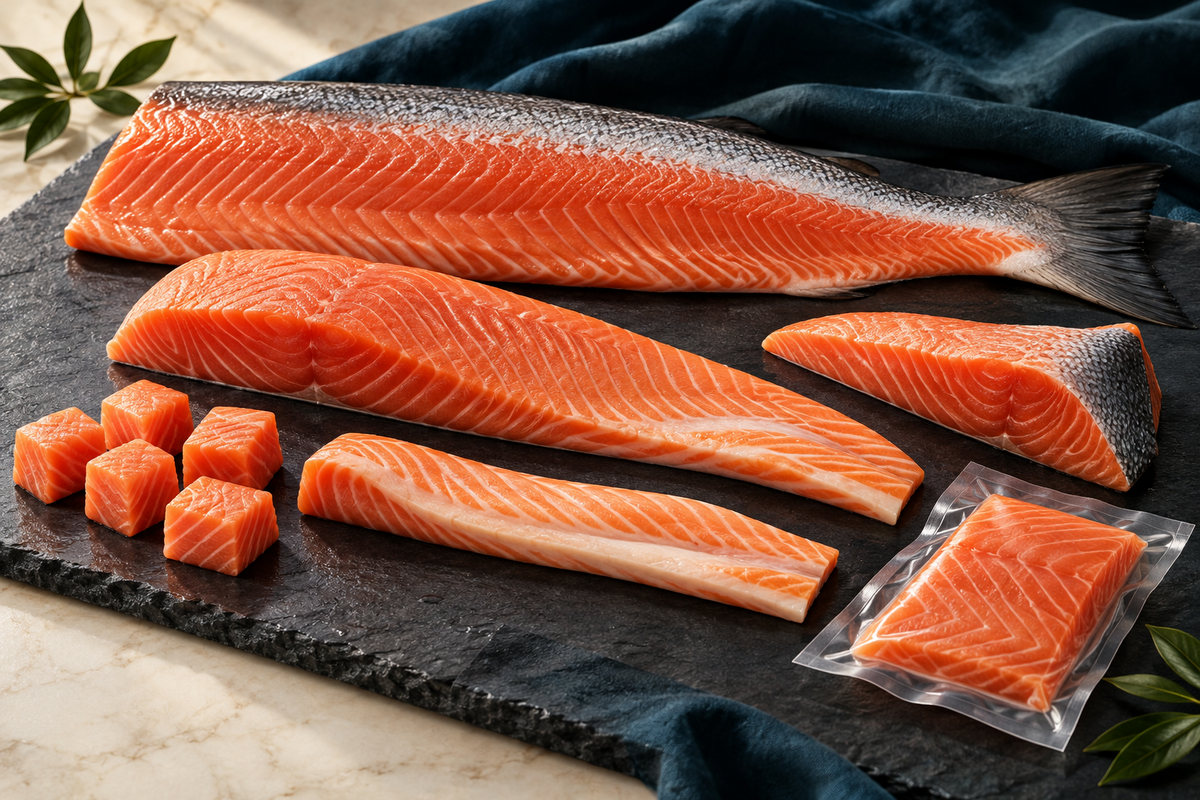
Salmon fillet cuts include whole sides, loins, centre-cut portions, belly strips, tail pieces and diced or sliced fillet meat. Choose by thickness, skin and pin bone status, intended use and the written specification, not the cut name alone. A steak is usually a cross-section of the fish rather than a fillet portion. Trim letters describe processing and may differ between suppliers; they do not identify species or guarantee suitability for raw consumption.
| Product | What you receive | Suitable applications | Confirm before ordering |
|---|---|---|---|
| Whole side | One full fillet with a thick front and tapering tail | Smoking, roasting and portioning | Trim, skin, pin bones and weight band |
| Loin or centre-cut loin | A thick back section; centre-cut boundaries vary | Consistent restaurant portions and retail packs | Exact cutting boundaries and thickness |
| Belly strips | Narrow pieces from the lower fillet edge | Grilling, smoking and cooked preparations | Membrane, skin and strip width |
| Tail portions | Thinner pieces from the rear of the fillet | Quick cooking, flaking and diced products | Minimum thickness and fin-end exclusion |
| Fixed-weight portions | Pieces sorted or cut to an agreed weight | Catering, retail and ready meals | Weight tolerance, source section and shape |
| Cubes, strips or slices | Smaller pieces cut to agreed dimensions | Cooked skewers, stir-fries and processing | Dimensions, source material and bone control |
| Steak | A slice cut across the fish, often containing central bone | Grilling and pan cooking | Bone presence and slice thickness |
| Any frozen cut | A frozen version of the agreed product | Distribution and planned production | Packing, net fish weight and handling instructions |
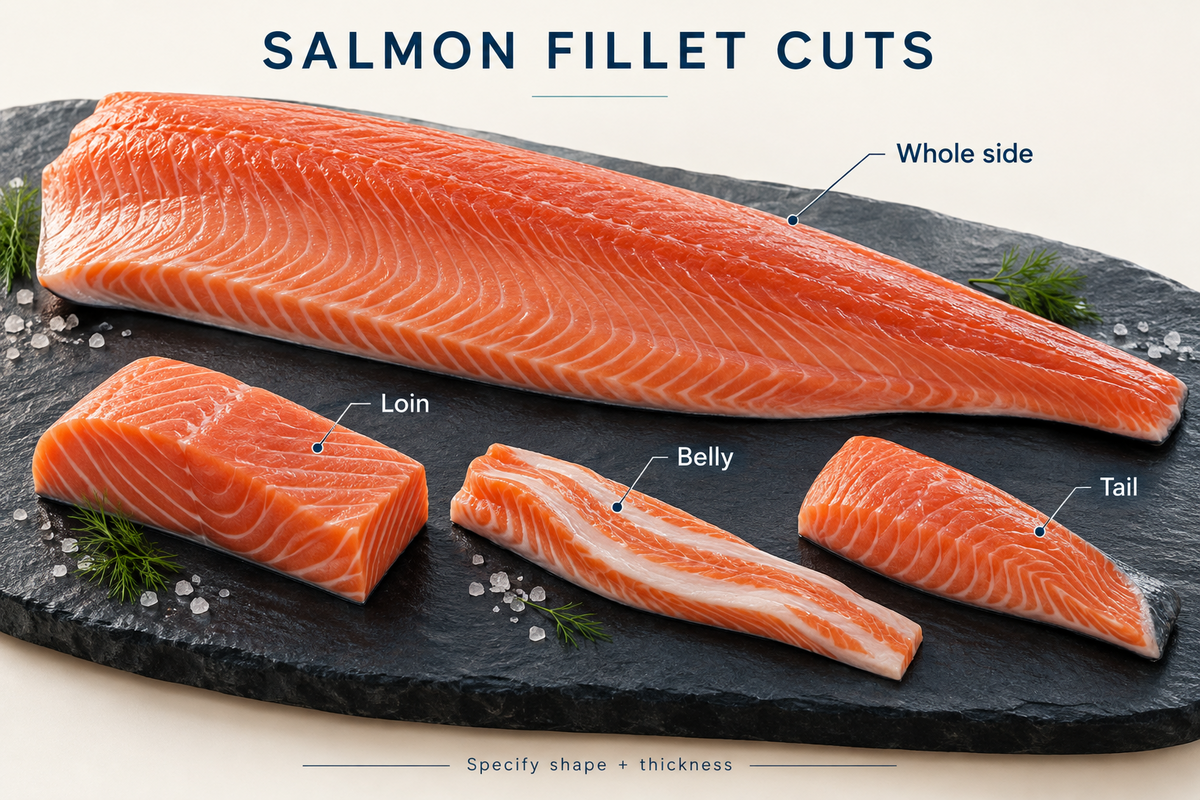
Salmon Fillet Cuts: What Each Name Actually Means
A cut name describes the product’s form, but it rarely tells you everything about the piece in the carton. Start with the physical shape, then add the processing and quality requirements your operation needs.
Whole Side and Butterfly Fillet
A whole side is a fillet taken from one side of the fish. It retains the natural change in thickness between the front, middle and tail, making it useful when a kitchen or processor wants control over portioning. It is not automatically skinless or pin bone-free.
A butterfly product keeps the two sides connected after removal of the frame. The connection and remaining bone status should be shown in the supplier’s specification. Do not confuse this presentation with a single side simply because both are sold as filleted fish.
Loin and Centre Cut
A loin usually refers to the thick back muscle separated from the thinner belly area. A centre-cut loin excludes the front and tail according to the processor’s cutting boundaries. Some sellers use “centre cut” for a transverse portion from the middle of a side, which may still include belly meat.
Ask for a labelled photograph and dimensions. The distinction matters when you want a compact block for portioning rather than a broad piece containing both thick and thin muscle. “Top loin” is also a commercial description, so define the actual section rather than assuming every supplier uses the term identically.
Belly and Tail
Belly pieces come from the lower edge of the fillet and generally have a richer, fattier character than the back section. The amount of membrane, skin and attached tissue depends on how the fish was processed. Specify the usable strip, not just “belly.”
The tail end narrows and becomes thinner. That shape can work well for cooked flakes or smaller pieces, but it is less suitable when every serving must have the same thickness. A tail portion is not inherently defective; it needs an application that suits its geometry.
Portions, Cubes and Trimmings
A portion is a piece intended for a serving or pack. It can come from different areas of a fillet unless the order restricts the cutting location. Cubes, strips and slices describe shape rather than quality grade.
Trimmings are pieces left from processing or portioning. Define whether these are clean edible muscle pieces, mixed shapes or material for further processing. They should not be treated as interchangeable with dimension-controlled cubes.
Steak and Collar
A conventional steak is cut across the fish and commonly contains a section of backbone. A collar comes from the area behind the head and is a separate bone-in product. Neither should be substituted for a boneless fillet portion without approval.
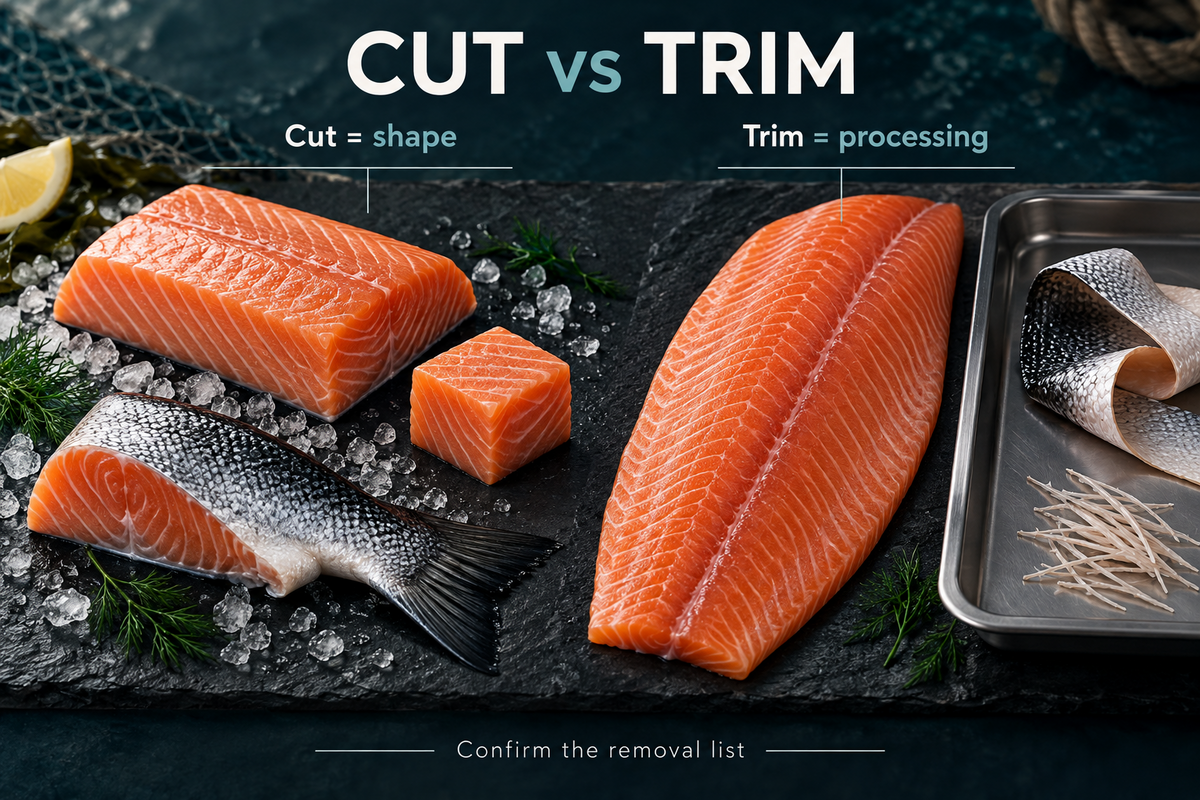
Cut vs Trim: Why A–F Labels Need a Written Specification
Cut and trim answer different questions. The cut describes the shape delivered; the trim describes tissue removed during processing. A loin can be skin-on or skinless, and a whole fillet can be processed to different trim specifications. Neither description replaces the other.
The Primanor fillet guide and First Seafood trim guide illustrate why a letter alone is insufficient: their lower-trim descriptions are not identical. Both show progressively more preparation, but the actual removal list must accompany your order. In the guides reviewed, C includes pin bone removal, D adds closer trimming and tail treatment, and E involves skin removal. First Seafood also lists an F product with the fatline removed.
Use the following table as a reading guide, not a universal contractual standard. The supplier’s current specification takes precedence. A more extensively trimmed product is not automatically fresher, safer or better suited to your recipe; it simply has different processing requirements and usable material.
| Label | Interpretation in the guides reviewed | What must remain explicit |
|---|---|---|
| A and B | Basic filleting with different levels of bone and fin removal | Exact bones, fins and belly tissue retained |
| C | More preparation, including pin bone removal | Skin, belly edge and inspection requirements |
| D | Closely trimmed fillet with additional belly and tail treatment | Cut boundaries and every removal step |
| E | Skin removed from a more extensively trimmed fillet | Normal or deep skinning and brown-muscle treatment |
| F, where offered | Further processing; First Seafood includes fatline removal | Supplier definition and approved appearance |
Skin, Pin Bones and Deep Skinning: What to Confirm
These details affect preparation, presentation and acceptance at delivery. Record each separately even when a supplier also provides a trim letter.
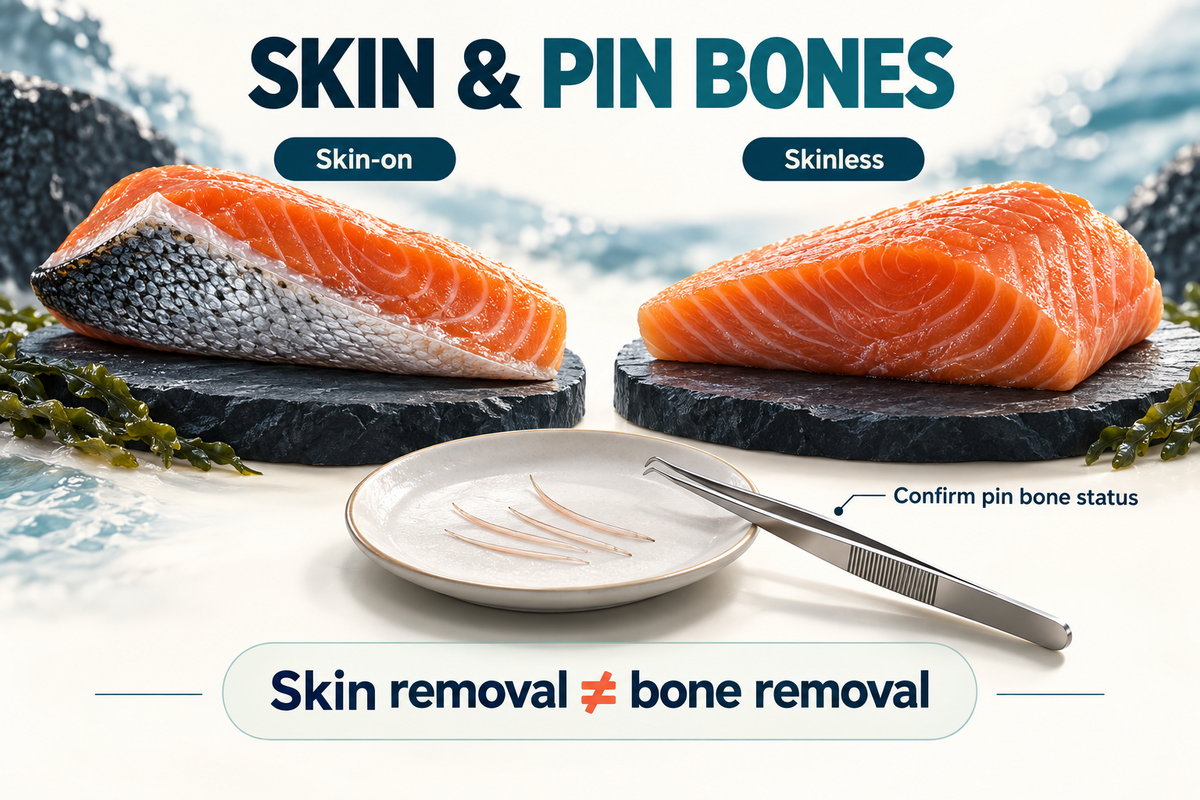
Skin-On vs Skinless
Skin-on pieces retain a supporting layer that can help hold a portion together during handling and cooking. They suit preparations where the skin is served or used during cooking. If the skin will be eaten, specify scaling as well as skin retention.
Skinless pieces avoid skin removal at the destination and may suit cooked ready meals or packs that require exposed flesh. Check that skin removal has not left loose fragments or damaged the portion’s edges.
Pin Bone Status
Filleting removes the main frame, but pin bones require a separate removal operation. Specify pin bone-out product if that is what your process needs, and agree how residual bones will be checked and handled. “Boneless” wording is not a substitute for a documented control procedure or an acceptance specification.
Normal vs Deep Skinning
Normal and deep skinning refer to how much tissue is removed with the skin. Deep skinning may remove more underlying tissue, including darker muscle, depending on the processor. Ask for the required flesh appearance and an approved sample; do not use the term as a guarantee of uniform colour, flavour or food safety.
Weight, Thickness and Shape: How to Specify Consistent Portions
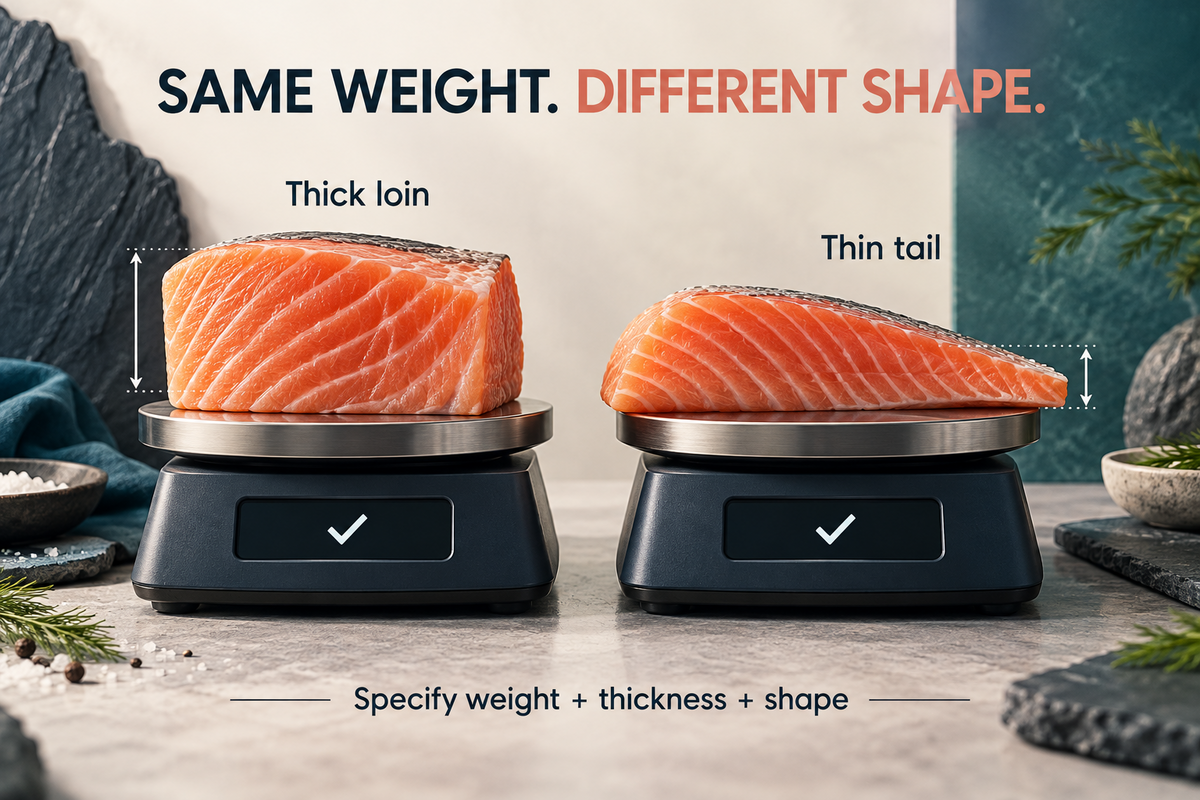
Equal weight does not mean equal cooking behaviour. A broad, thin tail piece and a compact loin portion can weigh the same but respond differently to the same cooking programme. For food service or production lines, specify thickness and permitted shape alongside the target weight.
The purchase order should distinguish fixed-weight from variable-weight portions. Fixed-weight product still needs an agreed tolerance and a measurement method. Define whether the quoted weight refers to frozen fish, thawed fish or another agreed condition, and whether it excludes glaze. Set tolerances with your supplier after assessing samples rather than adopting an arbitrary percentage from a generic guide.
For repeat orders, keep an approved reference photograph showing the acceptable length, width, thickness and belly inclusion. If your menu requires centre sections only, say so. A carton of mixed natural portions may satisfy a weight range yet fail your presentation requirement. Changes to source-fish size or cutting practice should trigger sample approval when they affect the agreed product.
Which Salmon Cut Fits Your Product or Menu?
Choose the cut around the finished product and the preparation your team can perform. A cut that works well for smoking may be inconvenient for a line that needs identical cooked portions.
- Restaurant plating: consider loins or defined centre portions when consistent thickness and appearance matter. Specify whether skin and belly are included.
- Whole-side cooking or smoking: retain a side when the process benefits from a complete fillet. Check that the equipment and preparation method accommodate its changing thickness.
- Retail packs: define the number of pieces, visible presentation, skin status and weight tolerance. Decide whether customers should receive centre portions or mixed natural cuts.
- Cooked ready meals and skewers: choose cubes or strips with agreed dimensions and permitted source sections. Irregular trimmings may require a different production process.
- Belly dishes: specify strip width, membrane removal and skin status to make preparation repeatable.
- Raw or lightly processed applications: obtain documented controls for the intended use. A loin, belly cut or attractive colour does not establish that a product is safe to eat raw.
Frozen Cuts, Packaging and Net Fish Weight
Freezing and packing are separate specifications from the cut. A correct portion can still be unsuitable for your operation if it arrives joined to neighbouring pieces, in the wrong pack size or without clear handling information.
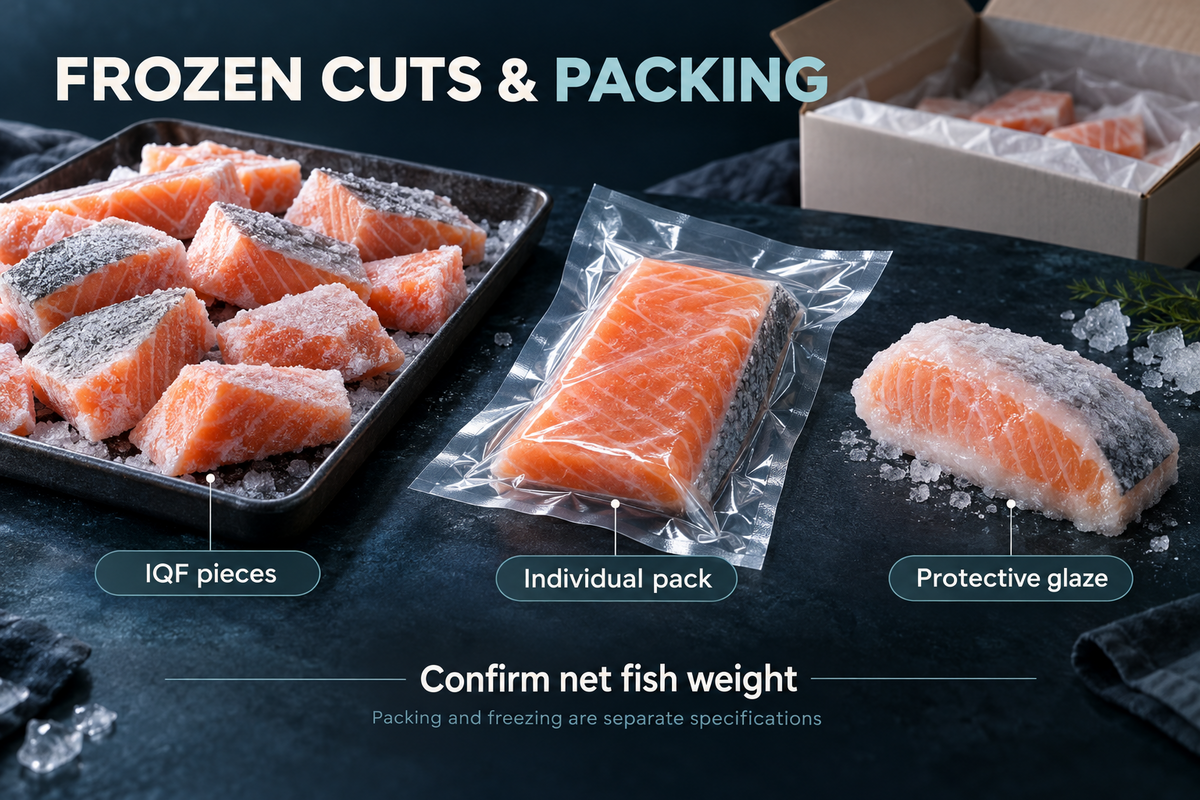
IQF and Individual Packing
IQF describes individually quick-frozen pieces. It can help an operation remove individual portions from a bulk pack, provided the product remains properly frozen and the pieces have not formed a solid clump.
Individual vacuum packing describes the package, not the freezing method. A product may be individually packed without being supplied as loose IQF pieces. State both the freezing presentation and packing format. For bulk cartons, specify liners, inner packs, piece arrangement and lot identification.
Glaze and Net Weight
Glaze is a protective ice coating and is not fish flesh. Ask the supplier to state net fish weight separately from protective ice and packaging, using the measurement and labelling rules applicable to the destination. Avoid comparing cartons solely by their gross shipping weight.
For a deeper purchasing review, use Iran Fish’s frozen salmon buying guide alongside the cut specification. Also agree how samples will be assessed after thawing, since frozen appearance alone does not show the final usable portion.
Handling and Storage
Follow the validated storage and thawing instructions for the actual product and packaging. The FDA seafood handling guidance recommends refrigerated thawing and preventing contamination between raw seafood and ready-to-eat food. Reduced-oxygen packages need their specific label instructions followed; do not assume the fish should remain sealed during thawing.
For cooked seafood, FDA advises an internal temperature of 145°F, approximately 63°C. Freezing does not eliminate all harmful germs, so frozen status is not an assurance of raw-use safety. Refer to the storage requirements guide for the related storage discussion rather than assigning a universal shelf life to every cut.
Species and Origin: Salmon Is Not the Same as Salmon Trout
The cut name does not establish species. Atlantic salmon, Pacific salmon and rainbow trout can all be sold in fillet or portion formats, but those shared shapes do not make the fish interchangeable. Request the scientific species name, origin and production information on the product documents.
Iran Fish identifies its relevant offering as salmon trout. Review the salmon trout product information and ask the supplier to confirm the species and available preparation. Do not assume an Iranian salmon-trout product is Atlantic salmon simply because it has pink flesh or appears in a salmon-related search.
Confirm the species before approving a cut specification, especially if your customer’s label or menu names a particular fish. Iran Fish’s rainbow trout versus salmon explanation provides context, but the order and shipment documents must identify the supplied product.
A Purchase Specification That Prevents Cut Mismatches
A useful specification lets the supplier understand the finished product before production begins. It also gives your receiving team an objective basis for checking the shipment.
- Species and origin: record the documented identity and permitted source.
- Cut: name the product and define the cutting boundaries.
- Trim: attach the supplier’s removal list rather than relying on a letter alone.
- Skin and bones: specify scaling, skinning and pin bone requirements separately.
- Dimensions: agree weight, tolerance, thickness and acceptable shape.
- Frozen presentation: define loose individual pieces, arranged packs or another agreed format.
- Packing and weight: record inner-pack format, net fish weight and glaze declaration.
- Intended use: identify whether the product will be cooked or needs other documented controls.
- Acceptance: approve a reference sample, inspection method and response to deviations.
The example below illustrates the fields to complete. It does not claim that a particular supplier offers every option.
| Field | What to put in the order |
|---|---|
| Product identity | Confirmed species, origin and fresh or frozen status |
| Cut boundaries | Whole side, defined loin, centre portion or permitted mixed sections |
| Processing | Agreed trim-removal list, skin status and pin bone requirement |
| Consistency | Target weight, agreed tolerance and minimum thickness |
| Packing | Inner pack, carton arrangement, lot identification and net fish weight |
| Approval | Reference photograph, sample review and written acceptance criteria |
How to Check Salmon Cuts at Delivery
Check the shipment against the approved specification before releasing it into production. Appearance alone cannot confirm species, safe handling or complete conformity.
- Match labels, lot numbers and product documents to the purchase order.
- Review temperature information and the product’s required receiving conditions.
- Inspect packaging integrity and note damaged seals or torn inner packs.
- Sample portions using the agreed weight and dimensional method.
- Check skin, belly inclusion, trim boundaries and pin bone status.
- Assess representative thawed samples when the acceptance process requires it.
- Record deviations and keep affected lots separate pending review.
Iran Fish’s frozen salmon quality checks can support the visual review. Use those checks alongside traceability and handling records, rather than treating a photograph as proof of safety.
Frequently Asked Questions
The same few naming questions often lead to mismatched expectations between buyers and processors. These answers separate the cut from the additional specifications needed to order it.
What Is the Difference Between a Salmon Loin and a Fillet?
A fillet is a side of fish removed from the main frame. A loin is generally the thick back section cut from that side. Loin boundaries vary commercially, so confirm the actual piece and whether it includes shoulder, tail or belly tissue.
Is Centre-Cut Salmon Always Better Than a Tail Portion?
It depends on the application. Centre sections often suit consistent plating and portioning; thinner tail pieces can suit cooked flakes or smaller cuts. Centre-cut wording alone does not establish freshness or safety, and a processor should define which section it includes.
Does Trim C Mean the Same Thing Everywhere?
Do not assume a trim letter is a complete specification. The reviewed supplier guides associate C with pin bone removal, but other processing details need confirmation. Include the current supplier removal list, skin status and acceptance requirements in the order.
Are Skinless Salmon Portions Guaranteed to Be Boneless?
No. Removing skin and removing bones are separate processes. Ask for the specified pin bone status and inspection controls. A skinless portion can still require bone checking if the purchase specification does not clearly address it.
Can Any Frozen Salmon Loin Be Used for Sushi or Sashimi?
No. The cut and frozen presentation do not establish suitability for raw use. That requires documented controls for the species, processing and intended market. Freezing does not destroy every harmful germ; follow appropriate food safety guidance and supplier instructions.
Discuss Your Fillet Specification with Iran Fish
Start with the documented species and the product you need, then agree the cutting and packing details.
Review Iran Fish’s salmon trout offering to see the relevant product category.
Send your intended use, required cut, skin and pin bone status, portion requirements and destination through the Iran Fish contact page so the team can confirm available options against your specification.