


Frozen Salmon Packaging for Export and Wholesale Supply

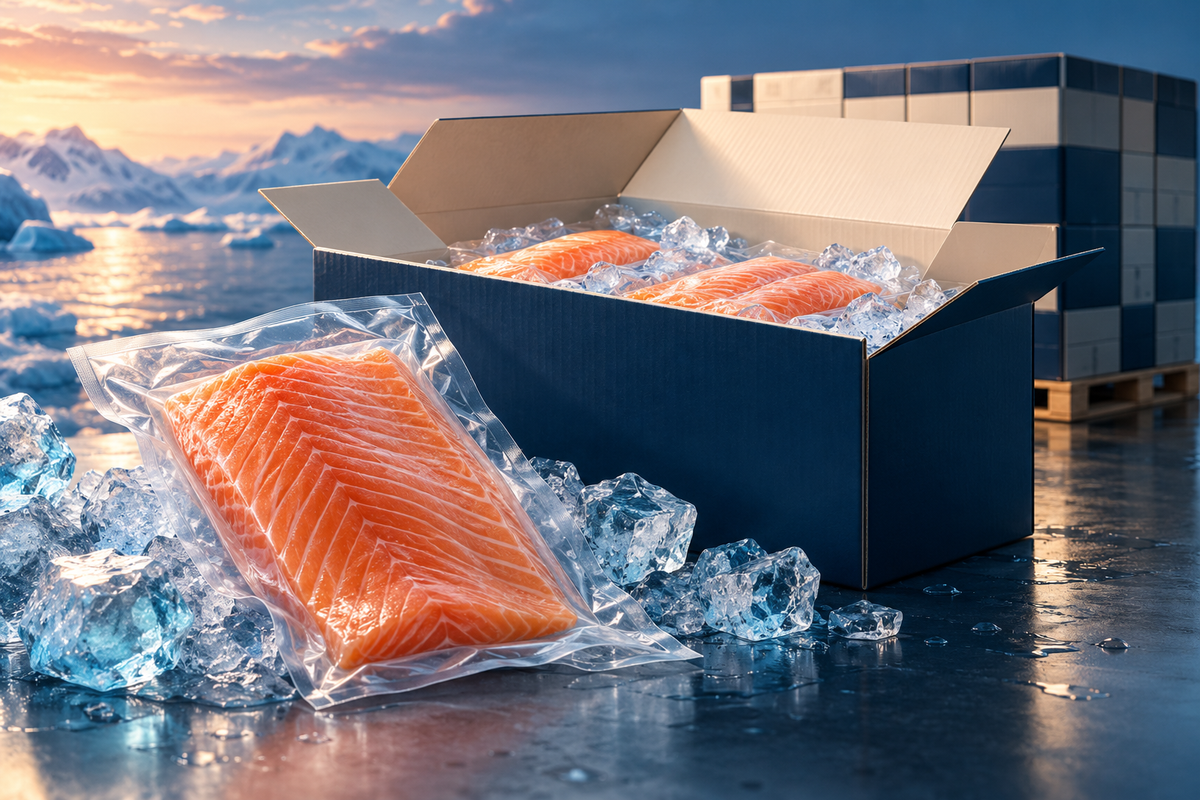
Frozen salmon packaging must protect the fish from dehydration, oxidation, physical damage and loss of traceability throughout distribution. Choose the freezing method, primary pack, glaze specification, carton and pallet layout separately. Agree net fish weight excluding glaze, validate materials and seals under frozen conditions, and provide appropriate storage and thawing instructions. Vacuum packing improves product protection but requires specific food-safety controls; it does not replace the cold chain.
| Requirement | Practical answer |
|---|---|
| Freezing format | Choose IQF or block freezing according to how the customer will handle the fish. |
| Primary packaging | Select food-contact materials suitable for the fish shape, frozen conditions and distribution route. |
| Vacuum packing | Validate seals and control reduced-oxygen hazards through the applicable process and instructions. |
| Glazing | Specify the protective coating separately from the fish quantity. |
| Net weight | Declare and verify fish weight excluding glaze and packaging. |
| Cartons and pallets | Validate strength, stacking and protection without obstructing required airflow. |
| Labels | Link identity, lot, quantity and handling instructions to supporting shipment records. |
| Cold chain | Use the agreed frozen specification; Codex quick-frozen fillets carry storage instructions of -18°C or colder. |
| Shelf life | Use a product- and pack-specific validated period rather than a generic promise. |
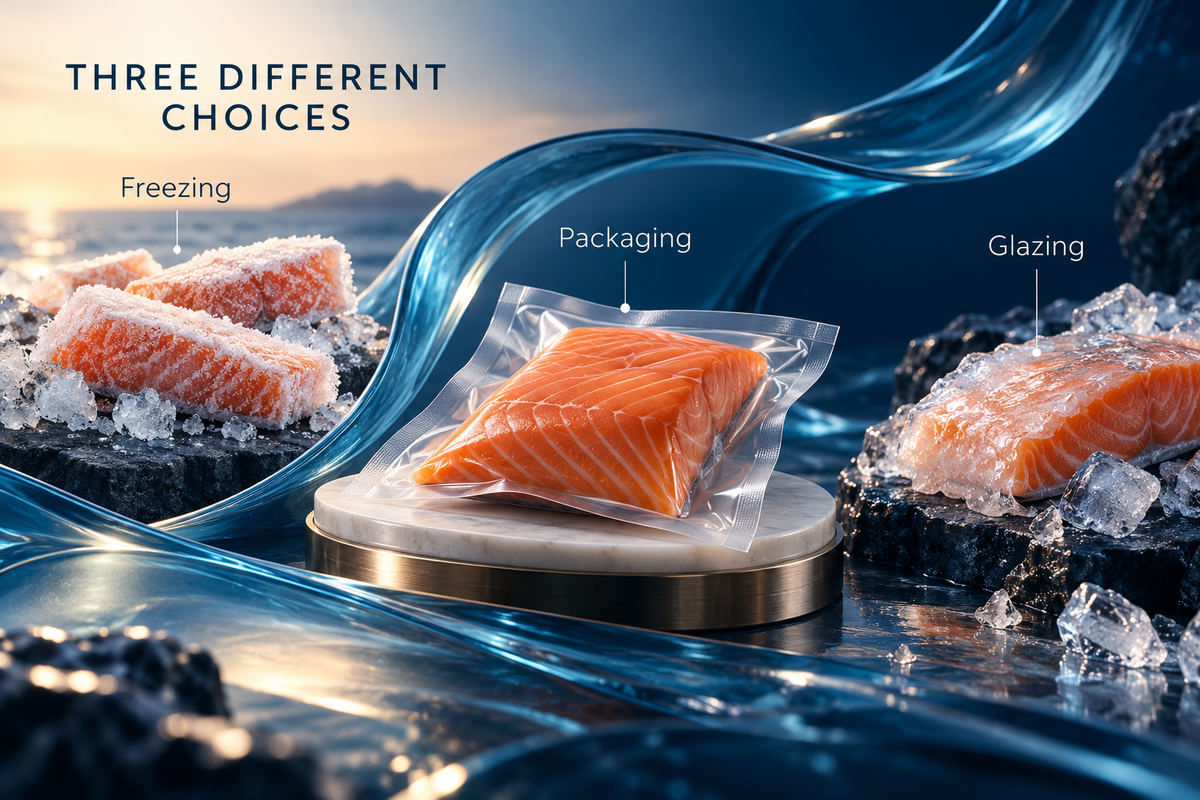
Frozen Salmon Packaging: Separate Freezing from Packing
IQF, block frozen, IVP and glazed do not all describe the same stage of production. Write each required feature separately so that the supplier can confirm the exact finished product.
IQF: individual freezing
Individually quick frozen fish pieces are frozen separately rather than intentionally forming one solid block. This can help a distributor or processor withdraw individual pieces without thawing an entire block, provided the product is handled and stored appropriately.
IQF does not tell you whether each piece has a bag, a vacuum pouch or a glaze coating. Ask how the pieces are protected after freezing and whether the pack specification requires them to remain free-flowing. Verify performance with a representative sample in its final packaging.
Block freezing: a grouped product
Block-frozen fish is supplied as a frozen mass in an agreed form. It can suit processing operations designed to handle that format, but the buyer should confirm block dimensions, fish arrangement and the intended separation or processing procedure.
Do not choose solely from a generic description of convenient bulk handling. A downstream line must be able to accept the block’s dimensions and condition. Clarify whether the product contains added water or protective glaze and how net fish quantity is determined.
IVP: individual vacuum packaging
Individually vacuum packed means each piece has its own vacuum pack. A fillet or portion can be IVP without the abbreviation specifying the freezing technology used.
Individual packs can protect the surface and support controlled withdrawal of pieces. They also introduce requirements for film performance, seal validation, handling instructions and reduced-oxygen hazard controls. Confirm the entire process, not merely the presence of a tight-looking pouch.
Glazing: a protective ice coating
Glazing applies an ice layer to the frozen fish surface. It is a protective treatment rather than a replacement for all packaging, as discussed in the FAO guidance on glazing and packaging frozen fish.
Agree the coating requirement and its verification method. There is no single glaze percentage that suits every product, process and route. Avoid using a coating figure to disguise the quantity of fish actually supplied.
| Term | Describes | Still needs confirmation |
|---|---|---|
| IQF | Freezing individual pieces | Primary pack, glaze and storage performance |
| Block frozen | Frozen product grouped as a mass | Dimensions, arrangement and handling method |
| IVP | Individual vacuum packs | Freezing process, film, seals and handling controls |
| Glazed | Protective ice coating | Coating specification and net fish weight |
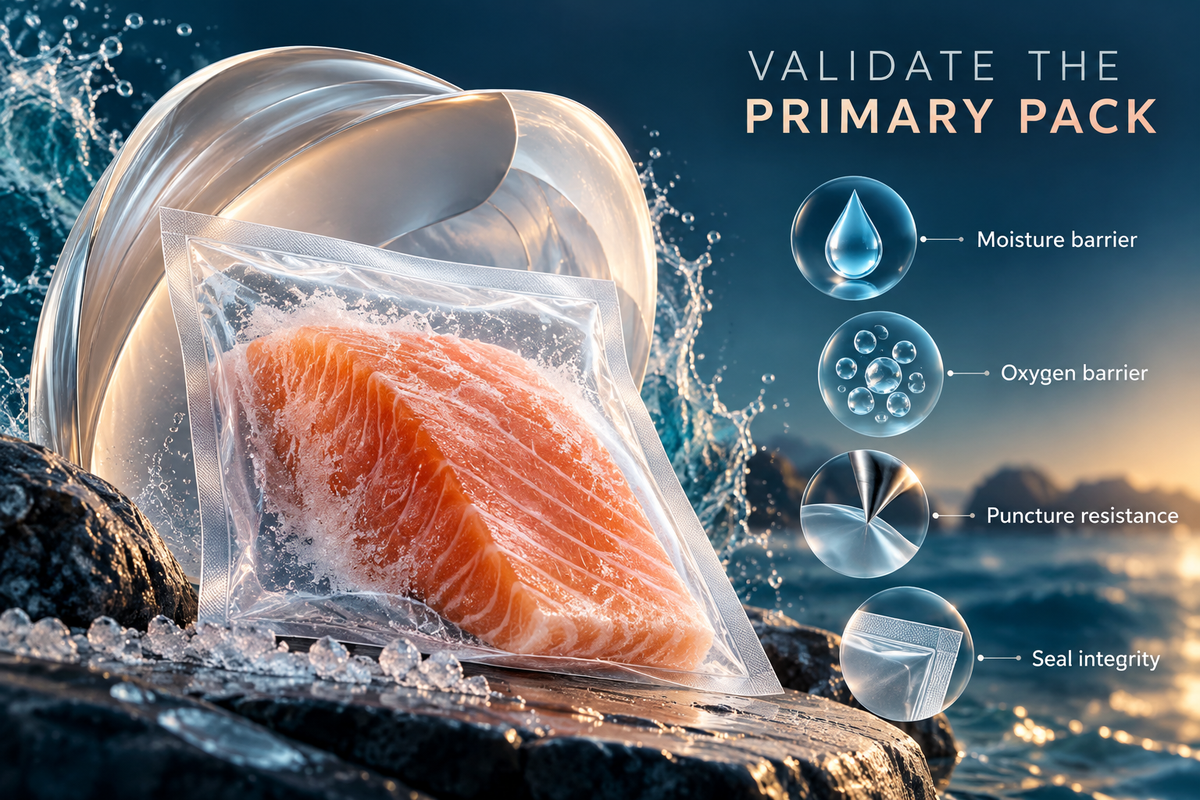
Choose Food-Contact Materials and Validate the Seal
The best pack is the one that performs with the actual fish and distribution conditions. Assess the primary material, seal and finished pack together rather than choosing by film thickness alone.
Moisture and oxygen barriers
Request confirmation that the material is suitable for food contact under the intended market’s requirements. Its specification should address frozen use and the product characteristics, including oily flesh and any sharp features that may contact the film.
Moisture and oxygen barriers help protect against dehydration and oxidation. Their performance depends on the material construction, seals and handling, so a claim such as high barrier should be supported by technical information and pack trials. Do not assign a universal film thickness to every fillet, steak or whole fish.
Puncture resistance
Whole fish, skin-on cuts and bone-in steaks can stress a pouch differently from boneless portions. Assess whether protective positioning, suitable liners or other design changes are needed without introducing unsuitable food-contact materials.
Test the final product under expected freezing, storage and handling conditions. Include likely contact with carton edges and adjacent packs. A pouch that survives packing can still fail during frozen handling if the design ignores the product’s shape.
Seal validation
Agree how seal performance will be checked and recorded. Relevant observations include contamination in the seal area, folds, incomplete bonding, punctures and loss of vacuum, supported by suitable integrity testing rather than appearance alone.
Establish an approved process for the chosen machine and film. Changes to product size, material or equipment settings may require renewed assessment. Link production checks to the lot so that failures can be isolated and investigated.
Vacuum Packing Requires Specific Handling Controls
Vacuum packaging creates a reduced-oxygen environment. The FDA guidance on reduced-oxygen seafood packaging identifies Clostridium botulinum growth and toxin formation as a relevant hazard in these products. A vacuum pouch should therefore be supplied within an appropriate food-safety system, with validated controls and instructions for the actual product and market.
Frozen condition is part of the intended handling system, not permission to leave the pack at uncontrolled temperatures. Under the FDA Food Code supplement’s thawing provision, reduced-oxygen packaged fish labelled to remain frozen until use must be removed from that environment before refrigerator thawing. This is US model-code guidance; confirm the applicable requirements and approved instructions for your operation rather than treating it as a worldwide packaging law.
The supplier and importer should agree the wording and language of handling instructions before shipment. Do not add an unsupported ready-to-eat or raw-use claim because the fish is vacuum packed. Packaging, parasite controls and intended-use safety assessment answer different questions, and the pack must communicate the relevant requirements clearly.
Specify Glazing and Net Fish Weight
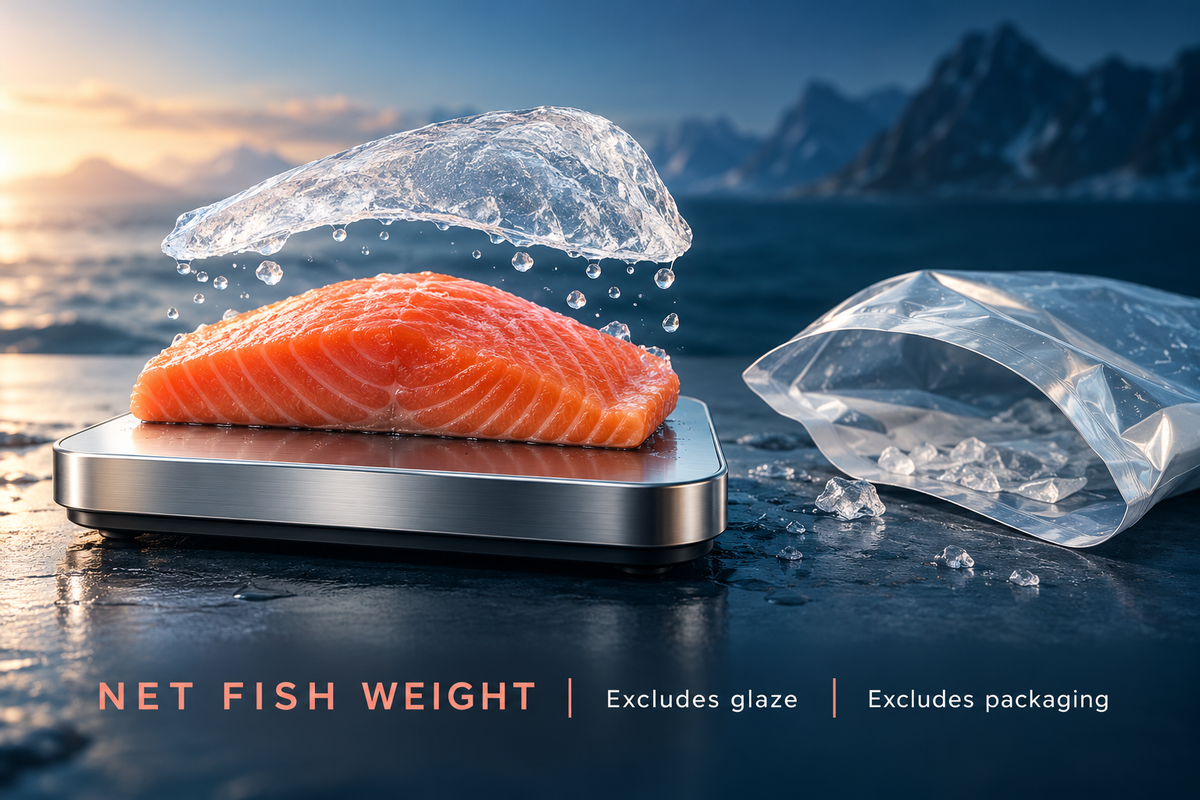
Glaze protects a frozen surface, but its amount can vary with product shape and processing conditions. Define the required coating and the measurement procedure instead of accepting an unexplained gross carton weight. If glaze percentage is reported, agree its calculation basis so that both parties are interpreting the same quantity.
The Codex standard for quick-frozen fish fillets states that declared net contents exclude glaze. Packaging is also separate from fish quantity. The contract, label and packing list should distinguish net fish weight, protective ice and gross shipping weight without relying on the buyer to infer the difference.
Approve a net-weight verification method suited to the product and applicable rules. Removing glaze must not become an uncontrolled thawing exercise that changes the product being measured. Record sample identity, method and results so that a discrepancy can be investigated against production records, rather than resolved through inconsistent weighings.
Design Cartons and Pallets for the Distribution Route
Primary packaging protects the fish surface, while outer packaging supports handling and identification. Design them as one system for the actual shipment route and the customer’s receiving operation.
Primary packs and master cartons
Specify pieces or packs per carton, net fish quantity, product arrangement and separation materials where needed. State whether a carton can contain mixed sizes or cut locations and how that variation is identified.
Confirm that cartons and labels remain usable in the expected cold and humid environment. A clear code on an individual pouch is helpful only if it can be linked to the outer carton and shipment records.
Carton strength and protection
Validate the carton for the expected frozen product load, handling and stacking conditions. An outer box that looks substantial may still deform or lose strength in the distribution environment.
Assess compression, movement inside the carton and protection of exposed pack edges. Check whether opening the carton at destination can damage pouches. An approved sample should include the filled, closed master carton rather than only an empty box and a loose fillet.
Pallet and container loading
Agree pallet dimensions, stacking pattern and securing method with the logistics provider and receiving site. Protect carton edges and avoid unstable overhang. Confirm that the arrangement fits the equipment and handling route.
Refrigerated transport also depends on appropriate loading and airflow. Do not block designated circulation paths or treat a transport unit as a substitute for completing product freezing. Record the loading arrangement and product condition before dispatch.
Prepare Labels and Traceability Records
The required label depends on the destination, sales channel and product form. Prepare a market-specific artwork and document checklist, then cross-check it against the actual shipment before printing and dispatch.
- Confirm the lawful commercial name and scientific identity where required.
- Describe the product form accurately, including relevant skin and bone information.
- State net quantity on the correct basis.
- Include lot identification linking packs, cartons and shipment records.
- Provide required producer or packer information.
- Include storage and handling instructions in the required language.
- Address fish-allergen declarations and other applicable labelling provisions.
- Use origin and production-method statements appropriate to the destination rules.
- Confirm date marking and shelf-life information for the actual product.
- Avoid certification claims unsupported by the shipment’s documentation.
| Label or record field | Cross-check |
|---|---|
| Product identity | Product specification, invoice and market naming requirements |
| Net quantity | Weight-control records excluding packaging and glaze |
| Lot code | Production batch, carton records and packing list |
| Dates | Actual production records and validated date-marking system |
| Handling instructions | Approved food-safety process and destination requirements |
| Certification claim | Relevant certificate scope and supply-chain evidence |
Do not assume that one export label is acceptable in every country. The importer should confirm the applicable requirements, and the supplier should approve an accurate version before shipment.
Protect the Cold Chain and Validate Shelf Life
For products covered by the quick-frozen fillet standard, Codex specifies storage instructions of -18°C or colder. Use the agreed product and transport specifications throughout distribution, including loading and transfer operations. A container setpoint or air reading is not the same as a measured product temperature; decide what monitoring evidence is required and where it will be collected.
Shelf life depends on the fish, process, pack and storage conditions. Do not attach a universal storage period to every frozen salmon product because another supplier publishes one. The producer should support the declared period with appropriate validation and records, and the buyer should specify the remaining shelf life required at delivery.
Use a receiving procedure that combines document review, packaging inspection and appropriate temperature checks. If damage or an excursion is found, hold the affected stock for assessment under the agreed procedure. The site’s frozen salmon shelf-life and storage guide provides related storage context; the shipment’s validated specification remains the basis for acceptance.
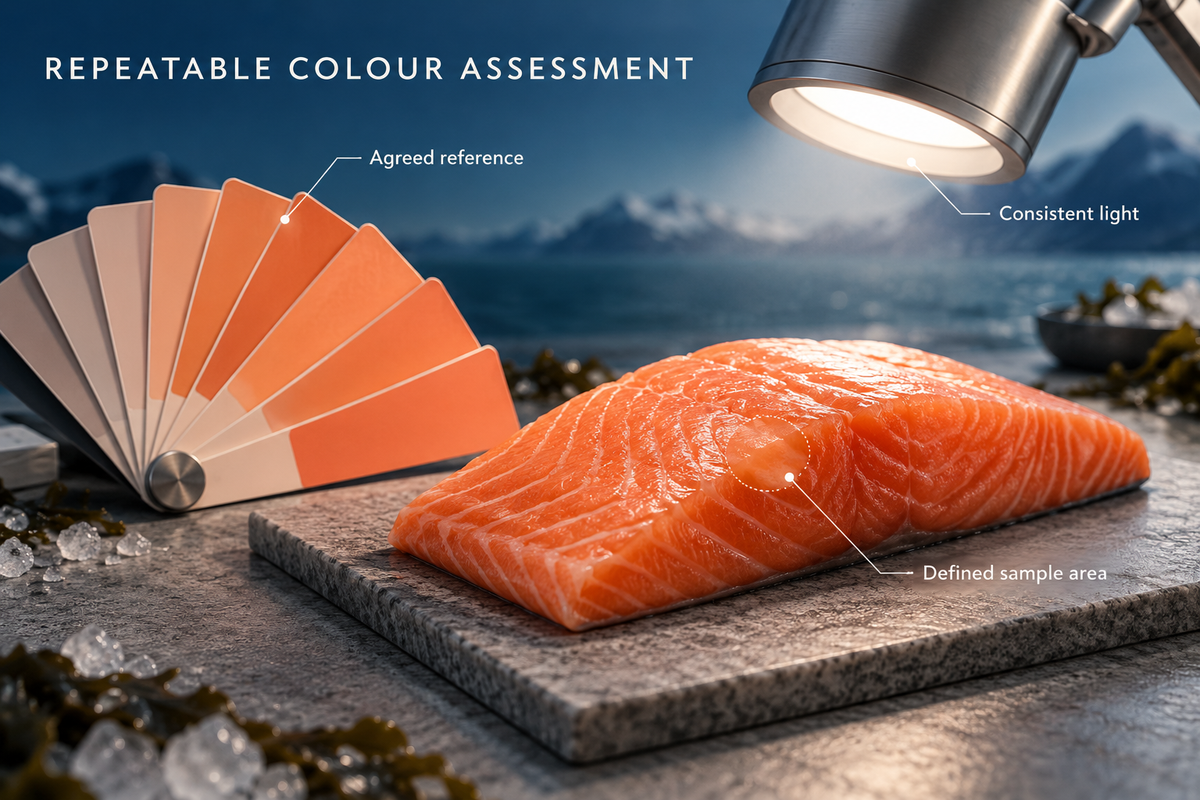
Approve a Packaging Sample Before Shipment
Assess the pack as the customer will receive it, including the primary pouch, carton and label. Record the approved version so later substitutions can be identified and reviewed.
- Confirm that the species and cut match the written specification.
- Inspect the frozen pack for damage, contamination and seal defects.
- Verify the agreed net-weight basis and sampling method.
- Check label legibility and consistency across pack levels.
- Evaluate carton fit, product movement and stacking performance.
- Confirm storage and thawing instructions with the responsible technical team.
- Review a representative product sample after controlled thawing where appropriate.
- Document changes that require renewed approval.
Use the frozen salmon buying checklist to organise the wider product enquiry. Packaging approval should accompany product and compliance approval rather than stand in for them.
Frequently Asked Questions
These questions clarify the terms most often confused in frozen salmon enquiries. The final pack still needs to be matched to the fish, handling process and destination.
Is IQF the same as vacuum packing?
No. IQF describes freezing pieces individually, while vacuum packing describes removing air from a sealed pack. A purchase specification should state the freezing and packaging methods separately.
Should glaze count towards the declared fish weight?
For quick-frozen fillets under the cited Codex standard, declared net contents exclude glaze. Agree a verification method and distinguish fish weight from protective ice, packaging and gross shipping weight.
Can frozen salmon be exported without individual vacuum packs?
Individual vacuum packing is not the only possible format. Depending on the product and process, other primary packs or glazed bulk formats may be suitable. Confirm protection, compliance and handling performance for the actual route.
Should vacuum-packed fish be thawed inside its sealed pouch?
Do not assume that it should. Follow the approved label and applicable procedure. The cited US model-code provision requires fish labelled to remain frozen until use to leave the reduced-oxygen environment before refrigerator thawing.
Is the same shelf life valid for every frozen salmon pack?
No. The declared period needs support for the actual product, process, packaging and storage conditions. Ask for the producer’s validated specification and agree the remaining period required at receipt.
Discuss Your Export Packing Requirements with Iran Fish
Start with the product on Iran Fish’s salmon-trout supply page and confirm its scientific identity and current availability.
Send the required cut, pack format, net quantity, destination, label language and receiving requirements.
Ask the team to confirm the proposed packing specification and provide a representative sample for approval before supply.