


How to Identify High-Quality Frozen Shrimp

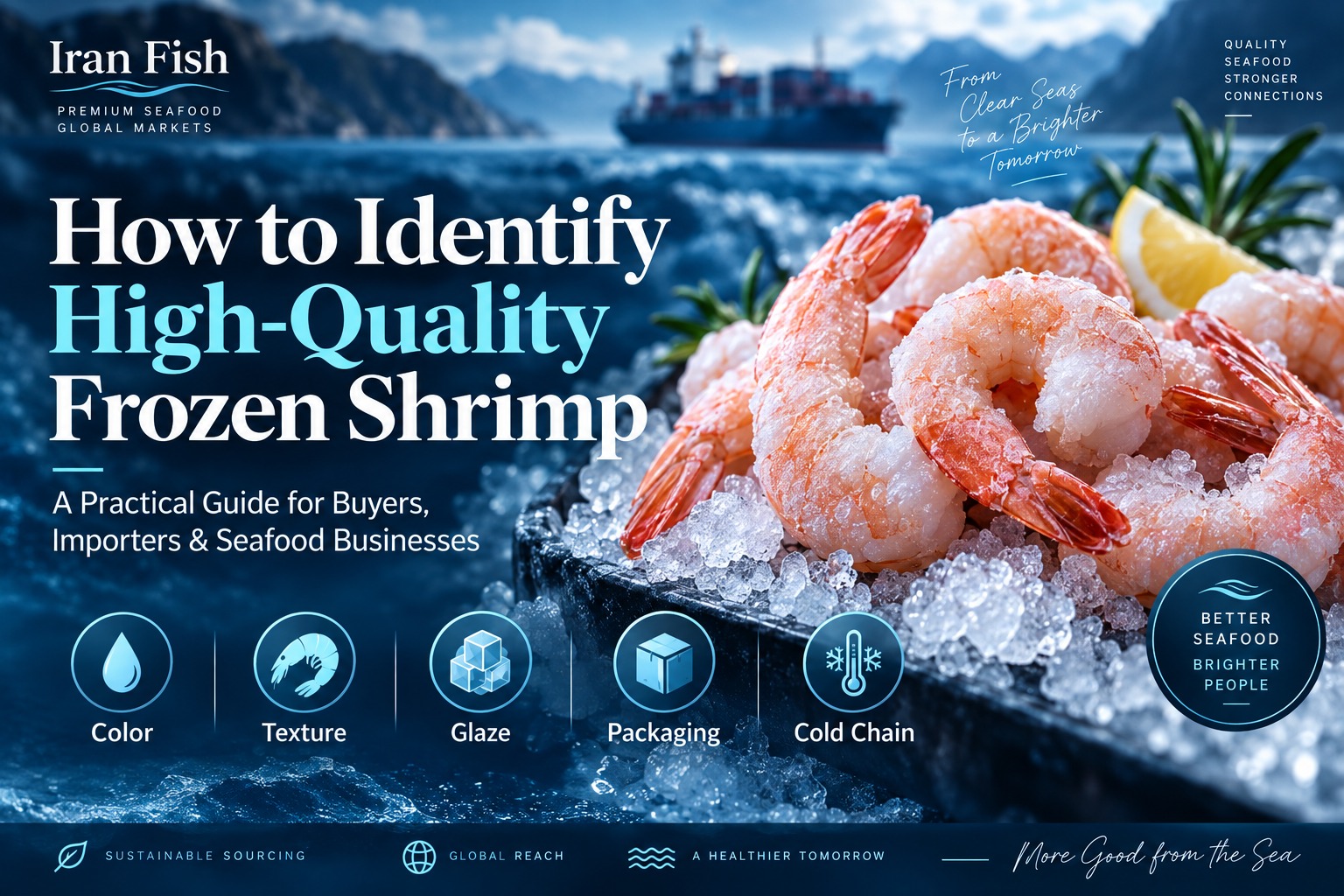
Good frozen shrimp quality is easier to judge when you know what to check: the shrimp should be solidly frozen, evenly coloured for its species and processing form, free from severe dehydration or excessive ice buildup, and packed in an intact package. After controlled thawing, high-quality shrimp should have a mild, clean marine smell and firm flesh rather than sour, ammonia-like, mushy, or unusually dry characteristics.
| Quality check | What good frozen shrimp should show | Warning signs |
|---|---|---|
| Frozen appearance | Natural, reasonably uniform colour; intact pieces | Large dry white patches, heavy dehydration, severe discoloration |
| Ice and glaze | Even protective glaze where used | Heavy loose ice, thick irregular ice, excessive frost, damaged glaze |
| Individual pieces | Free-flowing in an IQF pack | Large frozen clumps that suggest temperature fluctuation or partial thawing |
| Package | Sealed, intact, correctly labelled | Tears, leaks, open seals, damaged cartons |
| Odour after thawing | Mild, clean, characteristic seafood odour | Sour, rancid, strongly fishy, ammonia-like or other objectionable odours |
| Texture after thawing | Firm and resilient | Mushy, excessively soft, dry, leathery or badly damaged flesh |
| Size and workmanship | Consistent with the declared count and product form | Major size variation, excessive broken pieces, poor peeling or deveining |
| Net contents | Matches the declared deglazed or net product weight | Unclear glaze declaration or unexplained difference between gross and net weight |
| Traceability | Clear lot, origin, species and processing details | Missing or inconsistent product information |
| Cold chain | Product remains properly frozen through storage and transport | Evidence of repeated thawing and refreezing |

Frozen Shrimp Quality: What High-Quality Shrimp Should Look, Smell and Feel Like
Frozen shrimp quality should be assessed with more than one signal. Colour, odour, texture, shell condition and the way the shrimp has been frozen and packed work together to tell you whether the product has been handled well.
Appearance and Natural Colour
Colour varies by species, whether the shrimp is raw or cooked, and whether the shell has been removed. Raw whiteleg or Vannamei shrimp may look greyish to translucent when raw, while cooked shrimp develops a more opaque pink appearance. The important point is not one exact shade but a natural, reasonably consistent appearance for the declared product.
The U.S. Food and Drug Administration advises that shrimp flesh should be clear with a pearl-like colour and little or no odour when seafood is selected. Large areas of abnormal darkening, drying, or severe discoloration deserve closer inspection rather than being dismissed as normal variation.
Clean, Mild Odour
Frozen shrimp should not have a strong smell while fully frozen. After controlled thawing, its odour should remain mild and characteristic of clean seafood. Strong sour, rancid, ammonia-like or otherwise objectionable odours are warning signs.
Odour matters because visual appearance alone cannot establish whether a lot is satisfactory. FAO and Codex-related shrimp quality guidance uses odour as an important sensory criterion when evaluating thawed shrimp.
Firm, Resilient Texture
High-quality thawed shrimp should feel firm rather than mushy. Texture can deteriorate when raw material quality is poor, freezing is too slow, the product experiences temperature fluctuations, or the shrimp is repeatedly thawed and refrozen.
Very dry or leathery areas can indicate dehydration, while excessive softness may signal quality deterioration. Texture should be judged after proper thawing because frozen flesh is naturally rigid.
Shell and Flesh Condition
For shell-on products, look at shell integrity, broken sections, abnormal spotting and damage around the head or neck area. Peeled products should be checked for exposed damage, remaining shell beyond the agreed specification, incomplete deveining where deveining is required, and excessive broken pieces.
For wholesale buyers, product form matters. A Vannamei shrimp lot sold as HOSO, HLSO, PD or PDTO should be evaluated against the workmanship expected for that exact form rather than against a generic idea of what shrimp should look like.

Check the Package Before You Buy Frozen Shrimp
You can learn a great deal before opening the bag or master carton. Packaging condition is one of the fastest ways to spot possible handling or cold-chain problems.
- Check that the retail bag, inner pack or carton is sealed and has no tears, leaks or obvious punctures.
- Look for heavy loose frost or large amounts of free ice inside an IQF bag.
- Check whether individually frozen shrimp remain reasonably separate instead of forming one large solid clump.
- Read the species name, processing form, size count, net weight, storage statement and lot information.
- Confirm whether the product is raw or cooked and whether it is shell-on, headless, peeled, deveined or tail-on.
- For glazed shrimp, distinguish the declared net contents from gross pack weight.
- For B2B purchases, compare the physical pack with the written specification and approved sample rather than relying on the front label alone.
A damaged pack does not automatically prove the shrimp is spoiled, but it raises the risk of dehydration, contamination, weight loss or temperature exposure. Buyers receiving commercial quantities should record damaged cartons and inspect representative packs before approving the lot.
Ice Crystals, Clumping and Freezer Burn: What They Really Tell You
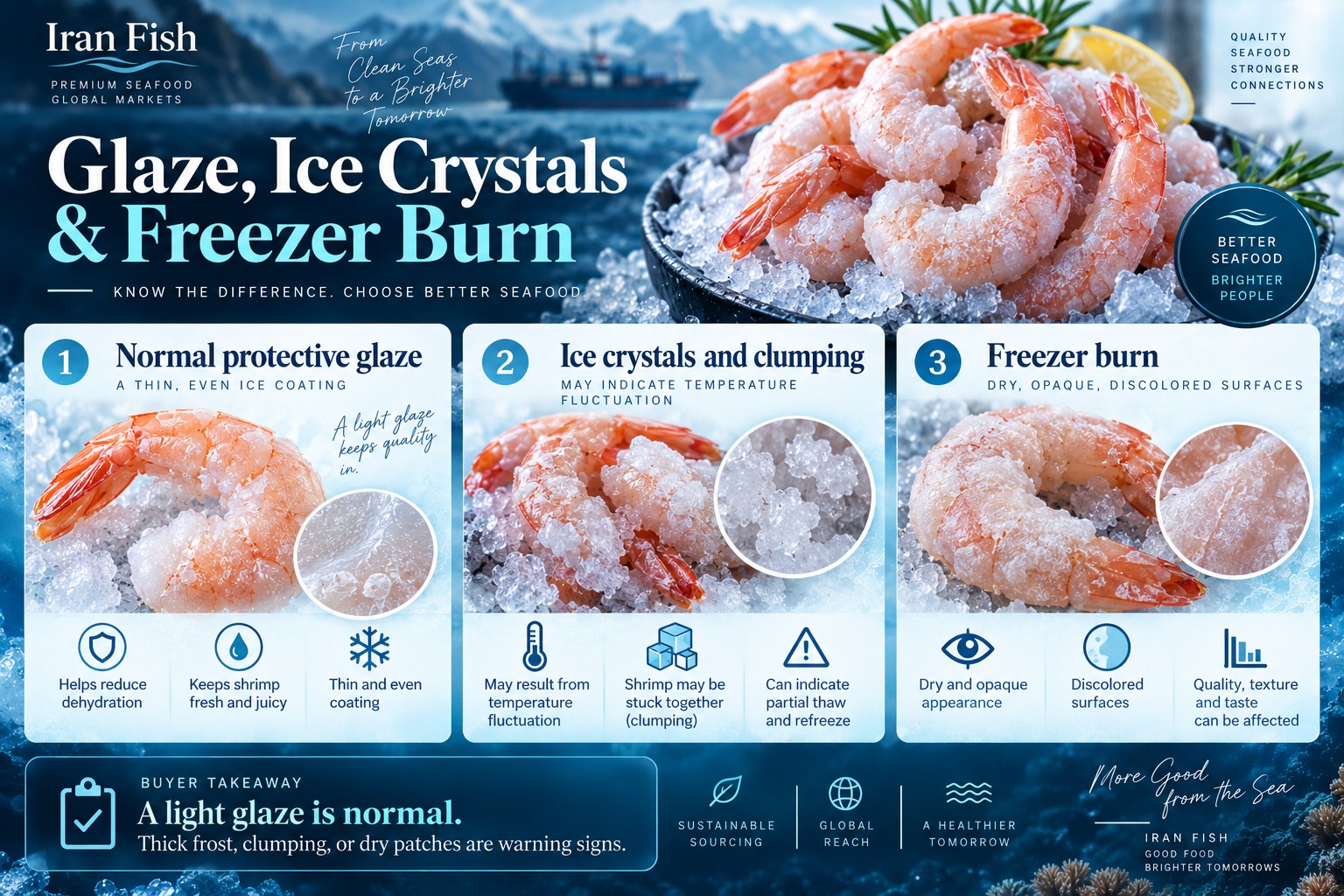
A light, even glaze can be intentional and useful. Glazing forms a protective ice layer around frozen shrimp and helps reduce dehydration during storage. FAO guidance for shrimp processing specifically describes glazing as a method used to protect frozen shrimp from dehydration and preserve quality during storage and distribution. That is different from uncontrolled frost or loose ice inside a package.
Large ice crystals, heavy frost and irregular clumps can indicate that the pack experienced temperature fluctuation. When frozen food warms enough for surface ice to melt and then becomes colder again, water can recrystallise. Repeated changes can damage texture and contribute to moisture loss. In an IQF product, pieces are expected to remain individually frozen, so a large solid mass deserves investigation even though clumping alone cannot prove that the shrimp is unsafe.
Freezer burn is primarily a quality defect caused by dehydration. It commonly appears as pale, dry, chalky or whitish areas and may produce a tougher texture after cooking. It should not be confused with every small frost crystal on a frozen product. When freezer burn is extensive, the shrimp may still have been continuously frozen, but its eating quality, appearance and yield can be significantly reduced.
Glazing and Net Weight: How to Judge the Ice Coating
Glaze is not automatically a defect. A properly applied glaze protects frozen shrimp, but buyers should know how much product remains after the protective ice is removed.
Why Frozen Shrimp Is Glazed
Frozen shrimp can lose moisture during cold storage as water migrates from the product surface. A controlled layer of ice helps reduce this dehydration and limits exposure of the shrimp surface to air. Research on frozen shrimp has also shown that glazing can help slow undesirable quality changes during storage.
For an importer or distributor, the practical question is whether the glaze is even, declared and consistent with the agreed product specification.
Normal Protective Glaze vs Excessive Ice
A smooth protective coating is different from thick, irregular ice buildup around the whole contents of a bag. Excessive ice can obscure the shrimp and make it difficult to judge the actual product condition. Uneven glaze may also leave some pieces poorly protected while adding unnecessary water around others.
There is no single glaze percentage that defines quality for every product, market and contract. The correct level depends on the specification and applicable rules. What matters commercially is that the glaze is declared accurately, applied consistently and excluded from net shrimp content where required.
Why Net or Deglazed Weight Matters
Codex requirements for quick-frozen shrimp state that where the product is glazed, the declared net contents should exclude the glaze. That is especially important when comparing suppliers because gross carton weight can include protective ice while deglazed weight reflects the shrimp itself.
Wholesale buyers should agree on the deglazing method before shipment and verify representative packs. Iran Fish’s Vannamei shrimp buying guide for importers and distributors explains why size count, glaze and net contents should be written into the purchase specification together.
IQF vs Block Frozen Shrimp: Does the Freezing Method Affect Quality?
Both IQF and block-frozen shrimp can be high quality when the raw material is good and the process is controlled. The freezing format should match the buyer’s intended use rather than being treated as a quality grade by itself.
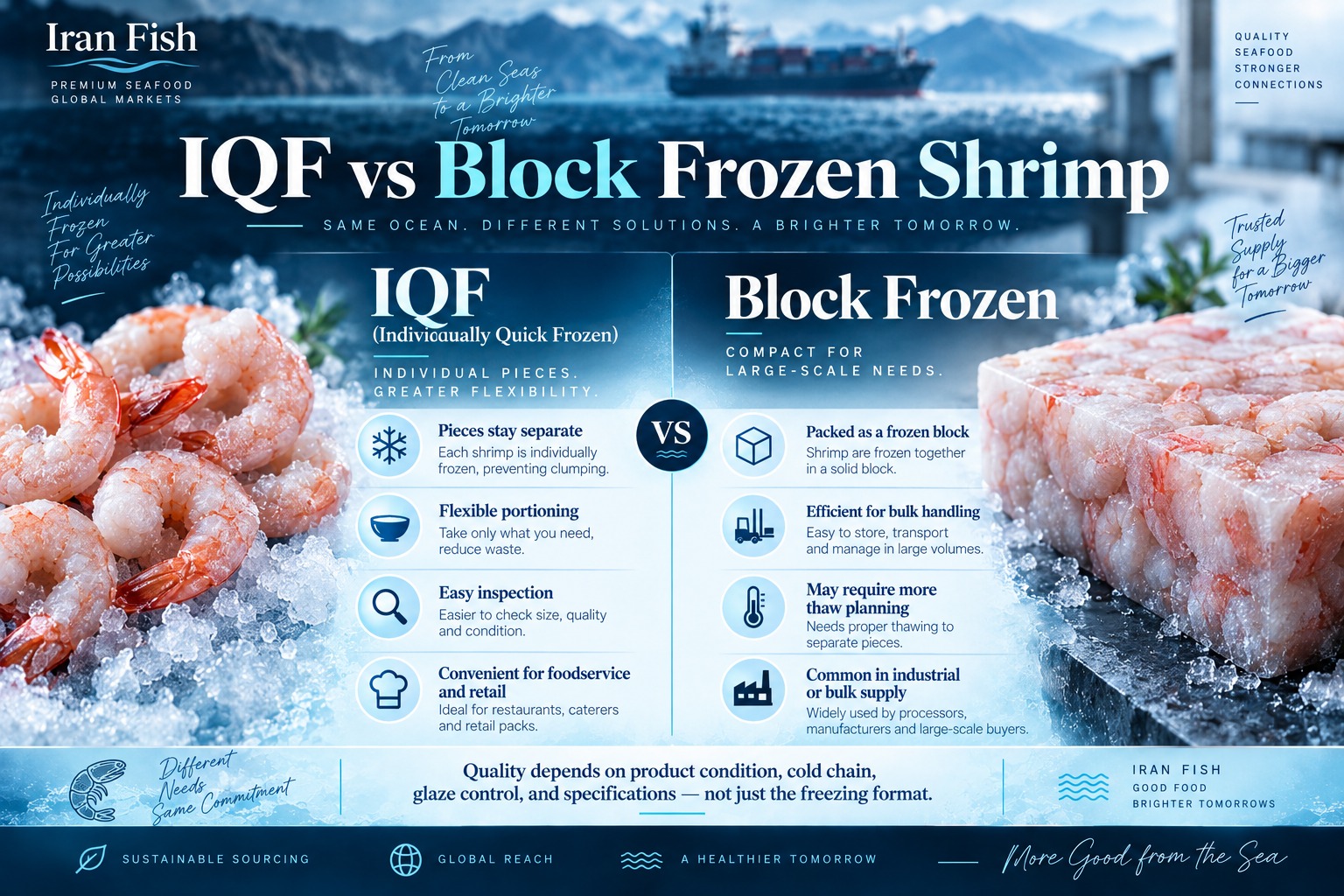
Individually Quick Frozen (IQF) Shrimp
IQF processing freezes shrimp as separate pieces. This is useful when restaurants, retailers or processors need to remove only the quantity required without thawing an entire block. Rapid freezing generally limits the formation of large ice crystals, which helps protect cell structure and reduce drip loss after thawing.
A good IQF pack should be free-flowing enough for the pieces to separate. Severe clumping may indicate glazing problems, packaging issues or temperature fluctuation and should be checked against the supplier’s specification.
Block Frozen Shrimp
Block freezing packs shrimp together and freezes them as a solid block, often with water providing additional physical protection. It can work well for bulk operations that thaw and process an entire block at once. Because less surface area is exposed directly to freezer air, block freezing can also offer strong protection against dehydration when handled correctly.
The trade-off is convenience. A buyer who needs portion-by-portion access may prefer IQF, while a processor using full-carton batches may find block frozen practical.
Which Quality Signals Matter More Than the Freezing Format
Raw material condition, freezing speed, glaze, stable storage, packaging integrity and cold-chain control often tell you more about final quality than the words IQF or block frozen alone. A poorly handled IQF product can be worse than a well-produced block-frozen lot.
When sourcing frozen shrimp, ask how the product was frozen, what storage condition is required, how glaze is measured and what acceptance criteria apply after thawing.
| Factor | IQF shrimp | Block-frozen shrimp |
|---|---|---|
| Physical format | Separate frozen pieces | Shrimp frozen together as a block |
| Portion flexibility | High | Lower unless the whole block is thawed |
| Main inspection clue | Pieces should remain reasonably free-flowing | Block should remain intact and properly protected |
| Dehydration control | Depends strongly on glaze and packaging | Often protected by the frozen block and surrounding ice |
| Best fit | Retail, food service, flexible production | Bulk processing, full-batch use |
Size Count, Uniformity and Product Form Are Part of a Quality Check
Size is not the same thing as quality, but inaccurate sizing is a quality-control and specification problem. Professional buyers should verify that the shrimp they receive matches the count, product form and unit of weight stated in the contract.
Understanding Shrimp Count Sizes
Commercial shrimp sizes are commonly expressed as the number of shrimp within a stated unit of weight. A 16/20 count contains fewer, larger shrimp than a 41/50 count when both use the same product form and weight basis.
The unit is essential. A count per pound cannot be compared directly with the same-looking number expressed per kilogram. The Vannamei shrimp sizes guide explains the count system and why deglazed weight should be used when verifying glazed products.
Why Uniformity Within the Pack Matters
A pack labelled with one size range should not contain a random mix of very large and very small shrimp. Some variation is inevitable in a biological product, but excessive variation affects portion control, cooking consistency, appearance and customer expectations.
Importers should define the permitted count and uniformity tolerance in the specification, then test a representative sample after deglazing.
HOSO, HLSO, PD and PDTO Quality Checks
Each product form has different inspection points. HOSO shrimp needs attention around the head, shell and attachment area. HLSO removes the head, so buyers can focus more heavily on the neck cut, shell condition and tail. Peeled and deveined products should be inspected for peeling workmanship, remaining vein, tail condition where applicable, shell fragments and broken flesh.
For a detailed comparison, see Iran Fish’s guide to HOSO vs HLSO shrimp.
How to Inspect Frozen Shrimp After Thawing
Frozen appearance is only the first half of the inspection. A controlled thaw allows you to assess odour, texture, workmanship and defects that may not be obvious through glaze or packaging.
- Thaw the shrimp under refrigerated conditions when time allows. FDA guidance recommends gradual thawing in the refrigerator overnight for frozen seafood.
- Keep the sample identity and lot information with the shrimp throughout the inspection.
- Remove glaze using the agreed method before checking net contents and count.
- Smell the shrimp before cooking. The odour should be mild and characteristic, not sour, rancid, strongly fishy or ammonia-like.
- Press the flesh gently. It should be firm and resilient rather than mushy, excessively soft or unusually dry.
- Inspect colour under consistent lighting and compare it with the approved sample or product specification.
- Check shell condition, black spotting, broken pieces, peeling and deveining workmanship according to product form.
- Count and weigh the shrimp if size accuracy and net contents are part of the purchasing specification.
- Record the results by lot and carton so a dispute can be traced to actual samples rather than general impressions.
Commercial buyers should use an agreed sampling plan instead of opening only the best-looking carton. NOAA’s chilled or frozen shrimp grading standards include workmanship and sensory quality criteria for evaluating shrimp lots, illustrating why a professional inspection looks beyond a single visual feature.
Freezer Burn vs Spoilage: Know When Quality Loss Becomes a Safety Concern
Freezer burn and spoilage are not the same thing. Freezer burn is moisture loss from frozen food and mainly affects quality, producing dry, pale or tough areas. USDA guidance explains that food maintained continuously at 0°F, approximately -17.8°C, remains safe from the standpoint of frozen storage, although quality can decline over time. For international frozen shrimp, Codex labelling guidance specifies storage at -18°C or colder.
Spoilage is different. After thawing, sour, rancid, strongly fishy or ammonia-like odours are reasons not to use the product. FDA seafood guidance specifically warns against seafood with sour, rancid, fishy or ammonia odours. A slimy or unusually mushy texture, obvious contamination, leaking packaging or other abnormal conditions also deserve rejection or food-safety review.
Do not rely on smell alone to prove safety. Pathogenic bacteria cannot always be detected by appearance, smell or taste. Consumers should follow safe handling and cooking guidance, while commercial buyers should rely on approved suppliers, HACCP-based controls, traceability, temperature records and applicable laboratory or regulatory requirements.
What Importers and Distributors Should Check Before Approving a Frozen Shrimp Lot
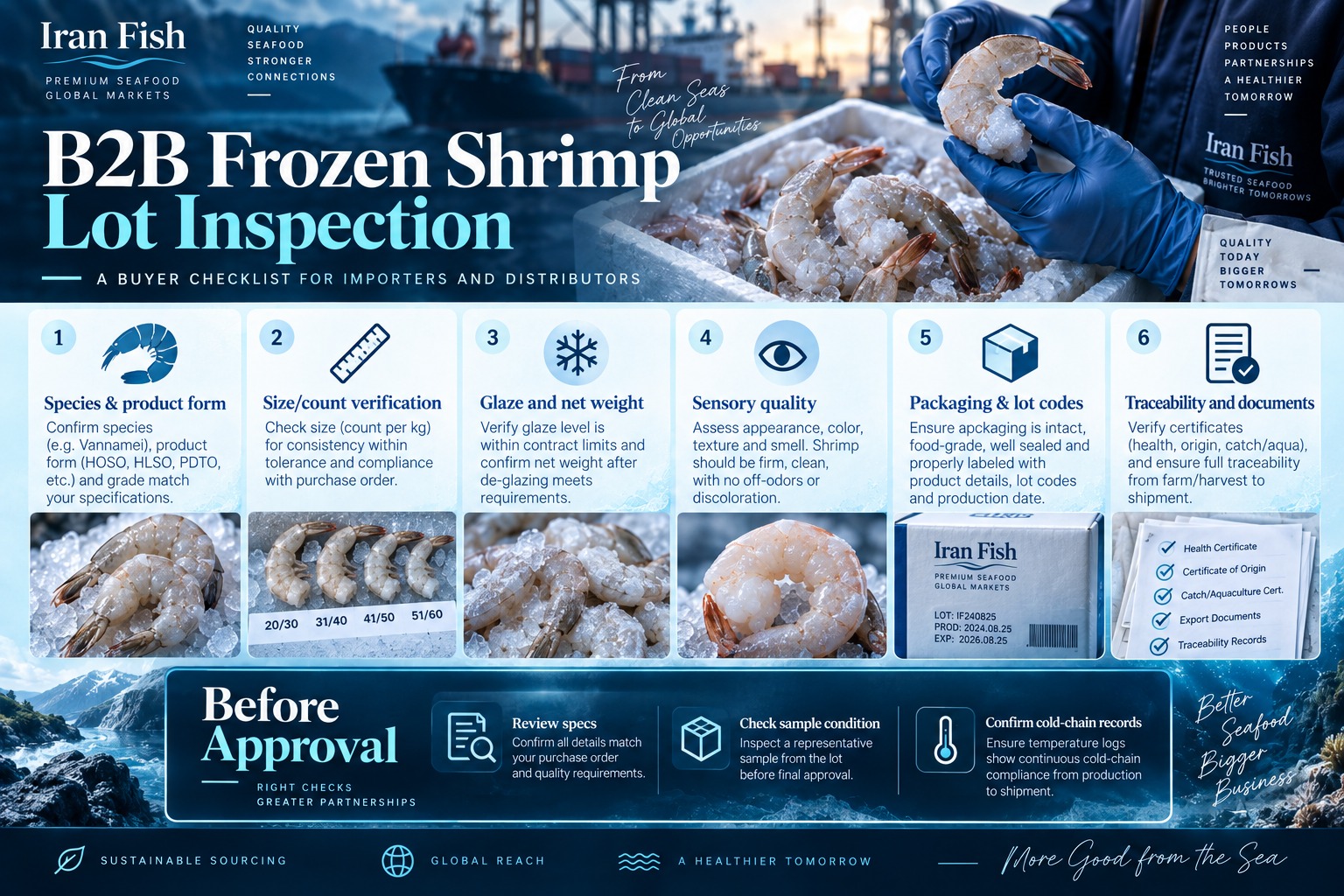
For B2B buyers, high-quality frozen shrimp is not simply shrimp that looks attractive. A shipment should conform to a written specification that can be tested at receiving or during pre-shipment inspection.
Confirm Species, Product Form and Count Basis
Write the scientific or accepted commercial species, the exact product form and the count basis into the order. For example, a specification should make clear whether the shrimp is HOSO, HLSO, PD or PDTO, whether the tail remains, and whether count is measured per pound or per kilogram.
Do not approve a quotation that lists only a vague size label such as jumbo or large. Numerical counts are much easier to verify.
Verify Glaze, Net Contents and Workmanship
Agree on glaze declaration, net contents excluding glaze where applicable, acceptable weight tolerance and the method used for deglazing. Then define workmanship requirements such as maximum broken pieces, remaining shell, vein removal, tail damage and other defects relevant to the product form.
These criteria turn subjective arguments about quality into measurable acceptance conditions.
Inspect Packaging, Lot Codes and Traceability
Outer cartons and inner packs should protect the shrimp from dehydration, damage and contamination. Labels should match the product inside and provide enough information for traceability, including lot identification and storage instructions.
For import shipments, product identity should remain traceable through the commercial documents. The exact documentation required depends on the destination country and product.
Define Sensory and Defect Acceptance Criteria
A useful specification describes acceptable colour, odour and texture rather than relying only on words such as premium. It should also define how black spot, dehydration, broken pieces, foreign material, poor peeling and other defects are handled.
NOAA’s current grading standards for chilled or frozen shrimp demonstrate the level of detail that can be used when assessing workmanship and sensory variation. A private commercial specification can adopt its own agreed tolerances as long as they comply with destination rules.
Review Food-Safety and Shipment Documentation
Food safety and commercial quality overlap, but they are not identical. Buyers should confirm the processor’s relevant food-safety system, traceability, lot records and shipment documents required by the importing market.
| B2B check | What to define before ordering | What to verify on the lot |
|---|---|---|
| Species | Exact shrimp species | Product and documents match |
| Product form | HOSO, HLSO, PD, PDTO or other | Workmanship matches the form |
| Size | Count range and unit | Count test after deglazing |
| Freezing | IQF or block | Frozen condition and clumping where relevant |
| Glaze | Declared method or target | Even coating and correct net contents |
| Sensory quality | Colour, odour, texture expectations | Thawed sample meets specification |
| Defects | Agreed tolerances | Representative sample inspected |
| Packaging | Inner pack and master carton | Seals, cartons and labels intact |
| Traceability | Required lot information | Lot codes correspond to documents |
| Documentation | Destination-specific requirements | Documents complete before shipment |
How Cold-Chain Handling Protects Frozen Shrimp Quality
Quality can be lost after processing if the cold chain is unstable. Frozen shrimp should remain at the required frozen-storage temperature from production through warehousing, transport and delivery.
Stable Frozen Storage
Codex guidance for quick-frozen shrimp states that the label should indicate storage at -18°C or colder. USDA consumer guidance similarly recommends maintaining a freezer at 0°F, approximately -17.8°C, for frozen food quality and safety.
The objective is consistency. A product that remains fully frozen under stable conditions is better protected from recrystallisation and moisture migration than one repeatedly exposed to warmer conditions.
Temperature Fluctuation and Recrystallisation
When frozen shrimp warms and cools repeatedly, small ice crystals can melt and reform into larger crystals. This may damage tissue structure and increase moisture loss during thawing. It can also contribute to frost, clumping and glaze damage.
For importers, temperature records and container condition can therefore provide important context when a shipment arrives with unexpected texture or ice buildup.
Safe Thawing Without Damaging Texture
For household use, the FDA recommends thawing frozen seafood gradually in the refrigerator overnight. When faster thawing is necessary, the seafood can be sealed in a plastic bag and immersed in cold water, or microwaved on defrost if it will be cooked immediately afterward.
Commercial thawing procedures should follow the receiving operation’s food-safety plan and the intended processing method. Avoid uncontrolled warm-water or room-temperature thawing because the outside of the shrimp can warm long before the centre is fully thawed.
A Practical Frozen Shrimp Quality Checklist
Use this checklist when comparing retail packs, samples or commercial lots. No single item proves quality on its own, so combine the observations before making a decision.
- The package is sealed, intact and correctly labelled.
- The shrimp is fully frozen when received.
- IQF pieces are reasonably separate rather than frozen into one unexplained mass.
- There is no severe freezer burn or extensive dehydration.
- Glaze appears even and consistent with the specification.
- Net contents and deglazed weight are clear where glaze is used.
- Species, product form and count size are identified.
- Shrimp size is reasonably uniform within the declared grade.
- Shell, head, neck, tail and peeled surfaces are appropriate for the product form.
- Broken pieces and workmanship defects remain within the agreed tolerance.
- After thawing, odour is mild and characteristic.
- Thawed texture is firm rather than mushy, leathery or excessively dry.
- There is no sour, rancid or ammonia-like odour.
- Lot codes and traceability information are available.
- Commercial buyers can match the physical lot to the approved specification and shipment documents.
Frequently Asked Questions About Frozen Shrimp Quality
These questions cover the quality signals buyers most often encounter when comparing frozen shrimp.
How can you tell if frozen shrimp is high quality?
Start with the package and frozen condition. Good shrimp should be properly frozen, naturally coloured for its species and processing form, free from severe dehydration, and protected by intact packaging. IQF shrimp should normally remain reasonably separate. After thawing, the flesh should be firm and the odour mild and characteristic. For wholesale purchases, also verify count size, deglazed net weight, glaze, workmanship, lot traceability and the written product specification.
Are ice crystals on frozen shrimp always a bad sign?
No. A protective glaze is intentionally made of ice, and a small amount of frost does not automatically mean the product is poor quality. Concern increases when there is heavy loose ice, thick irregular frost, broken glaze or a large clump in a product that should be individually quick frozen. These conditions may point to moisture loss or temperature fluctuation and justify closer inspection.
What should frozen shrimp smell like after thawing?
It should have a mild, clean and characteristic seafood odour. FDA guidance says shrimp should have little or no odour when selected and advises against seafood with sour, rancid, fishy or ammonia-like smells. If thawed shrimp develops an objectionable odour, do not treat the smell as a normal result of freezing.
Does freezer burn mean frozen shrimp is unsafe?
Not by itself. Freezer burn is dehydration and is mainly a quality problem. It can leave pale, dry or tough areas and reduce eating quality. USDA guidance notes that foods kept continuously frozen at 0°F remain safe from the standpoint of frozen storage, although quality declines over time. If the shrimp also shows spoilage signs after thawing, has damaged packaging, or has been mishandled, evaluate those issues separately.
Is IQF shrimp always better than block-frozen shrimp?
No. IQF offers convenience because the shrimp freezes as separate pieces, while block frozen can be effective for bulk operations and may provide strong protection against dehydration. Final quality depends on raw material, freezing control, glazing, packaging, storage stability and handling. Buyers should choose the format that fits their use and judge the actual lot against measurable specifications.
Looking for Consistent, Export-Ready Frozen Shrimp?
Quality is easiest to protect when the buyer and supplier agree on the specification before the shipment is produced. Species, product form, count size, freezing method, glaze, net contents, packaging, workmanship and inspection criteria should be clear from the start.
Iran Fish supplies frozen shrimp for international buyers and provides several product forms and grading options. You can review the company’s shrimp supply options and farmed Vannamei shrimp pages to compare available products.
For a specific size, form, packing requirement or destination, contact Iran Fish with your product specification so the team can review availability, processing, documentation and shipment requirements.