


HOSO vs HLSO Shrimp: Understanding the Key Differences

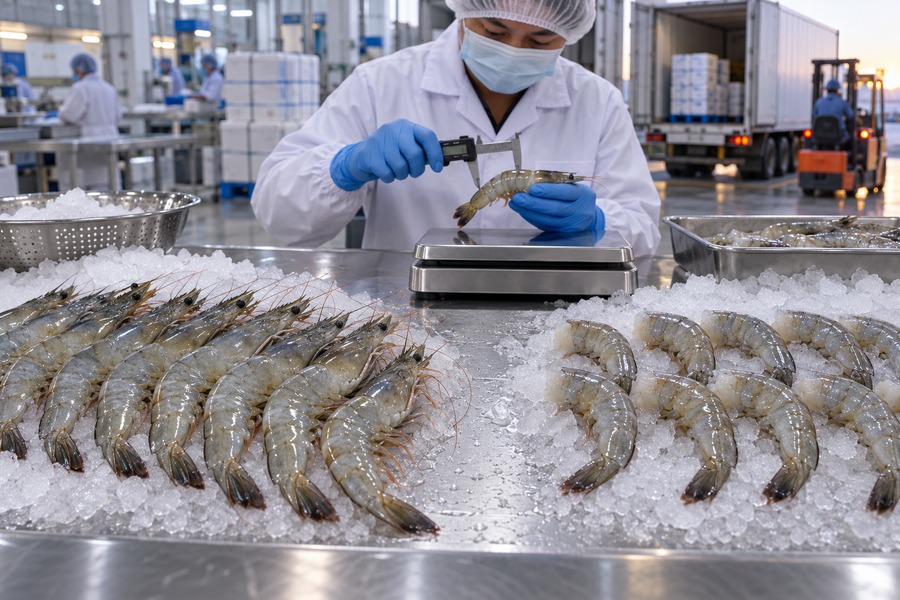
HOSO vs HLSO shrimp comes down to one processing step: HOSO keeps the head and shell, while HLSO removes the head but retains the shell. Choose HOSO when whole-shrimp appearance and head-derived flavour matter; choose HLSO when you need simpler handling, more usable tail weight per carton and a versatile raw material. Counts are not directly interchangeable, so compare the same species, form, unit, deglazed weight, freezing method and quality specification before ordering.
| Buying point | HOSO shrimp | HLSO shrimp |
|---|---|---|
| Full term | Head-on, shell-on | Headless, shell-on |
| Physical form | Whole shrimp with head, shell and tail | Head removed; shell and tail retained |
| Main strength | Natural whole-shrimp presentation and fuller shell-and-head flavour | Easier handling and a greater share of usable tail per stated net weight |
| Common size basis | Often specified as pieces per kilogram | Often specified as pieces per pound, although market practice varies |
| Preparation | Requires heading and usually peeling before many applications | Ready for peeling, deveining or further processing |
| Quality focus | Head attachment, head colour, melanosis, shell condition and odour | Shell integrity, exposed neck meat, count accuracy, texture and dehydration |
| Best suited to | Whole grilling, premium displays, seafood platters, broths and markets that value head-on shrimp | Restaurants, distributors, processors, retail packs and shell-on cooking |
| Buyer’s deciding factor | Appearance and whole-product use | Operational convenience and usable tail yield |

What Do HOSO and HLSO Mean in the Shrimp Trade?
HOSO means “head-on, shell-on.” The shrimp remains close to its harvested form: the head, carapace, abdominal shell and tail fan are present. It may be washed, graded, glazed and frozen, but it has not been headed or peeled. This makes HOSO visually distinctive and useful when the buyer wants the shrimp to arrive as a complete animal.
HLSO means “headless, shell-on.” Processors remove the head while leaving the abdominal shell and tail in place. Some markets also use terms such as head-off shell-on or green headless shrimp. Because shorthand can vary between sellers, a purchase specification should always write out “headless, shell-on” and describe any additional requirement, including whether the shell must be easy-peel, whether the vein remains and whether the tail fan must be intact.
Both forms can refer to several shrimp species. In international aquaculture trade, they frequently refer to whiteleg shrimp, scientifically identified by the FAO as Penaeus vannamei. Buyers looking specifically for Iranian farmed whiteleg shrimp can review the Iran Fish Vannamei shrimp range rather than relying on the word “shrimp” alone.

HOSO vs HLSO Shrimp: The Differences That Affect an Order
Removing the head changes far more than the appearance of the product. It changes the weight composition, size designation, handling needs, inspection points and way a kitchen or processor uses each carton.
- Presentation: HOSO delivers an intact, natural shape. HLSO presents the tail section without the head.
- Usable portion: A kilogram of HLSO contains more tail material than a kilogram of HOSO because the stated product weight does not include heads.
- Preparation: HOSO requires an extra heading step. HLSO can move directly to peeling, deveining, marinating or shell-on cooking.
- Quality sensitivity: The head is a delicate area. Its colour, attachment and odour deserve close attention in HOSO lots. HLSO removes those head-related visual concerns, but it still requires checks at the cut or neck area.
- Size comparison: A count written without the unit of weight and product form is incomplete. “30/40” HOSO and “30/40” HLSO may describe materially different shrimp.
- Flavour use: The head and shell can contribute depth to stocks, sauces and whole-shrimp cooking. HLSO retains shell-derived flavour while reducing preparation at the point of use.
- Market fit: HOSO suits channels that value whole appearance. HLSO suits buyers who need a flexible shell-on product for distribution, food service or secondary processing.
How Shrimp Count and Size Grading Change Between the Two Forms
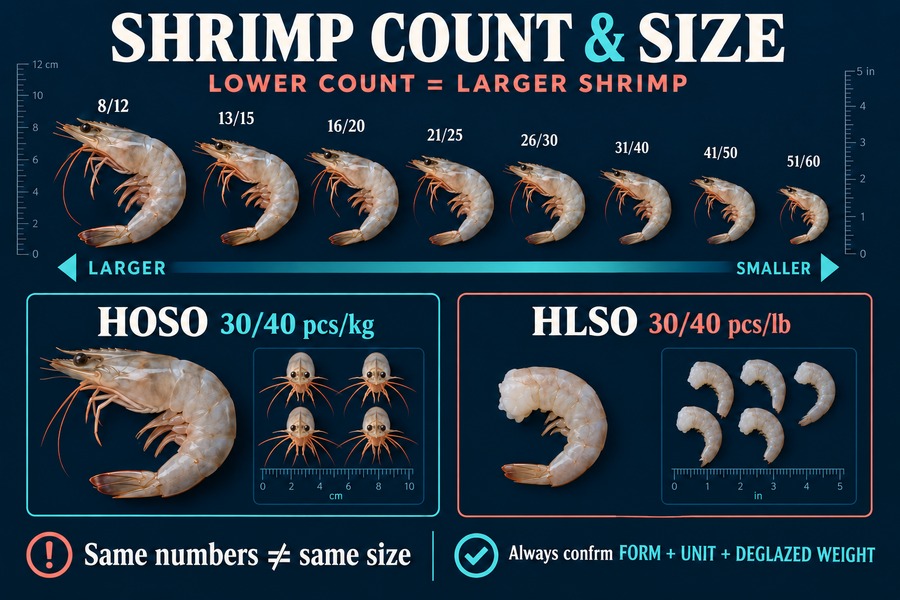
Shrimp size codes indicate how many pieces make up a stated unit of weight. A lower count means larger individual shrimp when the product form and unit are the same. For example, 16/20 pieces per pound are larger than 41/50 pieces per pound. The numerical range is more dependable than labels such as “large” or “jumbo,” which are not applied uniformly across every supplier and market.
HOSO shrimp are often traded by pieces per kilogram, while HLSO and peeled forms are often traded by pieces per pound. This is common practice, not a rule that should be assumed. A buyer should require the offer, pro forma documents, carton and inspection sheet to show all four elements together:
- the numerical count range;
- the unit, such as pieces per kilogram or pieces per pound;
- the product form, such as HOSO or HLSO;
- whether the result is verified using actual deglazed shrimp weight.
The current Codex Standard for Quick-Frozen Shrimps or Prawns, CXS 92-1981, amended in 2024, permits shrimp to be packed by count per unit of weight or per package. When count is declared, Codex determines it by counting the shrimp in a container or representative sample and dividing that number by the actual deglazed weight. That detail matters because ice glaze must not be treated as shrimp when verifying the grade.
| Example declaration | What it tells the buyer | What remains to be confirmed |
|---|---|---|
| HOSO 30/40 pcs/kg | 30 to 40 whole shrimp are declared per kilogram | Species, deglazed count method, glaze, freezing and defect limits |
| HLSO 30/40 pcs/lb | 30 to 40 headless shell-on shrimp are declared per pound | Species, tail and shell condition, deglazed count method and uniformity |
| 30/40 shrimp | Only a numerical range | Product form, count unit and test basis are all missing |
| U/10 | Fewer than 10 pieces in the stated unit | Whether the unit is a pound or kilogram and which product form applies |
Why There Is No Universal HOSO-to-HLSO Size Conversion
A fixed conversion chart may look convenient, but it can misstate the product. Heading removes a variable share of each shrimp, and that share can differ with species, biological condition, harvest size, processing cut and lot. The resulting HLSO count therefore has to be established from the processed batch, not guessed from a generic label.
Unit differences create another source of error. A 30/40 HOSO count per kilogram cannot be compared directly with a 30/40 HLSO count per pound. The numbers look identical, but the weight basis is different and the HOSO pieces still include the head. A buyer who compares only the printed range may approve the wrong tail size.
For a meaningful conversion, ask the processor to head a representative sample from the offered HOSO lot. After processing and deglazing according to the agreed method, weigh and count the HLSO pieces in the required unit. Record the resulting count distribution, recovery and sample identity. For broader guidance on documenting species, form, count and net contents, see the Vannamei shrimp buying guide for importers and distributors.
Edible Yield and Weight After Head Removal
HLSO provides a higher proportion of tail material within the declared shrimp weight because the heads have already been removed. HOSO includes the head in both the product and the count basis. This does not make one form inherently better. It means the two products answer different operational needs and should be evaluated on the amount and form of usable material required by the buyer.
Avoid applying a universal head-loss percentage to every shipment. Recovery varies by lot and by the heading method. A deep cut can remove more neck meat; a poor cut can leave irregular tissue that affects appearance and subsequent processing. If recovery matters to a production plan, make it a measured approval criterion using representative raw material from the proposed lot.
The comparison should also distinguish gross carton weight, glaze and net shrimp contents. Codex requires the declared net contents of glazed quick-frozen shrimp to exclude the glaze. For HOSO and HLSO alike, buyers should compare net deglazed product, verify pack weight using an agreed method and define whether broken or damaged pieces count as usable output.
Flavour, Texture and Presentation
HOSO is the stronger choice when the entire shrimp is part of the visual experience. The head, antennae and complete body create a generous presentation for whole grilling, seafood platters and display-led retail. The head and shell can also enrich broths, sauces and dishes in which cooking juices are deliberately retained.
HLSO keeps much of the protective benefit and culinary character of shell-on shrimp while removing the most perishable and visually sensitive section. The shell can help protect the flesh during handling and cooking, and it remains useful in grilled, roasted, boiled or sautéed preparations. The product is also easier to portion and process where the finished dish does not require a head-on presentation.
Texture depends on much more than the form. Harvest handling, time and temperature before freezing, freezing speed, glaze condition, storage stability, additives and thawing practice can all influence the result. A well-handled HLSO lot can outperform a poorly handled HOSO lot, and the reverse is also true. Product form should therefore be selected alongside a measurable quality specification.
Preparation, Throughput and Waste Handling
The right form should fit the customer’s workflow. A restaurant that serves whole grilled shrimp may gain nothing from buying headless product. A processor that peels and deveins large volumes may prefer HLSO because the heading stage has already been completed under controlled factory conditions.
- HOSO preparation: Plan for heading, peeling or deveining where the final recipe requires it. Staff must also separate and manage heads and shells.
- HLSO preparation: Begin with the tail section, then cook shell-on or proceed to peeling and further processing.
- Portion control: Base portions on usable output, not simply the unopened carton weight.
- Thaw planning: IQF packs support piece-by-piece removal, while block-frozen packs are better suited to operations that will thaw and process the full block.
- Waste management: HOSO creates head waste at the point of use unless the heads are intentionally used in stock or another preparation.
- Consistency: A processor should define heading cut, shell integrity, broken-piece tolerance and size uniformity before production.
The practical question is where the work should happen. HOSO leaves more preparation with the customer but preserves the whole form. HLSO transfers heading to the processing facility and arrives ready for the next production step.
Quality Checks for HOSO and HLSO Shrimp
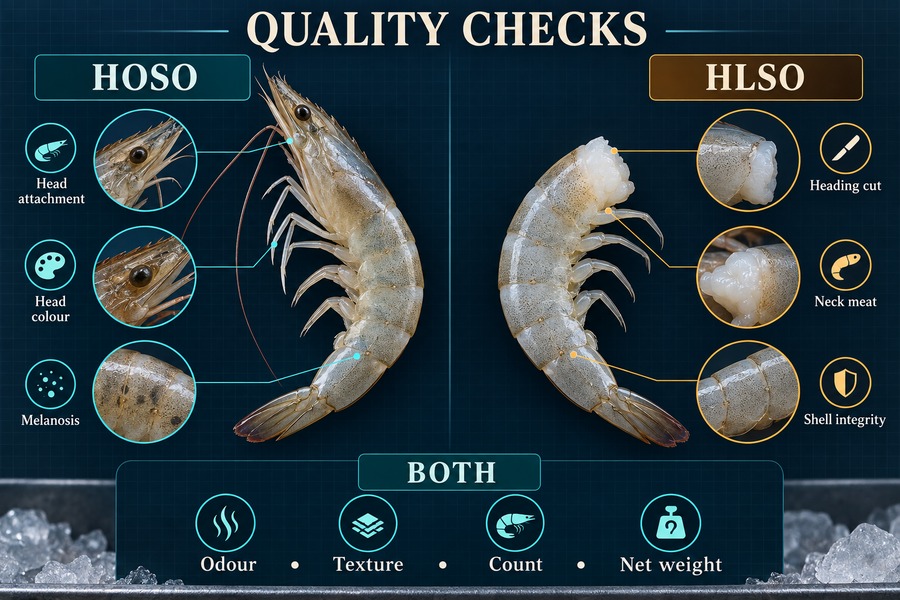
Quality language should describe observable conditions. Terms such as “premium” or “export quality” are not substitutes for an approved sample, a sampling plan and written acceptance limits. The inspection should cover frozen condition, thawed sensory quality, count, net weight, workmanship and packaging.
HOSO-specific checks
Inspect whether the heads remain securely attached and whether the head area shows damage, abnormal colour or extensive black spotting. Check the shell for softness, breakage and disease marks. After controlled thawing, assess odour and texture. HOSO demands disciplined handling because deterioration at the head can become visible before defects elsewhere on the body.
Melanosis, commonly called black spot, is an appearance change caused by enzymatic reactions. It should be assessed against an agreed visual tolerance rather than confused automatically with microbial spoilage. Nevertheless, extensive discolouration can make a HOSO lot unsuitable for a presentation-led programme.
HLSO-specific checks
Examine the heading cut for consistency. There should not be excessive loss of neck meat, ragged tissue or avoidable damage. Check shell integrity, tail condition, exposed flesh, dehydration and discolouration. If the shrimp will be peeled or further processed, run a representative recovery and workmanship test.
Checks shared by both forms
The 2024-amended Codex standard defines defects that include persistent objectionable odour or flavour, foreign matter, deep dehydration and specified discolouration. It treats deep dehydration as defective when more than 10 percent of the shrimp weight in the sample unit, or more than 10 percent of the block surface, shows the defined abnormality. Buyers may set additional private tolerances suited to their market, but those limits should be written and agreed before production.
| Inspection point | HOSO emphasis | HLSO emphasis | Shared evidence |
|---|---|---|---|
| Workmanship | Intact whole form and secure head attachment | Clean, consistent heading cut | Approved physical sample and photographs |
| Appearance | Head colour, melanosis and complete presentation | Neck area, shell and tail condition | Defined colour and defect tolerances |
| Size | Whole-shrimp count in stated unit | Headless count in stated unit | Deglazed count record and uniformity check |
| Weight | Net deglazed HOSO contents | Net deglazed HLSO contents | Calibrated scale records and sampling method |
| Sensory condition | Head and body odour, flesh resilience | Tail odour, flesh resilience | Controlled thawing and trained assessment |
| Frozen condition | Glaze coverage and intact bodies | Glaze coverage, separation and exposed neck meat | Product temperature and cold-chain records |
Freezing, Glazing and Cold-Chain Requirements
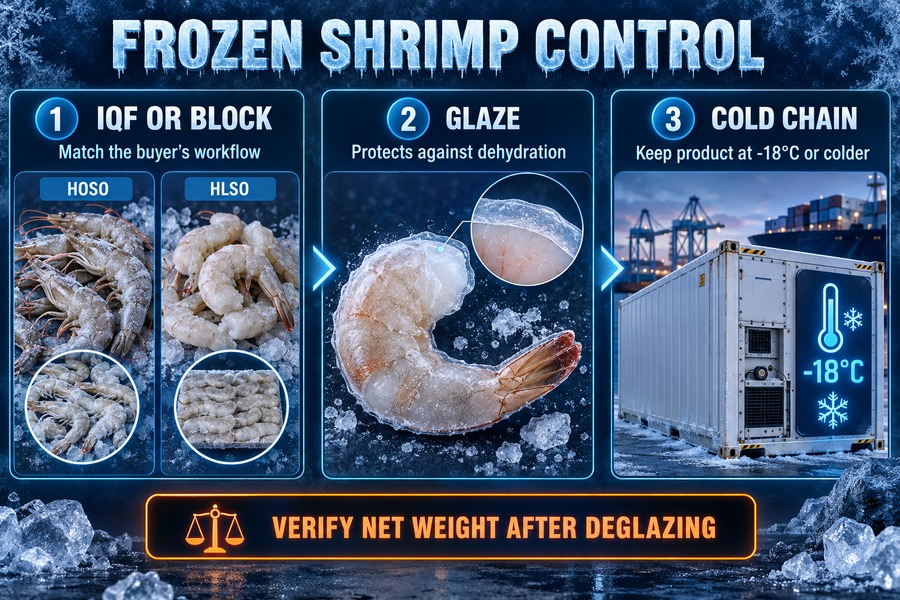
HOSO and HLSO may be supplied individually quick frozen or block frozen. IQF pieces should remain separate enough for controlled portioning. Block-frozen product suits buyers who plan to thaw and process the entire unit. Neither label proves quality by itself; the buyer should inspect piece separation, block integrity, dehydration, glaze condition and evidence of partial thawing or refreezing.
Under Codex CXS 92-1981, quick freezing is not complete until the product reaches -18°C or colder at its thermal centre after thermal stabilisation. The standard also requires the product to remain deep frozen during transportation, storage and distribution, and the label must indicate storage at -18°C or colder. These are product-condition requirements, not merely freezer settings.
Glaze protects frozen shrimp from dehydration and oxidation. It must be separated from the declared net shrimp contents when the pack is evaluated. Agree in advance on sample selection, deglazing, draining and weighing. Then use the same method at the factory, during pre-shipment inspection and at destination. This makes HOSO and HLSO comparisons repeatable rather than dependent on visual estimates.
Which Form Fits Each Buyer and Application?
Neither form wins every comparison. The best choice is the one that matches the intended product, customer workflow, count system and quality priorities.
Whole-shrimp restaurants and premium displays
HOSO is usually the natural fit when the head contributes to plating, customer perception or the cooking method. It works well for whole grilling, seafood presentations and dishes in which the shell and head are used to build flavour. These buyers should place tight controls on head condition, melanosis, antennae damage and overall visual uniformity.
Distributors and commercial kitchens
HLSO gives distributors a flexible shell-on line that can serve multiple customers. Kitchens receive more tail material within the net product weight and avoid the heading step. Buyers should focus on consistent cuts, reliable counts, shell condition and pack formats that suit gradual or full-batch thawing.
Secondary processors
Businesses producing PUD, PD, PTO, PDTO, breaded shrimp or other value-added products may prefer HLSO as a practical raw material. The shell can remain during storage and controlled thawing, then be removed on the processing line. A trial should confirm peeling performance, meat recovery, vein condition and the incidence of broken pieces.
Retail programmes
HOSO can support whole-product positioning in markets familiar with head-on shrimp. HLSO is often easier for shoppers who want shell-on flavour without handling the head. In either case, the final label must clearly describe the form, species, raw or cooked status, net contents, storage condition, origin and required destination-market information.
How to Write a Complete Wholesale Specification
A strong enquiry should make it possible for the supplier, inspector and buyer to identify the same product without verbal assumptions. Start with the scientific species name and finish with the shipment and document requirements.
| Specification field | Example of a clear buyer instruction |
|---|---|
| Species | Farmed Penaeus vannamei |
| Product form | Raw HOSO or raw HLSO, written in full |
| Size | Exact count range plus pieces per kilogram or pieces per pound |
| Count test | Verify against actual deglazed weight |
| Freezing | IQF or block frozen, with required physical condition |
| Net contents | Shrimp weight excluding glaze |
| Workmanship | Head attachment for HOSO or heading-cut standard for HLSO |
| Quality | Agreed odour, colour, texture, shell, dehydration and defect limits |
| Treatments | Full declaration of ingredients, processing aids and additives |
| Packaging | Inner pack, master carton, liner, coding and pallet requirements |
| Labelling | Destination-compliant product name, form, species, origin, lot and storage statement |
| Traceability | Farm, harvest, processor, production date and finished-lot connection |
| Inspection | Sampling plan, methods, acceptance criteria and reporting format |
| Documents | Current destination-specific certificates and shipment documents |
Do not submit “Vannamei 30/40” as a complete order description. It omits the form, unit, glaze basis, freezing method and inspection criteria. Likewise, do not accept an HOSO-to-HLSO conversion based only on a supplier’s general chart when the conversion affects your customer’s required tail size.
Iran Fish describes its shrimp supply as farmed Vannamei and wild shrimp sourced through its Iranian operations. Buyers can learn more about the company’s facilities and product scope on the About Iran Fish page. Every shipment should still be confirmed against current availability, the proposed lot and the importing market’s requirements.
Source HOSO or HLSO Vannamei Shrimp from Iran Fish
If you are comparing HOSO vs HLSO shrimp for an import, distribution or food-service programme, send Iran Fish a specification that includes your destination, preferred form, size-count basis, freezing method, pack format and inspection requirements. The team can review the requested configuration against the available Iranian Vannamei supply and clarify the product before production planning begins.
Explore the Vannamei shrimp product page or contact Iran Fish with your target specifications. A precise enquiry is the fastest route to a product that arrives in the form, grade and condition your customers expect.
Frequently Asked Questions
What is the main difference between HOSO and HLSO shrimp?
HOSO shrimp retain both the head and shell. HLSO shrimp have the head removed but keep the shell and tail. That single processing difference affects presentation, count grade, usable tail yield, preparation and the quality points a buyer must inspect.
Is HOSO shrimp larger than HLSO shrimp with the same count?
Not necessarily, and the labels should not be compared without more information. Confirm whether each count is measured per kilogram or per pound and whether it is based on actual deglazed weight. The head contributes to HOSO weight, so the same printed range does not guarantee the same tail size.
Can I use a standard percentage to convert HOSO weight to HLSO weight?
A universal percentage is not reliable for shipment approval. Recovery can change with species, shrimp size, biological condition, heading cut and lot. Ask the processor to head and test a representative sample, then record the actual HLSO recovery and resulting count.
Which form is better for restaurants?
HOSO is well suited to whole presentation, grilling and recipes that use the head and shell for flavour. HLSO is better when the kitchen wants shell-on shrimp with less preparation and easier portion planning. The menu and kitchen workflow should determine the form.
What should I verify before ordering frozen HOSO or HLSO shrimp?
Verify species, origin, exact product form, count range, count unit, deglazed test basis, freezing method, net contents excluding glaze, treatments, workmanship, defect limits, packaging, labelling, traceability, destination compliance and inspection terms. Approve a representative sample whenever appearance or processing performance is important.
One thought on “HOSO vs HLSO Shrimp: Understanding the Key Differences”