


Vannamei vs Tiger Shrimp: Which Is Better for Buyers?

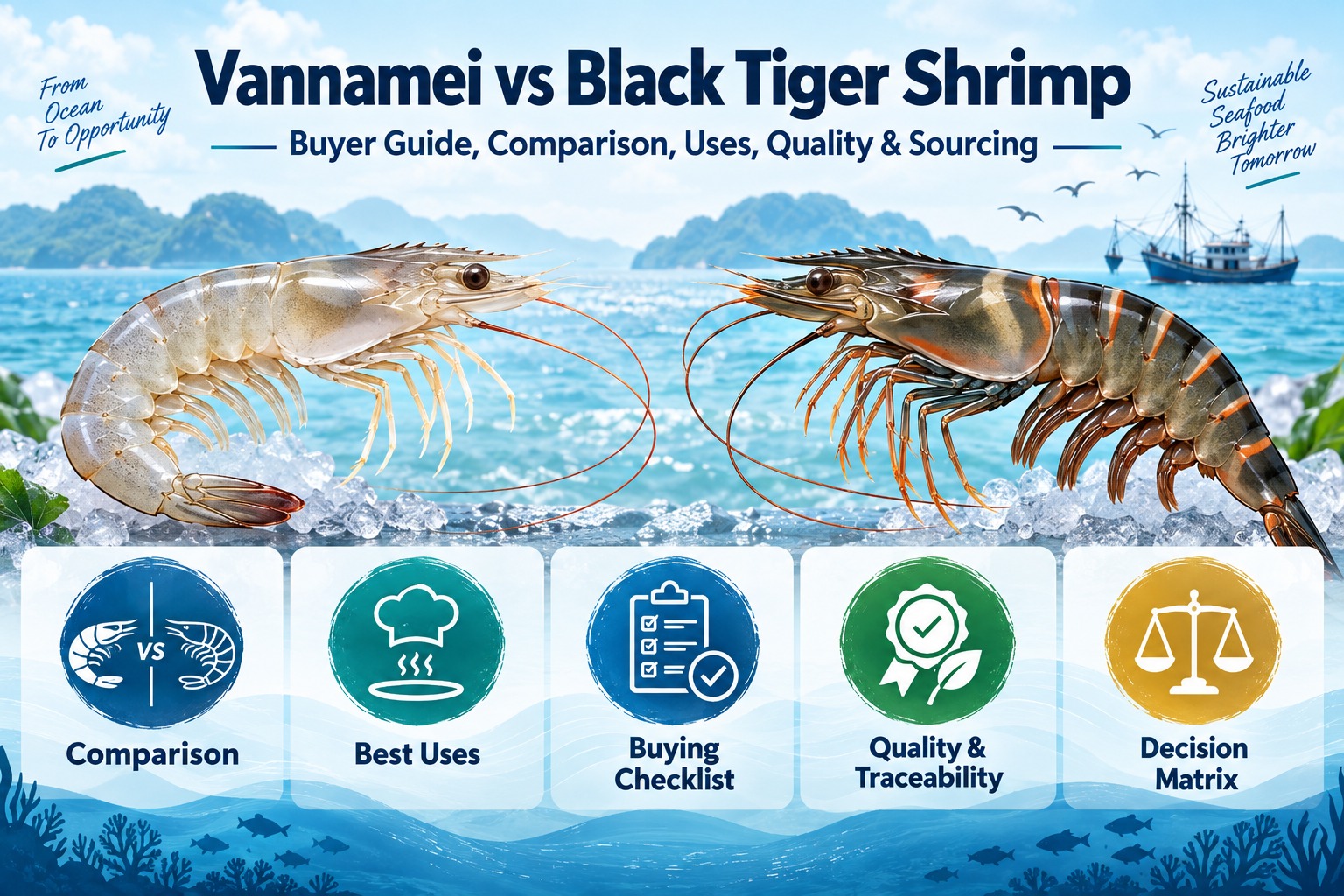
For most volume-focused buyers, Vannamei vs tiger shrimp comes down to consistency versus premium presentation. Vannamei is usually the more flexible choice for retail, foodservice, processing, and regular supply programs. Black Tiger is better suited to buyers prioritising larger size potential, distinctive striped appearance, and a firmer eating profile. Neither species is automatically “better”: the right choice depends on product form, count grade, end use, supply specification, certification needs, and customer expectations.
| Buyer question | Vannamei shrimp | Black Tiger shrimp |
|---|---|---|
| Scientific name | Penaeus vannamei; also widely referred to as Litopenaeus vannamei | Penaeus monodon |
| Common trade names | Whiteleg shrimp, Pacific white shrimp, white shrimp | Black Tiger shrimp, giant tiger prawn, tiger prawn |
| Typical appearance | Translucent to pale grey-white before cooking | Darker shell with characteristic transverse bands |
| Maximum length recorded by FAO | Up to 23 cm | Up to 33 cm |
| Texture | Can be tender to moderately firm depending on size and processing | Commonly selected for a firmer, more substantial bite |
| Size positioning | Broad range, strong fit for standardised high-volume programs | Particularly attractive where large whole shrimp are required |
| Farming model | Predominantly farmed in global trade | Farmed and also available from wild fisheries in some origins |
| Supply planning | Strong fit for repeat specifications and broad product formats | Better suited to premium or species-specific programs where availability matches the required grade |
| Best fit | Retail packs, foodservice, further processing, private label, regular wholesale programs | Grilling, whole-shrimp presentation, premium foodservice, high-visibility seafood displays |
| Main buyer priority | Consistency, versatility, grading, processing flexibility | Size, visual impact, firm texture, premium positioning |

Vannamei vs Tiger Shrimp: The Quick Buyer Verdict
If a buyer needs a shrimp line that can move across several channels, Vannamei is usually the more practical starting point. It is widely farmed, available in multiple count grades and processing forms, and works well for raw, cooked, peeled, shell-on, IQF, block-frozen, foodservice, retail, and further-processing programs. Buyers sourcing Iranian farmed shrimp can review the Vannamei shrimp range from Iran Fish and the company’s broader frozen shrimp supply options.
Black Tiger is more relevant when the product itself must make a visual or sensory statement. Its darker banded shell is immediately recognisable, and the species has greater biological size potential than Vannamei. FAO records a maximum length of 33 cm for Penaeus monodon, compared with 23 cm for Penaeus vannamei. Those figures describe species biology, not a guaranteed commercial grade, but they help explain why Black Tiger is strongly associated with large whole-shrimp presentations.
For procurement teams, species should never be the only deciding field. A well-specified Vannamei lot can be more suitable than a poorly specified Tiger lot, and the reverse is also true. Count unit, product form, glaze, net deglazed weight, freezing method, workmanship, cold-chain condition, origin, traceability, and destination-market documentation all need to be compared before approval.
What Is the Real Difference Between Vannamei and Black Tiger Shrimp?
The two species belong to the same broad commercial shrimp family, Penaeidae, but they differ in natural distribution, appearance, farming history, growth characteristics, and market positioning. Buyers should identify the species scientifically in purchase specifications rather than relying only on common names.
Vannamei Shrimp (Penaeus vannamei)
FAO lists Penaeus vannamei as whiteleg shrimp. The species is native to the Eastern Pacific, from the coast of Sonora in Mexico through Central and South America to northern Peru. Its natural colour is generally translucent white, although feed, substrate, and water conditions can influence appearance.
Vannamei became a major aquaculture species because it can be produced within highly standardised farming and hatchery systems. In trade, that translates into a broad range of product forms and size grades suitable for buyers who need repeatable specifications.
Iran Fish supplies farmed Iranian Vannamei shrimp and describes its shrimp operations as serving international buyers across multiple export markets. For importers building a formal specification, the company also provides a detailed Vannamei shrimp buying guide.
Black Tiger Shrimp (Penaeus monodon)
FAO identifies Penaeus monodon as giant tiger prawn. Its natural range includes the coasts of Australia, Southeast Asia, South Asia, and East Africa. The shell can vary in colour, but the alternating dark and pale transverse bands across the body are among its most recognisable characteristics.
The species can reach a larger maximum body length than Vannamei. That does not mean every Black Tiger shipment contains very large shrimp; commercial size still depends on harvest size, grade, product form, and the count system used in the contract.
Black Tiger may be farmed or wild-caught depending on origin and supply chain. Buyers therefore need to state not only the species but also production method, country of origin, harvest source, processing establishment, and traceability requirements.
Why the Scientific Name Matters in a Purchase Order
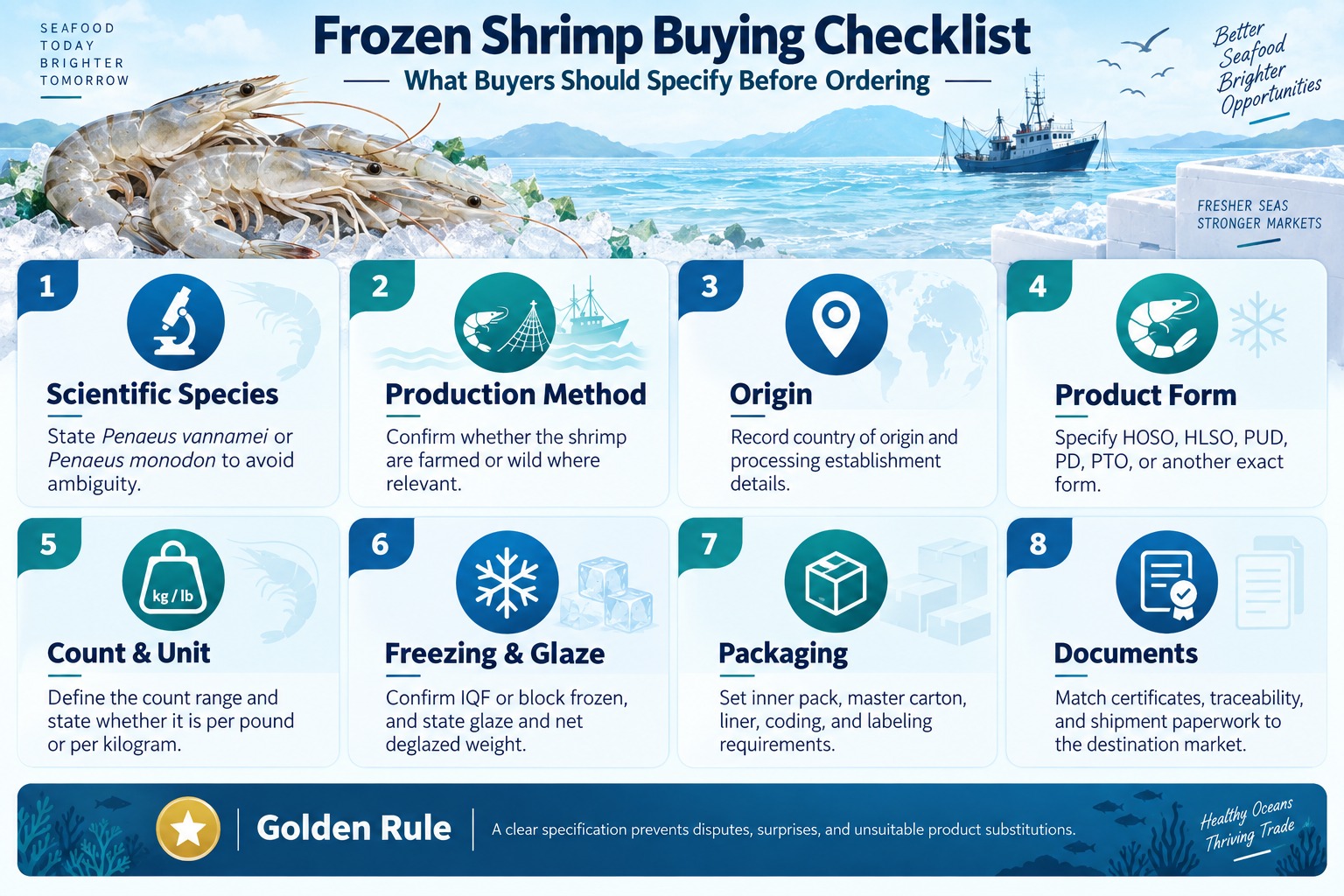
“White shrimp,” “tiger shrimp,” and “king prawn” are not precise enough for an international procurement document. Common names vary by country and market. A specification that states Penaeus vannamei or Penaeus monodon removes a major source of ambiguity.
The same principle applies to product form. “Frozen shrimp 30/40” is incomplete unless the order states whether the shrimp are HOSO, HLSO, peeled, deveined, tail-on or tail-off, and whether the count is per pound or per kilogram.
Taste, Texture and Appearance: What Buyers Should Expect
Vannamei is commonly selected where buyers want a clean, mild shrimp profile that can work across many recipes and value-added formats. Black Tiger is often chosen when a firmer bite, stronger shell-on presence, and premium whole-shrimp presentation are more important. These are useful trade expectations, but they should not be treated as fixed sensory rules.
Taste Is Affected by More Than Species
Feed, harvest handling, freezing speed, storage stability, thawing, additives, cooking method, and cooking time can all change the final eating experience. A trained sensory study of commercial shrimp has found that flavour and texture attributes do not always uniquely identify one shrimp type, which is a useful warning against buying on species reputation alone.
For a buyer, the practical step is to approve a representative sample from the proposed specification. The sample should match the intended product form, size, treatment, freezing method, and production lot as closely as possible.
Texture Can Change During Processing and Cooking
Research comparing Pacific white shrimp and Black Tiger has shown that processing method can affect hardness and chewiness differently between the two species. In one comparative texture study, cooking and blanching reduced measured hardness in Vannamei while increasing it in Black Tiger under the tested conditions.
That supports the commercial perception of Black Tiger as a strong option for applications where a firm bite matters, but it also shows why a blanket statement such as “Tiger is always firmer” is too simplistic. The actual product needs to be tested under the buyer’s cooking process.
Appearance Is One of the Clearest Differences
Appearance is easier to distinguish. Vannamei is normally pale or translucent before cooking. Black Tiger has a more dramatic shell pattern with dark transverse bands. For whole-shrimp displays, seafood platters, grill service, and premium retail presentation, that visible difference can influence product selection before flavour is even considered.
For peeled products, however, much of that species-specific shell identity disappears. Buyers purchasing PD, PUD, PTO, or PDTO products should give more weight to flesh quality, count uniformity, workmanship, texture, treatment declaration, and performance after cooking.
Vannamei vs Tiger Shrimp Size: Compare Counts, Not Marketing Names
Terms such as “large,” “jumbo,” and “colossal” are useful for merchandising but are not dependable enough for a technical purchase specification. Commercial shrimp should be compared using a numerical count together with the unit of weight and exact product form.
A lower count means a larger individual shrimp when the form and unit are the same. For example, a 16/20 count per pound contains fewer and therefore larger shrimp than a 41/50 count per pound. But a 30/40 HOSO grade per kilogram cannot be directly compared with a 30/40 peeled grade per pound.
Buyers who need a deeper breakdown can use the Iran Fish guide to Vannamei shrimp sizes and count grades.
| Specification example | What it tells the buyer | What still needs confirmation |
|---|---|---|
| 16/20 pcs/lb HLSO | 16 to 20 headless shell-on shrimp per pound | Species, deglazed basis, glaze, freezing method, workmanship |
| 30/40 pcs/kg HOSO | 30 to 40 whole head-on shrimp per kilogram | Species, glaze, count tolerance, freezing and quality limits |
| 31/35 pcs/lb PDTO | 31 to 35 peeled, deveined, tail-on shrimp per pound | Treatment, tail condition, glaze, net weight, defect limits |
| “Jumbo shrimp” | General marketing description only | Count, unit, form, species, and all technical requirements |
The current Codex Standard for Quick-Frozen Shrimps or Prawns, CXS 92-1981, states that shrimp may be packed by count per unit of weight or per package. When a count is declared, Codex determines count using the actual deglazed weight. That makes glaze control directly relevant to grading.
Product Form Can Matter as Much as the Species
A Vannamei HOSO order and a Vannamei PDTO order serve very different operational needs. The same is true for Black Tiger. Before comparing species, buyers should first decide what form their customers or production line actually need.
HOSO: Head-On, Shell-On
HOSO keeps the shrimp in its most complete commercial form. It suits whole-shrimp presentation, shell-on grilling, markets that value the head, and applications where the shell and head contribute to the cooking process.
The head also creates additional quality-control points. Head attachment, colour, odour, melanosis, antenna damage, and overall whole-body appearance should be included in the inspection specification.
HLSO: Headless, Shell-On
HLSO removes the head but retains the shell and tail. It gives the buyer more tail material within the stated shrimp weight and reduces preparation at the restaurant or processing facility.
Iran Fish has a dedicated guide explaining HOSO vs HLSO shrimp for wholesale buyers.
Peeled and Deveined Formats
PUD, PD, PTO, and PDTO formats are particularly useful when labour efficiency, portion control, retail convenience, or secondary processing matters more than whole-shrimp appearance.
Once the shell is removed, the Black Tiger visual advantage becomes less important. Buyers should then focus more closely on count accuracy, cut quality, vein removal, tail condition, broken-piece tolerance, texture, treatment declaration, and cooking performance.
Yield and Usable Product: Do Not Compare Carton Weight Alone
A meaningful Vannamei vs Black Tiger comparison should be based on what the buyer can actually use. Species matters, but product form, glaze, trimming, breakage, thaw loss, and cooking behaviour can change the usable output of a carton.
There is no reliable universal conversion percentage that can turn every HOSO lot into an expected HLSO or peeled yield. Head proportion, shrimp size, biological condition, processing cut, and workmanship vary. Where yield matters, buyers should request a representative processing test from the offered lot instead of applying a generic percentage from another supplier or origin.
Glaze must also be separated from shrimp weight when net contents are evaluated. Under the Codex quick-frozen shrimp standard, the declared net contents of a glazed product exclude the glaze. For procurement teams, that means product comparisons should use the same deglazing and weighing method rather than comparing gross frozen blocks or cartons by eye.
Farming, Origin and Supply Reliability
Vannamei and Black Tiger have different production histories, but buyers should avoid assuming that one farming model is automatically superior. Farm management, hatchery quality, stocking practices, biosecurity, feed, water quality, harvest handling, processor controls, and traceability can be more important than the species name alone.
Vannamei Supply
Vannamei is strongly associated with aquaculture and standardised hatchery production. FAO documents the development of specific-pathogen-free and disease-resistant broodstock programs that helped create more consistent seed supply for the species.
For importers, this production model can support regular programs with defined count grades and multiple processing formats. Iran Fish identifies Vannamei as its principal farmed shrimp species and sources its shrimp through Iranian operations. Buyers considering Iran as an origin can review the company’s shrimp exporter page for current product and packing options.
Black Tiger Supply
Black Tiger is also farmed, particularly in Asian producing regions, and may additionally enter trade from wild fisheries depending on origin. That makes source declaration important. “Black Tiger” alone does not tell a buyer whether the product is farmed or wild.
For each proposed shipment, the purchase specification should identify production method and origin rather than relying on species assumptions. If a buyer is comparing Black Tiger from one country with Vannamei from another, country-specific regulatory access, harvest season, processing infrastructure, and documentation need to be assessed separately.
IQF, Block Frozen, Glazing and Cold-Chain Control
The freezing format should match the customer’s workflow. IQF shrimp can be removed piece by piece, which is useful for retail packs, catering, restaurants, and production lines that do not want to thaw an entire block. Block-frozen shrimp can work well for industrial users that process full units at once.
Neither “IQF” nor “block frozen” proves quality by itself. A buyer still needs to examine dehydration, broken pieces, glaze condition, piece separation, block integrity, temperature abuse, and evidence of thaw-refreeze cycles.
The current Codex Standard for Quick-Frozen Shrimps or Prawns states that quick freezing is not complete until the product has reached -18°C or colder at its thermal centre after thermal stabilisation. It also requires frozen product to remain deep frozen through transportation, storage, and distribution.
| Frozen-product check | Why it matters |
|---|---|
| Product temperature | Confirms the cold chain has been maintained |
| Glaze condition | Helps protect against dehydration and oxidation |
| Net deglazed weight | Shows the shrimp quantity excluding protective glaze |
| Count after deglazing | Confirms the declared size grade on the correct weight basis |
| Dehydration | Can indicate storage or packaging problems |
| Piece separation in IQF | Affects portioning and handling |
| Block integrity | Helps identify physical damage or partial thawing |
| Odour after controlled thawing | Supports sensory quality assessment |
Certifications, Traceability and Buyer Documentation
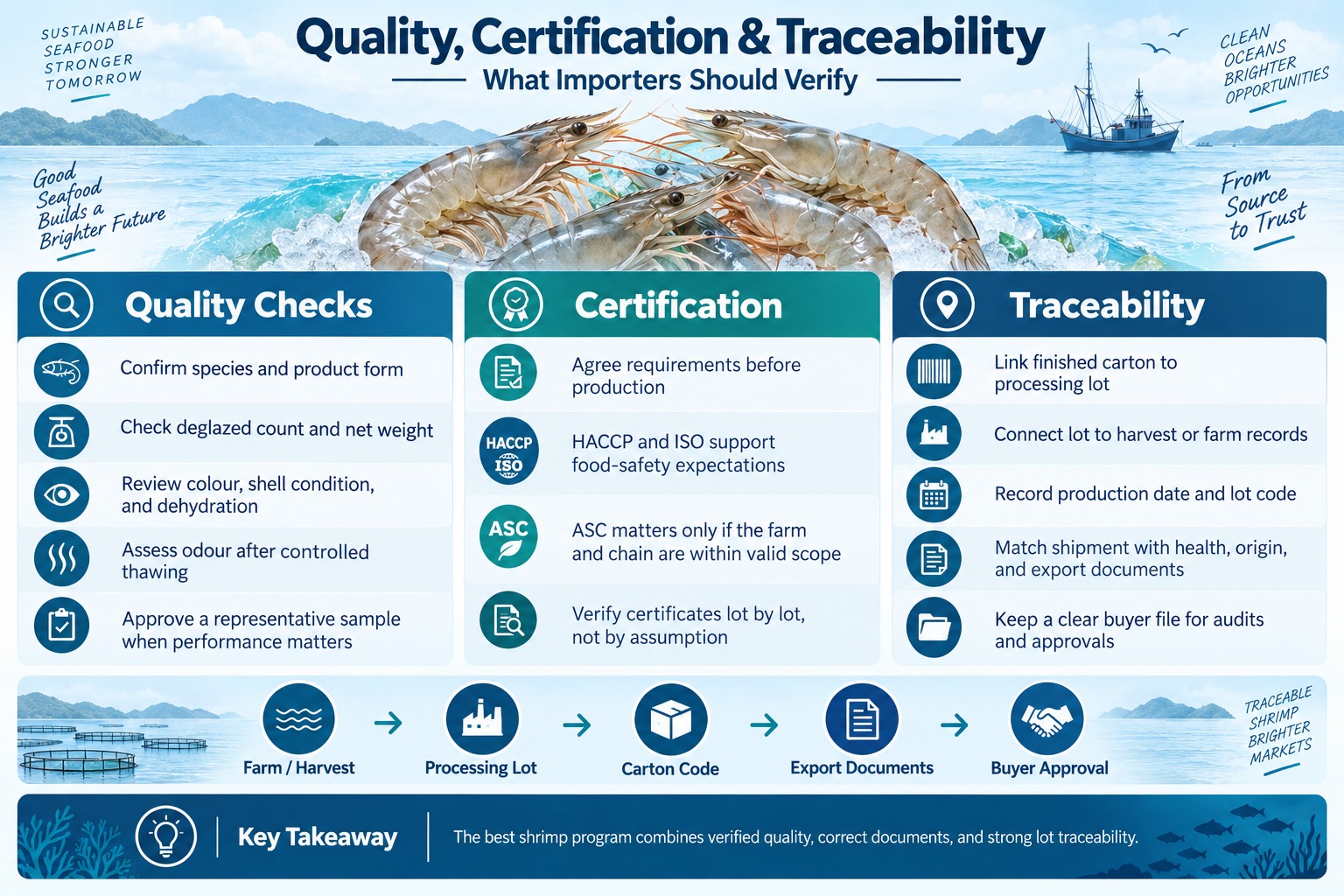
Certification requirements should be agreed before production, not after the shipment is ready. The correct documents depend on origin, destination country, farming system, customer program, and the legal status of the processing establishment.
The Aquaculture Stewardship Council’s shrimp program covers farmed shrimp species including whiteleg shrimp and giant tiger prawn. If ASC certification is a contractual requirement, the buyer should verify that the farm and relevant chain-of-custody steps are within the valid certification scope rather than assuming that the species itself is “ASC.”
Iran Fish states that its production processes follow HACCP and ISO food-safety standards and that it can provide shipment-related health and origin documentation. Buyers should confirm the exact certificates required for their destination and the specific lot before contracting. The company’s shrimp export page provides its current public information on certification, packing, and export documentation.
Traceability should connect the finished carton back through the processing lot to harvest or farm information. A strong buyer file normally identifies the species, origin, production method, processing establishment, production date, lot code, pack configuration, and relevant shipment certificates.
Quality Checks Before Approving Vannamei or Tiger Shrimp
Species selection should be followed by physical verification. A sample approval process is especially important when the finished product depends on appearance, peeling performance, cooking yield, or a tight count specification.
- Confirm the scientific species name.
- Confirm farmed or wild production status.
- Record country and production origin.
- State HOSO, HLSO, PUD, PD, PTO, PDTO, or another exact product form.
- Define the count range and whether it is per pound or per kilogram.
- Verify count against actual deglazed weight.
- State IQF or block-frozen format.
- Record glaze and net contents separately.
- Define acceptable colour, odour, texture, shell condition, and dehydration.
- Set limits for broken, damaged, soft-shell, or poorly processed pieces.
- Declare additives, processing aids, or moisture treatments where applicable.
- Confirm inner pack, master carton, liner, coding, and private-label requirements.
- Confirm cold-chain and storage requirements.
- Match documentation to the destination market.
- Approve a representative sample where product performance is critical.
Which Shrimp Works Better for Retail, Foodservice and Processing?
The correct species depends on how the shrimp will be sold and used. A buyer serving several channels may even need different specifications rather than a single shrimp line for every customer.
Retail Programs
Vannamei fits retail programs particularly well because it can be specified across a wide range of counts and convenient processing forms. Peeled and deveined, tail-on, cooked, raw, IQF, and private-label formats can be matched to different consumer needs.
Black Tiger can be attractive in retail where whole appearance, large size, shell pattern, and premium seafood positioning are central to the product.
Restaurants and Hotels
Restaurants should work backward from the dish. Vannamei is flexible for pasta, curries, frying, salads, skewers, mixed seafood dishes, and portion-controlled menus. Black Tiger is a strong candidate for grilled whole shrimp, shell-on dishes, premium platters, and centre-of-plate applications where visible size matters.
The kitchen should test the exact sample using its real thawing and cooking method. Species reputation is less useful than seeing how the proposed lot behaves on the actual menu.
Seafood Distributors
Distributors need a specification that can be reordered consistently and understood by multiple customers. Vannamei can support that model because of its broad size and processing range.
A distributor carrying Black Tiger may use it as a separate line for customers specifically seeking the species, firmer texture, larger presentation, or recognisable shell appearance.
Further Processors
For breaded shrimp, marinated products, ready meals, skewers, and other value-added lines, processing performance becomes central. The buyer should evaluate peeling recovery, count uniformity, breakage, straightness where required, texture after cooking, and compatibility with the production line.
Iran Fish states that it can provide several frozen shrimp formats and value-added or private-label options on request. Buyers can check the current Iran Fish shrimp range before preparing a specification.
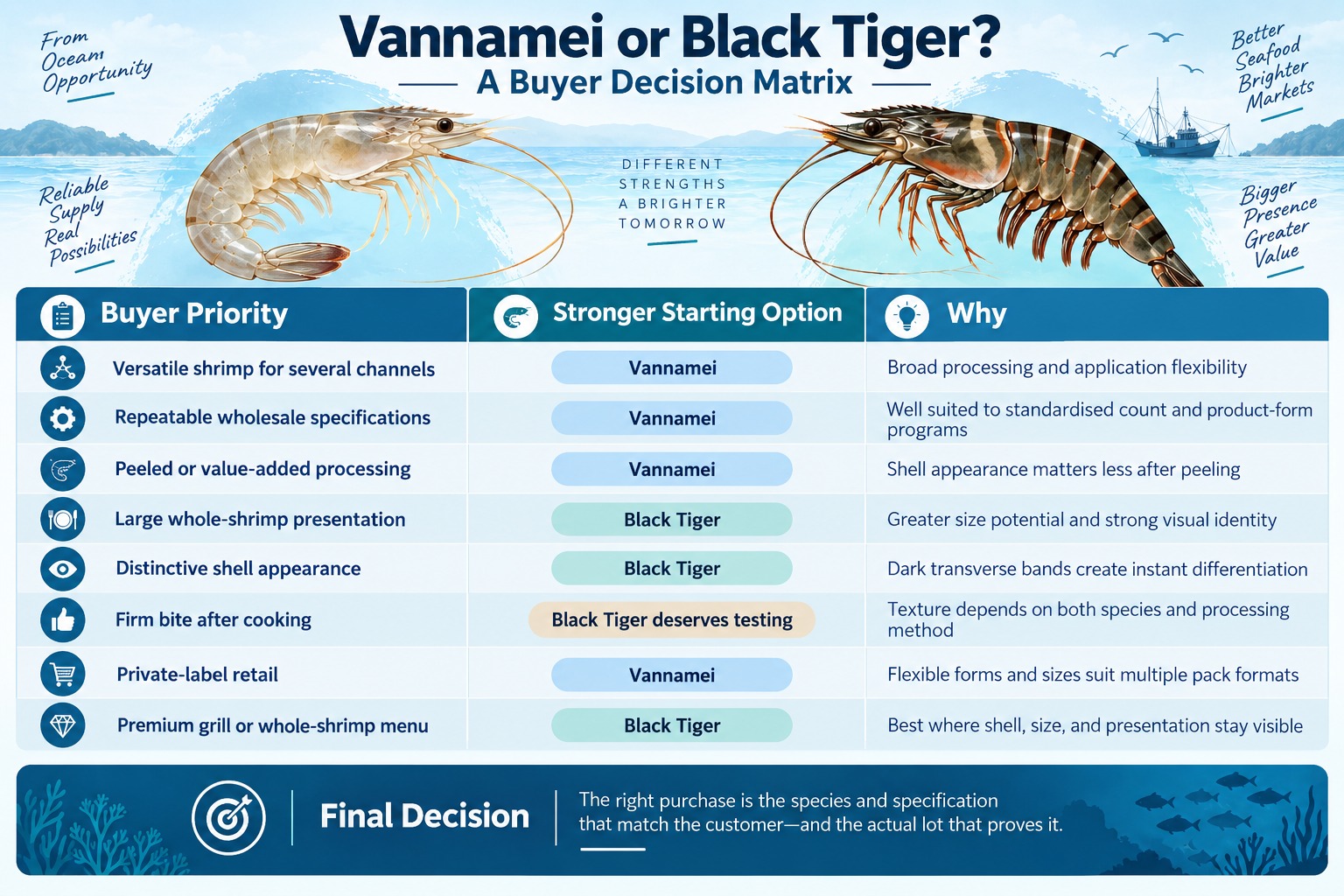
Vannamei or Black Tiger: A Buyer Decision Matrix
| If your main requirement is… | Stronger starting option | Why |
|---|---|---|
| A versatile shrimp for several channels | Vannamei | Broad processing and application flexibility |
| Repeatable wholesale specifications | Vannamei | Well suited to standardised count and product-form programs |
| Peeled or value-added processing | Vannamei | Species-specific shell appearance is less important after peeling |
| Large whole-shrimp presentation | Black Tiger | Greater biological size potential and strong visual identity |
| Distinctive shell appearance | Black Tiger | Dark transverse bands create clear visual differentiation |
| Firm bite after common cooking processes | Black Tiger deserves testing | Comparative research shows species and processing method both affect texture |
| Private-label retail | Vannamei | Flexible forms and sizes suit multiple pack formats |
| Grill or premium whole-shrimp menu | Black Tiger | Strong fit where size, shell and presentation remain visible |
| A mixed buyer portfolio | Consider separate specifications | One species does not need to serve every customer or application |
The best purchasing decision is not “Vannamei is better” or “Tiger is better.” It is choosing a species and specification that match the customer, then verifying that the offered lot actually meets that specification.
Source Iranian Vannamei Shrimp from Iran Fish
If your comparison points to Vannamei as the better fit for your wholesale, foodservice, retail, or processing program, Iran Fish supplies Iranian farmed Vannamei shrimp in export-oriented formats and size grades.
Send your target species, product form, count range, count unit, freezing method, pack configuration, destination country, labelling needs, and required documentation before production planning. This gives the supplier enough information to match the enquiry to the available lot rather than working from a vague request such as “large frozen shrimp.”
For a shipment-specific discussion, contact Iran Fish with your complete buyer specification.
Frequently Asked Questions
Is Vannamei the same as whiteleg shrimp?
Yes. FAO lists Penaeus vannamei under the English common name “whiteleg shrimp.” The species is also widely called Pacific white shrimp or Vannamei shrimp in international seafood trade. Some scientific and commercial sources use the name Litopenaeus vannamei.
Is Black Tiger shrimp always larger than Vannamei?
No. FAO records a higher maximum biological length for Penaeus monodon at 33 cm compared with 23 cm for Penaeus vannamei, but individual commercial lots overlap in size. Buyers should compare actual count grades, units, and product forms rather than assuming every Tiger shrimp is larger.
Which is better for restaurants, Vannamei or Tiger shrimp?
Vannamei is a flexible choice for high-throughput menus, mixed dishes, frying, pasta, curries, skewers, and portion-controlled applications. Black Tiger is particularly attractive for grilling, shell-on service, seafood platters, and dishes where a large, visually distinctive shrimp is part of the presentation. The final choice should be tested using the restaurant’s actual cooking method.
Can Vannamei and Tiger shrimp with the same count be treated as identical?
Not automatically. First confirm that the count uses the same unit, such as pieces per pound or pieces per kilogram, and that both products have the same form. HOSO, HLSO, and peeled shrimp retain different amounts of the original animal, so identical printed count numbers do not necessarily mean identical tail size or usable product.
What should an importer specify before ordering frozen shrimp?
At minimum, state the scientific species, origin, farmed or wild status, product form, count range, count unit, deglazed count basis, freezing method, glaze, net contents, quality tolerances, treatments, packaging, labelling, traceability, destination-market documentation, and inspection requirements. A representative sample should be approved when appearance or processing performance is commercially important.