

Farmed vs Wild Shrimp: Quality, Taste and Supply Differences


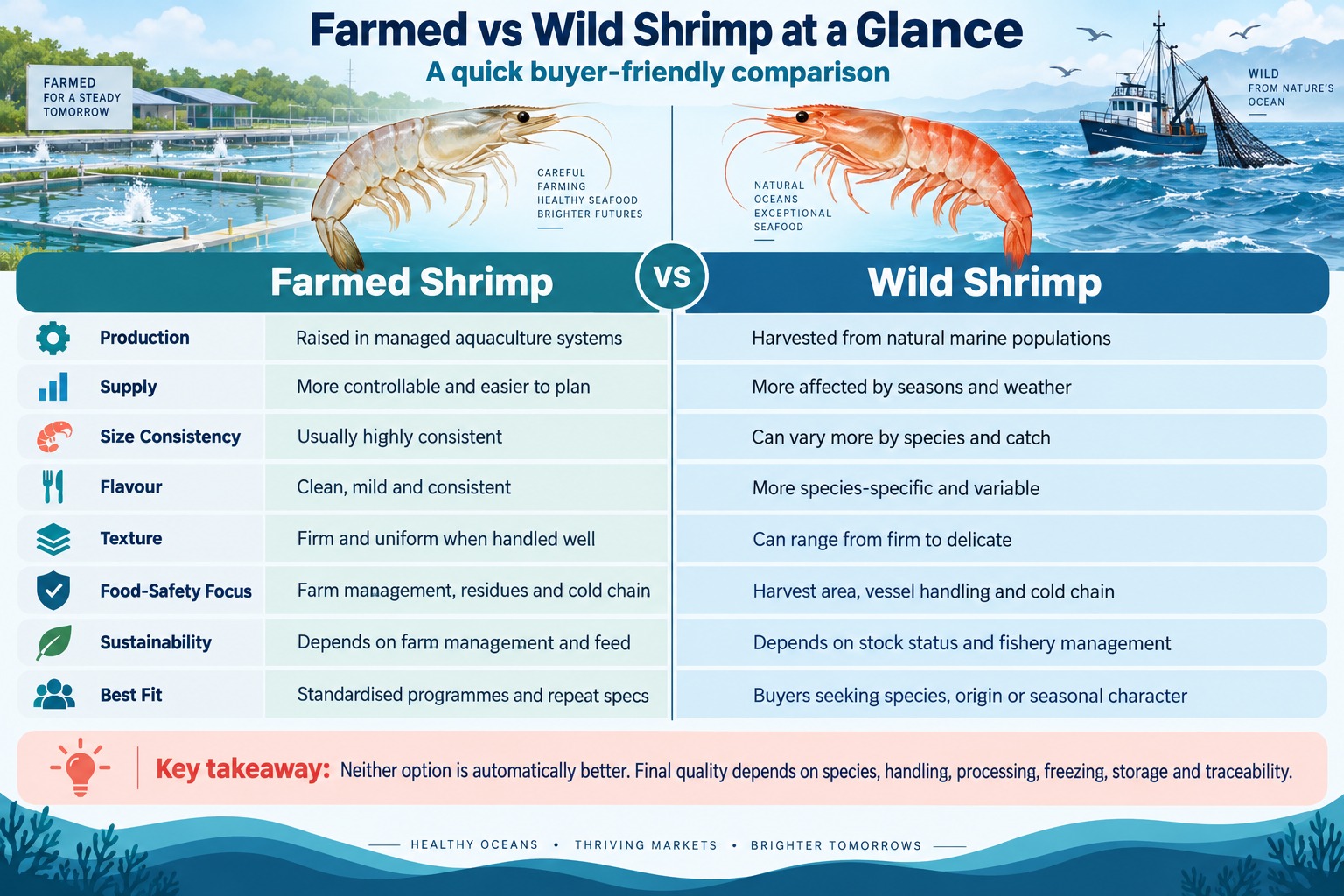
Choosing between farmed vs wild shrimp comes down to what matters most for the buyer. Farmed shrimp, especially Vannamei, usually offers more predictable sizing, specifications and supply, while wild-caught shrimp can deliver species-specific flavour, texture and seasonal character. Neither is automatically “better.” Quality depends on species, growing or fishing conditions, harvest timing, processing, freezing, storage and traceability.
| Comparison point | Farmed shrimp | Wild shrimp |
|---|---|---|
| Production | Raised in managed aquaculture systems | Harvested from natural marine populations |
| Typical supply pattern | More controllable and easier to plan | More affected by seasons, weather and fishery conditions |
| Size consistency | Usually highly consistent within commercial grades | Can vary more by species, season and catch |
| Flavour | Generally clean, mild and consistent | Often more species-specific and variable |
| Texture | Can be firm and uniform when handled correctly | Can range from firm to delicate depending on species |
| Quality control | Strong potential for control from farm through processing | Strong quality is possible when catch handling and freezing are well managed |
| Nutrition | High-quality seafood protein; fatty-acid profile can reflect feed and production system | High-quality seafood protein; fatty-acid profile varies with species, habitat and natural diet |
| Food-safety focus | Farm management, residues, water quality, processing and cold chain | Harvest area, vessel handling, processing and cold chain |
| Sustainability | Depends on farm siting, feed, effluent, disease control and management | Depends on stock status, fishing method, bycatch and fishery management |
| Best fit for buyers | Standardised programmes and repeat specifications | Buyers seeking particular species, origin or seasonal characteristics |
What Farmed and Wild Shrimp Actually Mean
Farmed shrimp are produced in aquaculture systems where farmers can manage stocking, feeding, water conditions, health monitoring and harvest schedules. Pacific whiteleg shrimp, commonly called Vannamei shrimp (Litopenaeus vannamei), is one of the world’s major aquaculture species. FAO notes that domestication and hatchery production have allowed more consistent supplies of selected Vannamei stocks.
For commercial seafood buyers, this controlled production model is one reason Vannamei shrimp is widely used for retail, food service and processing programmes. Farms can target defined harvest sizes, while processors can sort the product into commercial counts and specifications after harvest.
Wild shrimp, by contrast, grow in natural marine ecosystems and are harvested by fishing fleets. The term covers many species and fisheries, so “wild shrimp” is not one uniform product. Flavour, shell colour, body size, texture and seasonal availability can differ according to species, fishing ground and time of year. Buyers interested in this category can review Iran Fish’s wild-caught shrimp range.
The distinction is therefore a production-method difference, not a universal quality ranking. A carefully raised, promptly processed farmed shrimp can outperform poorly handled wild product, while well-managed wild shrimp that is frozen quickly after harvest can offer excellent eating quality.
Farmed vs Wild Shrimp: Where the Quality Differences Really Come From
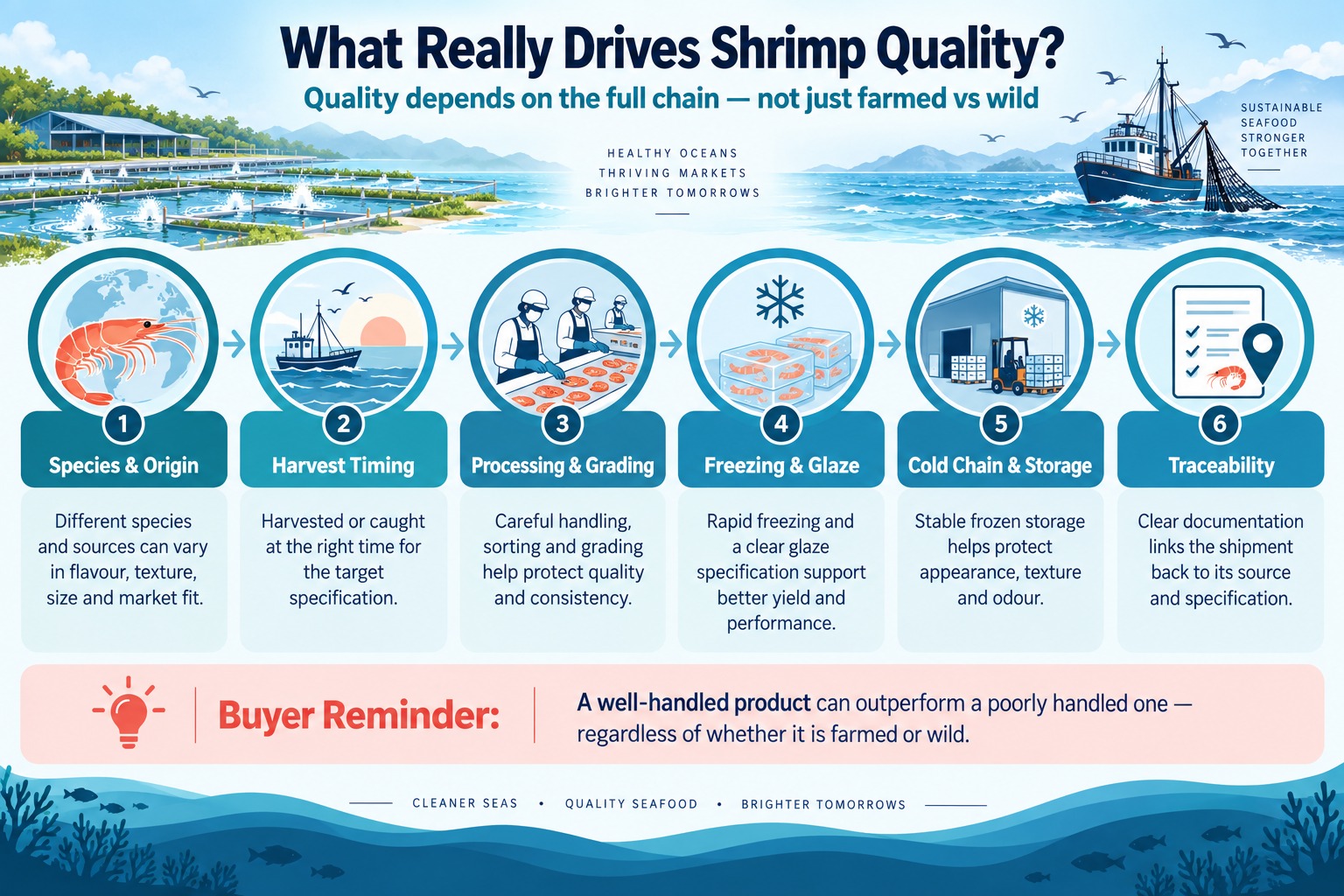
Quality starts before the shrimp reaches the processing line, but it does not stop there. Farming or fishing method influences the raw material; handling, temperature control, grading and freezing determine how much of that quality reaches the customer.
Size and Specification Consistency
Farmed shrimp has an advantage when a buyer needs repeatable commercial specifications. Producers can monitor growth and schedule harvests around target sizes. After harvesting, processors grade the shrimp into defined count ranges, which helps importers, distributors, restaurant groups and food manufacturers maintain a consistent product programme.
Wild catches are naturally more variable. The catch may contain different size distributions depending on species, location and season. This does not mean lower quality. It simply means a buyer may need tighter lot selection when consistency is critical.
For businesses comparing different forms and grades, Iran Fish’s shrimp category includes both farmed Vannamei and wild-caught options.
Freshness Depends on Handling, Not the Label
“Wild” does not automatically mean fresher, and “farmed” does not automatically mean more processed. The important question is what happened between harvest and freezing.
Shrimp deteriorates quickly when temperature control is poor. Prompt chilling, hygienic processing, rapid freezing and an uninterrupted cold chain help protect texture, odour and appearance. The U.S. Food and Drug Administration advises that shrimp flesh should be clear with a pearl-like appearance and little or no odour, while also warning that colour alone is not a reliable measure of freshness.
For frozen export shrimp, buyers should therefore look beyond the production method and review the processing date, freezing method, storage conditions, glaze specification, packaging integrity and traceability documents.
Added Water, Glaze and Processing Can Change the Experience
Two shrimp products from the same production method can perform very differently in the kitchen or factory. Excessive glaze, poor thawing behaviour or inappropriate processing can affect yield, bite and appearance. Product format also matters.
HOSO, HLSO, peeled, peeled-and-deveined, IQF and block-frozen products are designed for different supply chains. A restaurant that needs individually portioned shrimp may prioritise IQF convenience, while a processor may choose another format for its production line. The best comparison is therefore specification against specification, not simply farmed against wild.
How Farmed and Wild Shrimp Differ in Taste and Texture
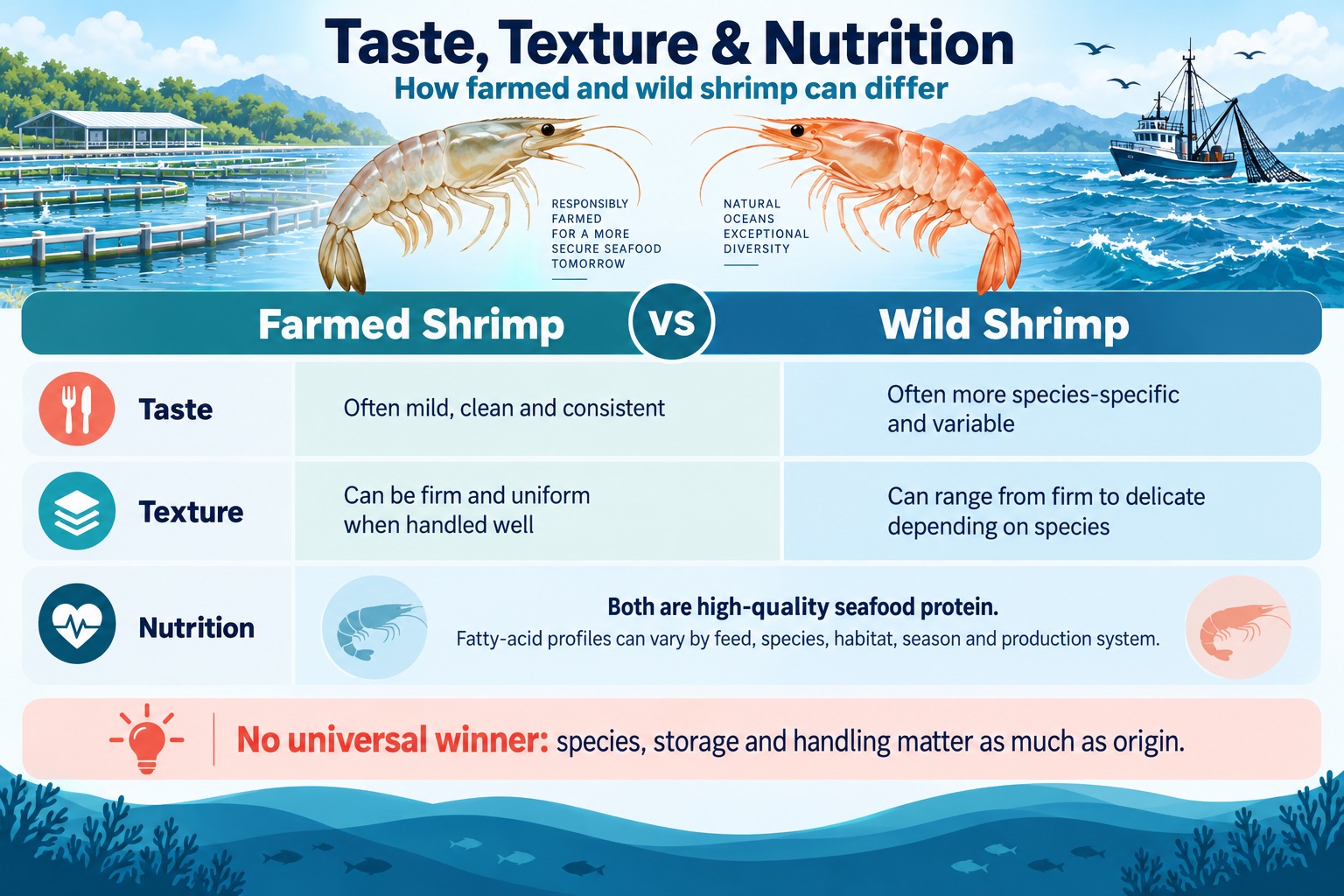
Taste is one of the most discussed differences between wild caught shrimp vs farm raised shrimp, but it is also one of the easiest areas to oversimplify. Wild shrimp feed within natural ecosystems, and their flavour can reflect species, habitat and diet. Some wild species are valued for a more distinctive marine flavour or a particular firmness. However, there is no single “wild shrimp taste” because the category includes many species from different waters.
Farmed shrimp are raised on formulated diets under managed conditions. Vannamei is popular partly because it offers a mild flavour and versatile texture that works across cuisines and processing applications. Consistency can be especially useful when a restaurant group or manufacturer wants each shipment to behave similarly during cooking. Feed formulation can also influence shrimp composition, which is one reason different farming systems can produce somewhat different sensory and nutritional profiles.
Storage matters as much as origin. A 2026 study published in the Journal of Food Science found that production system and region affected nutritional and sensory characteristics, but frozen storage also changed aroma, appearance and consumer acceptance over time. In practical terms, buyers should judge taste and texture together with species, harvest handling, freezing and storage history rather than assuming production method alone predicts eating quality.
Nutrition: Is Wild Shrimp Healthier Than Farmed Shrimp?
There is no sound basis for treating every wild shrimp as nutritionally superior to every farmed shrimp. Shrimp in both categories is a nutrient-dense seafood, and differences can occur because of species, feed, habitat, season and production system.
Research comparing farmed and wild shrimp has found measurable differences in fatty-acid profiles. A study covering 207 fatty-acid profiles across 28 penaeid shrimp species found that the production method can leave a detectable fatty-acid signature. Other research has shown that the fatty-acid composition of farmed shrimp can respond directly to the feed they receive. This is why broad claims such as “wild always has more omega-3” should be treated cautiously unless the exact species and production system are known.
A more recent 2026 study comparing Whiteleg and Pink shrimp from different production systems found higher omega-3 polyunsaturated fatty acids in the organic and wild groups studied than in the semi-intensive groups, but it also found differences in oxidative stability during frozen storage. The useful takeaway for buyers is not that one label always wins. It is that production method, feed, species and storage all matter.
From a mercury perspective, the FDA/EPA seafood advice places shrimp in its “Best Choices” category. That advice is based on mercury levels and does not distinguish shrimp simply by whether it was farmed or wild.
Food Safety, Antibiotics and Contaminants
Food safety deserves a more careful comparison than the common assumption that wild shrimp is “chemical-free” and farmed shrimp necessarily contains antibiotics. Neither claim should be accepted without evidence about the specific product and supply chain.
Farmed shrimp production involves managed water, feed and animal-health systems. Practices vary widely between countries, farms and certification schemes. For example, the Aquaculture Stewardship Council’s shrimp requirements prohibit shrimp treated with antibiotics from being sold as ASC-certified product. The standard also addresses areas such as farm impacts, health management and responsible production. This demonstrates why the farm and verification system matter more than the word “farmed” by itself.
Wild shrimp avoids aquaculture feed and farm-level veterinary treatment, but it still requires food-safety controls. Harvest waters, onboard handling, processing hygiene, temperature management and storage all affect the final product. Wild seafood also needs traceability so buyers know where and how it was harvested.
For both categories, importers should request documentation that matches their destination-market requirements. Iran Fish states that its seafood production follows HACCP and ISO food-safety systems and provides health and origin documentation for export shipments. More information about the supplier and processing network is available on the About Iran Fish page.
| Food-safety question | What buyers should verify |
|---|---|
| Where did the shrimp originate? | Farm or fishing area, country of origin and lot identification |
| How was it handled? | Harvest-to-processing controls, hygiene and temperature management |
| Was it frozen correctly? | Freezing method, storage history and cold-chain control |
| Are residues controlled? | Applicable testing and documentation for the destination market |
| Can the lot be traced? | Traceability records linking the shipment to source and processing |
| Is the packaging intact? | Carton condition, labels, glaze and product specification |
Sustainability: Farmed Shrimp vs Wild-Caught Shrimp
There is no responsible way to label all farmed shrimp sustainable or all wild shrimp sustainable. Environmental performance has to be assessed at the farm or fishery level.
Farmed shrimp sustainability can be influenced by farm location, habitat conversion, water discharge, feed ingredients, disease management, chemical use, escapes and energy use. Modern aquaculture standards are designed to address many of these areas, but performance still differs from one producer to another. The ASC Shrimp Standard, for example, evaluates environmental and social issues rather than treating aquaculture as a single uniform system.
Wild shrimp has a different environmental profile. The key questions include the condition of the shrimp stock, how the fishery is managed, seabed interaction and bycatch. Trawl fisheries can catch non-target species if gear and management are inadequate. Well-managed fisheries can reduce these impacts through measures such as bycatch-reduction devices, seasonal controls and gear requirements.
The Marine Stewardship Council evaluates wild fisheries against its fisheries standard and uses chain-of-custody requirements for certified products. This is another reason buyers should look for evidence tied to the exact supply source instead of making a sustainability judgment from “wild” or “farmed” alone.
Supply Differences: Why Farmed Shrimp Is More Predictable
Supply is one of the clearest practical differences between farmed and wild shrimp. Aquaculture lets producers plan stocking, growing and harvesting within a managed system. That does not remove every risk, since disease, weather, water conditions and farm performance can still affect output, but it gives the supply chain more control than a fishery that depends on naturally occurring stocks.
This predictability is one reason farmed Vannamei works well for programmes that require repeat sizes and specifications. A buyer can define product form, count, packing style and other requirements, then work with a producer or exporter toward a repeatable supply plan.
Wild shrimp supply follows natural and regulatory conditions. Catch can shift with season, weather, fishing effort, stock status and management rules. NOAA’s information on U.S. shrimp fisheries, for example, shows how individual wild fisheries can have specific seasons, gear rules or even closures. The exact situation differs by fishery and country, but the broader point is universal: wild supply is connected to the condition and management of a natural stock.
For buyers, neither model is inherently unsuitable. The right choice depends on whether a programme values repeatability or a particular wild species and origin.
| Supply requirement | Farmed Vannamei | Wild-caught shrimp |
|---|---|---|
| Repeated size specifications | Strong fit | Possible, but catch profile may vary |
| Planned procurement | Generally easier to schedule | More dependent on fishery conditions |
| Species-specific character | Vannamei offers a consistent commercial profile | Strong fit when a particular wild species is required |
| Seasonal menu or specialty range | Can be supplied beyond a narrow wild season | Often a natural fit |
| Large standardised programmes | Commonly used | Depends on fishery volume and grading |
| Flexible product formats | Available through processing and packing | Available, subject to catch and processor capability |
Why Species and Origin Matter as Much as Farmed vs Wild
When buyers ask, “Which is better, farmed or wild shrimp?”, the more useful question is: which species, from which source, processed to which specification?
Vannamei has become a major farmed shrimp because it performs well in aquaculture and fits standardised seafood supply chains. Wild shrimp may include several species with different shell characteristics, flavours and textures. Comparing the two without naming the species is similar to comparing “farmed fish” with “wild fish” without saying whether the products are salmon, sea bass or another species.
Origin also matters because farming rules, fishery management, environmental conditions and export controls differ by country and region. Buyers should ask for the scientific or commercial species name, production method, country of origin, harvest area or farm source, processing location and lot traceability.
Iran has access to both aquaculture and marine resources. Iran Fish offers farmed Vannamei shrimp as well as wild-caught shrimp, allowing buyers to compare products from the same export supplier instead of managing two completely separate sourcing relationships.
Traceability and Labelling: How to Know What You Are Buying
A reliable shrimp specification should tell the buyer more than whether the product is farm raised or wild caught. Accurate identification protects purchasing decisions, food-safety controls and customer claims.
Useful documentation should connect the physical shipment with its source. Depending on the product and destination market, that can include species information, production method, country of origin, processing establishment, health documentation, lot coding and shipment records.
Traceability is especially important because shrimp authenticity cannot always be judged visually after peeling, cooking or further processing. Scientific research has even explored fatty-acid profiling as a tool for distinguishing farmed from wild penaeid shrimp, which highlights how difficult visual identification can become once a product enters the processing chain.
For an importer, the practical solution is much simpler: buy against a clear written specification and require matching documentation. Iran Fish states that full source traceability can be provided upon request for its export shipments.
Choosing High-Quality Shrimp Beyond the Farmed or Wild Label
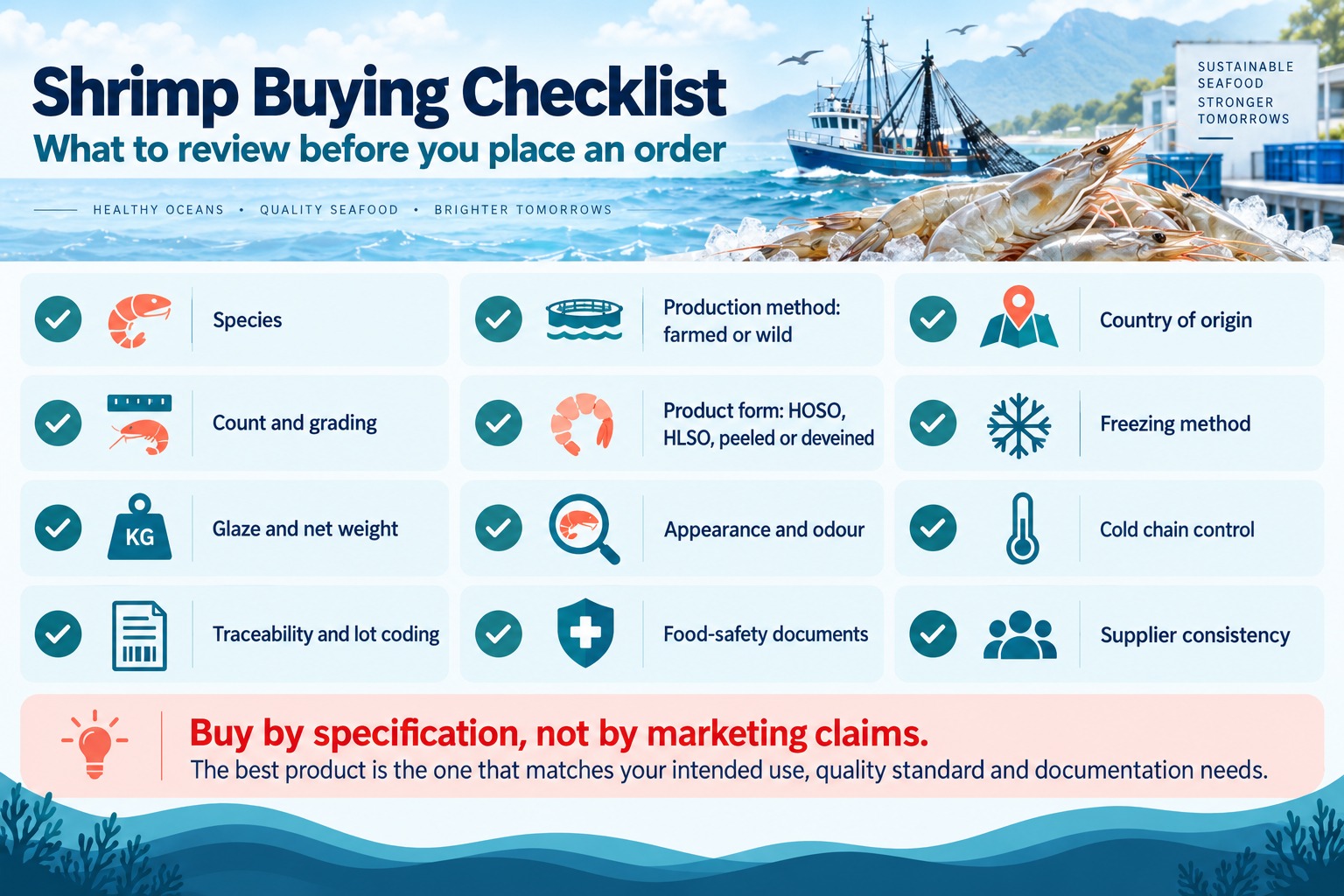
A good purchasing decision starts with the specification, not a marketing claim. Whether you are sourcing farm raised shrimp or wild caught shrimp, review the factors that directly affect product performance.
- Species: Confirm exactly what shrimp you are buying rather than relying on a generic trade name.
- Production method: Record whether the product is farmed or wild caught.
- Origin: Confirm country, farm or fishing area where relevant.
- Count and grading: Make sure the sizing system matches your intended use.
- Product form: Specify HOSO, HLSO, peeled, deveined or another required format.
- Freezing method: Select a format suited to your distribution and production needs.
- Glaze and net weight: Make sure specifications are clearly documented.
- Appearance and odour: Product should meet agreed sensory and quality criteria.
- Cold chain: Confirm appropriate frozen storage and transport controls.
- Traceability: Require lot identification and source documentation.
- Food-safety documents: Check that documentation satisfies your destination market and business requirements.
- Supplier consistency: Evaluate whether repeat shipments can match the approved specification.
The FDA also advises seafood buyers not to use colour alone as a freshness test. For shrimp, mild odour, appropriate appearance, correct storage and proper handling are more meaningful when assessed together.
Which Shrimp Is Better for Restaurants, Retailers and Seafood Importers?
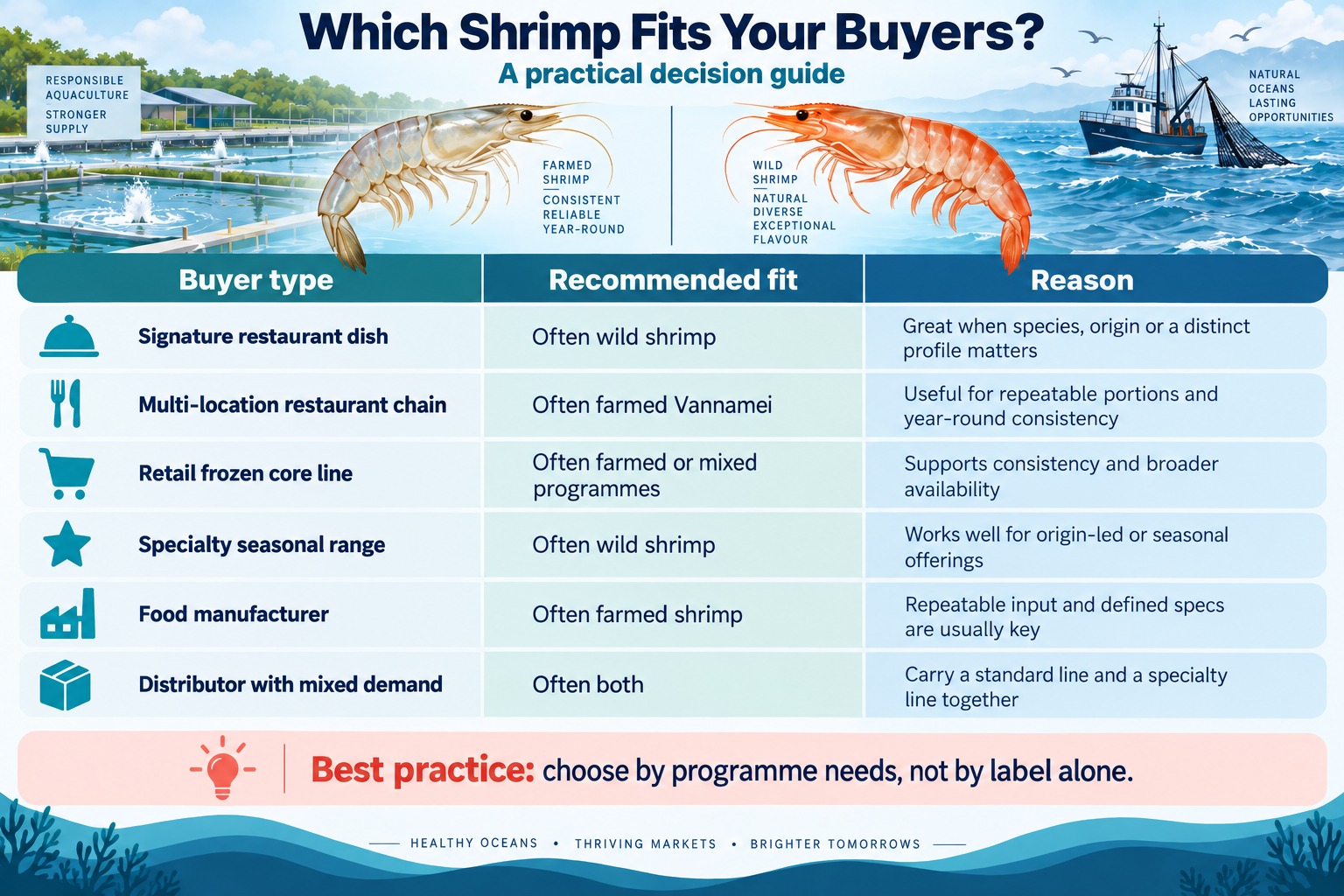
The answer depends on the programme. A restaurant that wants a distinctive wild species for a signature dish may value origin and seasonal character more than exact year-round uniformity. A multi-location restaurant group may prefer Vannamei because predictable counts and product specifications simplify portioning and kitchen procedures.
Retailers often need both consistency and a clear story for the shopper. Farmed shrimp can work well in core frozen lines, while selected wild shrimp can support origin-led or specialty ranges. The strongest programme does not have to choose one category exclusively.
Food manufacturers usually place greater emphasis on repeatable inputs. Size, texture, product form, freezing method and availability can be more important than whether the shrimp came from a farm or fishery. This is where a detailed supply specification becomes essential.
Importers and distributors need to look at the full chain. Product quality, documentation, origin, processing capability, packing, traceability and shipment planning should all be evaluated before deciding which shrimp fits a market.
Farmed vs Wild Shrimp for International Supply: A Practical Decision Guide
Choose farmed Vannamei when repeat specifications, planned supply and consistent grading are central to the programme. This does not mean accepting generic product. The buyer should still define origin, grade, processing style, freezing method, packaging and documentation.
Choose wild shrimp when the species, natural origin or a particular sensory profile is central to the product. Because catches can vary, confirm current availability and specification before building a programme around a wild product.
Consider using both when your business serves more than one customer segment. A distributor might keep a standard Vannamei line for regular food-service demand and a wild-caught line for customers who specifically request it. Working with a supplier that can handle both categories can simplify quality control and documentation.
The most important point is that farmed vs wild shrimp is only the first decision. The final quality reaching your customer is shaped by the full chain from source to harvest, processing, freezing, storage and delivery.
Source Farmed or Wild Shrimp from Iran Fish
If you are deciding between farmed Vannamei and wild-caught shrimp for an import, wholesale, retail or food-service programme, Iran Fish can help you compare the options against your required species, size, product form, freezing method, packaging and destination-market documentation.
Explore our complete shrimp export range, review our Vannamei shrimp and wild-caught shrimp pages, or contact Iran Fish with your required specifications. Our team can help identify which product is the better operational fit for your market.
Frequently Asked Questions
Is wild shrimp always better than farmed shrimp?
No. Wild shrimp is not automatically higher quality than farmed shrimp. Species, harvest conditions, processing speed, freezing, storage and cold-chain control all influence final quality. Well-produced farmed Vannamei can offer excellent consistency, while carefully handled wild shrimp can provide distinctive species-specific characteristics. Buyers should compare actual specifications and documentation rather than relying on the production label alone.
Is farm-raised shrimp healthy and safe to eat?
Properly produced and handled farm-raised shrimp can be a healthy seafood choice. Food safety depends on the farm, water and feed management, residue controls, processing hygiene, freezing and cold chain. Certification and testing requirements can add further controls. Shrimp is also included in the FDA/EPA “Best Choices” category for mercury, although buyers should still follow applicable food-safety and dietary guidance for their market.
Does wild-caught shrimp taste different from farmed shrimp?
It can. Wild shrimp species develop under natural diets and environmental conditions, which can produce different flavour and texture characteristics. Farmed Vannamei is generally valued for a mild, versatile and consistent profile. However, species, feed, freshness, freezing and storage can all affect sensory quality, so production method alone does not determine taste.
Which is more sustainable, farmed or wild shrimp?
Neither category is automatically more sustainable. Farmed shrimp should be assessed for issues such as habitat impact, effluent, feed, disease management and chemical use. Wild shrimp should be assessed for stock condition, bycatch, fishing gear and fishery management. Recognised farm or fishery certification can help buyers evaluate the specific source.
Can Iran Fish supply both farmed Vannamei and wild-caught shrimp?
Yes. Iran Fish lists both farmed Vannamei and wild-caught shrimp within its shrimp range. Available product forms, grades and supply specifications can differ, so international buyers should provide their required size, processing format, packaging, destination and documentation requirements when contacting the export team.