


Vannamei Shrimp Sizes Explained for Wholesale Buyers

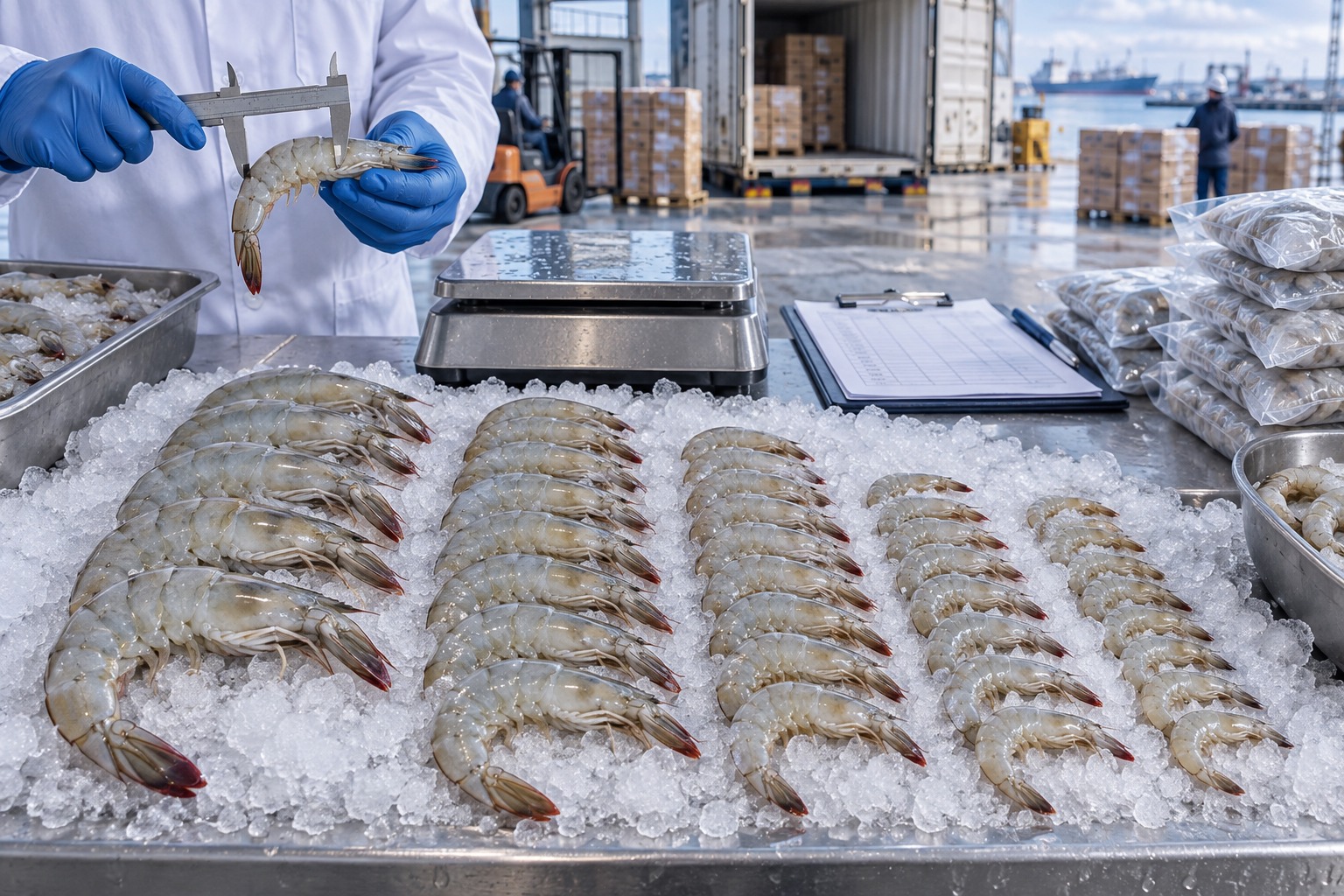
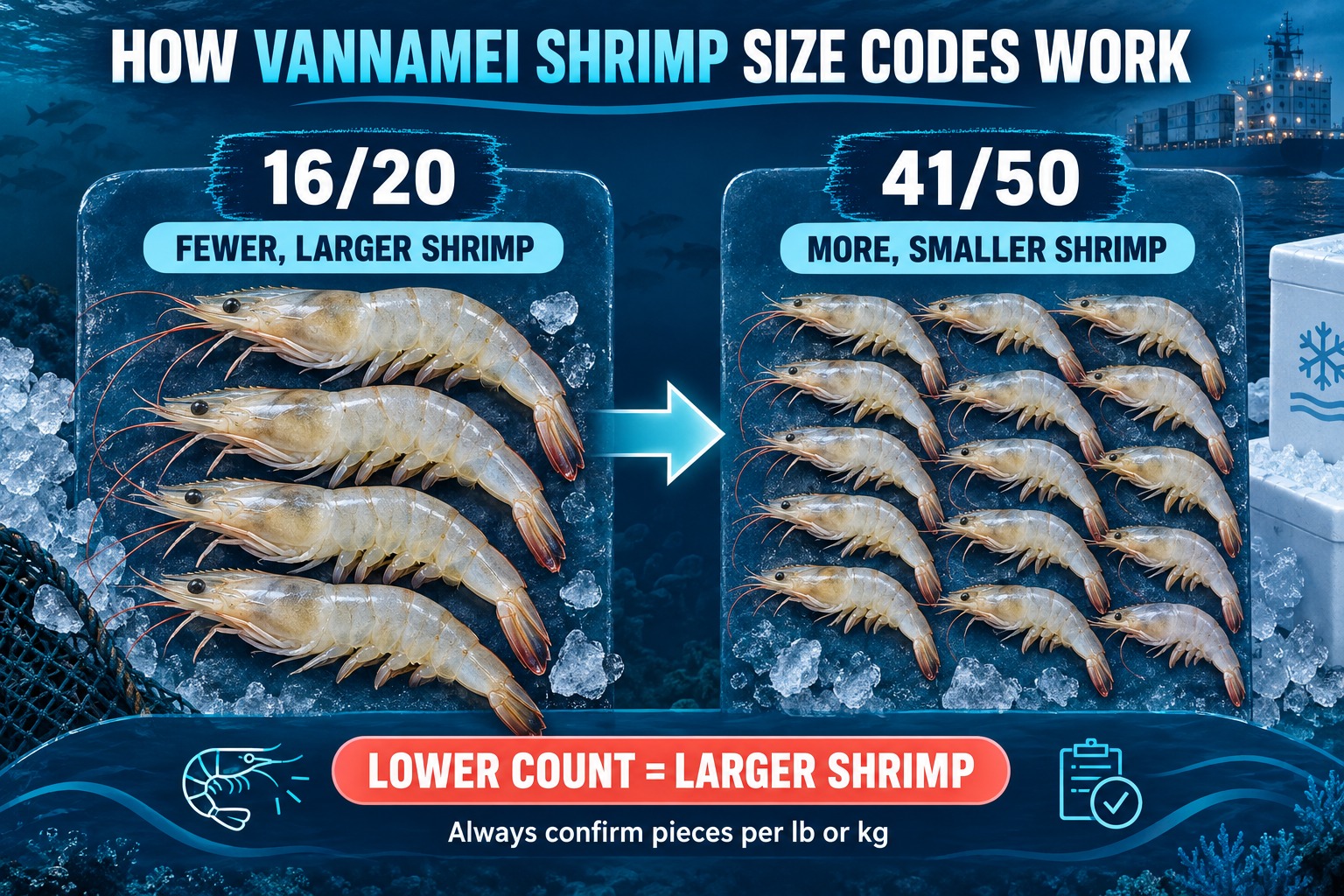
Vannamei shrimp sizes tell buyers how many shrimp make up a stated unit of weight: the lower the count, the larger each shrimp. A 16/20 grade is larger than a 41/50 grade, but the code is only meaningful when the quotation also identifies the count unit, product form, and whether the shrimp are checked after deglazing. Wholesale buyers should therefore specify the count per pound or kilogram, processing form, glaze, net weight, and permitted size tolerance together.
| Buying question | Practical answer |
|---|---|
| What does 16/20 mean? | The declared unit contains between 16 and 20 shrimp. The specification must state whether that unit is one pound or one kilogram. |
| Does a lower number mean a larger shrimp? | Yes. Fewer pieces are needed to make the same unit of weight, so each piece is larger. |
| What does U/10 mean? | “Under 10” shrimp per declared unit of weight. The unit must still be stated. |
| Are size names such as jumbo universal? | No. Numerical counts are more dependable than labels such as large, jumbo, or colossal. |
| Are HOSO and peeled shrimp compared on the same basis? | Not safely. Product form changes the weight retained in each piece and may also change the customary count unit. |
| Should glaze be included when checking count? | No. Count should be checked against actual deglazed product weight. |
| What belongs in a wholesale size specification? | Species, product form, count range, count unit, deglazing method, uniformity tolerance, glaze declaration, net contents, freezing format, and pack configuration. |
How Vannamei Shrimp Sizes and Count Codes Work
Commercial shrimp sizing is a count system rather than a direct length measurement. The two numbers show the minimum and maximum number of shrimp expected in a specified unit of weight. If a pack is described as 21/25 pieces per pound, one pound of deglazed product should contain 21 to 25 pieces when tested by the agreed method. A 31/35 grade contains more pieces in that pound, so its individual shrimp are smaller.
The letter “U” means “under.” U/10 therefore means fewer than 10 shrimp per stated unit. It does not automatically mean per pound or per kilogram. A buyer who receives an offer for “U/10 Vannamei” still needs the supplier to identify the weight basis and product form in writing.
This matters because the same bare code can describe substantially different shrimp. A 30/40 HOSO offer counted per kilogram is not equivalent to a 30/40 PDTO offer counted per pound. The first description includes the head and shell in each piece; the second describes peeled and deveined meat with the tail retained. The safest commercial description is complete, for example: “Penaeus vannamei, raw PDTO, 21/25 pieces per pound, IQF, count verified after deglazing.”
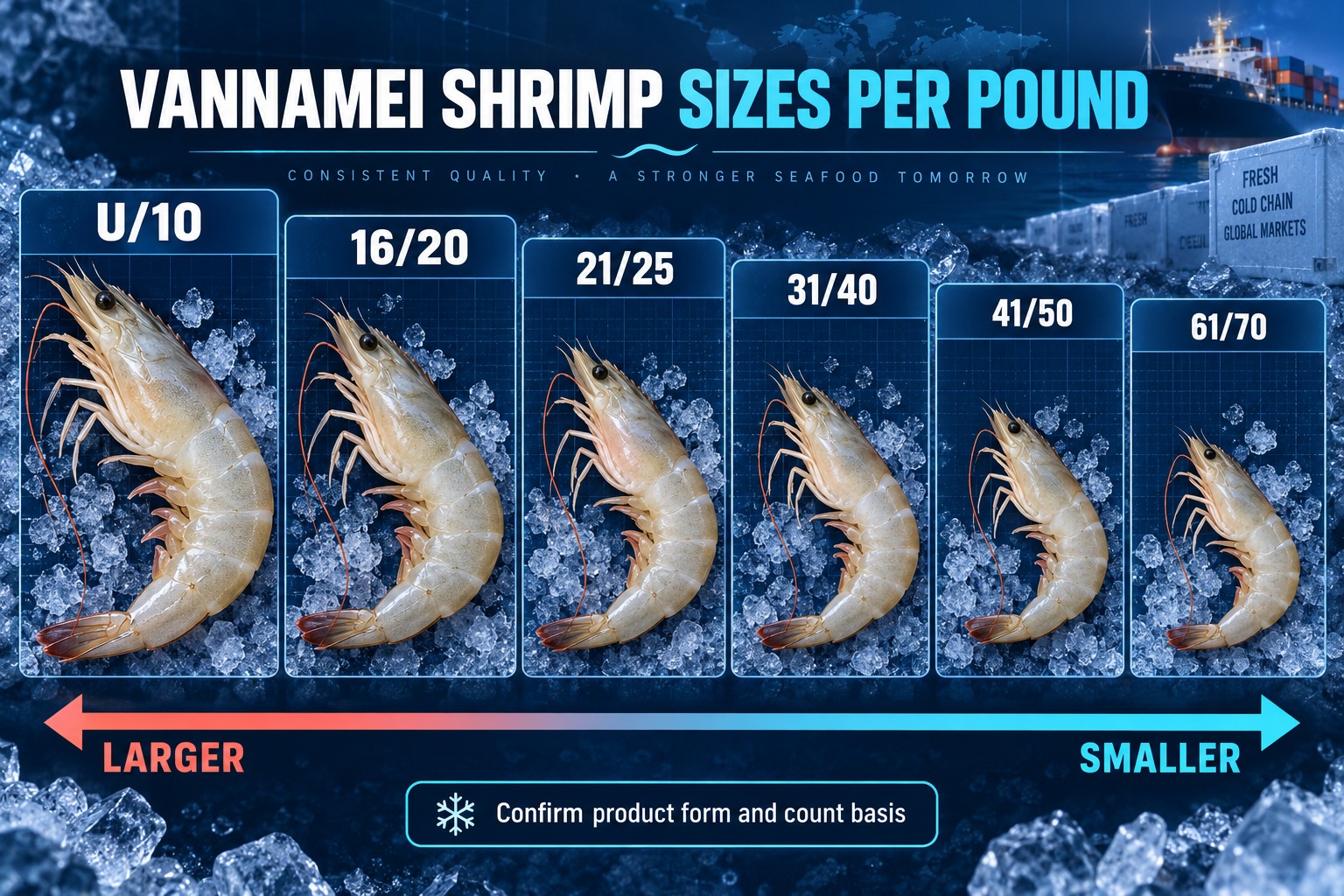
Common Vannamei Shrimp Sizes per Pound
Counts per pound are widely used for headless and peeled shrimp in international trade, although supplier and market practices differ. The approximate piece weights below are mathematical conversions based on one international avoirdupois pound equalling 453.59237 grams. They are orientation figures, not substitutes for physical count testing.
| Count per pound | Common descriptive name | Calculated weight per shrimp | Typical uses to evaluate |
|---|---|---|---|
| U/10 | Colossal | More than 45.4 g | Whole presentation, grilling, premium centre-of-plate dishes |
| 10/15 | Extra colossal | About 30.2–45.4 g | Grilling, large skewers, high-visibility food service |
| 16/20 | Extra jumbo | About 22.7–28.3 g | Grills, skewers, plated restaurant dishes |
| 21/25 | Jumbo | About 18.1–21.6 g | Food service, retail packs, pasta, curries |
| 26/30 | Extra large | About 15.1–17.4 g | Broad restaurant, catering, and retail use |
| 31/35 | Large | About 13.0–14.6 g | Frying, mixed dishes, portion-controlled menus |
| 36/40 | Medium-large | About 11.3–12.6 g | Buffets, rice dishes, prepared foods |
| 41/50 | Medium | About 9.1–11.1 g | Salads, fillings, frying, further processing |
| 51/60 | Small-medium | About 7.6–8.9 g | Prepared meals, fillings, industrial processing |
| 61/70 | Small | About 6.5–7.4 g | Soups, sauces, ready-meal production |
| 71/90 | Extra small | About 5.0–6.4 g | Ingredient applications and value-added products |
| 91/110 | Very small | About 4.1–5.0 g | Fillings, mixed seafood products, industrial use |
Descriptive names vary between sellers. One catalogue may call 21/25 “jumbo,” while another uses a different marketing term. A purchase order should rely on the numerical range, not the adjective. It should also state whether broken pieces count, how count is tested, and whether any tolerance applies at the edges of the range.
Gaps between common ranges are normal. For example, a supplier may offer 16/20 followed by 21/25 rather than a continuous sequence. Buyers should not rewrite a supplier’s grade into a preferred name without confirming how the processing plant sorts and verifies that product.
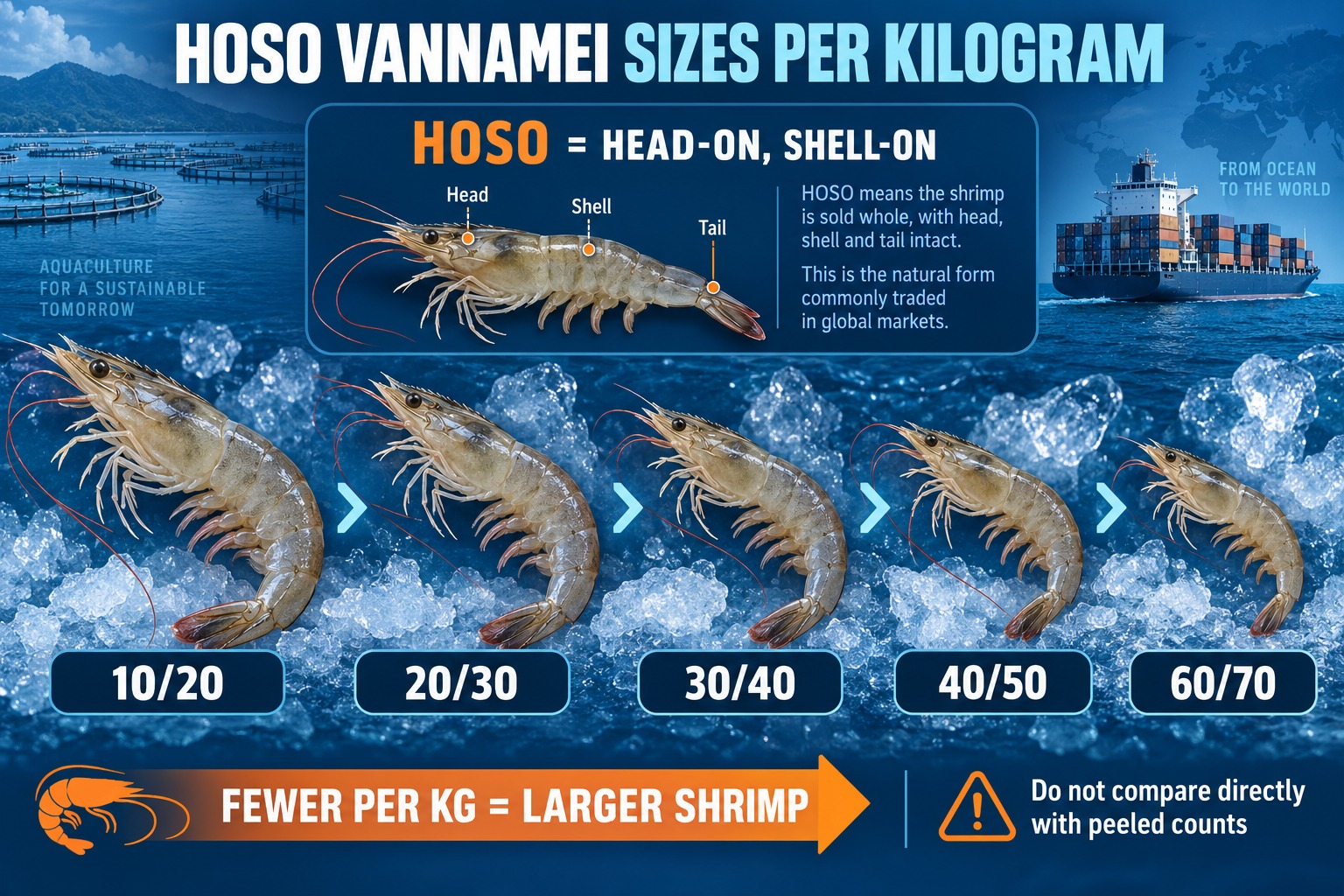
Common HOSO Vannamei Shrimp Sizes per Kilogram
Head-on, shell-on shrimp are commonly quoted in pieces per kilogram in many export markets. Because each shrimp retains its head and shell, its piece weight cannot be compared directly with a peeled product carrying the same numerical code.
| Count per kilogram | Calculated weight per whole shrimp | Relative size | Buyer consideration |
|---|---|---|---|
| U/10 | More than 100 g | Exceptional whole size | Confirm whether this grade is available and how “under” is verified |
| 10/20 | About 50.0–100 g | Very large | Check head condition, shell hardness, colour, and uniformity |
| 20/30 | About 33.3–50.0 g | Large | Suitable for prominent whole-shrimp presentation |
| 30/40 | About 25.0–33.3 g | Medium-large | Common food-service and retail presentation range |
| 40/50 | About 20.0–25.0 g | Medium | Check consistency across cartons and production lots |
| 50/60 | About 16.7–20.0 g | Medium-small | Useful for broad wholesale and food-service programmes |
| 60/70 | About 14.3–16.7 g | Small | Confirm usable yield for the intended preparation |
| 70/80 | About 12.5–14.3 g | Smaller | Often considered for processing and mixed dishes |
| 80/100 | About 10.0–12.5 g | Very small | Define minimum piece condition and defect tolerances |
| 100/120 | About 8.3–10.0 g | Extra small | Mainly relevant to ingredient and processing applications |
These ranges are common trade bands, not a universal list imposed on every supplier. Iran Fish identifies multiple sizes within its farmed Vannamei shrimp range, but current availability, count basis, product form, and packing specification should be confirmed for each shipment.
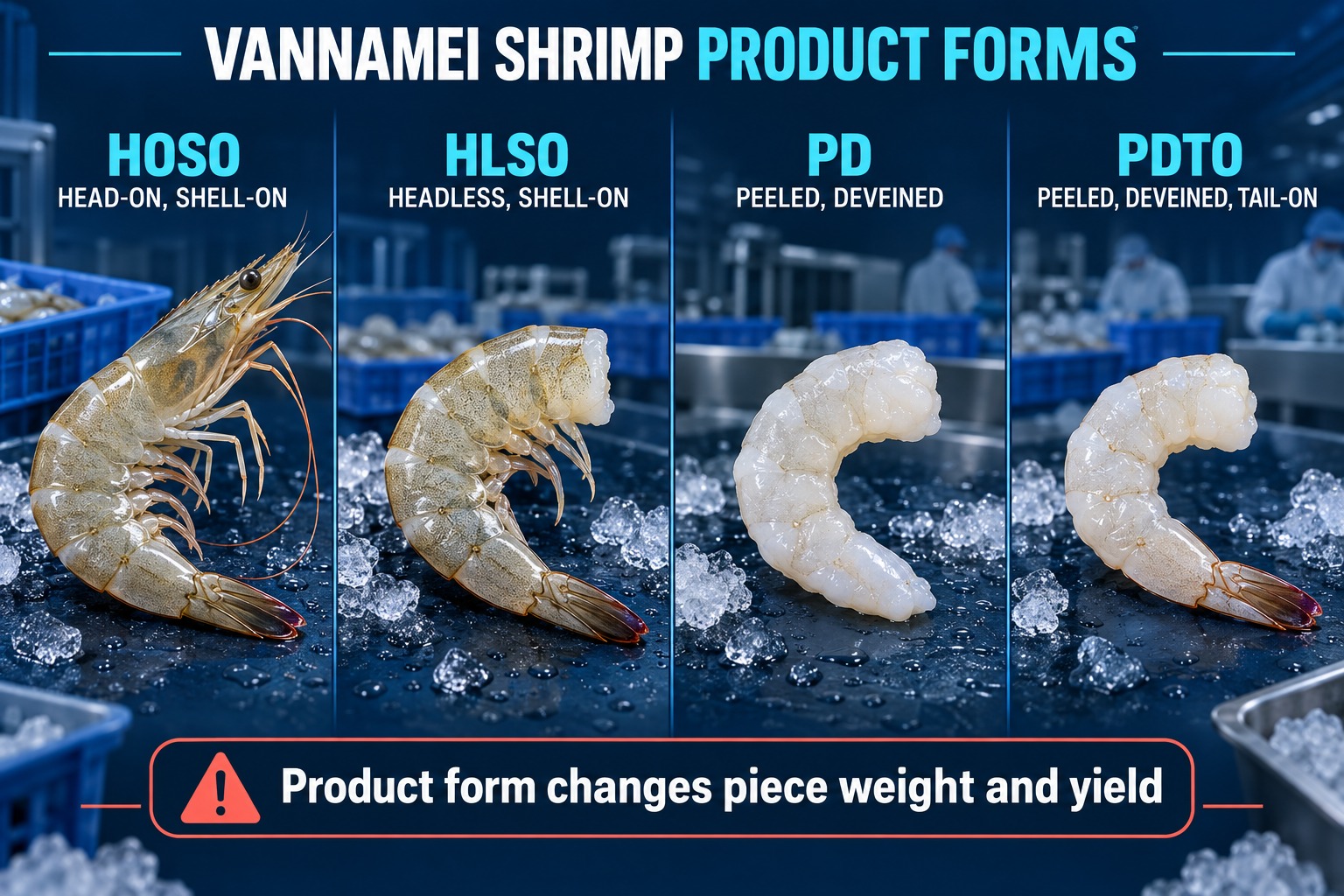
Why Product Form Changes the Meaning of Size
Processing removes different parts of the shrimp, changing the weight of each finished piece. A whole HOSO shrimp includes the head, shell, legs, and tail. HLSO retains the shell but removes the head. PD and PDTO products remove the head and shell, while PDTO keeps the tail. A count measured on one form should not be used to predict another form without a documented yield and an agreed finished-product specification.
| Code | Product form | What remains on the shrimp | Size-related buying point |
|---|---|---|---|
| HOSO | Head-on, shell-on | Head, shell, and tail | Often counted per kilogram; head and shell add substantial piece weight |
| HLSO | Headless, shell-on | Shell and tail | Usually offers more edible yield per piece than HOSO |
| PUD | Peeled, undeveined | Meat; tail status must be specified | Confirm whether the count applies before or after final trimming |
| PD | Peeled, deveined | Peeled meat; commonly tail-off unless stated otherwise | Define vein removal, cut depth, and remaining shell tolerance |
| PTO | Peeled, tail-on | Peeled meat and tail | Vein status should be stated separately |
| PDTO | Peeled, deveined, tail-on | Peeled and deveined meat with tail | Popular where plate presentation and preparation speed matter |
| CPD | Cooked, peeled, deveined | Cooked peeled meat | Count must relate to the finished cooked form |
| Easy-peel | Shell-on with a cut for easier peeling | Shell and tail, with processing cut | Specify cut style, vein condition, and shell integrity |
Wholesale buyers should therefore avoid asking for “Vannamei 30/40” alone. That request leaves unanswered whether the shrimp are whole or peeled, raw or cooked, counted per pound or kilogram, and assessed with or without glaze. Iran Fish’s Vannamei shrimp buying guide explains how product form, freezing method, net contents, treatments, and inspection terms fit into the wider purchasing specification.
Does the Count Apply Before or After Deglazing?
For glazed frozen shrimp, count verification should use the actual deglazed weight. The current Codex Standard for Quick-Frozen Shrimps or Prawns, CXS 92-1981, amended in 2024 and republished in 2026, states that a declared count is determined by counting the shrimp in the container or a representative sample and dividing that number by the actual deglazed weight.
This distinction prevents ice from distorting the count. If a one-pound declaration is checked against glazed gross weight, some of that weight is water rather than shrimp. The result may appear to meet a count range even though the deglazed product does not. The specification should name the deglazing method, draining procedure, scale accuracy, sample selection, and unit used for the calculation.
Codex also states that the declared net contents of glazed quick-frozen shrimp must exclude the glaze. Buyers should keep gross pack weight, glaze, and net shrimp contents as separate fields. A percentage by itself is not enough unless both parties use the same method to remove the glaze and determine the deglazed weight.
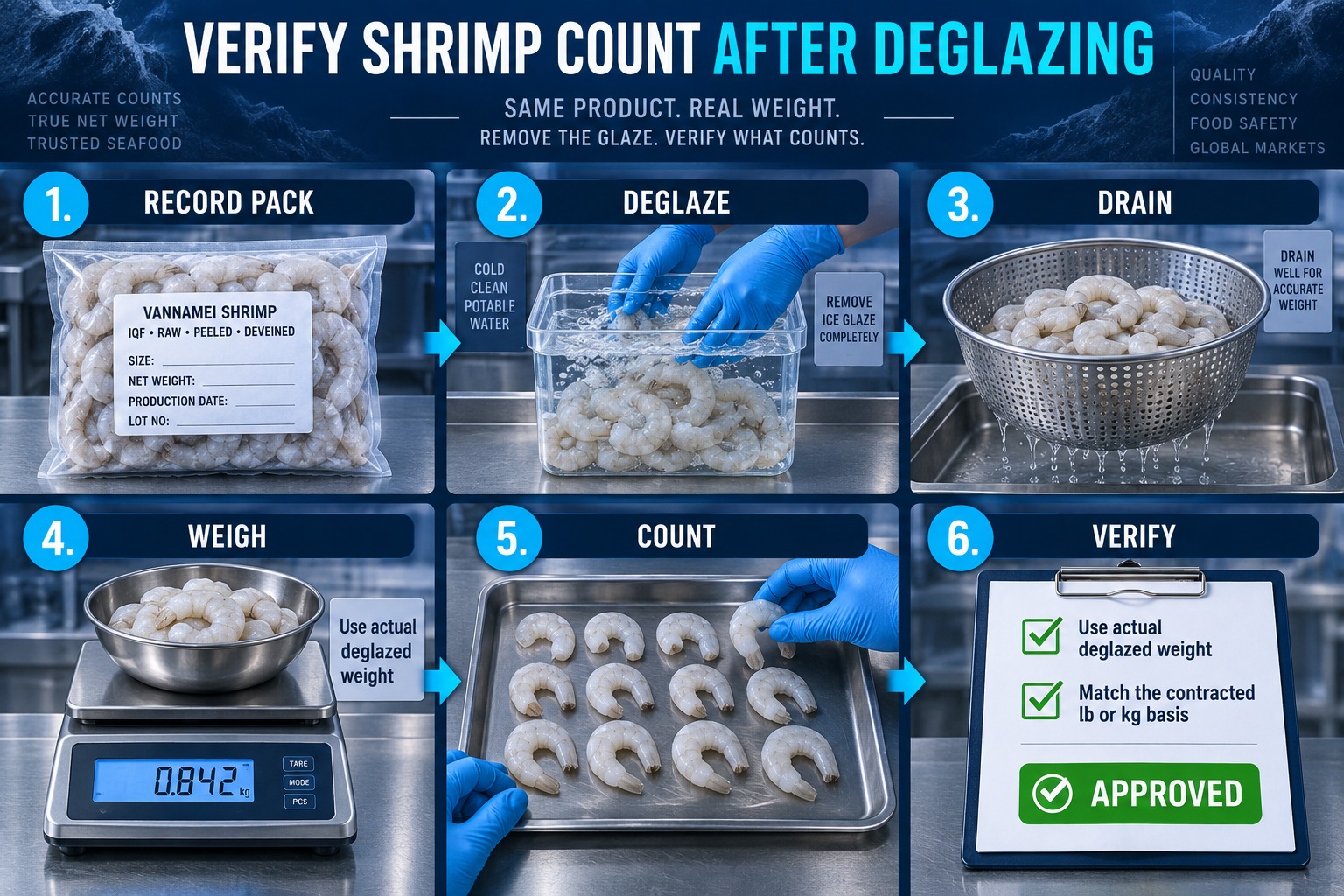
How to Check Count and Net Weight
A repeatable receiving or pre-shipment test is more useful than a visual guess. The supplier, inspector, and buyer should use the same written procedure:
- Identify the product, production lot, carton, and inner pack selected for testing.
- Record the unopened pack weight with a calibrated scale.
- Remove the glaze using the agreed recognised method without damaging the shrimp.
- Drain the product for the defined period without pressing water from the flesh.
- Record the actual deglazed weight.
- Count all qualifying pieces in the sample and record broken or nonconforming pieces separately.
- Divide the piece count by the deglazed weight in pounds or kilograms, matching the contracted unit.
- Compare the result with the size range, net-content declaration, and agreed tolerances.
- Retain photographs, scale readings, lot codes, and the signed inspection result.
Codex states that the sample unit for individually quick-frozen products is at least a 1 kg portion for the prescribed end-product examination. It also refers to an appropriate sampling plan with an AQL of 6.5 for examination of the end product. A private contract may require additional checks, but its methods and acceptance criteria should be agreed before production.
Uniformity Matters as Much as the Average Count
A carton can produce an average count inside the declared range while still containing an unattractive mix of noticeably large and small shrimp. That may be workable for industrial processing, but it creates problems for fixed-count retail packs, skewers, banquets, or restaurant plates where every serving is expected to look consistent.
Uniformity should be written as a measurable requirement rather than described as “good” or “premium.” The specification can identify how a representative sample will be sorted, weighed, and compared, along with the permitted variation. It should also state how pieces sitting just outside the declared grade are treated.
The physical count should distinguish intact shrimp from fragments. A pack with many broken tails or damaged bodies may reach the numerical count while delivering less usable product. For PDTO and other presentation-focused forms, buyers should combine size acceptance with workmanship criteria for tail damage, remaining shell, vein removal, back-cut depth, and broken pieces.
Matching Vannamei Shrimp Sizes to the End Use
The best grade is the one that fits the customer’s portion, cooking method, presentation, and workflow. Larger shrimp are visually prominent, but smaller grades may distribute more evenly through prepared foods. The correct choice cannot be made from the words “large” or “small” alone.
| End use | Size direction to evaluate | Product forms commonly considered | Questions for the buyer |
|---|---|---|---|
| Grilling and centre-of-plate dishes | Lower count, larger pieces | HOSO, HLSO, PDTO | Will shrimp be served whole, peeled, or on skewers? |
| Restaurant pasta and curries | Large to medium grades | HLSO, PD, PDTO | How many pieces are required per serving after cooking? |
| Shrimp cocktails and chilled display | Consistent medium to large pieces | CPTO, PDTO | Is tail-on presentation required? |
| Frying and breaded products | Medium, uniform pieces | PD, PDTO, butterfly | What finished portion and coating pickup are expected? |
| Retail frozen bags | Grade depends on pack promise | IQF HLSO, PD, PDTO | Does the label state a count, net weight, or serving expectation? |
| Catering and buffet service | Medium grades with dependable uniformity | HLSO, PD, PDTO | How will portions be controlled across many servings? |
| Ready meals, fillings, and sauces | Medium-small to small grades | PD, cooked PD | Must pieces remain visually distinct after processing? |
| Further processing | Grade selected by yield and line requirements | HLSO, PUD, PD, block frozen | Can the equipment handle the expected size variation? |
A menu trial using the approved sample is the most reliable way to confirm suitability. Count the pieces before and after cooking, record the finished yield, assess appearance, and test the actual portion. This connects the procurement specification to the product that the buyer’s customer will receive.
IQF vs Block Frozen Shrimp by Size
IQF shrimp are frozen as separate pieces, allowing a kitchen or processor to remove only the required quantity. This format makes piece counting and portion control convenient, provided the shrimp remain free-flowing and the glaze is intact. Inspection should check for clumping, dehydration, damaged glaze, broken pieces, and evidence of partial thawing.
Block-frozen shrimp are frozen together as a solid unit. They can suit operations that thaw and process the full block at once. Buyers should assess block integrity, inner packaging, uniformity across the block, thawing workflow, and whether the entire unit can be used safely after controlled thawing.
Freezing format does not change the contracted count range, but it affects how the product is sampled and handled. Codex states that quick freezing is not complete until the thermal centre reaches -18°C or colder after thermal stabilisation, and that the product should remain deep frozen during transport, storage, and distribution. Iran Fish presents IQF and block-frozen options within its broader shrimp export selection.
What to Put on a Wholesale Size Specification
Every enquiry, purchase order, label brief, and inspection instruction should describe the same product. At minimum, record the following:
| Specification field | What to state clearly |
|---|---|
| Species | Penaeus vannamei, farmed origin |
| Product form | HOSO, HLSO, PUD, PD, PTO, PDTO, cooked, or another fully defined form |
| Size range | Exact numerical count, such as 21/25 or 30/40 |
| Count unit | Pieces per pound, pieces per kilogram, or pieces per package |
| Count condition | Verified using actual deglazed weight |
| Uniformity | Test method and permitted variation within the lot |
| Workmanship | Rules for broken pieces, vein removal, shell remnants, tail damage, and trimming |
| Freezing | IQF, semi-IQF, or block frozen |
| Glaze | Declared separately with an agreed deglazing method |
| Net contents | Shrimp weight excluding glaze |
| Processing status | Raw, partially cooked, fully cooked, or value-added |
| Packing | Inner-pack weight, packs per carton, carton coding, and pallet pattern |
| Storage | Frozen storage and transport conditions stated on the label and shipment instruction |
| Inspection | Sampling method, count test, weight test, evidence required, and acceptance criteria |
Avoid using “standard size” unless the document names the standard, unit, and plant grading method. “Jumbo PDTO” is still incomplete. “Raw PDTO, 21/25 pieces per pound, IQF, count determined after deglazing” gives production and inspection teams a shared description.
Common Mistakes When Comparing Supplier Offers
- Comparing two numerical grades without confirming whether one is per pound and the other is per kilogram.
- Treating HOSO, HLSO, and peeled products as interchangeable because they carry the same count code.
- Using marketing names such as jumbo or colossal as though they were universal standards.
- Checking count against glazed gross weight rather than actual deglazed weight.
- Comparing packs by gross weight without separating glaze from declared net shrimp contents.
- Ignoring uniformity because the average count falls within the contracted range.
- Failing to define whether broken shrimp, detached tails, or heavily damaged pieces qualify in the count.
- Assuming the approved sample represents every later harvest or production lot.
- Omitting the freezing format, product condition, or processing status from the size description.
- Allowing the carton, purchase order, health documents, and inspection report to use different product descriptions.
These gaps often begin with a short enquiry and continue into production. A clear specification protects both parties because it creates one testable description for grading, packing, inspection, and receiving.
Verify Size During Pre-Shipment Inspection
Pre-shipment inspection should test the contracted product rather than a generic checklist. The inspector needs the approved specification, lot identity, sampling instruction, deglazing method, count unit, size range, and tolerances before selecting cartons.
The inspection record should show which cartons and inner packs were selected, the deglazed weight of every test sample, the number of pieces counted, the calculated count per contracted unit, and any oversized, undersized, or broken pieces. Photographs should include the product, packaging, lot codes, scale display, and representative size spread.
Count results should be reviewed alongside sensory condition, temperature, glaze, dehydration, workmanship, shell or head condition, packaging, and label accuracy. The FDA’s current Fish and Fishery Products Hazards and Controls Guidance also emphasises documented hazard analysis and appropriate controls for seafood processors. Destination-specific rules should always be confirmed by the responsible importer before shipment.
Source Vannamei Shrimp by a Clear Size Specification
Iran Fish works with importers, distributors, food-service businesses, and processors seeking farmed Vannamei shrimp from Iran. Buyers can discuss the required count range, count unit, product form, glaze declaration, net contents, freezing method, packing configuration, destination, and inspection requirements with the trade team.
Review the Iranian Vannamei shrimp product page and the complete wholesale shrimp range before preparing your enquiry. Then contact Iran Fish with the destination market, expected application, preferred processing form, numerical size range, and count basis so the available specification can be confirmed.
Frequently Asked Questions About Vannamei Shrimp Sizes
What does 16/20 mean on Vannamei shrimp?
It means the declared unit of weight should contain between 16 and 20 shrimp. In many headless and peeled trades, that unit is one pound, but the number alone does not prove the unit. Require the specification, carton, and inspection report to state pieces per pound or pieces per kilogram.
Is a 21/25 shrimp larger than a 31/40 shrimp?
Yes, provided both products use the same count unit and product form. A 21/25 grade has fewer shrimp in the stated weight, so each shrimp is larger. Do not compare the two codes directly if one product is HOSO per kilogram and the other is peeled per pound.
What does U/10 mean in shrimp sizing?
U/10 means fewer than 10 shrimp in the declared unit of weight. The “U” stands for “under.” The order must still identify whether the unit is a pound or kilogram and whether the count applies to HOSO, HLSO, peeled, raw, or cooked product.
Should shrimp size be checked before or after removing glaze?
For glazed quick-frozen shrimp, the count should be determined using actual deglazed weight. This follows Codex CXS 92-1981. The buyer and supplier should agree on the deglazing, draining, weighing, counting, and sampling procedure before production or inspection.
Which Vannamei shrimp size is best for wholesale buyers?
There is no single best grade. The right size depends on the sales channel, product form, portion, menu application, processing line, pack format, and presentation. Define the intended use first, then approve a numerical count range and sample that perform consistently in the buyer’s real workflow.
One thought on “Vannamei Shrimp Sizes Explained for Wholesale Buyers”