


Shrimp Processing Methods Explained: HOSO, HLSO, PD and PTO

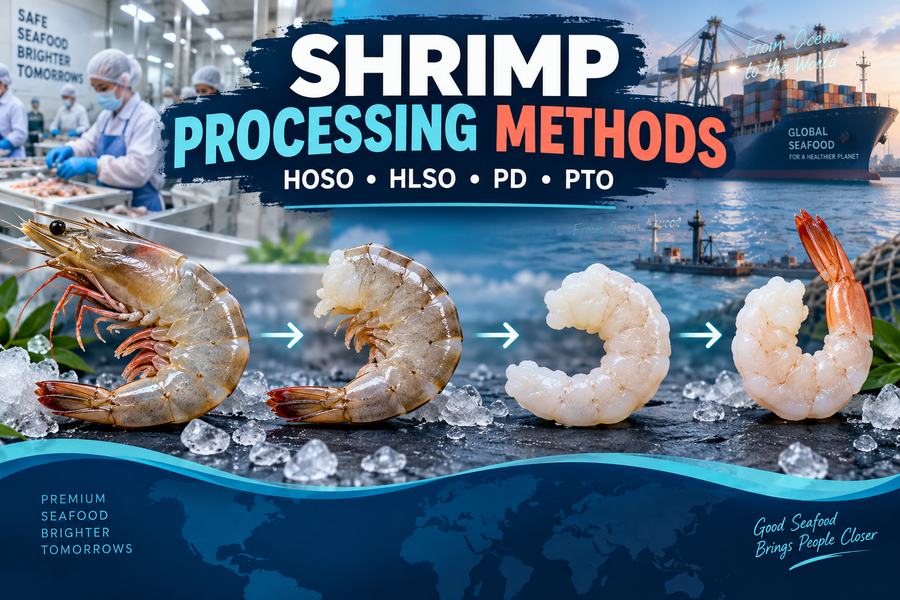
Shrimp processing methods describe what remains on each shrimp when it is packed. HOSO keeps the head and shell; HLSO removes the head but keeps the shell; PD removes the shell and vein; PTO removes the shell but leaves the tail. These forms suit different kitchens and processing lines. Before ordering, confirm whether PTO is also deveined, whether PD includes a tail, the size count for the finished form, and the freezing and glaze specifications.
| Form | What the buyer receives | Typical reason to choose it | Detail to confirm |
|---|---|---|---|
| HOSO | Head-on, shell-on shrimp | Whole presentation and cooking with the shell | Head integrity and count unit |
| HLSO | Headless, shell-on shrimp | Further processing or shell-on cooking | Shell condition and count basis |
| PD or P&D | Peeled and deveined shrimp | Kitchen convenience and defined preparation | Tail-off or tail-on, vein tolerance |
| PTO | Peeled, tail-on shrimp | A visible tail for serving or handling | Whether the vein is removed; PDTO specifies deveining |
| Any of these forms | Raw or cooked; IQF or block-frozen, as agreed | A fit for the buyer’s distribution and use | Net product weight excluding glaze and storage conditions |
Buyers comparing available export forms can start with Iran Fish’s bulk shrimp supply and farmed Vannamei shrimp pages.
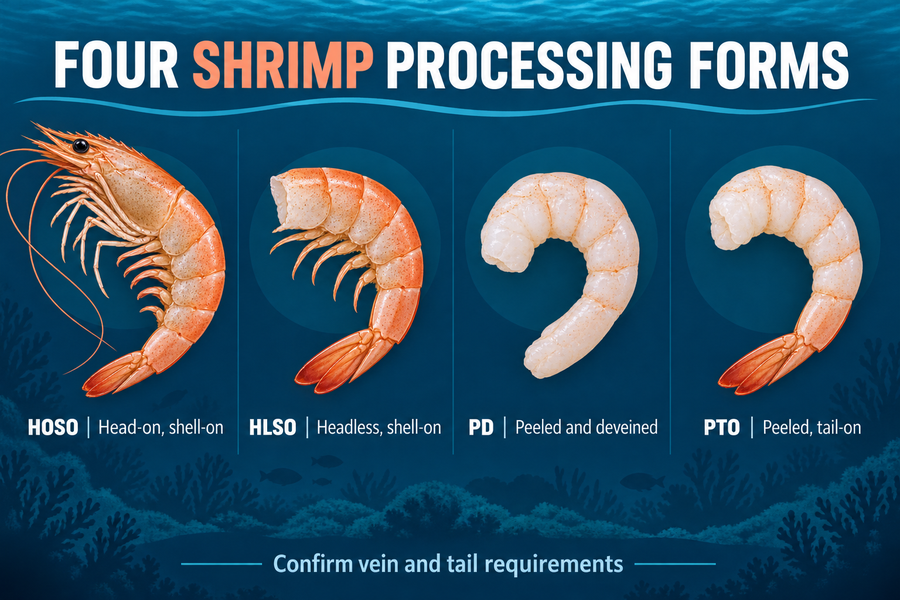
Shrimp Processing Methods at a Glance
The trade abbreviations describe the physical presentation, not the species, safety grade or freezing technique. A complete product name joins the presentation to the species, raw or cooked state, size count and packing method.
- HOSO preserves the complete animal, including head and shell.
- HLSO removes the head while retaining the shell, tail and the shrimp’s shell-on appearance.
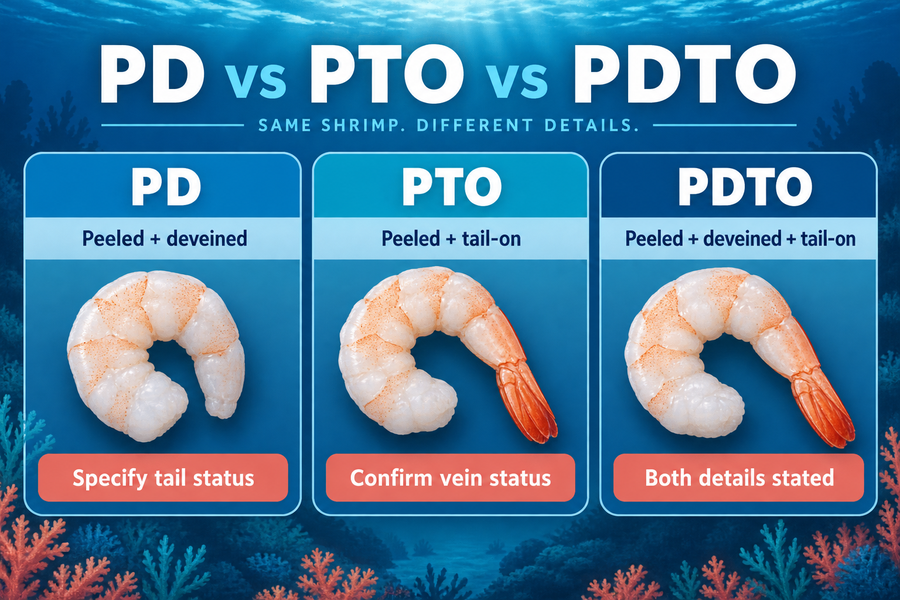
- PD, also written P&D, ordinarily means peeled and deveined; suppliers may differ on whether the tail is retained, so the contract must settle it.
- PTO means peeled, tail-on. It does not, by itself, promise that the vein has been removed.
- PDTO spells out peeled, deveined, tail-on. It is the clearest description when both tail retention and deveining matter.
- PUD means peeled, undeveined and should not be mistaken for PD.
An abbreviation can fit on a carton but cannot carry every acceptance condition. Product descriptions should spell out the physical form in words and specify how visible vein, broken pieces, loose shell and detached tails are handled.
What Happens Between Harvest and Export Packing?
The final presentation results from a sequence of controlled handling and preparation steps. The order and equipment vary by facility, but the buyer’s approved specification should determine what leaves the line.
Receiving, Temperature Control and Sorting
Shrimp arrive from a farm or fishery and are identified by source and lot. A processor checks condition and separates product according to the intended presentation and size specification. Handling time, hygiene and temperature control matter because later peeling or freezing cannot restore poor raw material.
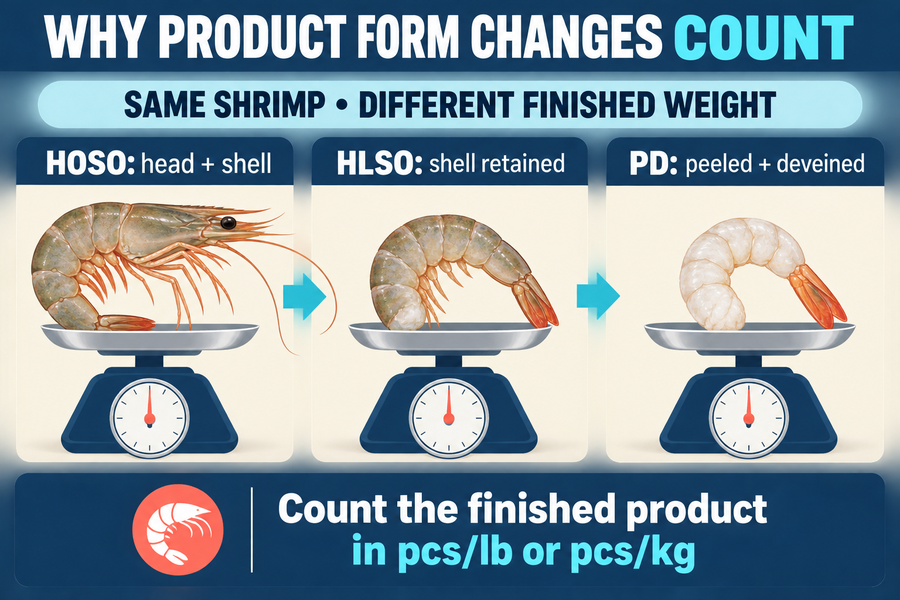
Sorting must account for the form that will actually be sold. A count measured on whole, head-on shrimp cannot simply be copied onto a peeled pack: head and shell removal change the weight per piece. Records should connect the received lot to the finished cartons.
Heading, Peeling and Deveining
Heading removes the head for HLSO and peeled products. Peeling removes the shell; a PTO line preserves the tail segment, while a tail-off line removes it. Deveining removes the visible intestinal tract where the product specification calls for it. Manual and mechanical methods can both require inspection for residual vein, shell fragments, damage and detached tails.
The physical steps should be matched to a clear description. A processor may offer peeled, tail-on shrimp with or without deveining. The words “peeled, deveined, tail-on” are less ambiguous than PTO alone.
Freezing, Packing and Lot Identification
Finished shrimp may be packed individually quick frozen (IQF) or frozen together in blocks. Protective glaze may be applied where specified. Pack labels and accompanying documents should identify the presentation, raw or cooked condition, net product weight, storage requirements and lot.
The current Codex Standard for Quick-Frozen Shrimps or Prawns requires the presentation to be described clearly and specifies that freezing reaches −18 °C or colder at the thermal centre after thermal stabilisation. The destination market and purchase contract can add further requirements.

HOSO Shrimp: Head-On, Shell-On
HOSO preserves the head, shell and tail. It presents the shrimp much as it was harvested, making it suitable for buyers who want a whole product for display or preparation. When cooked with the head and shell, the whole form can contribute to a dish’s characteristic appearance and flavour; the suitability of any lot still depends on handling and freshness.
Head integrity is particularly visible in this form. Buyers may specify the allowance for detached heads, damage, soft shells and dark spotting. A head-on product also needs careful condition checks because the buyer can see more of the original animal. Those conditions should appear in a written specification instead of being inferred from the letters HOSO.
HOSO count is often discussed per kilogram in international trade, while other presentations are often quoted per pound. These are trade patterns, not universal rules. Write the complete band and unit, such as pieces/kg, on every offer and packing document. Iran Fish also has a focused HOSO versus HLSO shrimp comparison for buyers comparing those two shell-on forms.
HLSO Shrimp: Headless, Shell-On
HLSO removes the head and retains the shell. It is useful when a buyer plans to peel the shrimp later, wants shell-on cooking, or needs a consistent headless starting material for another processing stage. The shell can be left in place until the kitchen or processing line is ready to work with the product.
Removing the head changes the weight of each shrimp. A headless count should therefore be tested and declared on headless product, with the correct weight unit. An HOSO count and an HLSO count with identical numbers describe different physical goods; they cannot be treated as interchangeable specifications.
Buyers should inspect shell condition, intact tails and remaining shell fragments after any further processing. HLSO still requires a clear raw or cooked declaration, freezing format and glaze and net weight terms. The presentation alone says nothing about the ice coating or the condition inside the carton.
PD Shrimp: Peeled and Deveined
PD, or P&D, indicates that the shell and visible vein have been removed. This format is useful for kitchens and manufacturers that need a shrimp with the most time-consuming preparation already completed. It may be sold raw or cooked, IQF or block-frozen, depending on the buyer’s specification.
The abbreviation does not always settle tail treatment. Some sellers use PD for tail-off product; others make a more specific tail-on variant available. Write “peeled, deveined, tail-off” or “peeled, deveined, tail-on” on the purchase order. If the buyer requires the tail, PDTO is a common shorthand, but the expanded description should still be present.
Inspection should consider residual vein, remaining shell, broken shrimp and presentation consistency. Deveining describes a processing step, not a guarantee that every piece will look identical. Define the permitted defects and method of assessment, including whether a slight visible vein segment is acceptable in the intended market.
PTO Shrimp: Peeled, Tail-On
PTO means peeled, tail-on. Most of the shell is removed while the tail remains visible. Buyers often choose this form for shrimp cocktails, skewers, plated service and other dishes in which the tail contributes to presentation or gives the diner a point to hold.
The abbreviation does not confirm deveining. A processor may produce PTO with the vein intact; another may offer peeled and deveined tail-on shrimp. If removal is required, specify PDTO or write out “peeled, deveined, tail-on.” This detail matters for receiving inspection and the amount of final preparation expected in the kitchen.
Tail integrity should also be specified. A pack with many detached tails may satisfy a basic peel description but fail the intended plated presentation. The size count should refer to the finished PTO form and the contract should say how broken or tail-less pieces will be assessed.
HOSO vs HLSO vs PD vs PTO: Which Form Fits the Buyer?
The right format follows the use of the finished shrimp and the work the buyer plans to do after receipt. Compare like for like by fixing species, count unit, freezing method and net product weight before deciding between presentations.
| Buyer use | Practical starting form | Why it fits | Confirm before ordering |
|---|---|---|---|
| Whole shrimp display or head-on cooking | HOSO | Keeps the full visual presentation | Intact heads, colour and shell condition |
| Shell-on cooking or further peeling | HLSO | Head removed; shell remains | Shell integrity and headless count |
| Ready-to-prepare recipes without shell or vein removal | PD | Peeling and deveining completed | Tail status and residual vein tolerance |
| Cocktail, skewer or plated shrimp with visible tail | PTO or PDTO | Tail stays attached | Whether deveining is included and tails remain intact |
- For retail packs, confirm the exact consumer-facing wording and pack contents.
- For food service, ask whether the kitchen needs tail-off pieces, a visible tail, or shell-on product.
- For secondary processing, confirm how the received form affects sorting, peeling and output specifications.
- For any destination, make the accepted form and inspection criteria part of the written order.
No one form is automatically superior. A whole shrimp may be appropriate for one menu and impractical for another. The most useful comparison is the condition and preparation of the product the buyer actually receives.
How Processing Changes Shrimp Count, Net Weight and Appearance
Removing parts changes each piece’s finished weight even if the shrimp originated from the same harvest. Count, yield and visual criteria therefore need to be attached to the specified form.
Count the Finished Form in the Declared Unit
Shrimp size is commonly expressed as pieces per pound or pieces per kilogram. If a shrimp loses its head or shell, more finished pieces may fit into the same unit of weight. A supplier should grade the form sold rather than transfer a whole-shrimp grade to a peeled pack.
A label such as 21/25 is incomplete without pcs/lb or pcs/kg. Confirm whether the count is measured on actual product weight after deglazing. For further detail, compare Iran Fish’s Vannamei shrimp sizes for wholesale buyers.
Separate Processing Yield from Net Product Weight
Processing yield concerns how much saleable finished product remains after heading, peeling and other preparation. It varies with the starting animal, processing method and product specification, so a generic percentage should not be applied to every shipment. Buyers can request a lot-specific yield report when further processing decisions depend on it.
Net weight is the weight of the shrimp product declared in the pack. For glazed frozen shrimp, Codex says that the declared net contents exclude glaze. A heavy iced carton is not proof of a heavier shrimp pack; deglazed net weight must be established with an appropriate method.
Inspect the Defects Relevant to Each Form
HOSO inspection prioritises whole appearance and head attachment. HLSO adds attention to shell damage. PD calls for checks of residual shell and vein. PTO calls for checks of tail retention, peeling and any separately required deveining.
All forms also need checks for objectionable odour, unusual colour, dehydration and foreign matter. Codex defines quality defect categories, while the purchase specification should identify any tighter presentation or processing tolerances required by the buyer.
IQF, Block Freezing and Glazing After Processing
HOSO, HLSO, PD and PTO tell the buyer what was removed; they do not indicate how the shrimp was frozen. A complete description adds the freezing method and any protective coating.
Individually Quick Frozen Shrimp
IQF shrimp are frozen as separate pieces, allowing users to take out a smaller quantity without thawing a complete block. The form can be HLSO, PD, PTO or another agreed presentation. Handling and packaging still matter: an IQF label alone does not establish the declared net weight or condition of every piece.
Block-Frozen Shrimp
Block-freezing holds product together in a frozen block. A buyer planning to thaw and process a full pack may find this format suitable. The product still needs a stated presentation, count, net weight and packing format. Iran Fish’s IQF versus block-frozen shrimp guide compares these two freezing formats in greater detail.
Protective Glaze and the Cold Chain
Glaze is an ice coating used to help protect frozen shrimp from dehydration and oxidation. The approved coating and the product’s net weight should be unambiguous in the specification. Codex requires net contents for glazed products to exclude the glaze and calls for storage instructions that maintain the frozen product’s quality.
Temperature records and intact packaging support the cold chain after processing. A selected peel or tail format will be of little use if the shipment suffers dehydration, thawing or damaged cartons before delivery.
What to Put in a Commercial Shrimp Specification
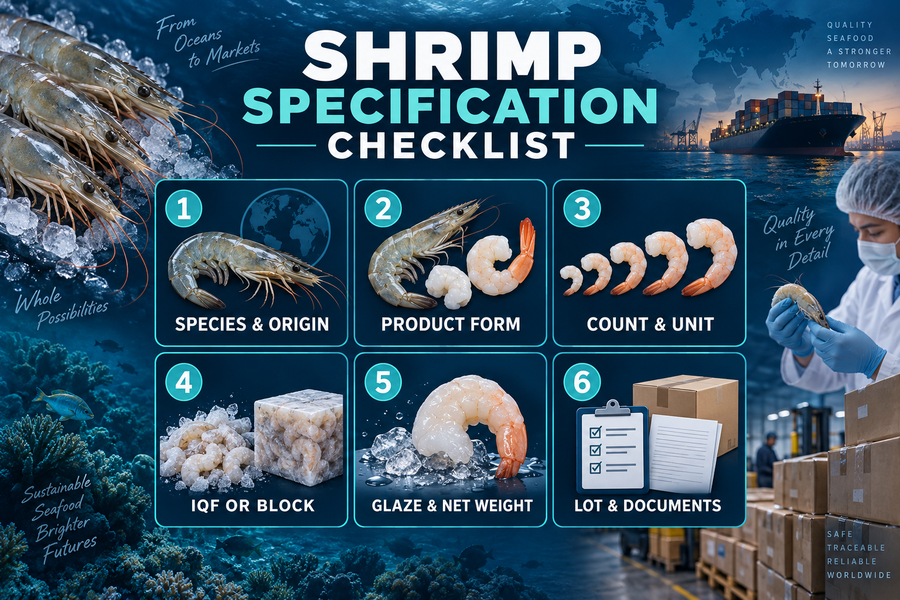
The most reliable order describes the shrimp that will be inspected on arrival, in words and measurable terms. Agree on the following fields before approving the final pack and carton artwork.
- Scientific or accepted species name; farmed or wild source and stated origin.
- Raw, partially cooked or fully cooked condition.
- Expanded presentation: head and shell status, vein status and tail status.
- Finished-form count band with an explicit unit, such as pcs/lb or pcs/kg.
- IQF or block-freezing method and individual pack format.
- Declared net shrimp weight exclusive of glaze and the agreed glaze information.
- Limits for broken pieces, detached heads or tails, residual vein, shell fragments and other defects.
- Product labelling, lot code, packing list, traceability and destination documents.
- Inspection method, sampling plan and how a nonconforming lot will be handled.
- Frozen storage and shipping requirements for the destination market.
Ask for a sample description that matches the same form, species and count as the offer. If the supplier uses a short code such as PTO, include its expanded meaning on the specification so production, inspection and receiving teams share one definition.
Frequently Asked Questions
The questions below address common points of confusion in export offers. The approved contract and destination requirements should settle any form-specific detail.
Is PD shrimp the same as PTO shrimp?
No. PD describes peeling and deveining, while PTO describes peeling with the tail left on. PD does not consistently specify the tail, and PTO does not itself specify removal of the vein. For peeled, deveined, tail-on shrimp, write the full description or use PDTO with the description alongside it.
Does HLSO shrimp still need peeling?
Yes, if the final recipe or manufactured product requires peeled shrimp. HLSO has had the head removed, while the shell remains. The buyer may deliberately keep the shell for cooking or peel it in a later processing step.
Can a HOSO size count be used for PD shrimp?
No. Heading and peeling remove weight from each piece. The finished PD product should be graded and declared on its own product form. Always put the weight unit and whether the count is based on deglazed shrimp in the specification.
Does PTO automatically mean deveined?
No. PTO identifies a peeled shrimp with the tail left on. Specify PDTO or “peeled, deveined, tail-on” when the vein must be removed, and include the acceptable residual vein condition for inspection.
Is IQF a separate shrimp processing presentation?
IQF describes how individual shrimp are frozen, rather than which body parts remain. A product can be PD IQF or HLSO IQF. State both the presentation and freezing method when buying frozen shrimp.
Choose the Right Shrimp Presentation with Iran Fish
Send Iran Fish the form your customers need, whether that is whole HOSO shrimp, shell-on HLSO, peeled and deveined PD, or tail-on PTO with an explicit vein requirement. Include the species, finished-form count, unit, freezing method, pack format, destination and inspection criteria.
Review the shrimp export range and Iranian Vannamei shrimp supply to frame your enquiry. Availability and the exact processed form should be confirmed with the supplier for the intended order.
A clear specification gives the production and receiving teams the same answer to a simple question: what, exactly, should be inside each pack?