


Shrimp Grading System: Counts, Sizes and Commercial Standards

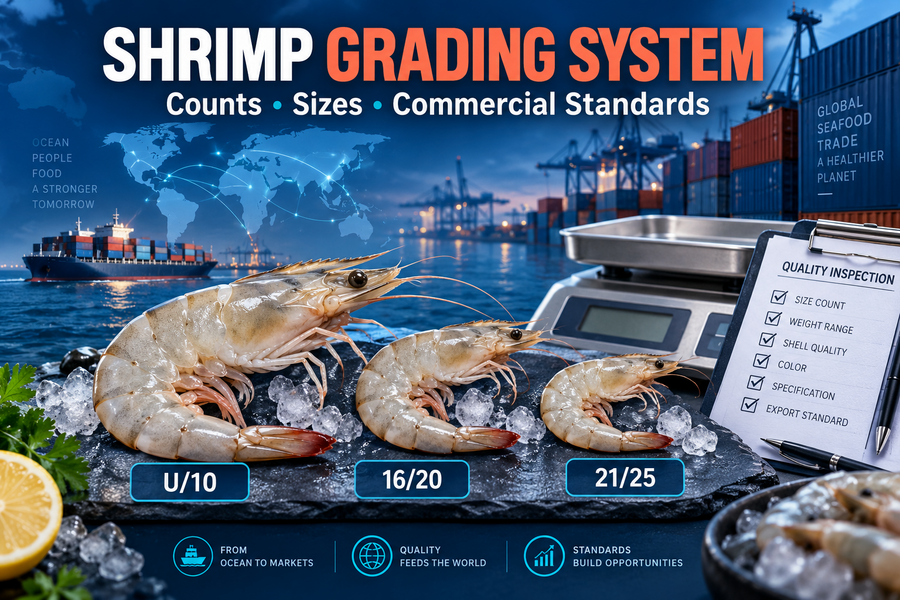
The shrimp grading system identifies size by the number of shrimp in a stated unit of weight, not by length. A code such as 16/20 usually means 16 to 20 pieces per pound, while U/10 means fewer than 10. Lower counts indicate larger shrimp. Commercial buyers must also define the weight basis, product presentation, glaze, species, uniformity, packing and inspection method before treating a grade as a complete specification.
| Buyer question | Practical answer |
|---|---|
| What does 16/20 mean? | The declared unit contains 16 to 20 shrimp, commonly per pound unless the contract states kilograms. |
| What does U/10 mean? | “Under 10”: fewer than 10 shrimp per declared unit of weight. |
| Does a lower count mean larger shrimp? | Yes. Fewer pieces are needed to make the same weight. |
| Is “jumbo” a fixed international grade? | No. Descriptive names vary between sellers; the numerical count is more dependable. |
| Can HOSO and peeled shrimp use the same grade interchangeably? | No. Heads and shells change the weight of each piece, so presentation must accompany the count. |
| Should glaze be included in count testing? | No. For glazed product, count should be assessed against actual deglazed product weight. |
| What makes a purchase specification complete? | Species, origin, presentation, count and unit, freezing method, glaze, net weight, uniformity, tolerances, packing and documentation. |
For available product forms and export sizes, buyers can review Iranian shrimp supplied for international markets before preparing an enquiry.

How Shrimp Count Codes Work
Count codes create a practical language for processors, importers, distributors and food-service buyers. The code is meaningful only when the unit of weight and the physical form of the shrimp are stated.
Reading Range Codes Such as 16/20 and 21/25
A range such as 16/20 means that the specified unit of product should contain no fewer than 16 and no more than 20 pieces. In markets using pounds, that is 16 to 20 shrimp in one pound. A 21/25 lot contains more pieces in the same weight, so its individual shrimp are smaller.
The slash does not describe length, age or a quality score. It marks the lower and upper piece-count limits. A buyer comparing 16/20 with 26/30 is therefore comparing two weight-based size bands rather than two visual descriptions.
What “U” Means in U/10, U/15 and U/20
The letter U means “under.” U/10 indicates fewer than 10 pieces per specified unit; U/15 indicates fewer than 15. Because the band is open-ended, a contract may need an additional minimum-size condition when exceptionally large pieces could affect portioning or pack appearance.
The unit still matters. U/10 per pound and U/10 per kilogram describe very different products. A quotation, pro forma invoice, packing list and carton marking should use the same notation and unit throughout.
Why Count Names Are More Reliable Than “Large” or “Jumbo”
Terms such as medium, large, jumbo and colossal are convenient retail descriptions, but they are not used consistently across suppliers or countries. One seller may call 16/20 “extra jumbo,” while another uses “jumbo” or “colossal.” Numerical bands provide a more auditable basis for comparison.
A sound procurement document may include the familiar size name for marketing, but the numerical count should control acceptance. This prevents a descriptive word on the carton from overriding the measurable requirement.
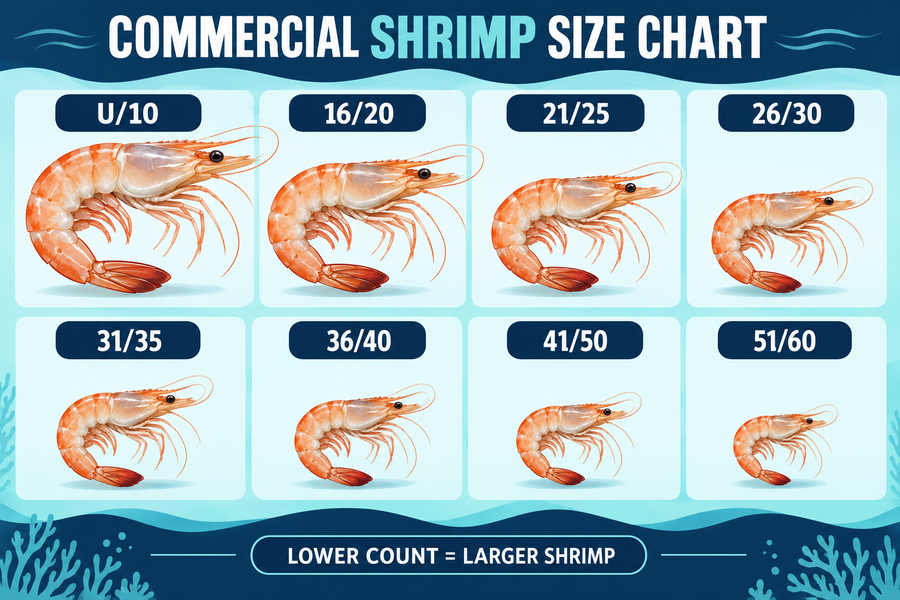
Commercial Shrimp Size Chart by Count
The following chart reflects common count-per-pound trade usage. The kilogram figures are mathematical equivalents rounded from the pound bands; they are not a substitute for a supplier’s independently declared count-per-kilogram grade.
| Common count grade | Pieces per pound | Approximate mathematical equivalent per kg | Common descriptive name, which may vary |
|---|---|---|---|
| U/10 | Fewer than 10 | Fewer than 22 | Extra colossal |
| U/12 | Fewer than 12 | Fewer than 26 | Super colossal |
| U/15 | Fewer than 15 | Fewer than 33 | Colossal |
| 16/20 | 16–20 | About 35–44 | Extra jumbo |
| 21/25 | 21–25 | About 46–55 | Jumbo |
| 26/30 | 26–30 | About 57–66 | Extra large |
| 31/35 | 31–35 | About 68–77 | Large |
| 36/40 | 36–40 | About 79–88 | Medium-large |
| 41/50 | 41–50 | About 90–110 | Medium |
| 51/60 | 51–60 | About 112–132 | Small |
| 61/70 | 61–70 | About 134–154 | Extra small |
| 71/90 | 71–90 | About 157–198 | Small or tiny |
| 91/110 | 91–110 | About 201–243 | Tiny |
| 110/120 | 110–120 | About 243–265 | Very small |
| 120+ | More than 120 | More than 265 | Very small |
- Use the count code, not the descriptive name, to compare quotations.
- Confirm whether the band is expressed per pound, per kilogram or per package.
- Match the grade to the exact presentation being purchased.
- Treat converted figures as planning aids only unless the contract expressly adopts them.
- Check whether the stated count applies before or after deglazing.
Count per Pound vs Count per Kilogram
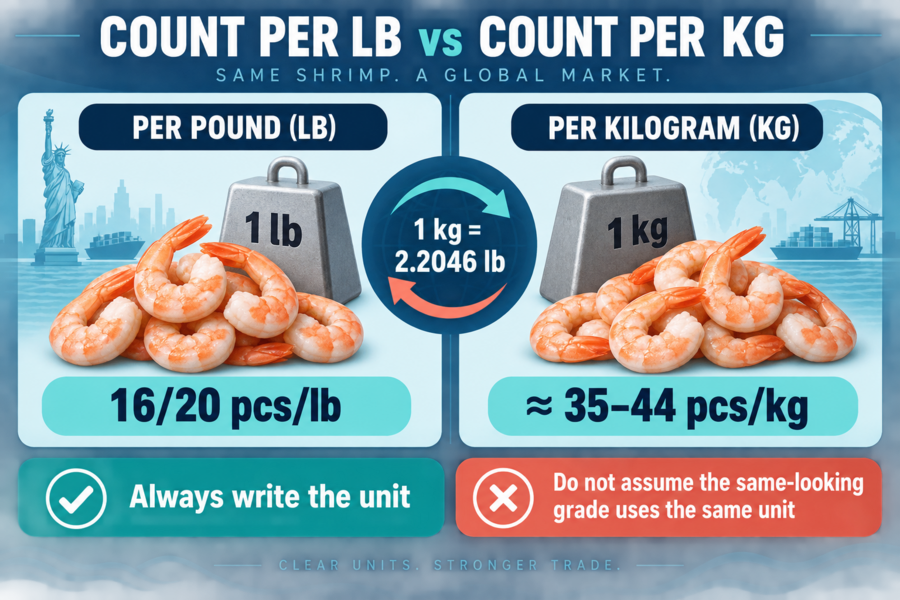
North American and many international specifications commonly express processed shrimp as pieces per pound. HOSO shrimp and trade in other regions are often quoted as pieces per kilogram, using bands such as 20/30, 30/40 or 40/50. The notation alone does not reveal the unit, because the same-looking range can appear in either system.
One kilogram equals approximately 2.2046 pounds, so a simple mathematical conversion multiplies a per-pound count by 2.2046. However, rounding can shift the limits, and established per-kilogram commercial bands may not align exactly with the converted range. For example, a trade grade explicitly sold as 30/40 pieces per kilogram should not be presumed equivalent to a per-pound grade merely because the figures look familiar.
The safest approach is to write the unit beside every grade: 16/20 pcs/lb or 30/40 pcs/kg. The sales confirmation, laboratory or quality-control report, inner packaging and master carton should agree. Where different documents conflict, acceptance criteria should be resolved before shipment rather than inferred at destination.
Why Product Presentation Changes the Grade
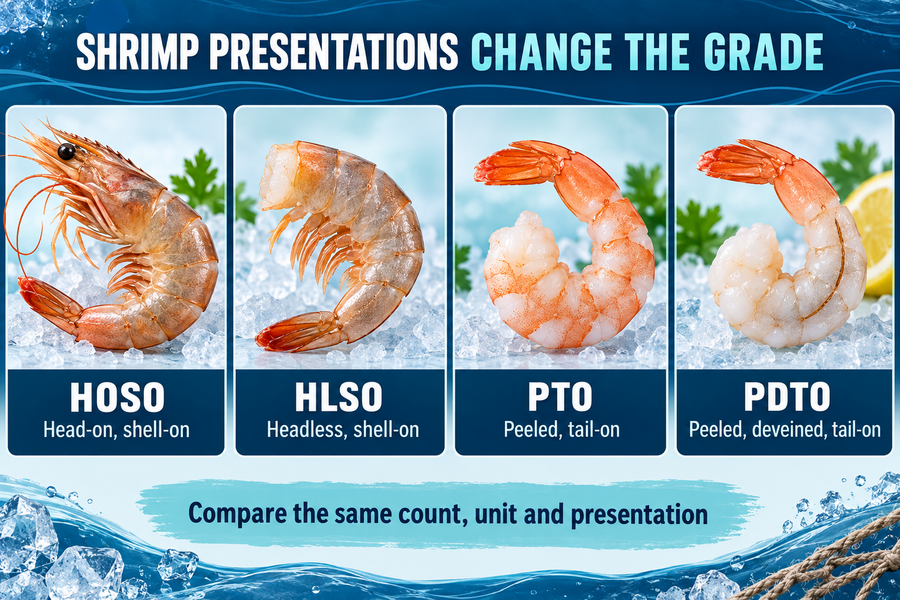
Shrimp presentation determines which parts contribute to the weight of each piece. The same animal can fall into a different count band after the head, shell, tail or vein is removed.
HOSO and Head-On Counts
HOSO means head-on, shell-on. Because the entire shrimp is weighed, each piece is heavier than its headless or peeled equivalent. HOSO grades are frequently stated per kilogram, although the buyer must still confirm the unit.
Head-on products also require presentation-specific checks, including intact heads, shell condition, colour and signs of melanosis. A count alone cannot communicate those attributes. Species, harvest origin and whether the product is raw or cooked should accompany the size grade.
HLSO, PTO, PDTO and Peeled Products
HLSO means headless, shell-on. PTO generally means peeled, tail-on, while PDTO means peeled, deveined, tail-on. Fully peeled and peeled-deveined products remove still more non-edible weight. Abbreviations can vary slightly by market, so the full presentation should appear at least once in the specification.
A 21/25 HOSO item and a 21/25 PDTO item are not equivalent yields from the same raw shrimp. Both may contain 21 to 25 pieces per pound in their final declared form, but the PDTO pieces must originate from larger whole shrimp to remain in that band after processing. Buyers comparing offers should therefore compare the same count, unit and presentation.
IQF, Block Frozen and Glazed Shrimp
Individually quick frozen shrimp remain separate and are convenient for sampling and portion control. Block-frozen shrimp are frozen together in a solid unit and may be selected for other distribution or processing needs. The freezing format does not redefine the grade, but it changes how the sample is thawed and handled during inspection.
Glaze is a protective ice coating intended to reduce dehydration and oxidation. It is not shrimp mass. The Codex Standard for Quick Frozen Shrimps or Prawns states that net contents for glazed products are declared exclusive of glaze, and its count method uses actual deglazed weight. A shipment can therefore look heavy in the frozen state yet fail its declared net weight or count after proper deglazing.
How Processors Verify Shrimp Count and Uniformity
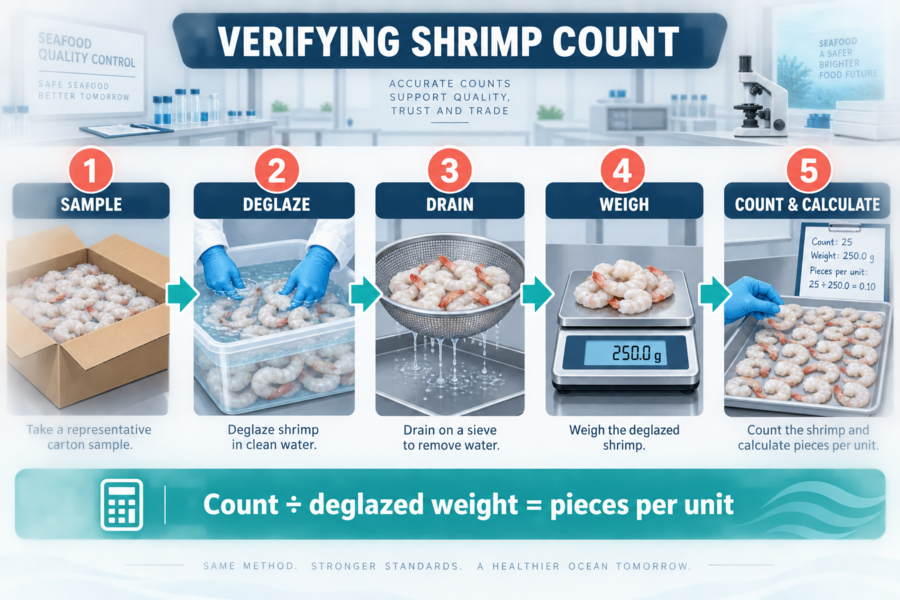
Count verification should follow a documented method that preserves the sample and uses the same basis as the label. Codex permits count per unit of weight or per package and describes count determination using the actual deglazed weight.
- Identify the lot, carton, inner pack, species, presentation, declared grade and declared unit before testing.
- Select representative sample units under the agreed sampling plan. Avoid choosing only cartons from an accessible top layer.
- For glazed product, remove glaze without damaging or cooking the shrimp. Codex describes water-based procedures for raw and cooked products, followed by controlled draining.
- Weigh the deglazed, drained product with calibrated equipment and record the actual product weight.
- Count every whole shrimp in the test portion. Apply the contract’s written rule for fragments or broken pieces rather than improvising one during inspection.
- Divide the number of pieces by the actual deglazed weight in the relevant unit. If 18 shrimp weigh exactly one pound, the measured result is 18 pcs/lb and sits within a 16/20 declaration.
- Repeat across the required sample units and compare each result with the agreed band and tolerance.
- Record results with lot codes, dates, equipment identification and photographs where the quality plan requires them.
Count compliance does not necessarily guarantee visual uniformity. A lot could average into a band while mixing noticeably large and small pieces. A common commercial uniformity check separates the largest and smallest pieces in a defined sample, weighs the groups and divides the large-group weight by the small-group weight. The exact sample size, maximum ratio and disposition of borderline results should be written into the buyer’s specification because these terms are commercial controls, not universal values for every market.
Automatic graders improve throughput, but final verification still matters. Equipment settings, species shape, soft shells, damaged pieces and processing variation can influence separation. Calibration records and manual checks connect the production setting to the grade printed on the carton.
Commercial Standards Beyond Size
A grade describes size distribution; it does not by itself establish safety, legality or overall quality. International orders need a broader product specification supported by processing and shipment documents.
Species, Origin and Product Form
Scientific or accepted commercial species identification helps prevent substitution and clarifies expected appearance and texture. Buyers should distinguish farmed Vannamei from wild species and state origin, harvest method when relevant, raw or cooked condition, and the full product presentation.
The Codex frozen-shrimp standard covers raw, partially cooked and fully cooked product, peeled or unpeeled. It also requires the presentation to be described clearly enough to avoid misleading the buyer. Iran Fish supplies farmed Vannamei and wild shrimp, with sizes listed from U5 through 120+ on its seafood export product page.
Glaze, Net Weight and Label Declarations
Glaze level, declared net weight and packing configuration should be separate fields. A specification might identify an inner-pack net weight, the number of inner packs per master carton and the permitted glaze declaration. The buyer should also state whether any protective treatment or additive must be declared under destination-market rules.
Codex requires the net contents of glazed product to exclude glaze. It also requires appropriate product naming, raw or cooked status, frozen designation, storage instructions and key information on non-retail containers. Destination countries may impose additional requirements, so Codex is a baseline rather than a complete import checklist.
Sensory Quality, Dehydration and Discoloration
Inspection should address odour, flavour where assessed, texture, shell integrity, foreign matter, dehydration and abnormal colour. Melanosis, commonly seen as black spotting, is commercially important even when it is not the same as microbial spoilage. Acceptance limits and the point of inspection should be defined.
Codex identifies deep dehydration, foreign matter, objectionable odour or flavour and discolouration as defect categories. Its standard defines deep dehydration at more than 10% of shrimp weight or block surface area under the stated conditions, and defines a discolouration defect using specified affected-area thresholds. Those criteria should be read in the source standard and alongside any stricter contract or destination regulation.
Food Safety, Traceability and Buyer Documentation
Food-safety management and size grading serve different purposes. HACCP-based controls address hazards, while grading supports size consistency and commercial conformity. A supplier may produce an accurately graded lot that still lacks a required health certificate, and a fully certified shipment can still miss its agreed count band.
Traceability should connect farm or catch information, processing date, lot code, production facility, cold storage and shipment. Depending on the destination and contract, the document set may include a health certificate, certificate of origin, catch documentation for wild product, packing list, invoice, bill of lading, analysis or inspection certificate, and facility approvals. AK Seafoods describes HACCP and ISO-aligned production and export controls on its company background page.
How Buyers Should Write a Shrimp Specification
A good specification leaves little room for interpretation at production, pre-shipment inspection or arrival. Each measurable term should have a unit, method and acceptance rule.
- Identify the species by scientific and commercial name.
- State farmed or wild origin and the approved production origin.
- Write the complete presentation, such as raw HOSO, raw HLSO, PDTO or peeled-deveined.
- State the count band and unit explicitly, such as 21/25 pcs/lb after deglazing.
- Define IQF or block frozen and any required pack style.
- State the glaze declaration and net product weight exclusive of glaze.
- Define the uniformity method and maximum acceptable ratio if uniformity is a purchase criterion.
- Specify how broken pieces, soft shells and out-of-range pieces are treated.
- List sensory and physical defect tolerances.
- Identify inner-pack and master-carton configuration and required carton marks.
- State storage temperature, shelf-life documentation and cold-chain recording requirements.
- Name the sampling plan, inspection stage and action for a non-conforming lot.
- List destination-specific certificates, traceability records and label requirements.
The final purchase order should incorporate the approved specification rather than relying on messages or a product photograph. A retained reference sample or an agreed visual standard can help with attributes such as colour, trimming and presentation, but it should supplement measurable terms rather than replace them.
Common Shrimp Grading Mistakes in International Trade
The most frequent mistake is ordering by a descriptive name alone. “Jumbo” sounds precise but may represent different numerical bands in different catalogues. Another is writing “20/30” without specifying pounds or kilograms. Either omission can produce a shipment that is internally consistent yet different from what the buyer expected.
Testing frozen gross weight instead of deglazed net product is another source of disagreement. Glaze protects the product, but it must not inflate the shrimp weight used for the declared count or net contents. Count results also become unreliable when the test mixes presentations, treats fragments inconsistently or uses an unrepresentative handful rather than the agreed sampling plan.
Finally, buyers sometimes treat the size code as a complete quality grade. It says nothing by itself about species authenticity, odour, melanosis, dehydration, shell condition, additives, food safety, traceability or documentation. A commercially useful shrimp grading system combines count with a complete written specification and a reproducible inspection method.
Frequently Asked Questions About Shrimp Grading
These answers address the points most often clarified between seafood suppliers and commercial buyers. Contract wording should always take priority over informal size names.
What does 16/20 shrimp mean?
It means the declared unit of weight contains between 16 and 20 shrimp. In common count-per-pound trade usage, that is 16 to 20 pieces per pound. The contract should still say “pcs/lb” because some markets use count per kilogram.
What is the largest commercial shrimp size?
Very large shrimp are usually expressed with an under-count such as U/10, U/8 or U/5. There is no single globally mandatory “largest” band, and availability depends on species and product form. The lower the under-count, the larger each piece must be for the same unit of weight.
Why is an HOSO count different from a peeled shrimp count?
HOSO product includes the head and shell, which add weight to every piece. Peeled processing removes that weight. The same original shrimp can therefore move into a higher numerical count band after processing, and identical-looking count codes should not be compared across presentations without yield information.
How is the count of glazed frozen shrimp checked?
The product is sampled, properly deglazed, drained, weighed and counted. The number of pieces is divided by actual deglazed product weight in the declared unit. Codex provides procedures for deglazing, draining and determining count, while the commercial contract should define sampling and tolerances.
Are shrimp size grades identical in every country?
No. Count-per-pound and count-per-kilogram systems coexist, established bands can differ, and names such as jumbo are inconsistent. International standards provide important principles for product description, net contents, testing and quality, but buyers must also meet destination regulations and write exact commercial terms.
Source Consistent Shrimp Grades for Your Market
Clear purchasing begins with a grade that can be measured at both ends of the shipment. Send the required species, presentation, count unit, freezing format, glaze, pack configuration, destination and documentation needs so the offer can be matched to the intended market.
AK Seafoods supplies farmed Vannamei and wild shrimp from Iran for international buyers. Explore the company’s marine fish and shrimp supply capabilities or contact the team through the details on the website to request a specification-aligned product discussion.
The most dependable order is not simply “jumbo shrimp.” It is a named species and presentation with a numerical count, unit, deglazed net basis, agreed tolerances and documented inspection method.