


Frozen Shrimp Packaging Options for International Shipping: A Buyer’s Guide

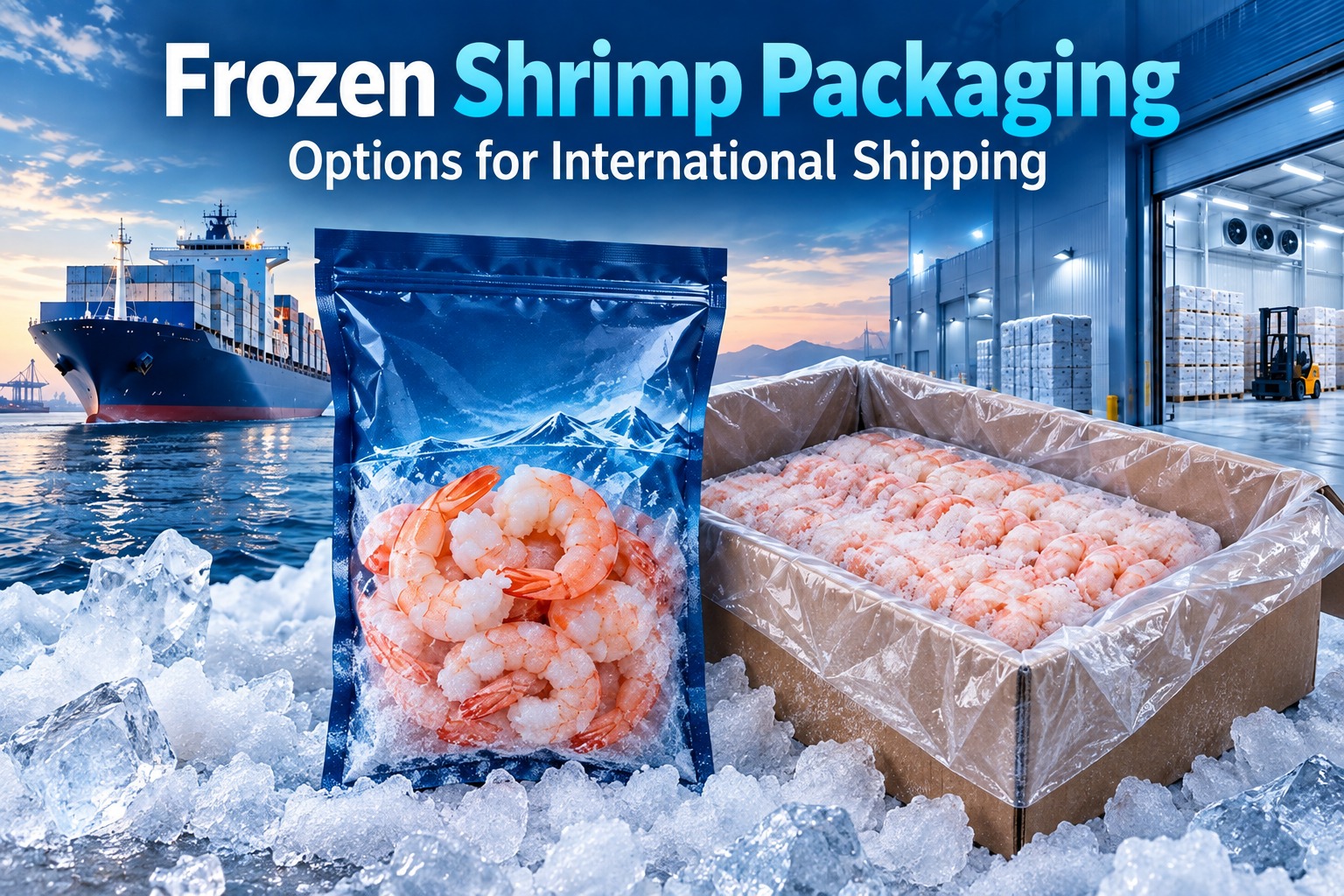
The best frozen shrimp packaging combines a sealed moisture-resistant inner pack, a strong export carton and a stable cold chain. IQF shrimp usually performs best in laminated or freezer-grade pouches, while block-frozen shrimp is commonly protected by a food-grade liner and moisture-resistant carton. The right choice depends on product form, pack weight, sales channel, destination rules and how the buyer will thaw or portion the shrimp. Explore Iran Fish’s frozen shrimp range when planning an export specification.
| Buyer question | Practical answer |
|---|---|
| Best format for retail | Printed freezer-grade pouch, often resealable, inside a labelled master carton |
| Best format for foodservice | Sealed 1 kg or 2 kg inner bags packed in a strong master carton, subject to the buyer’s specification |
| Best format for industrial processing | Block-frozen lined cartons or larger IQF bags where efficient handling is the priority |
| Essential film properties | Low water-vapour transmission, suitable oxygen barrier, reliable seals and flexibility at frozen temperatures |
| Essential carton properties | Moisture resistance, stacking strength, accurate printing and dimensions that support efficient pallet loading |
| Key cold-chain condition | The shrimp should remain deep frozen; Codex specifies a thermal centre of −18°C or colder after stabilisation for quick-frozen shrimp |
| Information to agree before packing | Species, product form, count size, glaze basis, declared net contents, pack configuration, label artwork, lot coding and destination requirements |
| Main dispatch checks | Seal integrity, carton condition, label accuracy, lot traceability, weight controls, product temperature and logger placement |

Why Packaging Determines Export Quality
Frozen shrimp remains vulnerable even after it has been properly frozen. Cold, dry air can draw moisture from exposed surfaces, leading to pale dry areas, weight loss and freezer burn. Oxygen entering a weak or poorly sealed pack can contribute to flavour and colour deterioration. Packaging therefore needs to control both moisture transfer and air exposure throughout storage and transport.
The pack must also protect the physical condition of the product. Sharp rostrums and shells can puncture thin film, while rough handling can crush cartons or open seals. A retail pouch that looks attractive on a shelf may still be unsuitable for export if it becomes brittle in a freezer or cannot tolerate pressure inside a fully loaded master carton.
Temperature control and packaging work as one system. A strong bag cannot undo partial thawing, and a stable freezer cannot fully protect shrimp in a torn liner. Repeated temperature changes may damage glaze, encourage ice recrystallisation and make IQF pieces clump. Buyers should evaluate the product, inner pack, carton, pallet and reefer plan together rather than approving each component in isolation.
Primary, Secondary and Tertiary Packaging Explained
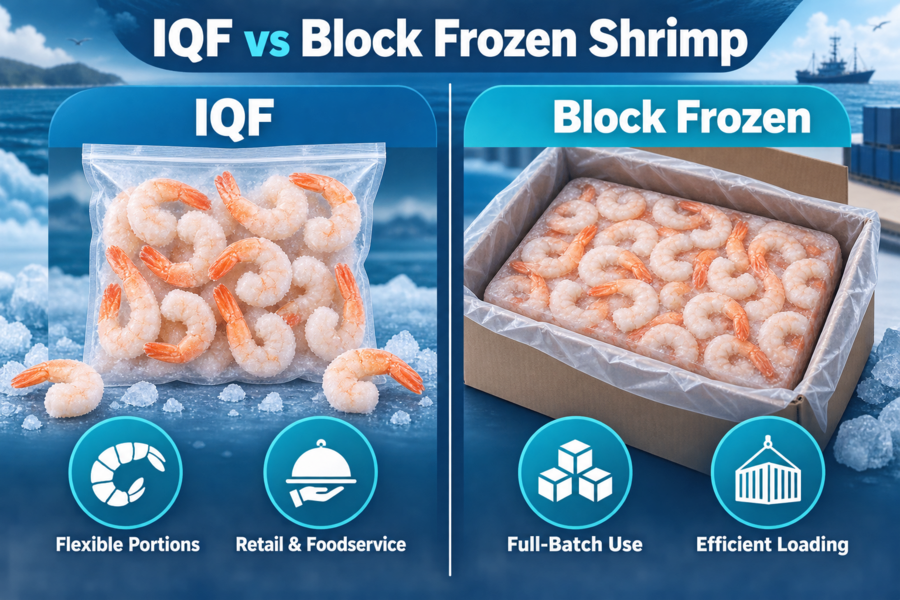
International shipments normally use three protective layers. Each layer has a different job, and weakness at any level can affect product condition or handling efficiency.
Primary Packaging: Direct Product Protection
Primary packaging directly touches the shrimp. It may be a heat-sealed polyethylene bag, a laminated pouch, a vacuum bag or a food-grade liner inside a block-frozen carton. This layer should be suitable for food contact, resistant to moisture and capable of maintaining a dependable seal at frozen temperatures. The required puncture resistance changes with the product: peeled shrimp is less abrasive than head-on shell-on shrimp, which has harder projections and needs more robust protection.
Secondary Packaging: Cartons and Case Packing
Secondary packaging groups inner packs into a manageable shipping unit. The master carton protects bags from compression, abrasion and impact while carrying the main shipment information. Board grade, coating, adhesive, closure method and print durability should suit cold, humid conditions. Carton dimensions also matter because unused space encourages movement, while overfilled cases can crush shrimp or put stress on seals.
Tertiary Packaging: Pallets, Wrap and Container Loads
Tertiary packaging keeps cartons stable during warehousing and international transport. Pallets, corner protection, straps and stretch wrap may be used according to the route and buyer specification. The load should resist shifting without blocking the airflow pattern required by the reefer container. Pallet type, treatment marking, stacking height and destination restrictions must be confirmed before dispatch.
IQF Shrimp Packaging for Flexible Portioning
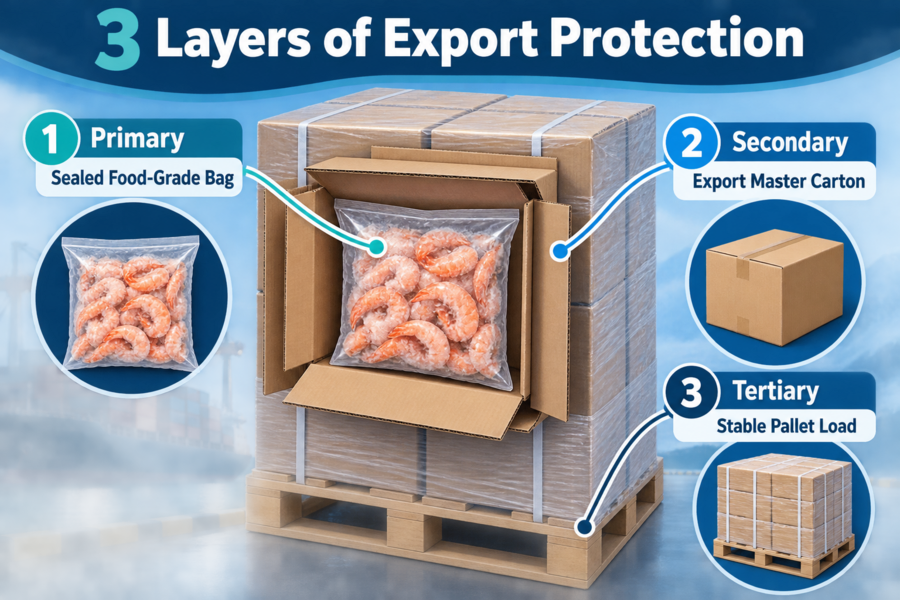
Individually quick frozen shrimp is valued because the pieces can remain separate, allowing a buyer or end user to remove only the required quantity. That convenience also exposes more individual surface area, so effective glazing and a high-performing inner pack are important.
Pillow Pouches and VFFS Bags
Vertical form-fill-seal equipment can produce pillow-style packs efficiently for retail or foodservice orders. The film must run reliably on the packing line, form consistent seals and remain flexible after freezing. Pack dimensions should leave enough room for sealing without creating excessive headspace. Clear areas can show the product, while printed areas can carry branding, cooking instructions and mandatory information.
Vacuum Bags and High-Barrier Laminates
Vacuum packaging reduces air around the product and can improve pack compactness. High-barrier laminates can provide stronger resistance to water vapour and oxygen than a simple single-layer film. Material structure should be selected for the actual product and distribution period, not merely by visual thickness. Vacuum-packed seafood also requires disciplined temperature control and handling instructions, so the processor and importer should verify that the chosen system is suitable for the destination market.
Resealable Retail Pouches
A zipper can help consumers protect unused IQF shrimp after opening, but it does not replace the original heat seal. The unopened pack still needs a tamper-evident, leak-resistant seal. Retail artwork should remain readable under frost and condensation, and the zipper area should be tested with the intended fill weight so shrimp does not interfere with closing.
Foodservice Polybags Inside Master Cartons
Foodservice buyers often prefer straightforward sealed bags packed into master cartons. This format simplifies stock handling and portioning without the additional presentation features of retail packaging. The exact inner weight and number of bags per carton should match kitchen usage, warehouse picking and the buyer’s declared-weight requirements. Common market configurations exist, but they should never be assumed without written approval.
For a deeper comparison of freezing formats, see IQF vs block frozen shrimp.

Block-Frozen and Semi-IQF Packaging
Block-frozen shrimp is arranged or packed with water in a food-grade liner and frozen into a solid unit. The liner and outer carton protect the block from dehydration and contamination, while the compact shape supports dense case packing. Moisture-resistant or coated cartons are commonly selected because ordinary board can weaken when exposed to condensation.
This format suits processors and high-volume kitchens that can thaw and use a complete block. It is less convenient when staff need small portions throughout the day. Carton size should therefore reflect the buyer’s production batch, thawing capacity and inventory system. A large block may load efficiently but create avoidable handling problems after delivery.
Semi-IQF formats place separated or layered shrimp in smaller inner units before those units are packed into a master carton. They can offer a middle ground between a fully solid block and loose IQF pieces. The specification should clearly define the freezing method, arrangement, inner wrapping, pack count and expected separation so buyer and supplier are not using the same term for different products.
How to Match the Package to the Shrimp Product
Packaging should be chosen after the shrimp specification is defined. Species, product form, count size, shell condition, processing treatment and intended customer all affect the protection required.
HOSO and HLSO Shrimp
Head-on shell-on shrimp can be vulnerable to broken appendages, head damage and dehydration. Its harder projections may also challenge thin bags. Headless shell-on shrimp removes one delicate area but still needs film with suitable puncture and abrasion resistance. In either case, the carton must limit movement and compression without being packed so tightly that the product is damaged.
Peeled, Deveined, PDTO and Cooked Shrimp
Peeled and deveined products have more exposed flesh and depend strongly on intact glaze, low moisture transfer and clean sealing. Peeled deveined tail-on shrimp also needs protection against tail damage. Cooked shrimp requires careful control of dehydration, odour transfer and texture. Buyers should state whether treatments or added ingredients are permitted and ensure the label reflects the final product accurately.
Retail, Foodservice and Industrial Orders
Retail packaging prioritises presentation, consumer information, portion size and opening convenience. Foodservice packs prioritise efficient storage, predictable portions and durable seals. Industrial buyers may favour larger bags or block-frozen cartons that move efficiently through further processing. Private-label orders add artwork approval, barcode verification and destination-language checks to the technical packaging specification.

Packaging Materials and Barrier Performance
No material is automatically best for every order. The correct structure balances product protection, sealing performance, packing equipment, presentation, route conditions and destination requirements.
| Packaging material or format | Main strengths | Points to verify |
|---|---|---|
| Freezer-grade polyethylene | Flexible, heat-sealable and widely used for inner bags or liners | Thickness, puncture resistance, seal consistency and oxygen-barrier needs |
| PET/PE or similar laminate | Combines print surface, strength and heat-seal layer; can provide stronger barrier performance | Approved food-contact structure, recyclability rules and low-temperature performance |
| Vacuum-grade barrier bag | Tight product fit and reduced air around shrimp | Seal-channel contamination, punctures and suitability of the food-safety system |
| Resealable stand-up or pillow pouch | Consumer convenience and strong shelf presentation | Original heat seal, zipper function after freezing and fill-line clearance |
| Coated or moisture-resistant carton | Case strength and protection in humid frozen logistics | Compression performance, coating, adhesive, print durability and stacking pattern |
| Food-grade carton liner | Separates product or block from board and limits moisture transfer | Liner integrity, dimensions, closure and compatibility with the freezing process |
Film specifications should be supported by supplier documentation and tested with the actual shrimp. Nominal thickness alone does not show how a pack will handle shell punctures, flexing, sealing contamination or extended frozen storage. Buyers can request the material structure, food-contact declaration and relevant performance data before approving production.
Glazing, Net Weight and Pack Accuracy
Glazing coats frozen shrimp with a controlled layer of ice. The glaze acts as a sacrificial barrier against dehydration and oxidation, especially for loose IQF pieces. It should be reasonably uniform and maintained by intact packaging and stable temperature. Loose frost inside a bag is not the same as a controlled protective glaze.
The purchase specification should state the agreed glaze basis and how net contents will be determined. Gross weight includes the product and packaging. Net weight follows the applicable declaration method, while deglazed weight is assessed after removing the protective ice by an agreed or legally prescribed procedure. These terms should not be used interchangeably.
Accurate control protects both parties. The exporter should monitor fill weight and glaze consistency during production, and the buyer should use an agreed sampling and deglazing method at receipt. A dispute is much harder to resolve when the contract lists only a carton weight without defining inner-pack weight, glaze, tolerances or the relevant test method.
Frozen Shrimp Packaging Requirements for International Shipping
Export packaging must satisfy product protection and the rules of the destination market. Requirements vary, so the importer should confirm the current legal position and approve the complete specification before materials are printed or the shipment is packed.
Food-Contact and Destination-Market Compliance
Every material that directly touches the shrimp should be suitable for its intended food-contact use and frozen conditions. The importer may request declarations, migration documentation or other evidence applicable to the destination. Sustainability and packaging-waste rules are also changing in several markets, including the European Union, making early review important for private-label projects.
Label Information and Multilingual Artwork
A commercial label commonly identifies the product name, species where required, product form, count size, net contents, storage condition, lot code, production or freezing details, best-before or expiry information where applicable, country of origin and responsible business. Added ingredients, allergens and treatments must be declared according to the destination’s rules. Barcode type, language and date format should be confirmed rather than copied from a previous market.
Lot Codes, Traceability and Export Documents
The code on each consumer pack, inner unit and master carton should remain linked to production and shipment records. Traceability is strongest when the lot connects raw material, processing date, packaging line, quality checks, cold-store location, pallet identity and dispatch documents. Labels and documents must tell the same story; mismatched codes can delay release even if the product itself is sound.
Buyer Approval Before Production
The importer should approve a specification sheet, dieline or artwork proof and a representative finished sample where practical. Approval should cover text, dimensions, colour references, barcode readability, seal position, carton marks and pack configuration. Last-minute label changes at the loading stage increase the risk of over-labelling errors and inconsistent case marks.
Cold Chain, Palletisation and Reefer Loading
The Codex standard for quick-frozen shrimps or prawns states that quick freezing is not complete until the thermal centre reaches −18°C or colder after thermal stabilisation, and the product should remain deep frozen through transport, storage and distribution. A reefer set point alone does not prove product condition, so loading controls and temperature records matter.
- Freeze and stabilise the product before loading; a reefer container is designed to maintain temperature, not to replace the freezing process.
- Check that cartons are dry, closed and structurally sound before palletising or floor loading.
- Use a stacking pattern that supports the cases and respects the container’s airflow channels and load limits.
- Confirm pallet material, treatment marks and destination acceptance before use.
- Secure the load against movement while avoiding wrap or materials that unnecessarily obstruct required airflow.
- Place calibrated temperature loggers according to a documented monitoring plan, including locations that provide meaningful evidence of shipment conditions.
- Record container identity, seal number, product temperature checks, loading time and any deviation or delay.
- At receipt, examine the reefer record, product temperature, cartons, seals, labels, frost pattern and lot documents before releasing the shipment.
For broader storage and receiving guidance, read Frozen Shrimp Shelf Life and Storage Requirements.
Packaging Quality-Control Checks Before Dispatch
A pre-shipment check should compare the finished cargo with the signed specification, not with memory or an earlier order. Sampling plans and acceptance criteria should be agreed according to the buyer’s quality system and destination requirements.
- Inspect heat seals for open channels, wrinkles, contamination and weak areas.
- Test representative packs for leaks and examine bags for punctures or cold-cracking.
- Confirm film, carton and liner match the approved material specifications.
- Check carton compression, closure and pallet stability under the intended load pattern.
- Verify product description, species, form, count size, storage statement, country of origin and mandatory declarations.
- Scan barcodes and confirm that retail packs, inner units, master cartons and documents carry matching lot information.
- Review fill-weight and deglazed-weight records against the agreed method and tolerances.
- Confirm product-temperature records, logger activation and container seal details.
- Retain approved samples, photographs and inspection records linked to the shipment.
These checks should be completed early enough to correct a genuine error without warming the cargo or delaying the container. Reworking frozen cases on an unprotected dock can create a new quality problem while solving a labelling one.
Sustainable Packaging Without Sacrificing Protection
Sustainable frozen shrimp packaging starts with preventing product loss. A lighter pack is not an improvement if it punctures, allows dehydration or causes cartons to fail in transit. Material reduction should follow performance testing with the actual shrimp, freezing process and export route.
Mono-material pouch designs may improve recyclability in markets with suitable collection systems, while responsibly specified corrugated cartons can reduce unnecessary fibre. Clear material identification and separation of components can also help. However, recycling claims should match the destination’s infrastructure and legal definitions rather than relying on broad statements such as eco-friendly.
The best environmental decision may differ by channel. A bulk industrial pack can use less material per kilogram than multiple retail pouches, but retail portioning may reduce food waste after sale. Buyers should compare product protection, pack-to-product ratio, transport efficiency, local recovery options and compliance before changing a proven structure.
Questions Importers Should Confirm Before Ordering
A complete request reduces revisions and makes supplier comparisons more meaningful. Provide the same technical brief to every shortlisted exporter.
- Which species, origin, product form and count size are required?
- Should the product be IQF, semi-IQF or block frozen?
- What glaze basis, declared net contents and test method apply?
- What inner-pack weight and number of units per master carton are required?
- Is the order retail, foodservice, industrial or private label?
- Which film structure, liner and carton performance have been approved?
- Which languages, date format, barcode and destination statements are required?
- How should lot codes connect inner packs, cartons, pallets and documents?
- Are pallets permitted, and what pattern, height and treatment markings apply?
- Where should temperature loggers be placed, and who reviews the data?
- Which certificates, inspection reports, photos and retained samples are required?
- What receiving procedure and non-conformance process will the buyer use?
Buyers can also review Iran Fish’s guide to identifying high-quality frozen shrimp when defining arrival checks.
Frequently Asked Questions
The following answers address common questions from importers, distributors, foodservice buyers and private-label customers.
What Is the Best Packaging for IQF Shrimp?
The best IQF shrimp packaging is usually a well-sealed freezer-grade pouch with strong moisture resistance, adequate oxygen barrier and enough puncture resistance for the product form. The pouch is then protected inside a moisture-resistant master carton. Retail orders may need printed resealable packs, while foodservice buyers may prefer simpler sealed polybags. Glaze, film and cold-chain stability must work together to keep pieces protected and reasonably free-flowing.
Is Block-Frozen Shrimp Better for Long-Distance Shipping?
Block-frozen shrimp can be highly effective for long-distance shipping because the compact block and liner provide strong protection and efficient case loading. It is not universally better. IQF may be the stronger commercial choice when the customer needs portion control, retail convenience or separated pieces. The correct decision depends on handling after arrival, not distance alone.
What Information Should Appear on Frozen Shrimp Packaging?
Typical information includes the product name, species where required, product form, count size, net contents, storage instruction, lot code, production or freezing details, date marking, country of origin and responsible business. Ingredients, treatments, allergens, language, barcode and other statements depend on the product and destination. The importer should verify current local requirements before approving artwork.
How Does Glazing Protect Frozen Shrimp?
Glazing applies a controlled ice layer around frozen shrimp. This layer helps shield the surface from dry air and oxygen, reducing dehydration and quality loss during frozen storage. It does not replace an intact pouch or stable temperature. Glaze should be uniform, declared correctly and assessed using the agreed net-weight or deglazing method.
What Temperature Should Frozen Shrimp Maintain During Shipping?
For quick-frozen shrimp, Codex identifies −18°C or colder at the thermal centre after stabilisation and calls for the product to remain deep frozen during transport, storage and distribution. The contract and destination rules may add specific operating limits, monitoring and corrective actions. Buyers should review product-temperature evidence and logger records rather than relying only on the reefer display.
Discuss Your Export Shrimp Requirements with Iran Fish
Effective frozen shrimp packaging begins with a precise buyer brief. Iran Fish can discuss shrimp species, product form, count size, freezing format, glaze, pack configuration, private-label artwork, documentation and shipping requirements for your destination.
Send your specification, expected order format and destination details through the Iran Fish contact page. The team can review the requested packaging and export arrangement before production is confirmed.
Clear specifications protect product quality, simplify inspection and reduce avoidable disputes at arrival. Start with the intended customer and handling process, then build the package and cold-chain plan around them.