


Frozen Shrimp Shelf Life and Storage Requirements: A Complete Guide for Buyers

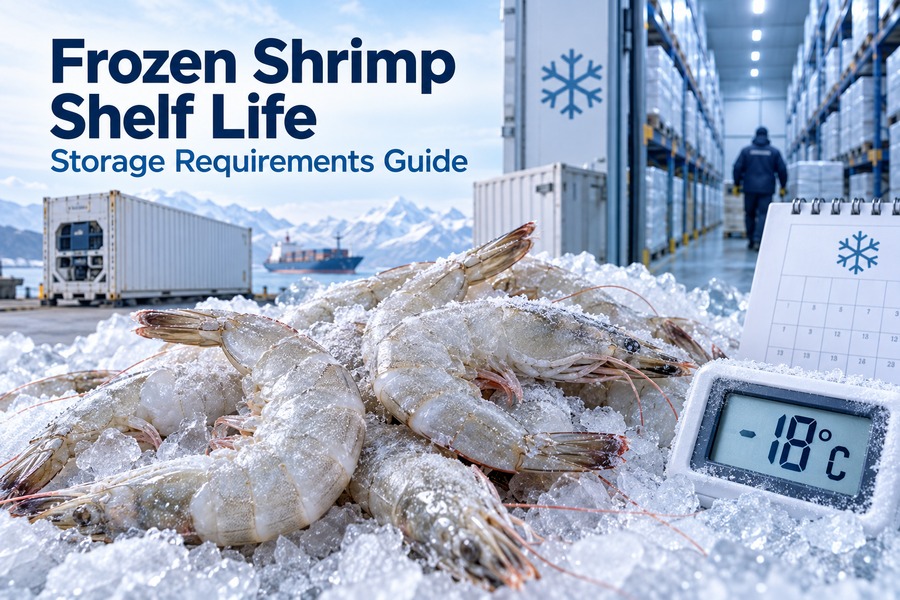
Frozen shrimp shelf life is commonly 6 to 18 months for best quality when the product remains continuously frozen at 0°F (-18°C) or below, although the supplier’s validated shelf life and label date should govern a commercial lot. Stable temperature, rapid freezing, intact moisture-resistant packaging, protective glaze, and disciplined handling matter as much as time. Buyers should reject or investigate shipments showing temperature abuse, damaged packs, severe dehydration, or abnormal odour after controlled thawing.
For export-ready product options, specifications, and documentation, review Iran Fish’s frozen shrimp range.
| Buyer question | Practical answer |
|---|---|
| How long does frozen shrimp last? | FoodSafety.gov lists 6–18 months in the freezer for shrimp and crayfish as a quality guideline. The producer’s declared shelf life remains the controlling limit for a commercial lot. |
| Required frozen condition | Keep the shrimp continuously at 0°F (-18°C) or below and follow the storage statement on the case and product specification. |
| Is frozen shrimp safe indefinitely? | FoodSafety.gov says foods continuously held at 0°F (-18°C) or below can remain safe indefinitely, but quality continues to decline and this does not override a labelled date, damaged packaging, a cold-chain deviation, or local law. |
| What shortens shelf life? | Poor raw material, delayed or slow freezing, air exposure, glaze damage, temperature cycling, partial thawing, refreezing, and weak stock rotation. |
| Main receiving checks | Product temperature, logger records, carton and seal condition, frost or clumping, label and lot code, net contents, and a controlled thaw test. |
| Best inventory rule | Use FEFO when lots have expiry or best-before dates; otherwise apply FIFO within the supplier’s declared shelf life. |

What Determines Frozen Shrimp Shelf Life?
The date on a carton is only one part of shelf-life control. The usable quality of frozen shrimp is shaped by everything that happens from harvest and processing to the moment the customer opens the pack.
Shrimp Condition Before Freezing
Freezing preserves the condition of shrimp; it does not improve raw material that has already deteriorated. Delays before chilling and freezing can affect odour, texture, appearance, and microbial condition. A reliable specification should therefore identify the species, product form, treatment where applicable, production date, freezing date, and lot.
For a buyer, this is why a long printed best-before period is not enough on its own. Supplier approval, process controls, sensory standards, and traceability provide the evidence behind that date.
Freezing Speed and Ice-Crystal Formation
Water in shrimp muscle turns to ice during freezing. Faster freezing generally creates smaller ice crystals, while slow freezing can create larger crystals that disrupt tissue. After thawing, that damage may appear as excess drip, softness, or reduced resilience.
IQF and block-frozen shrimp can both retain good quality when the process and cold chain are controlled. IQF offers individually separated pieces, while block freezing protects shrimp in a solid unit. Neither format compensates for weak raw material or temperature abuse.
Packaging, Glazing and Exposure to Air
Frozen shrimp can lose moisture when exposed to cold, dry air. A suitable inner pack and intact seal reduce air exchange, while a controlled ice glaze can shield the surface from dehydration and oxidation. Glaze should be reasonably even, properly declared, and consistent with the purchase specification.
Loose ice and uncontrolled frost are different from protective glaze. Thick frost inside the bag, torn liners, open seals, or dry white patches may point to moisture migration, packaging failure, or temperature fluctuation. These signs call for investigation rather than an automatic assumption about safety.
Temperature Stability Across the Cold Chain
Average temperature does not tell the full story. A shipment can record an acceptable average while still experiencing damaging warm periods during loading, customs inspection, cross-docking, or warehouse handling. Repeated warming and cooling encourages surface melting and recrystallisation, which can damage texture and make IQF pieces clump.
Continuous or frequent monitoring provides stronger evidence than one reading taken when a container door opens. Commercial buyers should define the required product temperature, permitted tolerances, monitoring method, and corrective action in the purchase specification.
Product Form and Processing
HOSO, HLSO, peeled, deveined, cooked, IQF, and block-frozen products do not have identical exposure or handling needs. Head-on shrimp requires particular attention to head condition and attachment, while peeled shrimp has more exposed flesh and depends heavily on packaging and glaze. Cooked shrimp also needs protection from dehydration and flavour change.
The shelf-life statement should match the exact product rather than a generic shrimp category. Buyers comparing suppliers should compare like with like: species, form, count, treatment, freezing format, glaze basis, pack size, and intended storage conditions.
Frozen Shrimp Storage Requirements for Commercial Buyers
Commercial storage must protect both food safety and the quality promised in the contract. The system should control temperature, packaging, inventory movement, and traceability as one connected process.
Maintain the Declared Frozen Temperature
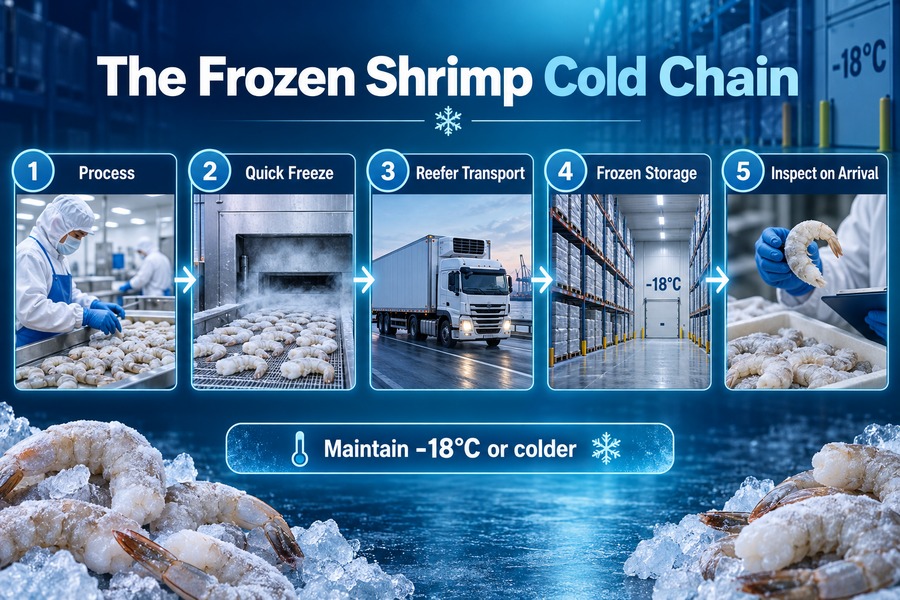
The Codex Standard for Quick-Frozen Shrimps or Prawns states that quick freezing is not complete until the thermal centre reaches -18°C or colder after thermal stabilisation, and that the product should remain deep frozen through transport, storage, and distribution. FoodSafety.gov likewise uses 0°F (-18°C) or below for freezer guidance.
That number refers to the condition of the product, not only the air shown on a wall display. Air temperature changes more quickly than the centre of a carton, so procedures should distinguish room readings, reefer set points, return-air readings, and measured product temperature.
Monitor Warehouses and Reefer Containers
Use calibrated equipment and keep records linked to the relevant lot or shipment. A documented program may include warehouse probes, container data loggers, alarm review, calibration records, dispatch checks, receiving measurements, and corrective-action reports.
Place loggers where they can provide meaningful evidence, not merely where they are easiest to retrieve. The monitoring plan should reflect airflow, pallet arrangement, door exposure, defrost cycles, and known warm zones. If a deviation occurs, a qualified person should assess its duration, severity, product temperature, and effect before release.
Protect Cartons from Moisture and Physical Damage
Master cartons and inner packs must stay closed, clean, dry, and structurally sound. Water-stained board, crushed corners, punctured bags, failed seals, exposed product, or damaged liners can reduce protection and complicate traceability.
Pallets should be arranged to support airflow and safe handling while avoiding direct contact with floors or unprotected surfaces. Staff should limit the time pallets spend on warm loading docks and should not leave cases near doors simply because they will be moved again soon.
Apply FIFO or FEFO Inventory Control
First expired, first out is the stronger approach when lots have different expiry or best-before dates. First in, first out can work when comparable lots share the same validated shelf-life basis. The warehouse system should flag stock approaching its date early enough for an informed commercial decision, not after quality has already declined.
Date rotation should never replace condition checks. A newer lot exposed to a cold-chain break may need attention before an older lot that remained continuously frozen.
Preserve Lot Identification and Traceability
Keep the supplier lot code visible and linked to receiving records, storage location, movements, inspection results, and customer dispatch. Do not combine unidentified product from different lots in a way that breaks traceability.
FDA HACCP guidance treats storage and distribution as relevant parts of hazard analysis and recognises time and temperature records where storage is a critical control point. The exact legal and documentary requirements depend on the product, destination, and business, so importers should confirm the rules that apply to their market.

How Long Do Different Types of Frozen Shrimp Last?
There is no universal commercial shelf life that applies to every shrimp product. The figures below are planning guidance; the validated date on the product and the agreed specification take precedence.
| Product or condition | Useful planning guidance | Main quality concern |
|---|---|---|
| Raw shrimp, continuously frozen | FoodSafety.gov lists 6–18 months for shrimp and crayfish | Dehydration, oxidation, texture change, glaze damage |
| Cooked frozen shrimp | Follow the manufacturer’s validated date | Dryness, flavour loss, tough texture |
| IQF shrimp | Follow the declared date and check that pieces remain free-flowing | Clumping, glaze loss, surface dehydration |
| Block-frozen shrimp | Follow the declared date and keep the block intact | Partial thawing, damaged liner, full-block handling |
| Thawed raw shrimp in a refrigerator | Use promptly; consumer guidance often treats raw seafood as short-life refrigerated food | Microbial growth and rapid quality decline |
| Thawed cooked shrimp in a refrigerator | Use promptly within the applicable refrigerated-food procedure | Contamination and sensory deterioration |
Raw Frozen Shrimp
FoodSafety.gov’s cold-storage chart lists a freezer quality range of 6 to 18 months for shrimp and crayfish at 0°F (-18°C) or below. This broad range reflects quality guidance rather than a promise for every product. Species, product form, freezing method, packaging, glaze, and temperature history can move acceptable quality toward either end.
Cooked Frozen Shrimp
Cooking changes proteins and moisture distribution, so cooked shrimp can become dry or tough during extended storage even while remaining frozen. Use the processor’s validated shelf life and handling statement. A buyer should also confirm whether seasoning, glazing, breading, or other added ingredients change the storage specification.
IQF Shrimp
IQF shrimp should remain reasonably separable. A few pieces sticking together does not prove abuse, but a solid mass, heavy internal frost, or large loose ice crystals deserves closer review. Resealable retail or foodservice packs also need protection after opening because air exposure accelerates dehydration.
Block-Frozen Shrimp
A frozen block can protect product efficiently when the block and liner remain intact. The main operational issue is that the whole unit normally needs planned thawing. Chipping pieces away from a block can damage the shrimp and undermine portion control.
Glazed and Vacuum-Packed Shrimp
Glaze reduces moisture loss when it remains intact, while low-oxygen packaging can limit exposure to air. Neither system creates unlimited shelf life. Seal damage, lost glaze, temperature cycling, and poor initial quality can still reduce performance. Net contents should be evaluated according to the declared basis and applicable rules, excluding protective glaze where required.

Safety vs Quality: Why “Still Frozen” Does Not Always Mean “Still Good”
FoodSafety.gov explains that foods held continuously at 0°F (-18°C) or below can remain safe indefinitely, while its freezer timelines are about quality. Freezing stops microbial growth but does not reliably destroy every microorganism. Once the product warms or thaws, surviving organisms can become active again, which is why safe handling still matters.
Quality continues to change in frozen storage. Moisture can migrate from the surface, fats can oxidise, proteins can change, and ice crystals can grow during temperature cycling. The result may be freezer burn, off-flavour, excessive drip, a dry surface, or mushy texture. None of these defects should be hidden behind the phrase “it was frozen.”
Commercial acceptance also involves the label and contract. A lot may fail because it has passed its declared date, lacks traceability, experienced a documented deviation, or does not meet the agreed sensory and net-weight specification. Conversely, a small area of freezer burn is primarily a quality defect and does not by itself prove a food-safety hazard. The decision should be evidence-based and made under the company’s food-safety and quality procedures.
How to Inspect Frozen Shrimp on Arrival
Receiving is the buyer’s best opportunity to detect a problem before stock enters normal inventory. Use a written sampling and escalation procedure so the decision does not depend on whoever happens to unload the container.
- Confirm the product and reefer condition before unloading, then measure product temperature using an approved method and calibrated equipment.
- Review available time-temperature or data-logger records for unexplained excursions.
- Inspect master cartons, liners, retail bags, seals, pallet wrap, labels, and coding for damage or mismatch.
- Look for heavy loose frost, large ice crystals, collapsed glaze, wet cartons, or an IQF pack frozen into an abnormal solid mass.
- Match the species, product form, count size, production details, storage statement, and lot code to the purchase documents.
- Check gross weight, declared net contents, and deglazed weight using the agreed method where glazing applies.
- Retain representative samples and conduct a controlled thaw assessment for odour, colour, firmness, drip, workmanship, and defects.
- Quarantine a suspect lot rather than mixing it with released inventory, and document the issue with photographs, readings, sample identity, and time.
One door reading cannot reconstruct the entire cold chain. Combine physical inspection with shipping records, logger data, pack condition, and thawed-product testing. Iran Fish’s guide to identifying high-quality frozen shrimp provides a complementary checklist for colour, odour, texture, glaze, count, and workmanship.
Freezer Burn, Ice Crystals and Other Signs of Quality Loss
Frozen defects provide clues, not complete diagnoses. Buyers should connect what they see with packaging condition, temperature history, and a controlled thaw test.
Freezer Burn and Surface Dehydration
Freezer burn develops when moisture leaves the shrimp surface. It may appear as pale, whitish, dry, or chalky areas and can produce a tougher cooked texture. Extensive dehydration reduces appearance, yield, and eating quality even if the lot stayed frozen.
Large Ice Crystals and Recrystallisation
Small frost crystals can occur without a serious problem. Large loose crystals, heavy internal snow, or irregular ice deposits may indicate moisture migration or temperature cycling. When surface ice melts during warming and freezes again, crystals can grow and damage the product.
Clumping in IQF Packs
IQF means the pieces were individually frozen during production; it does not guarantee permanent separation under every later condition. Excess water, uneven glaze, compressed packs, broken packaging, or partial thawing can cause clumps. A large solid mass should trigger a review of the temperature record and a representative sample test.
Discolouration, Odour and Texture After Thawing
Natural colour varies by species and whether the shrimp is raw or cooked. The concern is abnormal or severe change compared with the declared product and approved sample. After controlled thawing, the flesh should have a mild, clean marine odour and an appropriate firm texture.
Sour, rancid, strongly fishy, or ammonia-like odours are rejection signals. Unusual slime, extreme softness, severe dryness, contamination, or leaking packs also need food-safety or quality review. Smell cannot prove safety, because harmful microorganisms may be present without an obvious sensory warning.
Safe Thawing, Refreezing and Handling After Thawing
The shelf-life calculation changes once shrimp is thawed. The product is no longer protected by a fully frozen state, so time, temperature, hygiene, and a clear use plan become critical.
Refrigerator Thawing
Gradual thawing under refrigeration is the preferred controlled method for most uses. Keep the shrimp in a clean, leak-proof container, maintain lot identity, and prevent drips from contaminating other food. A commercial operation should define its own validated thawing time, container depth, load size, and refrigerator limit.
Cold-Water Thawing
For faster handling, sealed shrimp may be thawed in cold water. The pack should remain closed so the product is not exposed to uncontrolled water or contamination. Do not use warm water or leave shrimp at room temperature, as the surface may warm into a range that supports microbial growth before the centre has thawed.
How Long Thawed Shrimp Lasts
Thawed shrimp should be used promptly. Storage time depends on whether it is raw or cooked, the thawing method, the refrigerator temperature, prior handling, and applicable local procedures. Do not assume the original frozen best-before date remains the usable deadline after thawing.
FoodSafety.gov lists fresh shrimp and crayfish at 3 to 5 days under refrigeration at 40°F (4°C) or below, but a previously frozen commercial product may carry more specific instructions. Follow the label, the approved food-safety plan, and the more conservative limit where requirements differ.
When Refreezing May Be Unsafe or Harm Quality
Refreezing is not a routine fix for poor planning. If shrimp has been held outside controlled refrigeration, has an uncertain time-temperature history, or shows spoilage signs, it should not be refrozen to extend use. Refer the lot for an authorised safety decision.
Even when refreezing is permitted under applicable guidance, another freeze-thaw cycle usually increases drip, dryness, clumping, and texture loss. For consistent commercial quality, choose pack sizes that match real throughput and thaw only the amount required.

Frozen Shrimp Storage Checklist for Importers and Distributors
A short checklist helps purchasing, quality, logistics, and warehouse teams work from the same standard. Attach measurable acceptance criteria to the purchase order rather than relying on words such as “premium.”
- State the species, product form, count range, count unit, raw or cooked status, treatment, and freezing format.
- Define the required product temperature for storage and transport and the evidence needed to verify it.
- Request production, freezing, best-before or expiry, and lot information before shipment.
- Agree on glazing, net contents, deglazed-weight method, and tolerances.
- Approve inner packaging, master carton strength, coding, and pallet configuration.
- Use calibrated temperature-monitoring equipment and retain records.
- Review reefer, loading, transfer, warehouse, and receiving data for unexplained gaps.
- Apply FEFO or FIFO correctly and prevent expired or unidentified stock from entering saleable inventory.
- Keep frozen stock protected from warm-door exposure, wet floors, crushed stacking, and damaged wrapping.
- Maintain lot separation and traceability from receipt through customer dispatch.
- Record non-conformities, quarantine affected stock, and document release, rejection, or corrective action.
- Reassess suppliers using actual delivery performance, not only pre-shipment samples.
Frequently Asked Questions
These answers distinguish general storage guidance from the product-specific requirements that commercial buyers must follow. When a label, specification, law, or validated food-safety plan gives a stricter rule, use that rule.
How long can frozen shrimp stay in the freezer?
FoodSafety.gov lists 6 to 18 months for shrimp and crayfish as a freezer-quality guideline at 0°F (-18°C) or below. It also explains that continuously frozen food can remain safe indefinitely, but quality declines. For imported or wholesale shrimp, follow the producer’s validated shelf life, labelled date, product specification, temperature history, and destination-market rules.
What temperature should frozen shrimp be stored at?
Store frozen shrimp at 0°F (-18°C) or below unless the approved product specification requires a colder condition. Codex states that quick-frozen shrimp should reach -18°C or colder at its thermal centre after stabilisation and remain deep frozen during transport, storage, and distribution. Monitor product condition as well as room or reefer air.
Can frozen shrimp go bad before the expiry date?
Yes. A printed date assumes the product was made, packed, transported, and stored under the stated conditions. Seal failure, severe temperature fluctuation, partial thawing, contamination, or poor initial quality can make a lot unacceptable earlier. Inspect the pack, records, and a controlled thawed sample instead of relying on the date alone.
Is freezer-burned shrimp unsafe to eat?
Freezer burn is mainly a quality defect caused by moisture loss. It can make shrimp dry, pale, tough, or less flavourful, but it does not by itself prove a food-safety hazard. Severe freezer burn may still breach a commercial specification. Discard or escalate shrimp with uncertain temperature history, damaged packaging, contamination, or abnormal sour, rancid, fishy, or ammonia-like odour.
Can thawed shrimp be frozen again?
Do not refreeze shrimp with an uncertain handling history or shrimp that has been allowed to warm outside controlled conditions. Where refreezing is permitted after safe refrigerator thawing, quality can still decline because a second freeze-thaw cycle increases moisture loss and texture damage. Commercial operators should follow their validated procedure and thaw only what they can use.
Source Frozen Shrimp with Documented Cold-Chain Control
Shelf life is strongest when the product specification, freezing method, packaging, temperature records, and receiving checks all support the same claim. Importers should ask for evidence before shipment and keep each lot traceable after arrival.
Iran Fish supplies Vannamei shrimp and wild shrimp in commercial product forms for international buyers. Available freezing format, count, glaze, pack configuration, documentation, and shipping terms should be confirmed for the proposed lot.
Contact Iran Fish to discuss your destination, required shrimp specification, packaging, cold-chain documentation, and order requirements.