

Vannamei Shrimp Farming: From Hatchery to Harvest

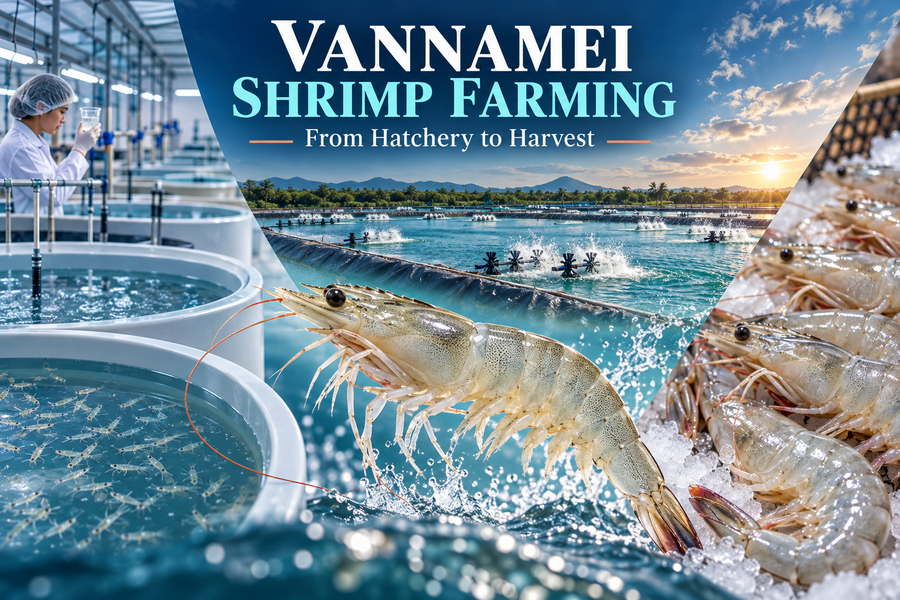
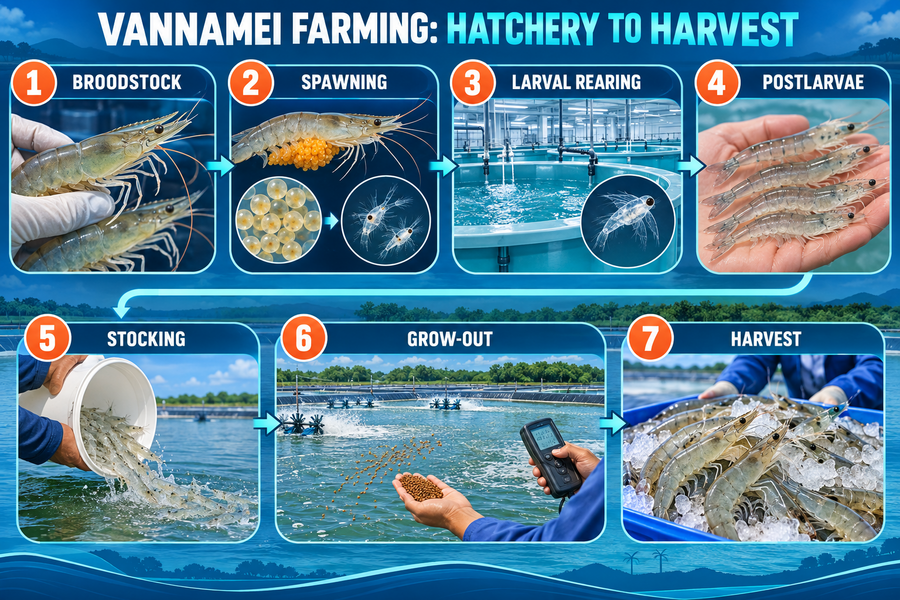
Vannamei shrimp farming begins with healthy broodstock and hatchery-produced postlarvae, followed by nursery rearing or direct pond stocking, grow-out management and a carefully timed harvest. Success depends on matching seed quality and stocking density to the farm’s real carrying capacity, then managing feed, oxygen, water chemistry, pond-bottom condition and biosecurity as one connected system. Harvested shrimp must be cooled quickly and linked to traceable farm and lot records.
| Production stage | What happens | Main management priority | Output |
|---|---|---|---|
| Broodstock and spawning | Mature shrimp produce fertilised eggs | Health status, clean water and controlled maturation | Eggs and nauplii |
| Larval hatchery | Nauplii develop through zoea and mysis | Hygiene, stage-appropriate feeding and stable water | Postlarvae |
| Nursery, when used | Small postlarvae are reared before grow-out | Acclimation, survival and uniform development | Stronger juveniles |
| Pond preparation | The production unit is dried, repaired and prepared | Exclusion of predators and pathogens; working aeration | Ready grow-out pond |
| Stocking and grow-out | Acclimated shrimp enter the culture system | Density, feed, oxygen, health and waste control | Market-size shrimp |
| Harvest and handling | Shrimp are removed at the agreed size | Fast, clean collection and immediate chilling | Traceable raw material for processing |
Buyers interested in Iranian aquaculture can review Iran Fish’s farmed Vannamei shrimp and bulk shrimp export range.
Why Vannamei Is Widely Farmed
Pacific white shrimp, commonly called Vannamei and scientifically classified as Penaeus vannamei or Litopenaeus vannamei in different references, has become a major aquaculture species because hatchery production and controlled breeding can supply postlarvae for organised farming. Farmers can use it in extensive, semi-intensive, intensive and other controlled systems, provided management matches the level of production.
The species can tolerate a broad range of culture conditions, but tolerance should not be confused with an invitation to ignore water quality. Growth, survival and feed use are shaped by temperature, salinity, dissolved oxygen, pH, alkalinity, ammonia, nitrite and interactions between them. A range reported by one farm cannot automatically become a universal operating target for a different life stage, water source or system.
Vannamei also supports a range of processed and frozen presentations for importers, distributors and food service. That commercial flexibility begins on the farm: size uniformity, shell condition, harvest handling and traceability affect what a processor can produce. Iran Fish states that its shrimp operations include the Shif Shrimp Site in Bushehr, an important southern aquaculture region.
Hatchery Stage: From Broodstock to Postlarvae
The hatchery converts eggs from selected broodstock into postlarvae suitable for transport and stocking. Each transition changes the animal’s behaviour and feeding needs, so water treatment, hygiene and observation must follow the actual stage rather than a fixed calendar alone.
Broodstock, Maturation and Spawning
Broodstock can come from controlled breeding programmes or other approved sources. Modern production often values specific pathogen free, or SPF, status because it describes animals raised under a health programme and tested free from named pathogens. SPF does not mean resistance to every disease, and it does not protect postlarvae from exposure after they leave the controlled facility.
Maturation units manage broodstock in controlled tanks with treated water, a suitable feeding programme and separation from larval production areas. Records should connect the broodstock group, spawning event and resulting larval batch. The FAO species profile for Penaeus vannamei reports that females weighing 30–45 g can produce 100,000–250,000 eggs and that hatching occurs about 16 hours after spawning and fertilisation. These biological figures describe the species; commercial results depend on broodstock, facility and operating conditions.
Nauplius, Zoea and Mysis Stages
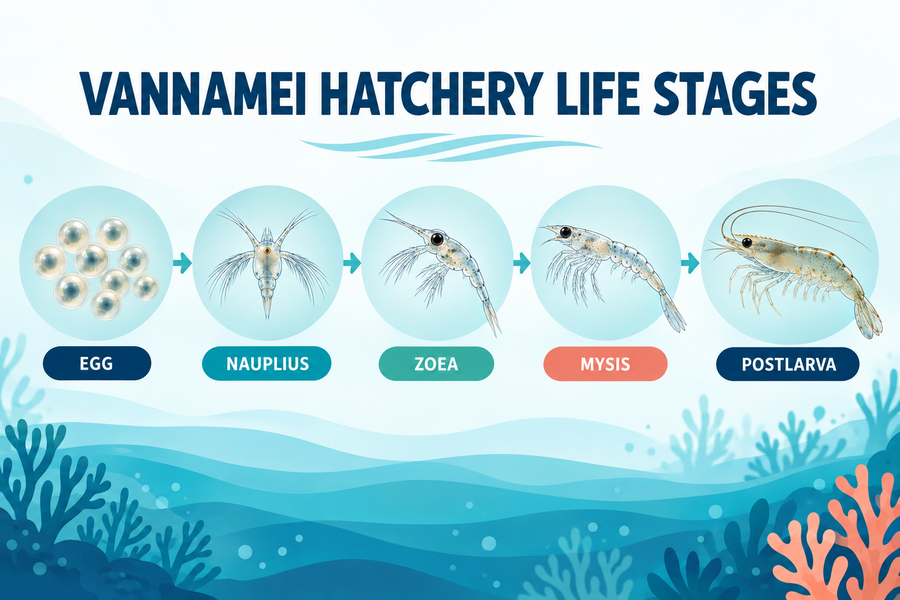
The first larval stage is the nauplius. FAO describes six naupliar stages, followed by three protozoeal or zoea stages and three mysis stages before the postlarval phase. Nauplii rely on yolk reserves. Later planktonic stages feed and undergo major changes in body form, behaviour and digestive function.
Hatchery staff manage these changes through stage-appropriate feeds, treated water, tank cleaning, monitoring and controlled transfers. Microalgae, Artemia and formulated larval diets may be used in programmes designed for the stage and facility. Feed quantity must be observed because uneaten material and organic waste can impair the rearing environment.
Postlarvae Quality and Hatchery Biosecurity
Once larvae become postlarvae, hatcheries evaluate readiness for transport and stocking. Assessment can include activity, uniformity, development, appearance, gut condition, stress response and health-screening results. A supplier’s age label, such as PL10 or PL12, tells how many days have passed since metamorphosis to the postlarval stage; it does not replace a quality assessment.
Biosecurity separates broodstock, spawning, larval rearing and support activities as required by the facility design. Treated intake water, sanitation, movement controls, batch records and appropriate diagnostic testing reduce avoidable risks. Buyers of seed should confirm the hatchery source, batch identity, health documentation, transport plan and the conditions to which the postlarvae have been acclimated.
Nursery or Direct Stocking?
Many farms transport PL10–12 from the hatchery and place them into grow-out ponds after controlled acclimation. FAO documents this direct-stocking route as common in Vannamei production. It reduces one transfer and simplifies the production chain, but the grow-out pond must be ready for small animals and the farm must be confident in postlarval quality, transport and initial feeding conditions.
A nursery adds an intermediate phase in tanks, small ponds, raceways, cages or other controlled units. It can concentrate observation, make early feeding easier to manage and allow the grow-out pond to receive larger juveniles. The nursery also introduces another handling and transfer event, so its value depends on design, health control and the farm’s ability to move juveniles without excessive stress.
The decision is operational rather than ideological. A farm should compare its pond schedule, water source, climate, biosecurity, labour, transfer method and survival records. If a nursery does not improve control or production timing under local conditions, direct stocking may be the clearer route. If it allows stronger observation and better use of grow-out capacity, the extra stage may be justified.
Preparing a Grow-Out Pond
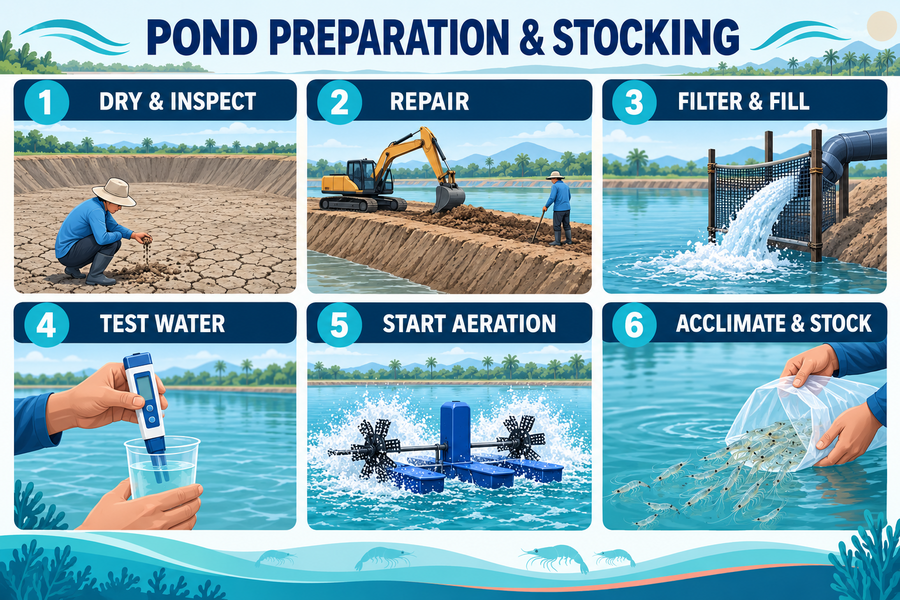
Pond preparation creates the physical and biological starting point for the crop. Procedures vary between lined ponds, earthen ponds, low-exchange systems and other designs, but every farm needs a documented readiness check.
- Drain the previous crop’s water through the farm’s approved discharge route and remove residual stock.
- Dry and inspect the pond bottom as the system and soil conditions allow; address excessive sludge rather than merely covering it.
- Repair gates, screens, liners, dikes, drains and erosion before filling.
- Clean and service pumps, pipes, feeders, aerators, sensors and backup power equipment.
- Prevent entry of unwanted fish, crustaceans and other organisms through appropriate intake treatment and filtration.
- Prepare water according to the farm’s operating plan and legal requirements; verify source-water risks before it reaches production units.
- Establish baseline measurements for salinity, temperature, pH, dissolved oxygen, alkalinity and relevant nitrogen compounds.
- Position and test aeration against the planned biomass and pond circulation pattern.
- Confirm that bird, crab and human-access controls are in place before seed arrives.
- Record pond identity, preparation actions, water source and approval for stocking.
Preparation cannot compensate for a production plan that exceeds the pond’s practical carrying capacity. The farm must align intended stocking and harvest biomass with aeration, water treatment, feeding, waste removal, power reliability and staff response time.
Acclimation and Stocking
Postlarvae leave a controlled hatchery or nursery environment and enter water with different temperature, salinity and chemistry. Acclimation reduces the speed of that change and should follow a farm protocol based on measured conditions.
Matching Temperature and Salinity
Farm staff compare transport water with receiving water before release. Water is adjusted gradually where the difference could stress the animals. The appropriate rate depends on postlarval condition, the magnitude of the difference, transport history and the approved protocol; a single universal acclimation time is not reliable for every delivery.
Observe activity and mortality during the process. Release should take place into a prepared environment with adequate oxygen, while avoiding unnecessary crowding and handling. Record the arrival time, water values, batch details, number stocked and any abnormal observations.
Stocking Density Is a System Decision
Stocking density affects the biomass the pond must support as shrimp grow. Higher density generally increases dependence on feed, aeration, monitoring, waste management and reliable power. Published densities range widely because extensive ponds, aerated earthen ponds, biofloc tanks and recirculating systems are not equivalent.
The correct density is the one the specific facility can manage through the planned harvest, with a margin for weather, equipment failure and biological variation. Farm history, pond shape, oxygen-transfer capacity, water exchange policy, desired harvest size and disease risk should inform the decision.
Recording the Start of the Crop
The stocking record begins farm-to-export traceability. It should identify the hatchery and postlarval batch, health documents, pond, stocking date, estimated number, life stage, acclimation observations and starting water parameters.
These records later help interpret survival, growth and feed use. They also allow harvest lots to be connected back to their source rather than existing as anonymous biomass at the processing gate.
Feeding and Growth Management
Feed is both nutrition and a major source of organic input to the pond. A good programme follows biomass and appetite while protecting water and pond-bottom conditions.
Feed Programme and Observation Trays
Farmers select feeds suited to shrimp size and the production system. Ration tables can provide a starting point, but real feeding decisions require observation. Feed trays, feeding behaviour, weather, moulting, water quality and recent consumption indicate whether the planned amount is appropriate.
Automatic feeders can distribute smaller portions more frequently, while manual feeding can also work with consistent staff and records. Neither method removes the need to verify response. Overfeeding wastes feed and can increase organic loading; persistent underfeeding can restrict growth and worsen size variation.
Growth Sampling and Biomass Estimates
Periodic sampling estimates average body weight, size distribution and general condition. Combining sample weight with a realistic survival estimate gives an updated biomass figure for feed planning and aeration decisions. The sample should represent the pond rather than the easiest location to net.
Sampling also reveals changes in uniformity, shell condition, gut fill and visible health. The farm should minimise handling stress, use consistent methods and record the date, pond, sample count, weight and observations.
Adjusting Feed Without Damaging Water Quality
Feed changes should be explained by evidence from appetite, growth, biomass and environmental conditions. During low oxygen, abrupt salinity change, heavy rainfall, unusual behaviour or suspected disease, normal feeding tables may no longer fit the pond.
The response should follow the farm’s health and water-quality protocol rather than relying on one reading. Feed records, water measurements and tray observations become more useful when reviewed together, allowing managers to distinguish a one-off change from a developing problem.
Water Quality, Aeration and Pond Bottom Management
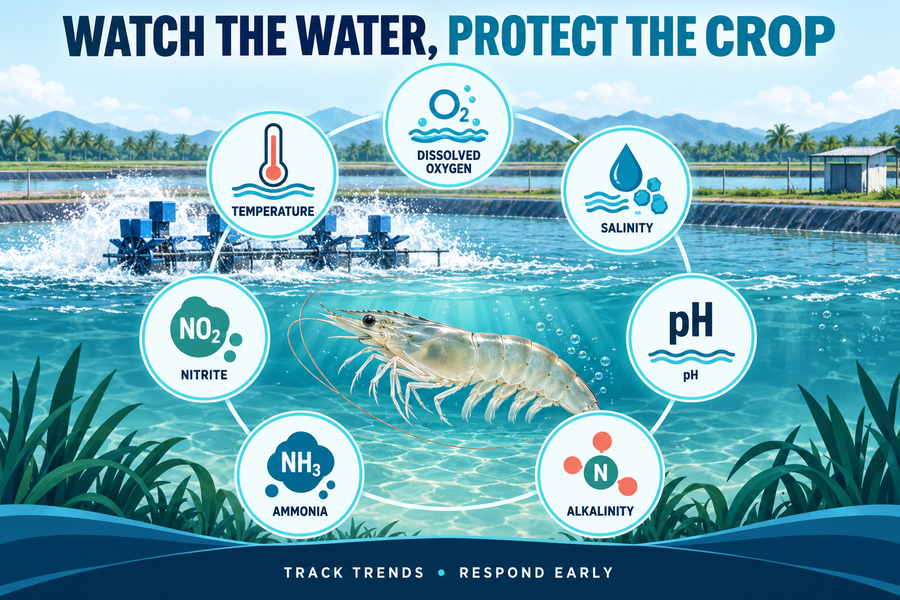
Shrimp, microbes, algae, feed and waste continually alter the culture water. Monitoring is valuable when it leads to timely action and the farm understands how values change through the day and crop cycle.
| Parameter | Why it matters | Management interpretation |
|---|---|---|
| Dissolved oxygen | Supports shrimp respiration and aerobic pond processes | Measure at meaningful times and locations; plan aeration and backup capacity for biomass and risk |
| Temperature | Affects metabolism, appetite, oxygen demand and toxicity | Interpret feed and oxygen observations in the context of temperature change |
| Salinity | Influences osmoregulation and acclimation | Manage changes gradually and consider mineral balance, life stage and water source |
| pH | Interacts with biological activity and ammonia toxicity | Track daily pattern as well as individual readings |
| Alkalinity | Supports buffering and biological processes | Use laboratory or farm data to guide system-specific correction |
| Ammonia and nitrite | Indicate nitrogen loading and biological treatment performance | Investigate feed, biomass, oxygen and waste processes when levels trend upward |
| Transparency or plankton condition | Helps describe the pond’s biological state | Interpret with weather, oxygen and nutrient data rather than colour alone |
Monitor Trends, Not Isolated Numbers
The useful schedule depends on culture intensity and risk. Dissolved oxygen can change substantially between afternoon and the hours before sunrise, so one comfortable daytime reading may hide a weak early-morning condition. Sensors require calibration, and manual measurements need consistent sampling locations and technique.
A farm should define action thresholds for its system with qualified technical support. Generic internet ranges cannot account for all interactions among salinity, temperature, pH, biomass and microbial processes.
Aeration Must Follow Biomass and Circulation
Aerators provide oxygen and influence water movement. Placement should avoid poorly mixed zones while supporting the pond’s waste-management strategy. As biomass and feeding increase, operating hours and backup readiness may need to change.
Power loss can become a rapid production risk in high-density systems. Farms should test generators, alarms and response responsibilities before an emergency. Equipment capacity on paper is not enough if maintenance, fuel or staff response is unreliable.
Manage Organic Matter and Pond Bottom Condition
Faeces, uneaten feed, plankton and other organic material accumulate during grow-out. Excess deposits can consume oxygen and create unstable areas. Pond circulation, feed control, sludge removal where the system allows it, and water or microbial management must work together.
Actions should follow measured conditions and applicable environmental rules. Moving waste from the pond to an uncontrolled discharge point does not solve the management problem.
Biosecurity and Shrimp Health
Biosecurity reduces the chance that pathogens enter, spread within or leave a farm. It works as a chain of controls, and the weakest routine can undermine stronger measures elsewhere.
- Source postlarvae from an approved hatchery and verify batch identity and required health screening.
- Understand what SPF status covers and which named pathogens were included in the programme.
- Filter or treat incoming water according to the farm’s risk assessment and permissions.
- Control people, vehicles, animals and equipment moving between production areas.
- Assign equipment to individual ponds where practical, or clean and disinfect it under a validated procedure.
- Prevent transfer of untreated water or stock between ponds.
- Monitor feed response, swimming behaviour, appearance and mortality every day.
- Record unusual events and escalate them through the farm’s aquatic-animal-health plan.
- Do not move sick or unexplained stock to another pond.
- Follow competent authority instructions for sampling, reporting, containment and disposal when disease is suspected.
White spot syndrome virus and acute hepatopancreatic necrosis disease are among the serious hazards discussed in shrimp aquaculture. Visible signs alone cannot provide a definitive diagnosis. Laboratory testing and professional aquatic-animal-health advice are needed for decisions that affect the crop or movement of animals.

Deciding When and How to Harvest
Harvest connects farm performance with the processor’s required size and condition. The decision should combine sample data, buyer specification, shrimp health, weather, pond condition, processing capacity and transport readiness.
Confirm Harvest Readiness
Representative samples estimate average body weight, count range, size uniformity and shell condition. A pond may contain healthy shrimp but still be unsuitable for immediate harvest if a large share is soft-shelled after moulting or if the receiving plant cannot handle the volume quickly.
Coordinate harvest timing with the processor before draining begins. Containers, ice, clean water where used, labour and vehicles should be ready. Lot identification must follow the shrimp from pond to receiving.
Partial and Full Harvest
A partial harvest removes part of the biomass while the remaining shrimp continue growing. It may reduce load and target a specific market size, but the operation can disturb the pond and surviving animals. A full harvest removes the crop, commonly through controlled drainage and collection or another method designed for the facility.
The chosen method should minimise physical damage, contamination, prolonged crowding and time out of temperature control. Farms need a contingency for pump, gate, net, transport or processing delays.
Immediate Post-Harvest Handling
Shrimp quality can deteriorate quickly after harvest. Prompt washing under the approved process, rapid chilling with suitable ice or chilled conditions, gentle handling and clean containers help preserve condition before processing.
The receiving record should capture farm, pond, harvest date and time, lot, delivered weight, temperature or chilling checks as applicable, and condition observations. Processing presentation and freezing come later, but raw-material quality is already being established at this point.
From Farm Records to Export Specifications
Farm records provide the history behind an export lot: postlarval source, pond identity, stocking date, feed and health events, sampling, harvest and transfer to processing. The processor adds product form, count, freezing, glaze, net weight, packaging and finished-lot controls. Traceability connects these records without turning every internal farm detail into a carton claim.
An importer should still assess the finished commercial specification. Farmed origin does not tell the buyer whether the pack is HOSO, HLSO, peeled, IQF or block-frozen. Iran Fish’s guide to shrimp processing methods explains these presentations, while its Vannamei shrimp size guide covers trade count terminology.
Claims about production practices should be supported by the relevant supplier records and documents. Buyers can request the product specification, origin information, processing approvals and destination-market documents appropriate to their order.
Frequently Asked Questions
These answers clarify how the production stages fit together. Exact farm targets must be set for the local system by qualified operators and applicable authorities.
How does Vannamei shrimp farming start?
It starts with broodstock and hatchery production. Eggs hatch into nauplii, which pass through zoea and mysis stages before becoming postlarvae. Farms purchase or produce suitable postlarvae, acclimate them and either stock them directly into grow-out ponds or rear them in a nursery first.
What does PL10 or PL12 mean?
PL means postlarva, and the number refers to days after the animal entered the postlarval stage. PL10 is approximately ten days into that stage. Age is useful for planning but does not prove health or quality, so source, appearance, activity, development and required screening should also be checked.
Is there one ideal stocking density for Vannamei?
No. Suitable density depends on pond or tank design, aeration, water treatment, power reliability, feed delivery, waste control, target harvest size, staff capability and risk tolerance. Densities from unrelated systems should not be copied without confirming that the farm can support the projected biomass.
How long does Vannamei take to reach harvest?
There is no single crop length for every farm. FAO describes cultured shrimp harvested from ponds after roughly four to five months at 15–25 g in one broodstock-production pathway, while commercial harvest schedules vary with starting size, temperature, density, feed, health and the buyer’s target grade. Iran Fish describes its broader Iranian farming period, including preparation and harvest, as about six months.
What is the biggest risk during grow-out?
Risk comes from interacting factors rather than one universal cause. Poor seed quality, pathogen entry, inadequate oxygen, unstable water chemistry, overfeeding, waste accumulation, weather and equipment failure can reinforce one another. Daily observation, measurement, biosecurity, reliable aeration and a written response plan are therefore managed together.
Source Farmed Vannamei Shrimp from Iran Fish
Iran Fish supplies farmed Vannamei shrimp for international buyers and identifies the Shif Shrimp Site in Bushehr as its shrimp-farm location. Buyers can begin with the Vannamei shrimp supplier page and compare the wider Iranian shrimp export range.
Send the destination, required product form, finished count, freezing method, pack configuration and documentation needs when making an enquiry. The team can confirm the available specification and current production fit for the intended order.
Farm-to-harvest knowledge helps buyers ask better questions, but the shipment should still be approved against its finished product specification and supporting documents.