


Shrimp Import Requirements for International Buyers

Shrimp import requirements begin with a simple question: is this exact product from this origin and processing plant allowed into your destination? If it is, confirm importer permits and advance filings, official health certification where required, matching trade documents, food-safety evidence, accurate labels and an unbroken frozen chain. Farmed and wild-caught shrimp can require different traceability records. Check current rules with your importing authority and broker before confirming a shipment.
| Requirement | What the buyer must establish before dispatch |
|---|---|
| Market access | The origin, plant and product form are eligible; trade restrictions have been checked. |
| Importer obligations | Permits, registrations, customs entry, advance notices and border inspection are arranged. |
| Documents | Invoice, packing list, transport document and official certificates describe the same lots. |
| Safety and traceability | Processing controls, required tests and farm or catch records connect to the product. |
| Product and delivery | Species, form, count, net weight, glaze, labels, packaging and frozen transport match the specification. |
Check Whether the Shrimp Can Enter Your Market
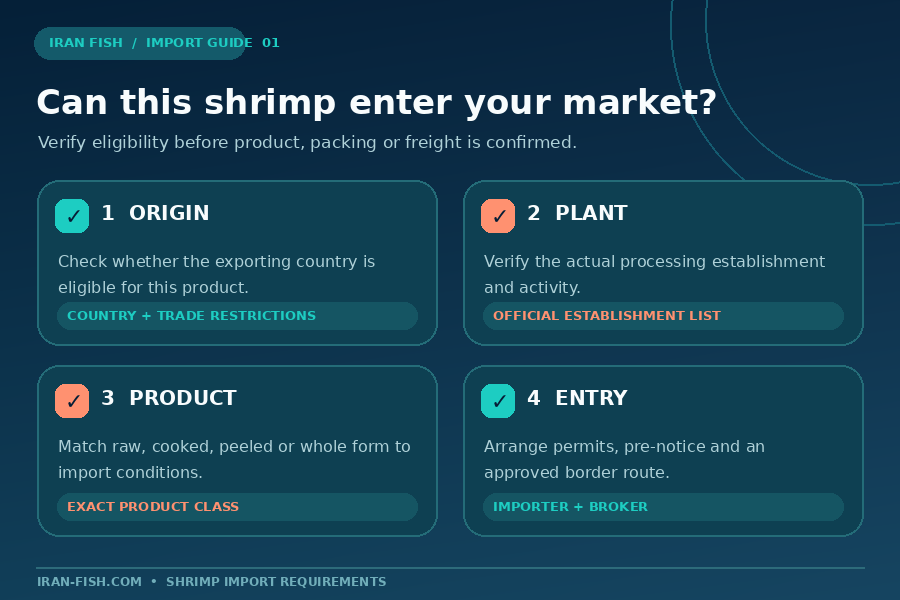
Importability is determined by the destination’s current rules for the specific product, not by an exporter’s general ability to ship seafood. Ask your broker to check the commodity description, origin, processing plant and intended use together.
Verify country, product and establishment eligibility
Some authorities authorise only certain exporting countries and listed establishments. The European Commission’s guidance on fishery products, for example, identifies country approval, approved establishments, health certification and border controls as separate requirements. Check a plant’s listing for the relevant activity and product; a supplier’s general certificate does not replace official market access.
Product form matters too. Raw, cooked, peeled and whole shrimp can follow different conditions, and processing may change the applicable classification. Describe the product precisely before asking whether it can be imported. For Iranian shrimp, verify origin-specific trade restrictions as well as food rules. Under US regulation 31 CFR § 560.201, importation of Iranian-origin goods into the United States is generally prohibited unless authorised. FDA seafood compliance does not override that prohibition.
Identify importer filings and the border route
The importer may need registration, a permit, advance notification, customs declaration and a booking at an authorised border control post. Agree on who supplies data, who submits each filing and which document must exist before the shipment leaves. A certificate issued after a missed pre-arrival deadline may not solve the entry problem.
Check the destination port and transit route as carefully as the destination country. If the shipment changes vessels or crosses another jurisdiction, ask the broker whether transit documents or additional controls apply. Keep the purchase specification, booking and customs classification aligned.
Farmed and Wild-Caught Shrimp Follow Different Evidence Trails
“Shrimp from Iran” does not explain how a lot was produced. Establish whether it is farmed Vannamei or wild-caught shrimp, then request records appropriate to that production method and destination.
Farmed shrimp: trace the production lot
For aquaculture, connect the farm or production source, harvest date, processing batch and final cartons. Depending on the market, buyers may also need information on veterinary-drug controls, residue testing and the approved processing establishment. An aquaculture record is useful only when its identifiers reconcile with the packing list and labels.
Wild-caught shrimp: verify harvest records
Wild-caught shrimp may require vessel, flag, catch area, landing and catch-certificate information under rules against illegal, unreported and unregulated fishing. In the EU, the CATCH system became mandatory for EU operators and authorities handling in-scope catch certificates on 10 January 2026. Do not assume that farmed and wild-caught shrimp have identical catch-document requirements; confirm each lot’s classification.
Mixed lots deserve special attention. When shrimp from several harvests or farms is consolidated, the exporter should show how each input lot maps to processing batches and cartons. A product photograph is no substitute for an identifiable lot record.
Shrimp Import Documents: What Each One Proves
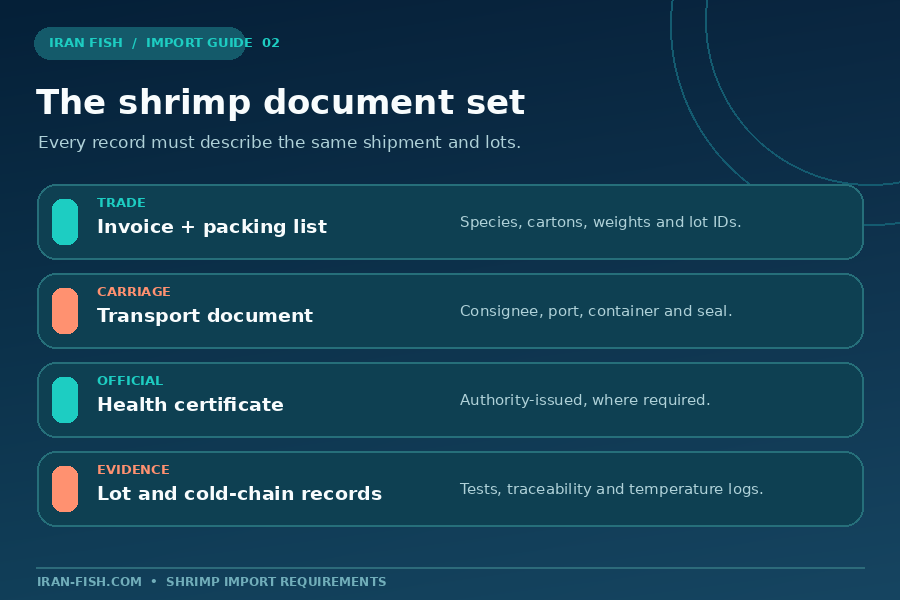
No universal document pack works for every destination. Build the checklist from the importing authority’s conditions, then check every draft against the same product specification before loading.
- The commercial invoice identifies seller, buyer, origin, detailed product, quantity and shipment terms. Avoid vague descriptions such as “frozen seafood” when cartons contain a specific shrimp species and form.
- The packing list maps lots, cartons, pack sizes, net and gross weights, and shipping marks. Add container and seal numbers consistently when available.
- The bill of lading or air waybill records carriage, consignee and destination. It must match the intended clearance route.
- An official health or sanitary certificate, when required, comes from the competent authority using the destination’s accepted model and attestations. A private quality certificate is not an automatic substitute.
- A certificate of origin, catch certificate, import permit, inspection report or laboratory result may be required by market, product or contract. Check its issuer and link to the lots.
- Traceability and temperature records support verification of origin and frozen handling. Some records must be retained by the importer without physically accompanying the shipment.
| Review point | Buyer and exporter check |
|---|---|
| Before ordering | Eligibility, permits, official certificate model and product specification. |
| Before packing | Carton artwork, lot codes, count basis, net weight and required tests. |
| Before loading | Invoice and packing-list drafts against cartons; certificate issuance arrangements. |
| Before arrival | Transport document, entry notification, seal, container and temperature records. |
A preventable mismatch is a product described differently on the certificate, invoice and cartons. Agree on the scientific name, production method, processing form and count unit. If a document needs correction, ask its proper issuer to amend it; an informal alteration may not be accepted.
Write a Product Specification That Can Be Inspected
“Frozen shrimp, large size” is not an inspection standard. A useful specification lets the plant pack the right product and the importer compare delivered cartons with the approved order.
Species, production method and processing form
State the scientific species and whether it is farmed or wild-caught. Spell out HOSO (head-on, shell-on), HLSO (headless, shell-on), peeled and deveined, or the requested form instead of relying only on shorthand. Add raw or cooked status, whether the tail remains, and whether freezing is individual quick freezing (IQF) or block freezing. Compare Iran Fish’s shrimp range, farmed Vannamei shrimp and wild-caught shrimp against the permitted form in your market.
Count, glaze and net contents
Specify a count range and whether it is per pound or kilogram, plus the form on which the count is measured. Agree on glaze separately from shrimp net weight. The Codex Standard for Quick-Frozen Shrimps or Prawns says declared net contents exclude glaze. A carton with the correct gross weight can still fail the order if shrimp content or size grade differs.
Packaging and labels
Confirm retail or food-service pack, inner and master cartons, label language, storage statement, country of origin, lot code and allergen declaration under destination rules. Send buyer-approved artwork to the processor before printing. If relabelling is planned after arrival, first confirm that the route is permitted; it cannot be assumed to cure a border-label problem.
Verify Food Safety and the Frozen Cold Chain
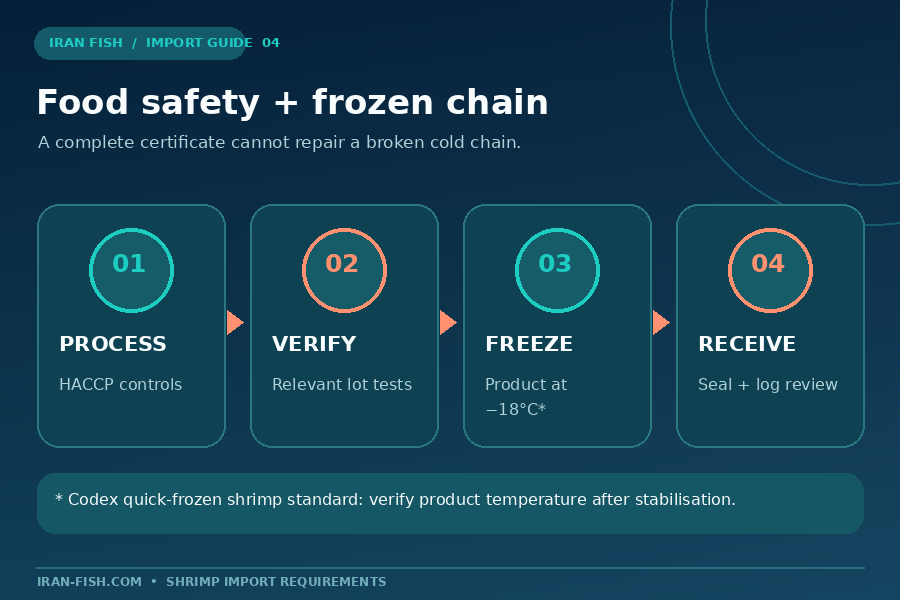
Food safety evidence should describe controls for the actual process and destination. Request documents and test results relevant to the lot instead of a generic “export quality” promise.
Processing controls and testing
Seafood HACCP addresses hazards through process controls; it does not itself grant import approval. For farmed shrimp, a destination may examine veterinary-drug residues. Microbiological and contaminant requirements depend on form and local law. Agree on sampling, test methods, laboratory acceptance and what happens if a result fails before production or loading.
The FDA’s seafood import guidance covers seafood HACCP, prior notice, applicable food-facility registration and truthful labelling. FDA says it does not approve individual food products, labels or shipments before importation; avoid “FDA approved shipment” claims. When an official health certificate is required, verify its issuer and wording separately from a plant’s management-system certification.
Freezing, transport and receiving
Packaging should protect shrimp from dehydration, broken cartons and handling damage. For quick-frozen shrimp, Codex calls for a product temperature of −18°C or colder after thermal stabilisation and appropriate frozen storage and transport. Specify reefer settings and the recording method, then review loading and transit temperature evidence.
At receipt, compare seal and container identification, carton condition, lot labels and temperature records with the paperwork. Document signs of thawing, refreezing or damage and follow the agreed inspection procedure. A clean temperature graph cannot fix a missing certificate, just as complete documents cannot rescue a compromised cold chain.

How Rules Differ Across Major Destination Markets
Use these examples to frame questions for your importer, not as clearance guarantees. Rules change, and origin-specific restrictions can block a route before ordinary seafood requirements become relevant.
European Union
Check country and establishment authorisation for the product, official health certification, a border control post and the Common Health Entry Document process in TRACES. The EU’s digital CATCH workflow applies when a catch certificate is required for in-scope wild-caught fishery products. Confirm whether the particular farmed or wild lot falls within the scheme. Labels and traceability must also meet EU and Member State rules.
United States
For otherwise admissible origins, FDA prior notice, applicable facility registration and seafood HACCP importer verification matter. NOAA’s Seafood Import Monitoring Program covers shrimp reporting and recordkeeping. Crucially, Iranian-origin shrimp faces the general US import prohibition in 31 CFR § 560.201 unless a specific authorisation applies. The FDA and NOAA checklist is not permission to import it.
Great Britain
The UK’s fish import guidance addresses country and establishment approval, health certification, import notification and border controls. Confirm the current risk category, certificate model and whether an IUU catch certificate applies to wild-caught shrimp. The importer’s IPAFFS notification and the exporter’s certificate must identify the same consignment.
Australia
Australia treats prawns as a biosecurity-sensitive product. Its notice on uncooked prawn conditions says the standard pathway requires frozen prawns with heads and shells removed and deveining; applicable batches face disease testing. Other product classes have distinct conditions. An HOSO carton suitable elsewhere should not be assumed eligible for Australia. Check the current BICON pathway and permit before agreeing on processing.
A Pre-Shipment Review That Prevents Document Mismatches
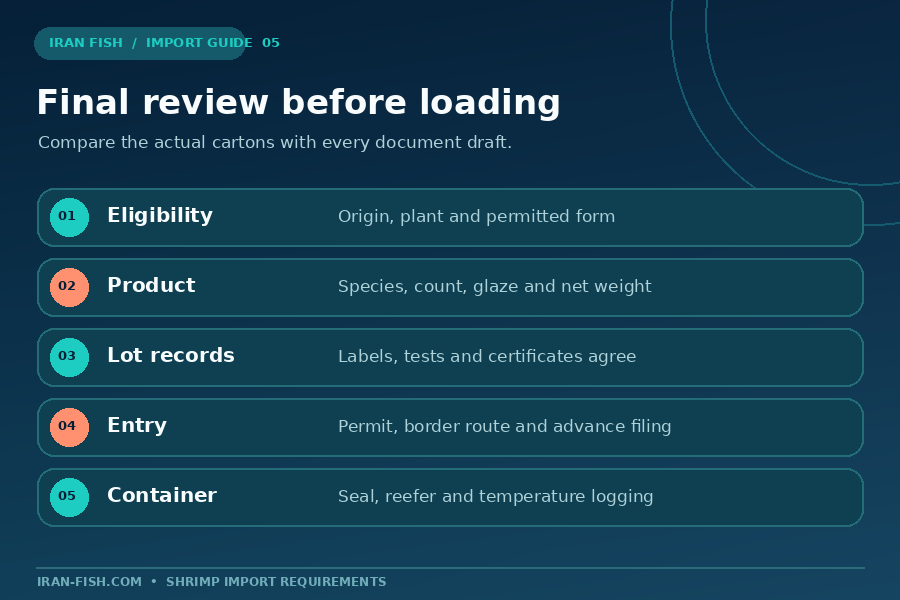
The final review is most useful while shrimp remains at the plant. The importer, exporter and broker should compare one approved specification with physical cartons and every document draft.
- Confirm destination eligibility, origin restrictions, the named plant and border route.
- Match species, farmed or wild status, form, raw or cooked state, count unit, glaze and net weight to order and labels.
- Reconcile lot codes and cartons across packing list, certificates, test reports and traceability records.
- Check official certificate wording, issuer, dates and catch or permit references.
- Review consignee, port, container, seal, reefer instructions and temperature monitoring.
- Resolve discrepancies before loading; send final copies in time for advance filings.
If an item cannot be verified, identify who can provide authoritative confirmation. Substituting an unrelated certificate or changing only one document creates a new inconsistency.
Frequently Asked Questions
The destination authority, exact product and origin determine the final answer. These are common questions to resolve before booking a container.
Is a health certificate always required to import shrimp?
There is no universal certificate. Many markets require an official one for fishery products, but its model, statements and issuer depend on destination and product. Ask the importer for the current template before issuance.
Do I need a shrimp import permit?
That depends on market and product. Some destinations require a permit or importer registration alongside customs and food notifications. Australia uses product-specific biosecurity conditions. Confirm the route with the authority and broker; exporter documents do not satisfy every buyer-side obligation.
Do farmed shrimp need the same catch certificate as wild-caught shrimp?
Not necessarily. Catch certification is associated with covered wild-capture products under particular rules; farmed shrimp needs aquaculture origin and production traceability. Both need identifiable lots and applicable food-safety documents. Ask the broker how mixed or processed products are classified.
Can Iranian shrimp enter the United States if FDA rules are met?
Generally, no. US rules prohibit importation of Iranian-origin goods unless an authorisation applies. Meeting FDA seafood requirements does not remove that separate restriction. Seek a current determination from the relevant US authority and qualified trade adviser before planning such a shipment.
What should be checked before a frozen shrimp container is loaded?
Check market and plant eligibility, certificate arrangements, permits, specification, labels, lot mapping, invoice and packing-list drafts, any required test results, seal and temperature-monitoring plan. Identifiers and weights should match the physical goods.
Discuss Your Shrimp Import Requirements With Iran Fish
Send your destination country and port, importer checklist, preferred species and processing form through the Iran Fish contact page. Include count basis, pack format, label language and official certificate or testing requirements.
Iran Fish can review its available shrimp export selection against your specification and discuss the documents associated with the proposed lot. Confirm destination eligibility and final entry obligations with your authority and broker before committing to a shipment.
An early exchange gives both sides a concrete product and document set to verify, rather than a vague request for “export-ready shrimp.”