


Vannamei Shrimp Buying Guide for Importers and Distributors

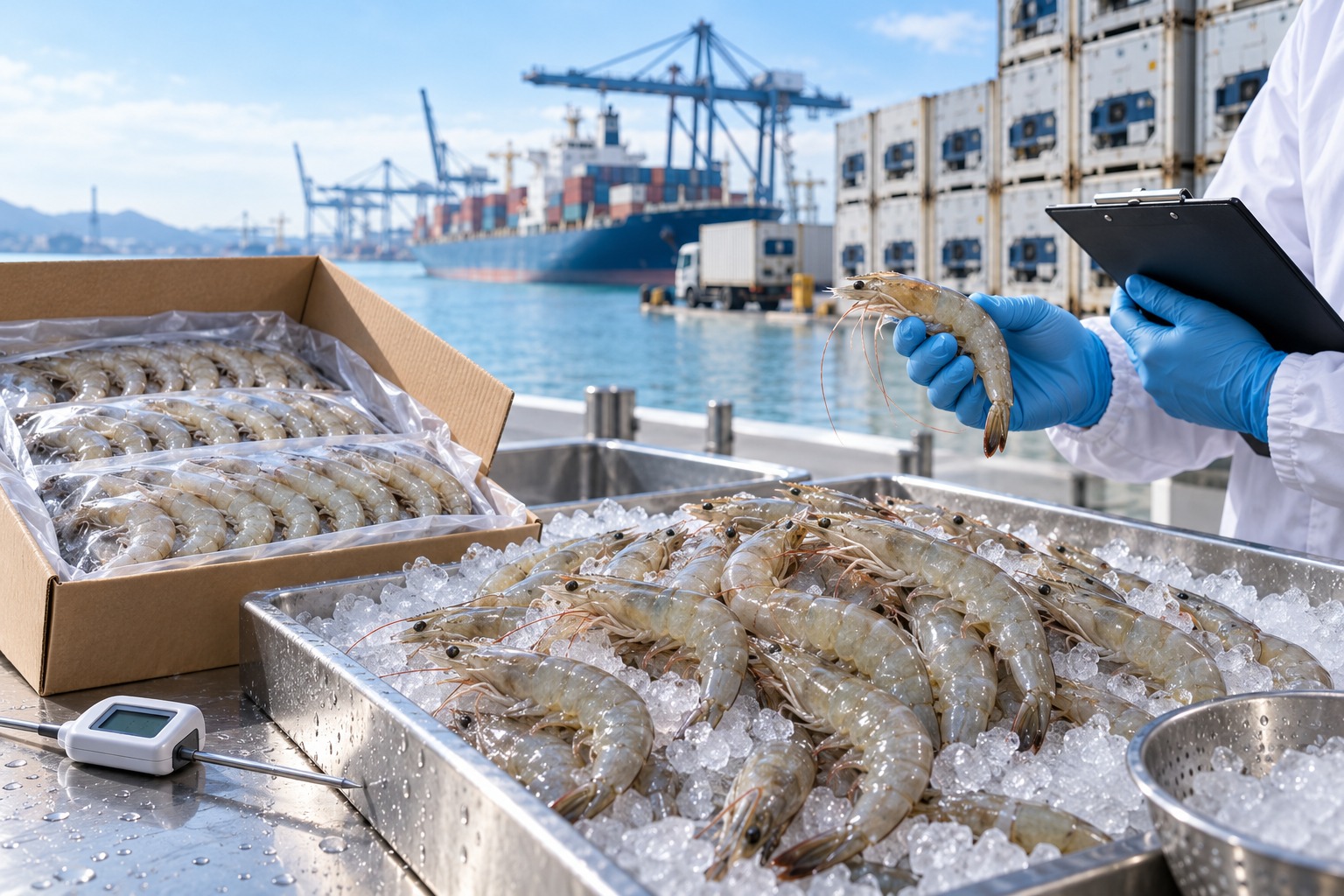
This Vannamei shrimp buying guide gives importers and distributors the practical answer first: define the species, size-count basis, product form, freezing method, net weight, permitted treatments, quality tolerances, packaging, labelling, certificates and inspection terms before confirming an order. The safest purchase is not simply a familiar size in a standard carton. It is a shipment whose written specification matches your market, can be verified after deglazing and remains traceable from farm and processor to destination.
| Buying decision | What to specify | What to verify before shipment |
|---|---|---|
| Species | Penaeus vannamei, also traded as whiteleg or Pacific white shrimp | Scientific name, farmed origin and traceability records |
| Size | Count range and whether it is measured per pound or kilogram | Count test based on actual deglazed weight |
| Product form | HOSO, HLSO, PUD, PD, PTO, PDTO or another defined form | Head, shell, vein and tail condition |
| Processing | Raw, cooked or value-added | Process description and approved facility details |
| Freezing | IQF, semi-IQF or block frozen | Product temperature, glaze condition and cold-chain records |
| Net contents | Net weight excluding glaze | Deglazing method, drained weight and pack-weight checks |
| Treatments | Permitted additives, sulphites or phosphate status | Ingredient declaration and residue test reports where required |
| Quality | Colour, odour, texture, shell condition, uniformity and defect limits | Approved sample, lot inspection and written acceptance criteria |
| Packaging | Inner pack, master carton and private-label requirements | Final artwork, carton strength, coding and pallet pattern |
| Compliance | Destination-specific health, labelling and import requirements | Valid certificates, establishment eligibility and buyer-side approvals |
| Logistics | Incoterm, loading plan, destination port and required temperature | Reefer settings, container condition, seal number and document set |
Why Vannamei Is a Practical Species for International Buyers
Vannamei shrimp, scientifically identified as Penaeus vannamei and widely known as Pacific white shrimp or whiteleg shrimp, is well suited to structured international supply programmes. It is farmed in several producing regions, processed in many commercial forms and accepted across retail, food-service and industrial channels. Those qualities give buyers flexibility, but they also make vague enquiries risky. Two suppliers may use the same product name while offering different count systems, glaze levels, processing yields or quality tolerances.
For an importer, consistency matters more than a broad description such as “large frozen shrimp.” A restaurant distributor may need a uniform PDTO product that presents well on the plate. A processor may prefer block-frozen HLSO for controlled thawing and further processing. A retailer may require IQF shrimp in consumer-ready packs with destination-language labels. The correct choice depends on the customer’s use, not on the species name alone.
Iranian farmed Vannamei is available through the Iran Fish Vannamei shrimp range. Buyers comparing it with other seafood lines can also review the wider shrimp export selection, which includes farmed and wild products. Keeping those categories separate at the specification stage prevents substitutions and makes the commercial description clear.
Vannamei Shrimp Buying Guide: Build the Specification Before You Source
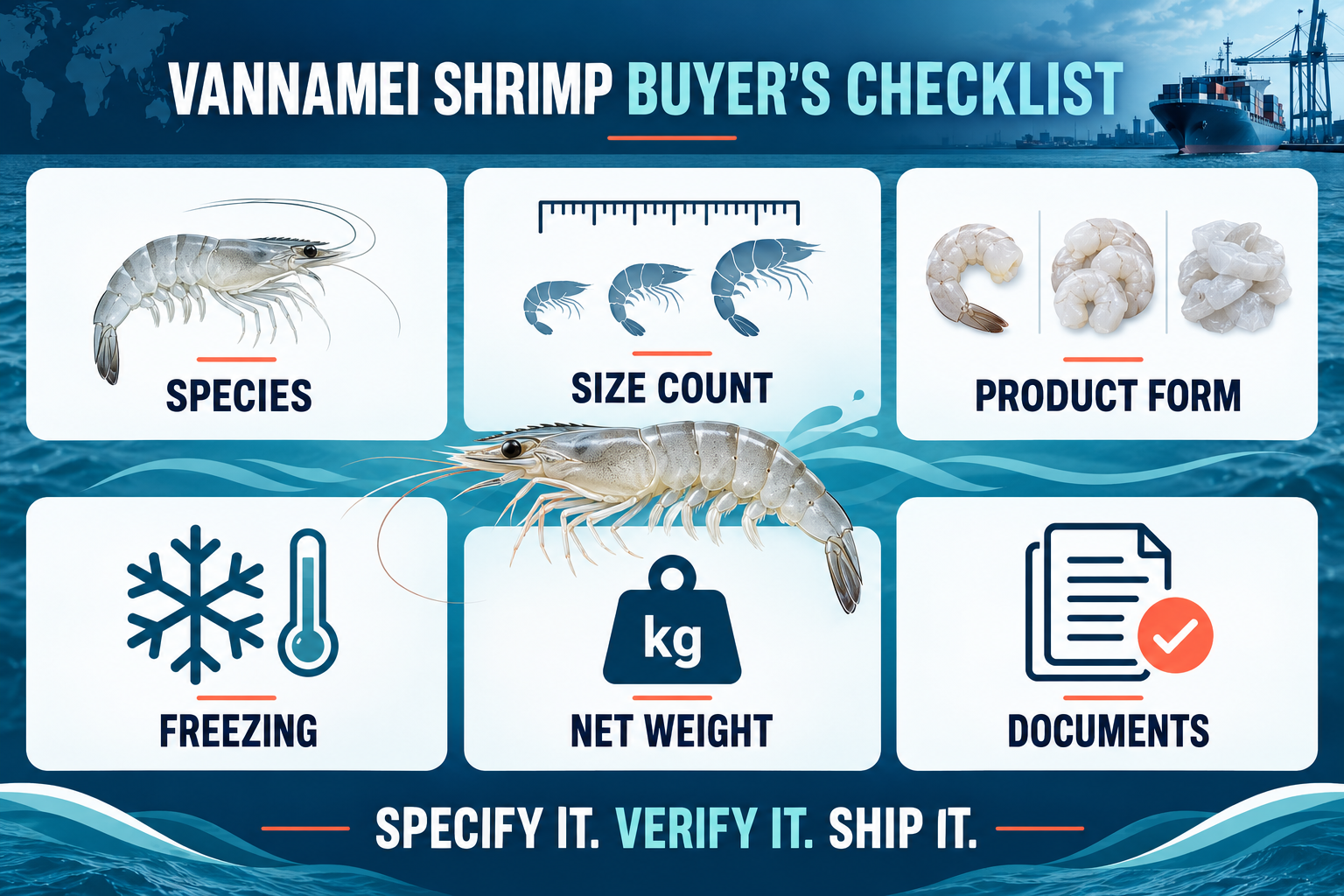
A dependable order starts with an end-use specification. The buyer should know who will handle the shrimp, how it will be portioned or displayed, whether the pack will be opened gradually or thawed at once, and which claims may appear on the final label. These decisions determine the appropriate product form and freezing method.
Avoid sending a request that lists only “Vannamei 30/40.” That description does not say whether the count is per pound or kilogram, whether the product is HOSO or peeled, whether the count is determined before or after deglazing, or whether the pack is raw, cooked, IQF or block frozen. Each missing detail creates room for a technically different product to be supplied.
Use a specification sheet that both parties can approve and attach to the sales contract or purchase order. At minimum, it should contain the following fields:
| Specification field | Example of a clear instruction |
|---|---|
| Species | Penaeus vannamei, farmed |
| Product form | Raw PDTO, tail fan intact |
| Size basis | 21/25 pieces per pound, verified after deglazing |
| Freezing | IQF, free-flowing pieces |
| Glaze | Declared separately; net contents exclude glaze |
| Treatments | List every additive and processing aid; no undeclared treatment |
| Sensory quality | Clean marine odour, firm texture, characteristic colour |
| Workmanship | Fully deveined, no loose shell beyond agreed tolerance |
| Pack format | Agreed inner-pack and master-carton configuration |
| Label | Product name, species, form, net weight, lot code, dates, origin and storage statement |
| Documents | Health, origin, packing, traceability and laboratory documents required by destination |
| Inspection | Approved sampling plan, test methods and rejection criteria |
This written description becomes the control document for sampling, production, inspection and claims. If the buyer later changes the pack format or end market, the specification should be reviewed again rather than assumed to remain suitable.
Understand Shrimp Counts Before Comparing Sizes
Shrimp size is normally expressed as a count range: the approximate number of pieces in a stated unit of weight. A lower count indicates larger individual shrimp. A 16/20 product therefore contains fewer, larger pieces than a 41/50 product when both ranges use the same weight basis and product form.
The weight basis must always be written beside the count. In many trades, headless and peeled forms are counted per pound, while HOSO products may be counted per kilogram. Practices vary by market and supplier. Never convert a bare count into a product assumption.
The current Codex Standard for Quick-Frozen Shrimps or Prawns, CXS 92-1981 states that shrimp may be packed by count per unit of weight or per package. When count is declared, Codex determines it by counting the shrimp in the container or a representative sample and dividing that number by the actual deglazed weight. This is why a count checked against glazed gross weight can give the buyer the wrong result.
| Common count range | Relative trade size | Typical applications to evaluate | Buyer check |
|---|---|---|---|
| U/10 | Colossal | Premium whole presentation and centre-of-plate use | Confirm “under” basis and unit of weight |
| 10/20 | Extra large | Grilling, skewers and high-visibility food service | Confirm exact contracted sub-range |
| 20/30 | Large | Restaurants, catering and retail packs | Check size uniformity within the lot |
| 30/40 | Medium-large | Broad food-service and retail use | State pound or kilogram basis |
| 40/50 | Medium | Mixed dishes, frying and processing | Verify count after deglazing |
| 50/60 | Medium-small | Prepared foods and portion-controlled recipes | Check breakage and grading accuracy |
| 60/70 | Small | Salads, fillings and further processing | Confirm usable yield after thawing |
| 70/80 | Small | Industrial and value-added applications | Set uniformity and defect tolerances |
| 80/100 | Very small | Prepared meals, fillings and processing | Approve sample against final use |
| 100/120 | Extra small | Ingredient applications | Define minimum usable piece condition |
These descriptions are commercial orientation, not universal grade names. “Large” in one market can be labelled differently in another. Your contract should rely on the numerical count, defined weight basis, product form and test method.
Size uniformity deserves its own tolerance. A lot can produce an average within the declared range while still containing an unattractive mix of noticeably large and small pieces. Importers supplying restaurants or fixed-count retail packs should define how uniformity will be assessed and what variation is acceptable.

Choose the Product Form That Matches the Customer’s Workflow
Processing codes are shorthand, but they only work when the parties use the same definitions. Put the full form next to every abbreviation on the specification and label artwork. If a detail matters, such as whether the tail fan remains intact or how deeply the back is cut, describe it in words and photographs.
| Code | Product form | Main buyer consideration |
|---|---|---|
| HOSO | Head-on, shell-on | Strong whole-shrimp presentation; more preparation and careful head-quality control required |
| HLSO | Headless, shell-on | Flexible raw material for wholesale, food service and further processing |
| PUD | Peeled, undeveined | Reduced preparation while retaining the vein |
| PD | Peeled and deveined, commonly tail-off unless otherwise stated | Convenience for processing and cooking; workmanship must be checked |
| PTO | Peeled, tail-on | Presentation-focused form; vein status must be stated separately |
| PDTO | Peeled, deveined, tail-on | Ready for restaurant plating, skewers and value-added products |
| CPD | Cooked, peeled and deveined | Ready-to-use product requiring validated cooking and tight temperature control |
| CPTO | Cooked, peeled, tail-on | Suitable for chilled displays, salads and cocktail presentation after controlled thawing |
| Easy-peel | Shell-on shrimp cut to make peeling easier | Cut style and vein removal must be defined |
| Butterfly | Peeled shrimp cut along the back and opened | Cut depth, tail condition and appearance require an approved standard |
| Nobashi | Peeled, deveined and stretched shrimp | Length, weight, breakage and uniformity are key controls |
HOSO offers the most natural presentation, but the head is also a sensitive quality area. Buyers should set limits for melanosis, damaged heads, detached heads, soft shell and discolouration. HLSO removes that concern and is commonly chosen by processors, although shell condition, count accuracy and thawed yield remain important.
Peeled forms reduce labour for the final user but add workmanship variables. A PD or PDTO sample should be checked for complete vein removal, excessive back cutting, remaining shell, tail damage, ragged meat and broken pieces. “Deveined” should not be accepted as a complete quality specification on its own.
Cooked products require an agreed degree of cooking, final colour and texture. The supplier should be able to explain the validated cooking process and how the product is cooled, frozen and protected from post-process contamination. If the intended use is ready-to-eat, the destination market may apply additional microbiological and facility controls.

Decide Between IQF and Block-Frozen Vannamei Shrimp
Freezing format changes how the product moves through a distributor’s warehouse and a customer’s kitchen. IQF shrimp are frozen as separate pieces, allowing a user to remove only the required portion. Block-frozen shrimp are frozen together as a solid unit, making them suitable where the entire block will be thawed for processing.
| Freezing method | Operational advantage | Points to inspect |
|---|---|---|
| IQF | Portion control and free-flowing handling | Clumping, damaged glaze, dehydration and piece separation |
| Semi-IQF | Pieces can be separated with less handling than a full block | Degree of adhesion and pack consistency |
| Block frozen | Compact format for full-batch thawing and further processing | Block integrity, internal condition and thawing plan |
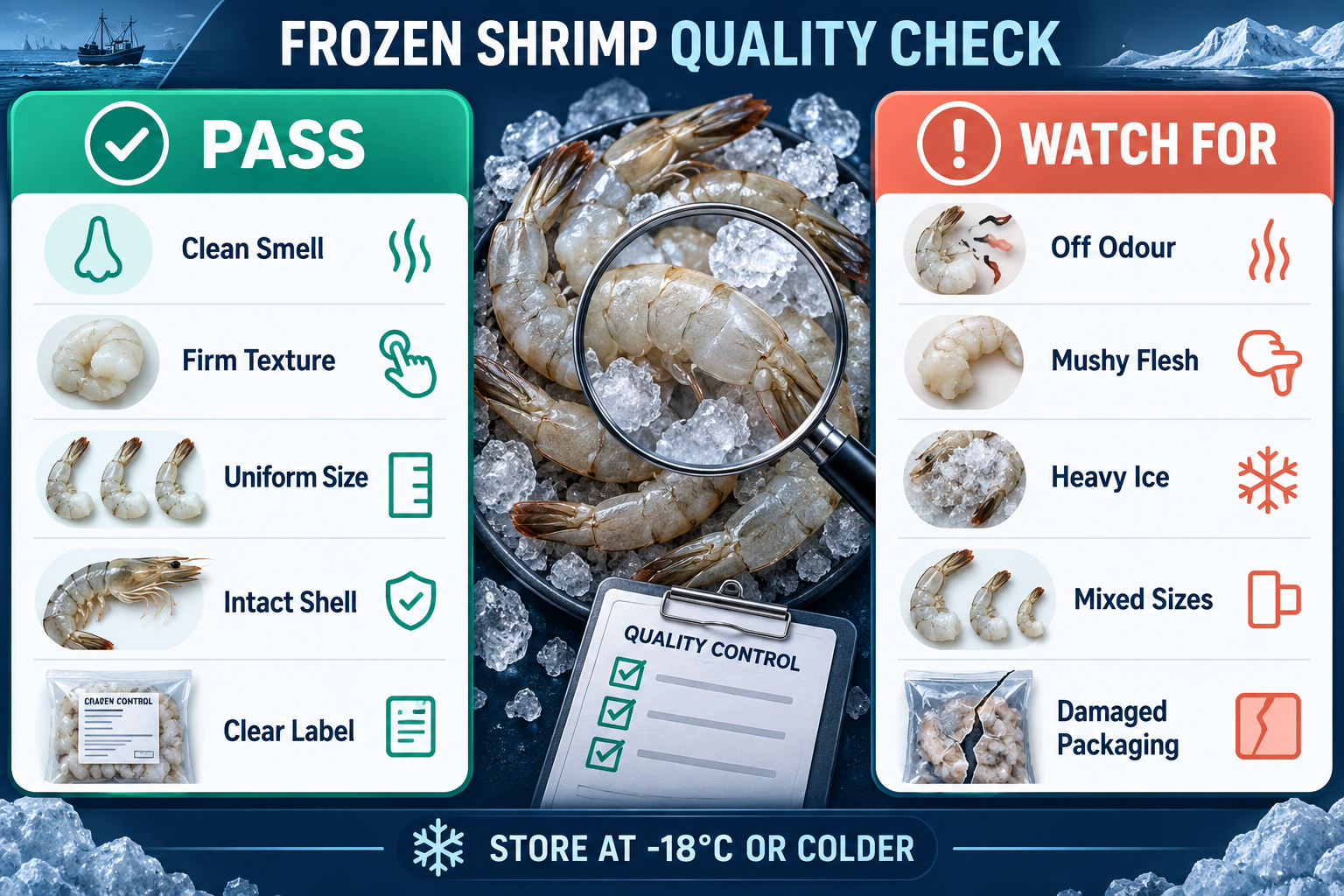
The freezing label does not prove the quality of the process. Inspect whether IQF pieces remain separate, whether the surface is protected without heavy ice accumulation and whether the shrimp shows freezer burn or deep dehydration. For blocks, confirm that the pack freezes evenly and arrives without evidence of partial thawing and refreezing.
Codex defines quick freezing by the product, not just the freezer name. Under CXS 92-1981, the process is not complete until the product reaches −18°C or colder at its thermal centre after thermal stabilisation. The same standard says the product should be kept deep frozen during transportation, storage and distribution. Put the required product condition, reefer setting and evidence of temperature control into the shipment instructions.
Check Glaze, Net Contents and Deglazed Weight
Glaze is a protective ice coating used to reduce dehydration and oxidation. It has a legitimate function, but it must not obscure how much shrimp is actually in the pack. The buyer needs three clearly separated concepts: gross pack weight, glaze or ice, and net shrimp contents after deglazing.
Codex requires the declared net contents of glazed quick-frozen shrimp to exclude the glaze. It also determines count using actual deglazed weight. Those two rules should guide both incoming inspection and supplier comparison.
Do not rely on a percentage alone without defining the test method. Agree on how samples will be selected, how glaze will be removed, how water will be drained and when the sample will be weighed. The test should be repeatable by the supplier, pre-shipment inspector and buyer’s receiving team.
An effective control sequence is:
- Record the unopened pack weight and identify the production lot.
- Open the pack and deglaze the product using the agreed recognised method.
- Drain the shrimp for the defined period without pressing water from the flesh.
- Record deglazed weight.
- Count the pieces and divide by actual deglazed weight using the contracted unit.
- Compare the result with the label and purchase specification.
- Retain photographs, scale records and sample identification.
This procedure verifies both quantity and sizing. It also makes supplier discussions objective if the received product differs from the approved specification.
Review Additives and Residue Requirements
Importers should ask for a complete ingredient and treatment declaration before approving a product. Shrimp may be processed with permitted substances for functions such as moisture retention or melanosis control, but permission, maximum levels and labelling obligations differ by destination. A treatment accepted in one country is not automatically accepted in another.
Phosphates can affect water retention and texture. Sulphites may be used to help control melanosis. Neither subject should be handled with a simple “treated” or “untreated” description. State the compound, intended function, target or maximum level, method of analysis and label declaration required for the destination market. If the order must be phosphate-free or sulphite-free, define how that claim will be verified.
Aquaculture residue control is equally important. The purchase specification should prohibit substances not authorised by the destination country and require compliance with applicable maximum residue limits. Ask for a recent report from a competent laboratory covering the residue panel relevant to the origin, farm system and importing authority. The sampling identity must connect the report to the production lot; a generic certificate from an unrelated batch has limited value.
For the United States, the FDA Fish and Fishery Products Hazards and Controls Guidance reflects the agency’s current thinking on seafood hazards and control strategies. Buyers in every market should still confirm their own current national rules with the responsible authority or an import specialist before shipment.
Inspect Quality With Written Defect Tolerances
“Premium quality” is not an inspection standard. The buyer and supplier need observable criteria, sample sizes and acceptance limits. Photographs of the approved sample help, but photographs should support rather than replace written tolerances.
| Quality point | Acceptable expectation | Warning sign |
|---|---|---|
| Odour | Clean, mild and characteristic after controlled thawing | Persistent sour, rancid, feed-like or ammonia odour |
| Texture | Firm and resilient for the specified product | Soft, mushy or cottony flesh |
| Colour | Characteristic and reasonably uniform for origin and form | Unexplained yellow, green or extensive black discolouration |
| Shell | Appropriate hardness and integrity for the order | Excessive broken shell, shell disease marks or softness |
| Head condition | Secure, clean and within agreed colour tolerance | Loose heads, damaged heads or extensive melanosis |
| Workmanship | Processing matches the approved form | Remaining vein, deep cuts, loose shell or damaged tails |
| Size | Count and uniformity match the specification | Mixed sizes or count based on glazed weight |
| Freezing | Stable frozen condition with protective surface | Clumping, freezer burn, dehydration or evidence of refreezing |
| Foreign material | Product handled under good manufacturing practice | Non-shrimp material or excessive processing debris |
Codex CXS 92-1981 treats persistent objectionable odour or flavour, deep dehydration, foreign matter and defined levels of discolouration as defects. Its provisions are a useful baseline, but a buyer may need additional requirements for a particular retail or food-service programme.
Melanosis needs careful interpretation. Black spotting is an enzymatic colour change and is not, by itself, the same thing as microbial spoilage. It can still make a shipment commercially unacceptable, especially for HOSO retail presentation. Separate the appearance tolerance from food-safety criteria so that both are assessed correctly.
The most reliable approval process uses a representative pre-production or production sample. Evaluate it after thawing under controlled conditions, photograph the results and record count, deglazed weight, odour, colour, texture, defects and workmanship. Seal the approval in writing before the supplier completes the full lot.
Match Origin and Harvest Planning to Your Supply Programme
Country of origin influences availability, farming conditions, processing options, logistics and documentation. It does not determine quality on its own. Strong lots can come from many origins, and weak lots can come from well-known producing regions. Judge the farm, processor, controls and shipment rather than treating nationality as a quality grade.
For Iranian supply, ask the exporter to identify the farming area, harvest window, processing facility and available count ranges for the planned shipment. Iran Fish sources farmed shrimp from its stated shrimp operations in Bushehr and provides product information through its Iranian Vannamei shrimp page. Buyers who need background on the species and Iranian production can also review the site’s Vannamei shrimp overview.
Harvest planning matters when a programme requires repeated containers with similar colour, shell hardness and count. Ask whether the proposed volume will come from one farm, several farms, one harvest period or stored lots. If material from multiple sources will be combined, require traceability for each contributing batch and define how uniformity will be maintained.
Distributors should also plan for season transitions. The last stock from one harvest and the first stock from the next may differ in shell condition, colour or size availability. A rolling approval procedure is safer than assuming an approved sample remains representative indefinitely.
Verify the Supplier, Farm and Processing Facility
Supplier due diligence should establish who owns the product, where it was farmed, where it was processed and which legal entity will appear on the commercial and health documents. A polished catalogue is not evidence that a company controls the stated facility or has authority to export the product.
Start with corporate registration, export eligibility and the processing establishment’s approval status for the destination. Cross-check names, addresses and approval numbers across certificates, labels and shipping documents. If an agent is involved, clarify which party carries contractual responsibility for specification compliance and claims.
Request the facility’s food-safety plan, audit reports or certification scope relevant to shrimp processing. A certificate should name the correct company and site, cover the proposed activity and remain valid on the expected production date. Search the certification body’s public database when one is available rather than accepting an image of a certificate without verification.
Traceability should work in both directions. Starting with a finished-carton lot code, the processor should be able to identify the raw-material reception, farm or farm group, harvest information, production date, line records, test results and dispatch. Starting with a farm batch, it should be possible to identify the finished lots that used it. Test this system during supplier approval.
Iran Fish presents itself as an Iranian seafood supplier serving international buyers. Its broader operations and product scope are described on the About Iran Fish page. Importers should still complete their own destination-specific legal, technical and sanctions checks before entering any international transaction.
Check Certifications Without Treating Them as Substitutes for Inspection
HACCP, ISO-based systems and third-party certification can strengthen a supplier’s control programme, but no logo replaces product verification. Certification tells the buyer that a system or site was assessed against a defined standard. It does not prove that every carton in a particular shipment meets a private specification.
For each certificate, confirm:
- the legal entity and site address;
- the certificate number and issuing body;
- the activity and product scope;
- the issue and expiry dates;
- any exclusions or conditions;
- the certificate’s status in the issuer’s database;
- whether the destination authority separately requires establishment listing or approval.
Sustainability schemes such as ASC or BAP may be requested by specific customers. If certified status is part of the sale, verify chain-of-custody requirements and the exact claim allowed on the pack. Certified farm material can lose its claim if custody, segregation or licensing requirements are not maintained through processing and distribution.
Halal documentation may also be important for a target channel. Confirm which certification body the customer or destination recognises, which processing site is covered and whether ingredients or processing aids fall within the scope. “Seafood is generally halal” is not a replacement for a recognised document when the buyer’s programme requires certification.
Confirm Destination-Market Import Rules Before Production
The importing party is responsible for knowing the rules that apply at destination. Requirements may depend on species, farmed or wild origin, processing method, ready-to-eat status, country, establishment, packaging type and intended use. Verify eligibility before approving labels or starting production.
| Compliance area | Buyer action before production |
|---|---|
| Country eligibility | Confirm that the origin may export the specific aquaculture product to the destination |
| Establishment approval | Verify that the processing site appears on any required official list |
| Health certification | Obtain the current model and confirm who can issue and endorse it |
| Residue controls | Confirm applicable prohibited substances, limits and official control-plan requirements |
| Microbiology | Set criteria appropriate to raw, cooked or ready-to-eat status |
| Traceability | Define required farm, harvest, batch and supply-chain data |
| Labelling | Approve legal name, origin, net contents, dates, storage, ingredients and allergen statement |
| Importer registration | Complete permits, licences, notifications or importer programmes before arrival |
| Trade restrictions | Check current sanctions, banking, carrier and customs eligibility for all parties |
In the United States, shrimp is one of the species groups covered by NOAA’s Seafood Import Monitoring Program. NOAA states that SIMP requires reporting and recordkeeping from harvest or production to entry into U.S. commerce. Its shrimp requirements have applied since 31 December 2018. Separate FDA seafood safety, facility, labelling and importer obligations also apply. Import eligibility involving Iranian origin must be assessed under current U.S. trade restrictions before any commitment.
For the European Union, importers should verify the current third-country, residue-plan, establishment-listing and certificate requirements through the European Commission and the relevant border control authority. Farmed shrimp documentation is not identical to documentation for wild-caught fish. Do not request an IUU catch certificate simply because the product is seafood without first confirming whether it applies to the product and production method.
Rules change. Store a dated compliance checklist in the order file and have the importer or appointed specialist verify it again before loading. A previous successful shipment does not guarantee that the same certificate model or approval status remains current.
Approve Packaging and Labels as Part of the Product
Packaging protects frozen shrimp from dehydration, contamination, physical damage and temperature fluctuation. It also carries the legal and traceability information needed at customs, in the warehouse and at the customer’s receiving point.
The buyer should define the inner-pack material, seal type, pack weight, number of inner packs per carton, carton dimensions, liner, pallet pattern and any private-label artwork. Confirm that the master carton can withstand frozen storage, container stacking and humid handling conditions without collapsing or losing legibility.
At minimum, label review should consider the legal product name, species where required, product form, raw or cooked status, net contents excluding glaze, country of origin, ingredient and additive declarations, allergen statement, lot code, production and durability dates, storage instruction, establishment identification and importer information required by destination law. Codex also requires quick-frozen shrimp labels to indicate storage at −18°C or colder.
Private-label artwork should be frozen before production starts. Text, barcode, colour, language and date format need written approval. Ask the supplier to provide a photograph or scan of the first printed pack and carton. A technically sound product can still be delayed or rejected if a label omits mandatory information or uses a description inconsistent with the contents.
Control the Cold Chain and Shipping Documents
Frozen shrimp quality can deteriorate without an obvious break in the carton. Partial thawing may damage glaze, encourage clumping and affect texture even if the product is frozen again before arrival. Container preparation and temperature evidence are therefore part of quality control.
Before loading, the exporter should inspect container cleanliness, odour, structural condition, door seals, drainage, refrigeration operation and set point. The product should already be at the required carrying condition; a reefer container is designed to maintain cargo temperature, not to act as the primary freezer for warm product. Loading should allow appropriate air circulation and respect the container’s load line.
Use a calibrated temperature recorder where appropriate and agree who receives the data. Record the container number, seal number, set point, loading time and product condition. If a claim arises, these records help distinguish a production defect from an interruption during inland transport, port handling or ocean carriage.
A typical document file may include:
- commercial invoice;
- packing list;
- bill of lading;
- certificate of origin;
- health certificate in the destination’s current form;
- farm and lot traceability records;
- laboratory reports required by the specification;
- treatment or additive declaration;
- halal or sustainability documents when contracted;
- insurance and inspection documents where applicable;
- temperature records and loading photographs.
Document names, weights, lot codes and product descriptions must agree. Resolve discrepancies before originals are issued or cargo arrives. Even a small mismatch between the invoice, health certificate and carton label can cause unnecessary customs questions.
Use Pre-Shipment Inspection to Test the Contracted Product
A pre-shipment inspection should test the written specification, not a generic seafood checklist. Give the inspector the approved product description, sampling plan, methods and tolerances before the visit. The inspector should identify the available lot and select samples independently rather than examining only cartons presented by the factory.
The inspection can cover carton count, pack weights, deglazed net weight, size count, uniformity, sensory condition, workmanship, defects, glaze, packaging, label accuracy, production codes, storage temperature, container condition and document consistency. Laboratory sampling may be added for microbiology, residues or additives according to destination and contract requirements.
Sampling has limitations. It provides evidence about the inspected lot but cannot guarantee every unit. The value comes from representative selection, traceable samples, competent methods and a contract that says what happens if results fall outside tolerance.
For important programmes, retain sealed counter-samples under controlled frozen storage. Identify each sample with lot, date and seal information. If a disagreement occurs after arrival, the parties have a reference linked to the shipment rather than relying only on photographs or memory.
Watch for These Buying Red Flags
Most avoidable disputes begin with ambiguity or unverifiable claims. Pause the approval process if you encounter any of the following:
- the offer names a size but omits the count unit or product form;
- the count is calculated using glazed weight rather than deglazed weight;
- net contents and glaze are not separated clearly;
- the supplier will not identify the processing establishment;
- certificate names or addresses do not match the contracting or producing parties;
- laboratory reports cannot be linked to the offered lot;
- additive, phosphate or sulphite questions receive only verbal answers;
- the approved sample differs from the proposed production lot;
- traceability stops at the processing factory and cannot reach the farm batch;
- label artwork is printed before destination compliance review;
- the supplier discourages independent inspection;
- shipping documents use inconsistent product descriptions or weights;
- the product is claimed to be certified, but the certificate scope or status cannot be verified;
- a shipment route is proposed without confirming current trade, banking and import eligibility.
A red flag is not always proof of misconduct. It is a reason to request evidence, correct the specification or stop until the issue is resolved.
Final Purchase Checklist for Importers and Distributors
Before authorising production or loading, confirm that the order file contains:
- the scientific and commercial species names;
- farmed origin and production area;
- exact product form, including head, shell, vein and tail status;
- raw, cooked or value-added processing status;
- count range and unit of weight;
- count test based on deglazed weight;
- size-uniformity tolerance;
- IQF, semi-IQF or block-freezing requirement;
- net contents excluding glaze;
- agreed deglazing and weight method;
- full ingredient, additive and treatment declaration;
- destination-specific residue and microbiological requirements;
- sensory, colour, workmanship and defect limits;
- approved sample and photographs;
- inner-pack, carton and pallet specification;
- final approved label artwork;
- valid facility and certification documents;
- complete farm-to-lot traceability;
- pre-shipment inspection instructions;
- destination import and establishment eligibility confirmation;
- Incoterm, port, reefer and document instructions;
- current trade, carrier, customs and sanctions clearance by the responsible parties.
If one of these items is still described as “standard,” ask whose standard applies and attach the answer to the order. Clear specifications protect both buyer and exporter.
Source Export-Ready Vannamei Shrimp With Iran Fish
Iran Fish works with importers, distributors and food businesses seeking frozen farmed Vannamei from Iran. Available requirements can be discussed by species, count range, product form, freezing method, pack format, destination and documentation rather than relying on a one-line bulk enquiry.
Review the Vannamei shrimp product page for the current product overview, or compare farmed supply with the company’s wild-caught shrimp range. For a shipment-specific discussion, use the Iran Fish contact page and send your destination port, intended market, required form, count basis, packaging and certificate list. The trade team can then confirm availability and prepare the relevant specifications for review.
Frequently Asked Questions
What information should I include when requesting wholesale Vannamei shrimp?
Include the scientific species name, farmed origin, product form, raw or cooked status, count range, count unit, freezing method, net contents, glaze requirement, permitted treatments, pack configuration, destination port and required documents. If the shrimp will carry a private label, include the target country, sales channel and artwork requirements. This gives the frozen Vannamei shrimp supplier enough information to confirm whether the requested product can be produced and documented correctly.
How do I know whether a Vannamei shrimp count is per pound or per kilogram?
You cannot reliably know from a number such as 30/40 alone. The specification, carton and supporting documents should state the unit. Many markets use counts per pound for headless or peeled products and counts per kilogram for HOSO, but practices vary. Require the unit in writing and verify the count using actual deglazed weight.
Is IQF Vannamei shrimp always better than block-frozen shrimp?
No. IQF is usually more convenient when users need individual pieces and portion control. Block-frozen shrimp can be suitable for processors or kitchens that thaw and use a complete block at once. The better method is the one that matches the handling system while meeting the agreed quality, freezing and cold-chain requirements.
How can an importer verify the true net weight of glazed shrimp?
Use an agreed, recognised deglazing method on representative samples. Record the unopened weight, remove the glaze, drain the product as specified and weigh the shrimp without pressing water from the flesh. Codex CXS 92-1981 states that declared net contents for glazed shrimp exclude the glaze. The same deglazed sample can be used to verify size count.
Which documents should be checked before a Vannamei shrimp shipment leaves the origin?
The exact set depends on the destination, but buyers commonly review the invoice, packing list, bill of lading details, certificate of origin, official health certificate, processing-establishment information, farm and batch traceability, required laboratory reports, treatment declaration, label artwork and any contracted halal or sustainability certificates. Confirm current destination rules with the responsible authority and check that names, weights, lot codes and product descriptions agree across every document.