


Can You Freeze Caviar? Sturgeon Caviar and Trout Roe Compared

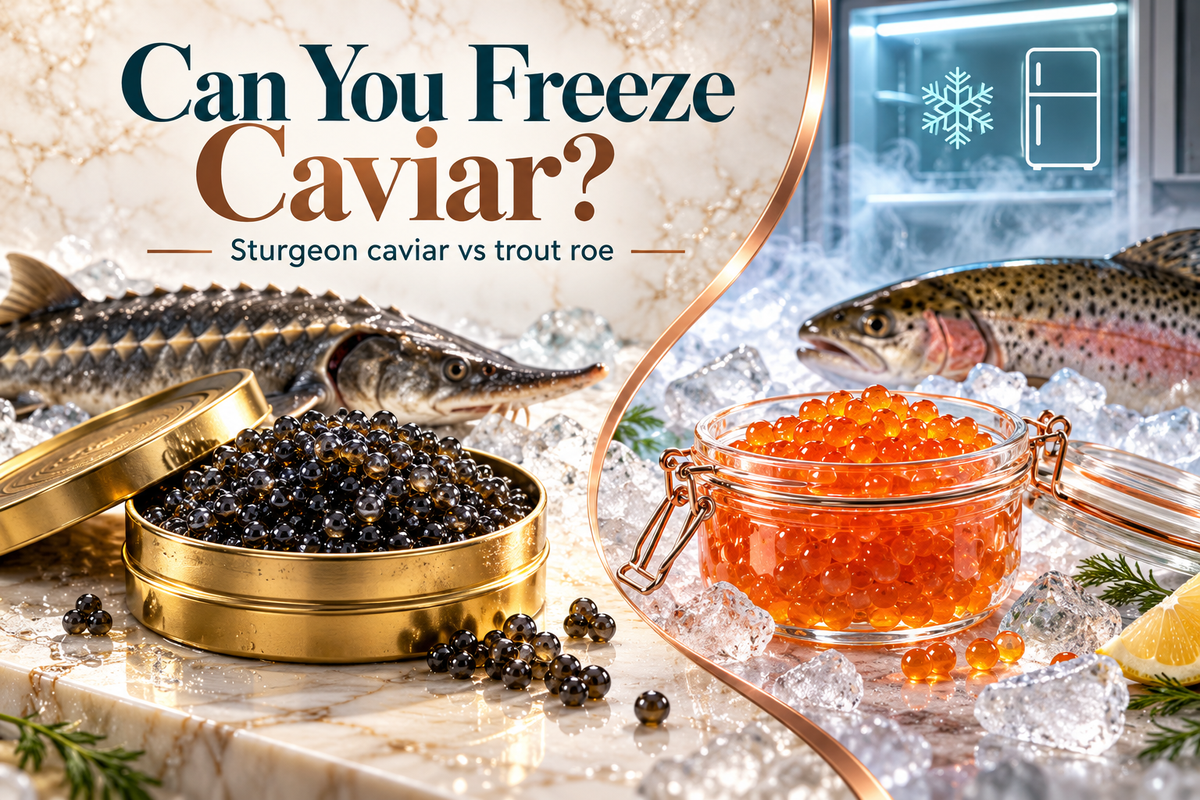
Can you freeze caviar? Usually, chilled sturgeon caviar should stay refrigerated because freezing can damage its delicate texture. Trout roe is different: some products are manufactured and labelled for frozen storage. Follow the exact pack instructions rather than treating every type of fish egg alike. Freezing does not make mishandled caviar safe, extend a use-by date automatically, or remove the need for controlled thawing. If the label is unclear, ask the producer before freezing.
| Product or situation | What to do | What matters most |
|---|---|---|
| Chilled sturgeon caviar | Refrigerate at the temperature on its label; avoid freezing unless expressly approved | Preserve pearl texture and follow its use-by date |
| Trout roe supplied frozen | Maintain the labelled frozen-storage conditions | Use the producer’s thawing and after-thaw instructions |
| Chilled trout roe | Freeze only if the producer permits it | Species alone does not establish freezer suitability |
| Pasteurized caviar or roe | Follow the specific label | Pasteurization does not automatically mean shelf-stable or freezer-safe |
| Opened caviar | Cover, refrigerate and follow the opened-life instructions | Opening does not create a reason to freeze leftovers |
| Accidentally frozen chilled caviar | Record what happened and obtain product-specific advice | A quality change and a safety failure are different questions |
| Warm delivery or unknown temperature history | Do not taste to check; contact the supplier and withhold use | Freezing cannot repair a broken cold chain |
Can You Freeze Caviar? Start with the Product Label
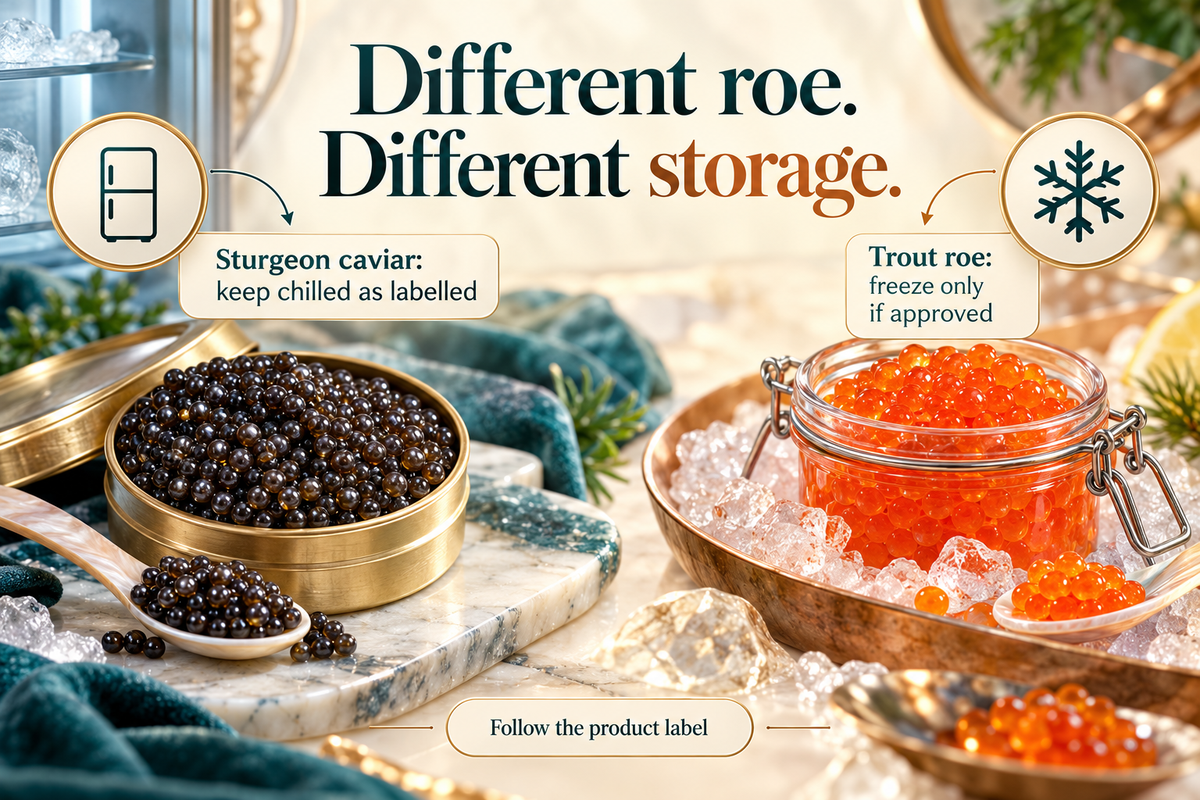
A freezer can turn caviar solid, but that does not tell you whether freezing is suitable for the product. The useful question is whether its producer has specified frozen storage for that formulation, package and intended use. Chilled sturgeon caviar is normally selected for its distinct, intact pearls. Avoid introducing a storage step that the supplier has not approved.
Labels should identify whether a pack is chilled or frozen, how it must be stored, and when it must be used. Check for separate instructions after opening or thawing. Words such as “premium,” “fresh,” “malossol” and “pasteurized” cannot replace those instructions. A description of salt treatment or product quality is not a validated storage schedule.
This distinction also explains why online answers conflict. A retailer describing chilled sturgeon caviar and a processor describing commercially frozen trout roe are answering different questions. Neither instruction should be copied onto an unrelated tin. For a mixed order, retain the instructions for each product instead of putting the entire shipment into one storage category.
Sturgeon Caviar vs Trout Roe: Why the Freezing Advice Differs
Sturgeon caviar and trout roe are different products, even when both are marketed with the word caviar. Species matters, but processing and the producer’s storage specification determine the handling decision.
Chilled sturgeon caviar
Beluga, Osetra and other sturgeon caviars are often sold chilled for direct service. Freezing may soften the eggs and change their separation and mouthfeel. Keeping the tin unopened does not prevent freeze damage. Nor does a strong salt flavour prove the product will tolerate a home freezer.
For example, Petrossian’s caviar storage guidance advises against freezing its caviar because of the effect on texture. That is useful producer guidance, not proof that all roe products share the same storage rules.
Trout roe manufactured for frozen storage
Frozen trout roe is an established commercial product. Kalaneuvos’s trout roe specification includes frozen formats, storage below −18°C and a direction not to refreeze after thawing. Those instructions apply to its specified product, rather than to every jar of trout roe.
For buyers considering trout roe from Iran Fish, confirm the supplied format before arranging storage. Request the current specification for the exact item and batch. A frozen format and a chilled format should remain distinguishable on purchase and warehouse records.
Pasteurized roe
Pasteurization is a processing treatment. It does not, by itself, establish that a jar can sit on a shelf or tolerate freezing. The formulation, treatment, packaging and storage conditions work together. Read the full label rather than drawing a storage conclusion from one processing term.
| Comparison | Chilled sturgeon caviar | Trout roe labelled for frozen storage |
|---|---|---|
| Storage decision | Keep refrigerated as specified | Keep frozen as specified |
| Main quality concern | Loss of distinct, delicate pearls | Changes caused by thawing or temperature cycling |
| Home freezing | Usually unsuitable without approval | Follow instructions; do not assume a chilled version is equivalent |
| After thawing | Obtain advice if freezing was accidental | Apply the product’s after-thaw limit |
| Shelf-life evidence | Label and supplier documentation | Label, frozen-life specification and after-thaw instructions |
What Freezing Changes in Caviar
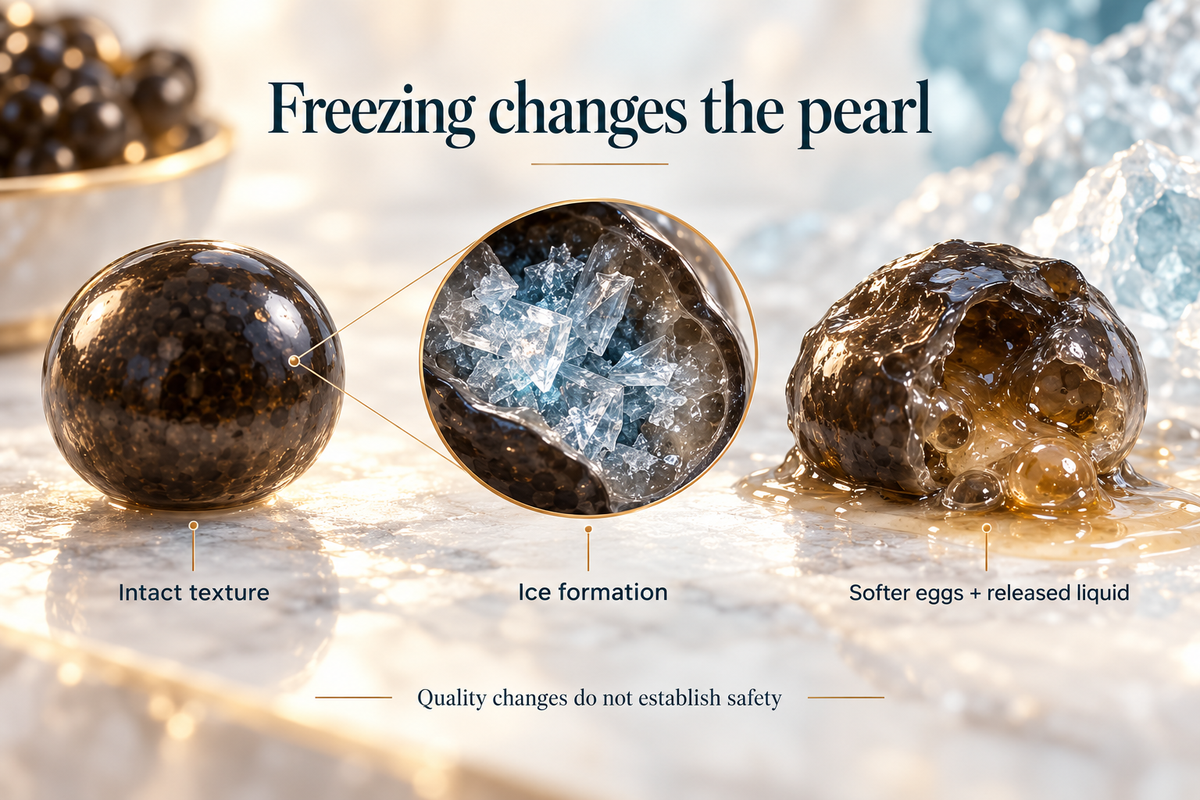
For caviar served as intact pearls, texture is part of the product’s purpose. A pack can remain cold yet arrive at the table with a different eating quality after freezing and thawing.
- Pearl firmness: ice formation can disrupt the structure of delicate eggs, leaving softer or broken grains after thawing.
- Liquid separation: damaged eggs may release liquid, making the contents look wetter and less evenly separated.
- Flavour perception: a change in texture and released liquid can alter how the flavour is experienced, even without an obvious off-odour.
- Appearance: crushed or collapsed pearls can make a carefully plated garnish look uneven.
- Repeated temperature changes: moving a pack between chilled and frozen conditions adds avoidable handling and makes its storage history harder to verify.
The severity of these changes is not identical for every product. Do not invent a percentage loss of flavour or a universal number of acceptable freeze-thaw cycles. Commercially frozen roe should be assessed against its agreed specification; chilled caviar should not be promised unchanged quality after unapproved freezing.
How to Store Unopened and Opened Caviar
Start with the temperature and shelf life stated for the exact pack. Then make sure the refrigerator, handling routine and serving arrangement can maintain those conditions.
Unopened packs
Leave unopened caviar in its original intact packaging. Choose a stable location in the refrigerator rather than a door compartment that is repeatedly exposed to warmer air. Use a thermometer to verify conditions; a dial setting alone does not establish the temperature around the tin.
Do not place the pack against a freezing surface simply because the surrounding refrigerator feels cold. Some specialist caviars have storage specifications close to or below the freezing point of plain water. That is not permission to choose your own subzero setting. Follow the actual product requirement.
Opened packs
Open caviar when it is needed, handle it with clean utensils and cover the remaining product as directed. Mark the opening time in a commercial kitchen. Keep serving utensils and anything that has contacted other food out of the stored pack.
There is no reliable universal opened-caviar shelf life. Beleaev’s storage guide distinguishes its quality recommendations from the use-by date and product instructions. Apply your own supplier’s limit rather than borrowing another brand’s number.
During service
Keep the tin chilled and serve small amounts as needed. A suitable ice presentation can help maintain cold conditions, but melting ice must not enter the product. Keep the food container protected and return usable stock to controlled storage promptly.
| Storage question | Practical answer |
|---|---|
| Is the fridge dial sufficient? | No; verify the temperature with a thermometer |
| Is the door shelf ideal? | Prefer a location with stable, verified conditions |
| Does an unopened seal prevent freeze damage? | No; the contents can still be affected |
| Can the printed date be extended by freezing? | Do not extend it without producer-approved instructions |
| Can opened stock be mixed with a new tin? | Keep batches and opening records separate |
How to Freeze Trout Roe When the Producer Allows It
Use this workflow only for a product whose instructions permit freezing. If the producer does not provide suitable directions, keep it under its existing specified conditions and ask for clarification.
- Confirm the product identity: identify the species, processing treatment and whether the roe has already been frozen.
- Check eligibility: verify the use-by date, package condition and temperature history before freezing.
- Follow the packing instruction: retain the original container if it is approved for frozen storage. Do not assume every glass jar or tin is freezer-compatible.
- Avoid unnecessary handling: do not rinse, stir, compress or repack the eggs unless the producer’s directions require it.
- Record the change: note the freezing date, batch identification and applicable instructions. Keep the original label readable.
- Maintain stable conditions: use the temperature specified by the producer and avoid repeated warming during stock access.
- Plan the thaw: select a pack size that can be used within the stated after-thaw period.
Commercially frozen trout roe is processed and distributed within a defined system. A home freezer does not automatically reproduce the same freezing rate, packaging performance or shelf life. Do not assign a newly frozen chilled jar the expiry period of a factory-frozen product.
How to Thaw Frozen Roe Without Unnecessary Damage
Plan thawing around the product instructions and when the pack will actually be used. Allow enough refrigerated time without turning that planning allowance into a universal thawing duration.
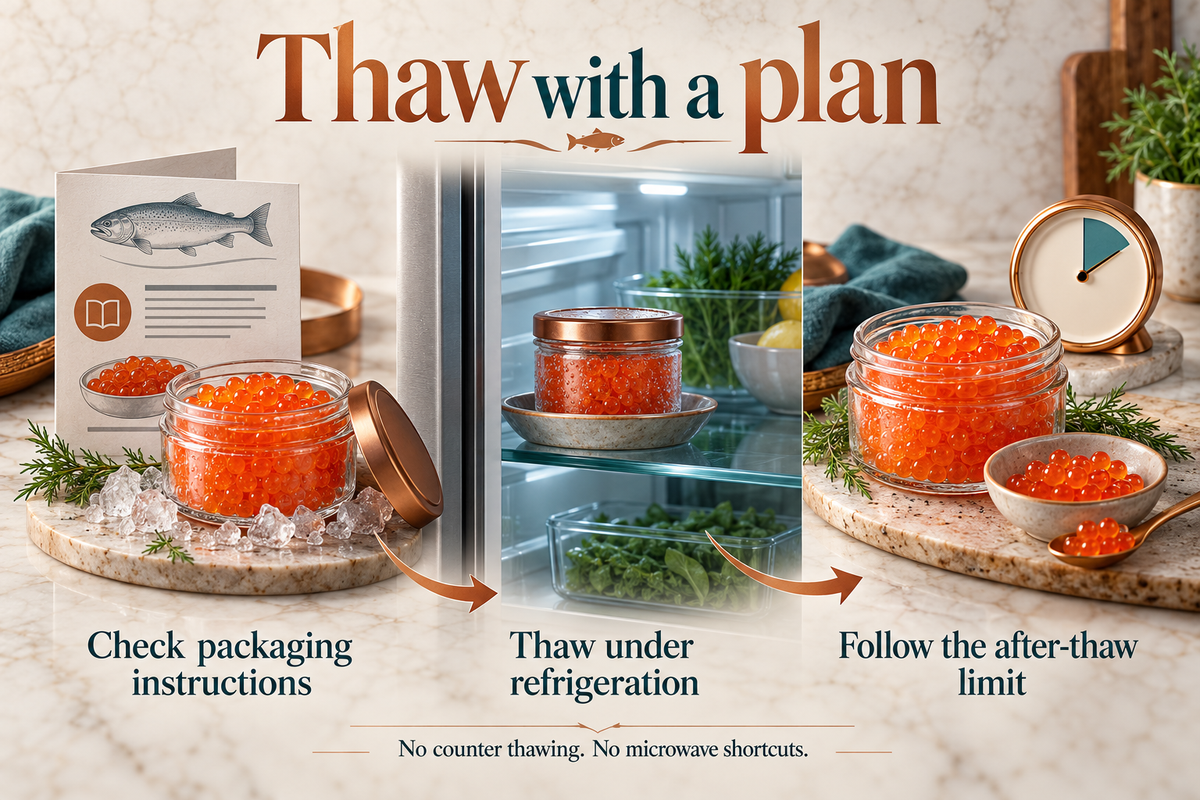
Read the packaging directions first
Check whether the product must remain in its container or be removed from particular packaging before thawing. Reduced-oxygen seafood packaging can require specific controls. The FDA’s guidance on reduced-oxygen fishery products describes different labelling approaches, including refrigerated thawing immediately before use or removal from packaging before thawing.
Do not apply a vacuum-packed fish-fillet instruction blindly to every salted roe jar. Equally, do not ignore an instruction to remove packaging. If it is missing or ambiguous, obtain the producer’s procedure before proceeding.
Thaw under refrigeration
Use refrigerated thawing when directed. Keep the roe protected from contamination and away from raw seafood drips. The general preference for gradual refrigerated thawing is consistent with the FDA’s seafood handling guidance.
Do not microwave serving roe or leave it on a kitchen counter to hurry the process. Neither is a sensible way to preserve delicate pearls. Avoid stirring the eggs to break up a frozen centre.
Handle thawed roe as a time-limited product
Record when thawing began and when the product became ready for use, according to the supplier’s procedure. Apply any after-thaw and after-opening limits together with the printed expiry date. Where more than one limit applies, use the earliest applicable deadline.
Keep the label with the pack until it has been used. A date copied onto a plain container without the batch identity and storage instructions is incomplete information.
What to Do If Caviar Freezes Accidentally
First, identify what actually happened. Was chilled caviar placed in a freezer, was it touching an excessively cold refrigerator surface, or was the product supplied frozen intentionally? Record the pack condition, the approximate timing and any known temperatures. Do not treat the presence of ice as a complete safety assessment.
If the product was intended to remain chilled, contact the supplier for handling and quality advice. Keep it segregated under the appropriate controlled conditions while awaiting a decision. A commercial buyer should record the deviation rather than relabel the stock as fresh or silently move it into normal service.
A continuously cold, accidentally frozen pack presents a different question from a pack that became warm and was frozen afterward. The former may primarily raise a quality issue; the latter also involves its prior time-temperature exposure. Do not use freezing, cooking or a normal smell as a substitute for resolving that history. Discard product when safe handling cannot be established.

Freezing, Refreezing and Food Safety
Storage decisions need separate answers for microbial safety and eating quality. Freezer suitability is not a guarantee that the product was handled safely before it entered the freezer.
Freezing is not a safety reset
The USDA’s freezing and food-safety guidance explains that freezing does not reliably destroy all microorganisms. A colder temperature cannot erase previous temperature abuse or establish a new use-by date.
For ready-to-eat roe, preserve the intended cold chain throughout storage and service. A thawing method used for seafood that will be cooked immediately should not be transferred automatically to caviar eaten directly from the tin.
Refreezing requires more than a general rule
General food guidance may allow refreezing in some controlled circumstances, but a roe producer can prohibit it for the specific product. Follow that restriction. Repeated freezing can also make quality and traceability decisions more difficult.
For food-service use, avoid improvising a freeze-thaw-refreeze routine. Use suitable pack sizes and a documented release procedure instead. If a frozen delivery arrives partly thawed, retain the temperature evidence and seek a product-specific decision.
Reject unsafe or uncertain stock
Bulging, leaking or damaged packaging needs investigation. Unusual odour or visible spoilage is a reason to reject the product, but normal appearance is not proof of safety. The USDA’s refrigeration guidance notes that illness-causing bacteria may not change a food’s taste, smell or appearance.
Do not taste suspect caviar. Separate it from usable stock and follow the supplier’s complaint or disposal procedure.
A Storage Checklist for Importers and Food-Service Buyers
A product specification should support the decision before the shipment arrives. Ask for a clear handling document rather than relying on a general statement that the goods are shipped cold.
- Match the species and product description across the order, label and specification.
- Identify chilled, frozen or previously frozen status explicitly.
- Confirm processing treatment and any relevant packaging controls.
- Obtain storage, thawing, after-opening and after-thaw instructions.
- Check remaining shelf life against the planned distribution and service period.
- Assign responsibility for receiving checks and temperature deviations.
- Retain batch records so stock can be traced or withdrawn when necessary.
| Information to request | Why it changes the decision |
|---|---|
| Exact product and batch | Connects the instructions to the goods received |
| Approved storage temperature | Determines the required storage equipment |
| Freezing history | Prevents an undocumented repeat cycle |
| Packaging and thawing directions | Identifies how to handle the product before use |
| Opened and thawed shelf life | Supports realistic service planning |
| Temperature-deviation procedure | Defines who can assess and release questionable stock |
When reviewing Iran Fish’s caviar range, ask for the specification attached to the selected item. Information for Beluga caviar should not automatically become the instruction for trout roe or another processed product.
Frequently Asked Questions
These questions address the decisions most likely to arise after purchase or delivery. The pack’s instructions remain the starting point for each answer.
Can you freeze unopened caviar?
An intact seal does not make chilled caviar suitable for freezing. Keep it refrigerated unless its producer explicitly approves frozen storage. The seal protects the pack’s closure, not the texture of the eggs against ice formation.
Can you freeze caviar after opening?
Do not make freezing the default solution for leftovers. Follow the opened-pack instructions and use suitable serving quantities. Freezing does not reverse contamination or extend the product’s life automatically.
Can you freeze trout roe in a glass jar?
Only when the producer permits freezing and the jar is suitable for it. Confirm whether the product has already been frozen and follow any directions about packaging, thawing and refreezing.
How long does frozen caviar last?
There is no single period for all caviar and fish roe. Use the producer’s frozen-storage limit for that exact product. For chilled caviar without an approved freezing procedure, do not invent a freezer shelf life.
Is watery caviar after thawing unsafe?
Released liquid can reflect damaged eggs, but it cannot establish safety on its own. Assess the packaging, label, temperature history and supplier instructions. Do not taste a questionable pack to decide whether it is safe.
Discuss Your Caviar Storage Specification with Iran Fish
Choose the product format around your receiving facilities and intended use. Chilled sturgeon caviar and frozen trout roe need different handling plans.
Review the available products and prepare your required species, packaging format, delivery destination and storage capability. Ask for the current storage and thawing specification before confirming an order.
Contact Iran Fish about your caviar requirements to discuss a product and handling specification suited to your distribution or food-service operation.