


Real vs Fake Caviar: Check Identity, Labels and Supplier Evidence

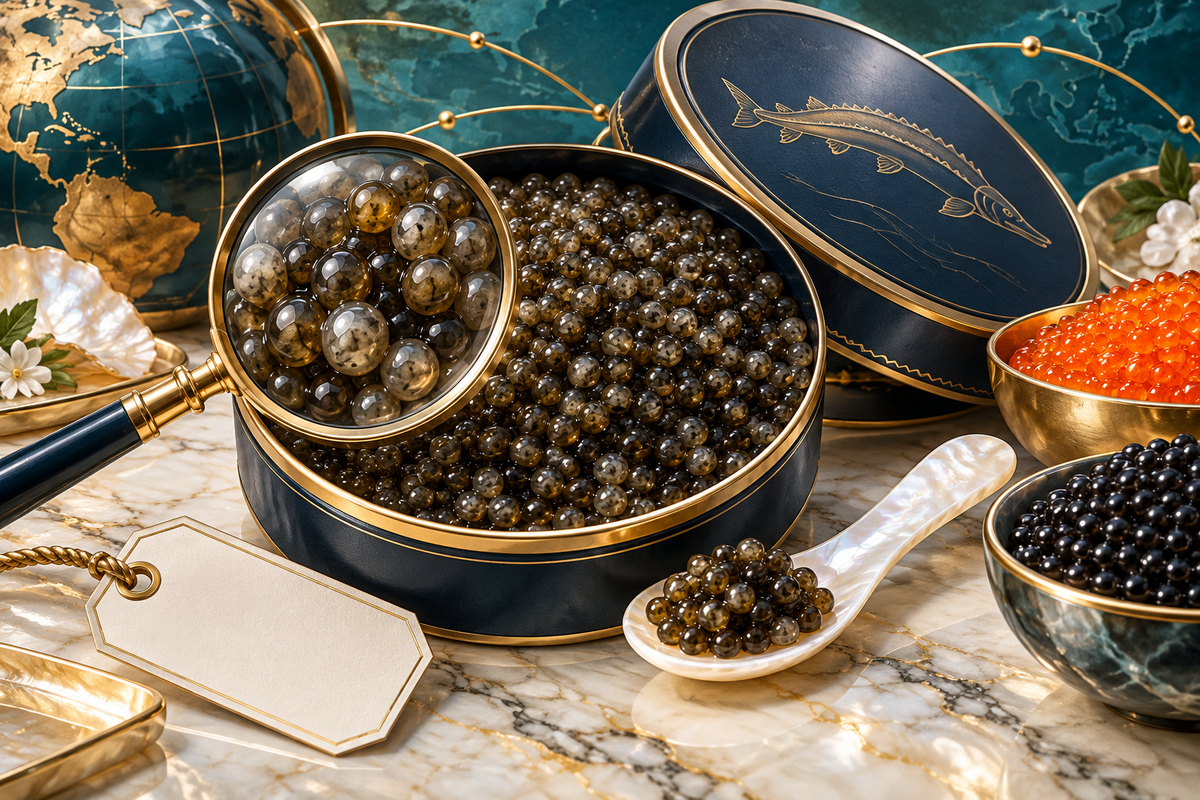
To assess real vs fake caviar, start with the declared species, ingredients and batch records, then inspect the packaging. Genuine sturgeon caviar is processed sturgeon roe; other fish roe and manufactured pearls are different products, but are not fraudulent when honestly described. Colour, taste and home tests cannot establish species or origin. For a buying decision, match the tin’s identity to its supplier documents and investigate discrepancies before accepting it.
| Buyer’s question | Practical answer |
|---|---|
| What is genuine sturgeon caviar? | Processed roe from an identified sturgeon species or declared sturgeon hybrid. |
| Is trout or salmon roe automatically fake? | No. It is another fish-roe product; the problem arises when it is passed off as sturgeon caviar. |
| Can colour prove authenticity? | No. Natural colour varies, and substitutes can resemble sturgeon roe. |
| What should the label establish? | Product identity, ingredients, responsible operator and applicable traceability information. |
| Does a CITES label settle everything? | No. Its information needs to agree with the batch records; it is not a laboratory result or a freshness guarantee. |
| What should a business buyer do? | Check the species, lot, origin, processor and shipment records together, then hold any unresolved product. |
| What if the identity remains disputed? | Preserve evidence and obtain an appropriately scoped laboratory assessment when necessary. |
Real vs Fake Caviar: What Are You Actually Comparing?
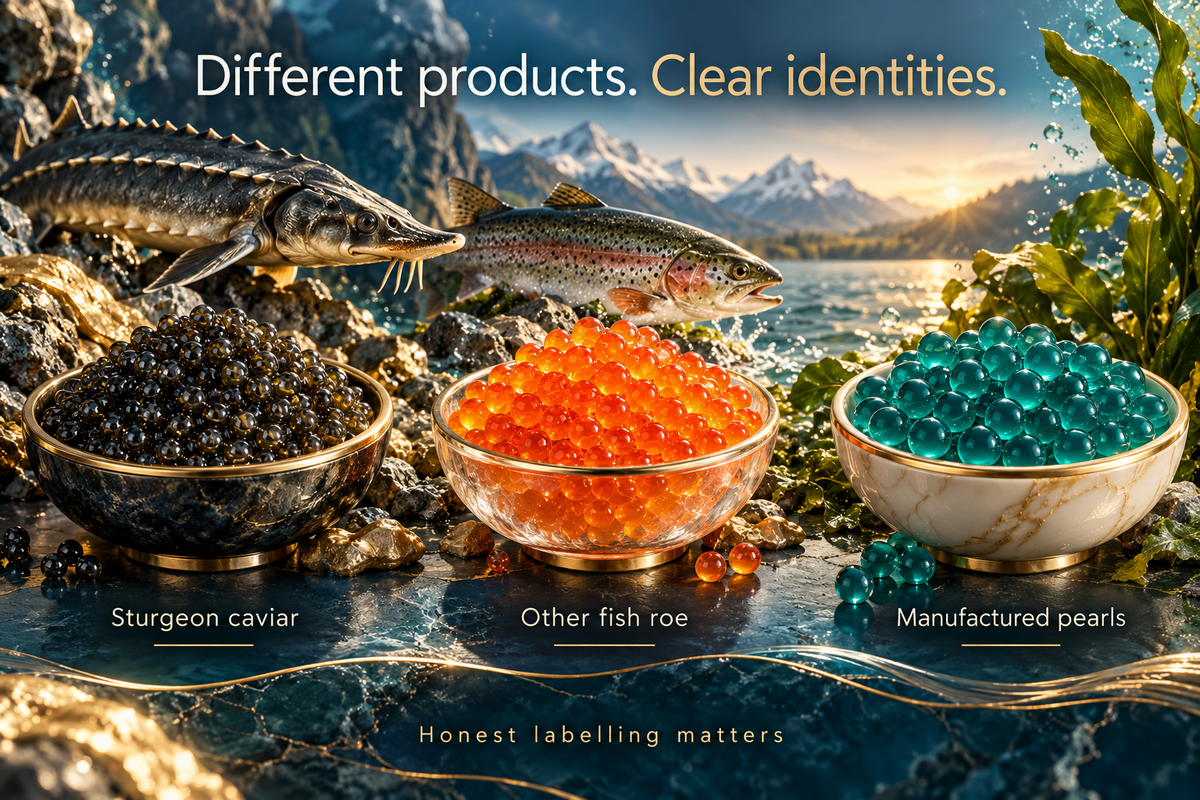
“Fake caviar” can describe several different problems. Separating them helps you ask the supplier the right question rather than rejecting a correctly labelled alternative.
Genuine sturgeon caviar
The Codex standard for sturgeon caviar addresses granular caviar made from fish in the Acipenseridae family. A commercial description should identify what is in the container, rather than relying on a luxury name or a photograph. Farmed sturgeon roe can be genuine caviar; wild origin is not a requirement for authenticity.
Other fish roe
Salmon, trout and lumpfish produce real fish eggs. These products have their own culinary uses and should be described by their actual identity. A package of clearly labelled trout roe is different from a package that falsely claims to contain Beluga sturgeon roe. You can review Iran Fish’s trout roe product information separately from its sturgeon offering.
Manufactured substitutes
Some caviar-style pearls are formed from gels, algae-derived ingredients or other food materials. Depending on their formulation, they may contain fish ingredients or may be plant-based. Read the ingredients and allergen declaration instead of assuming that every artificial pearl is vegan or fish-free.
Mislabelled genuine caviar
A product can contain genuine sturgeon eggs and still be misrepresented. Substitution of one species for another, an undeclared hybrid, an incorrect origin claim or an unsupported production description can all matter to the buyer. Establishing that eggs are biological does not establish that the sales description is accurate.

Read the Ingredients Before Judging the Pearls
Begin with the product name and ingredient declaration together. If the order specifies sturgeon caviar, the description should support that identity. Gel-forming ingredients in a product presented as intact sturgeon roe need an explanation. For a declared manufactured substitute, those ingredients may simply describe how the product is made.
Do not turn a short ingredient list into an authenticity certificate. A statement such as “sturgeon roe and salt” is still a statement that must agree with traceability records. Equally, the presence of a declared preservative does not, by itself, prove that the eggs are artificial. Additive permissions and labelling requirements depend on the destination market and formulation.
Ask for the specification matching the actual product, including its ingredients, allergen information and processing description. A generic catalogue page may cover several recipes or packing formats. Keep the approved specification with the purchase order so a later change in formulation does not pass unnoticed under an unchanged brand name.
Check the Species, Hybrid and Origin Claims
A familiar commercial name is a starting point, not a complete identity. Ask the supplier to connect it to a scientific name and the batch being supplied.
Beluga and Kaluga need distinct descriptions
Beluga is associated with Huso huso; Kaluga is Huso dauricus. A marketing description that compares their eating qualities does not make them the same species. If a quotation says “Beluga-style,” ask what fish actually produced the eggs before treating it as a Beluga specification.
Hybrids should be disclosed
Hybrid sturgeon can produce genuine caviar. The issue is whether the hybrid identity is accurately declared and consistent across the specification and traceability records. A buyer seeking a named species should not have to infer hybrid parentage from a product nickname.
Origin is different from packing location
A tin may be packed or repacked in a country different from the origin of the roe. The brand’s headquarters, distributor’s address and dispatch warehouse are also separate facts. Ask which location a claim such as “Iranian,” “Persian” or “Caspian” describes and which record supports it.
Farming does not prove every wider claim
“Farmed” answers a sourcing question, not every question about environmental practices, welfare or product quality. Where those attributes are part of your purchasing requirements, request evidence specific to them. Do not use a genuine species name as a substitute for evaluating the other promises in the offer.

Understand the CITES Label and Its Limits
CITES traceability is relevant to sturgeon and paddlefish caviar trade. The U.S. caviar trade rule describes non-reusable labels and distinguishes original packing from repackaging.
- Inspect the primary container, which directly holds the caviar, rather than checking only the outer carton.
- Look for the applicable coded identity and readable lot information.
- Ask the supplier to explain any difference between the processing and repackaging records.
- Match the label to the relevant shipment paperwork instead of accepting an unrelated certificate.
- Treat a missing, altered or inconsistent label as a reason to stop and investigate.
| Label field | What to check |
|---|---|
| Species | Whether the code agrees with the scientific identity, including any hybrid declaration. |
| Source | Whether the recorded source agrees with the supplier’s sourcing description. |
| Country of origin | Whether it matches the origin claim rather than merely the dispatch address. |
| Year | Whether the record concerns harvest or repackaging, as applicable. |
| Plant | Whether the processor or repacker can be identified. |
| Lot or permitted traceability reference | Whether it connects the container to the supporting records. |
A label’s appearance alone is insufficient. An impressive seal can be copied, and a genuine label can be attached to a product whose surrounding paperwork needs checking. The label also does not confirm the tin’s current temperature, remaining shelf life or eating quality.
What Appearance, Texture and Taste Can Tell You
A visual inspection can identify a mismatch worth investigating. Sturgeon caviar has a range of natural shades, so “real caviar must be jet black” is an unreliable rule. Look at whether the contents broadly fit the approved product description, while allowing for the natural variation that the supplier has specified. A product photograph is an illustration of an offering, not evidence of the contents of every subsequent tin.
Texture and flavour can contribute to a quality assessment, but they are not species tests. Firmness, free liquid and the condition of the eggs can also reflect processing, handling and storage. Do not treat a soft batch as automatically counterfeit or assume that a convincing mouthfeel proves an origin claim. Sensory comparisons are most useful when made against an agreed reference product under comparable conditions.
Keep freshness and authenticity separate. A genuine product can be mishandled, while a substitute can be accurately labelled and properly handled. If packaging is damaged or the product’s safety is in doubt, do not taste it to decide whether it is real. Record the problem and use the supplier’s complaint process before considering any further examination.
Why Home Tests Cannot Authenticate a Tin
Online advice often suggests hot water, pressure, freezing or household chemicals. These demonstrations may show how a sample reacts, but they do not establish its species, geographical origin or legal sourcing. Different recipes and processing methods can produce different reactions.
A dye bleeding into water may justify a question about ingredients. Lack of bleeding does not prove that the sample is sturgeon roe. Likewise, an egg that bursts or holds its shape cannot establish the fish species. Do not consume samples that have been exposed to test chemicals, and avoid damaging the evidence needed for a formal complaint.
For a material dispute, ask a competent food-testing laboratory what method can answer the actual question. Species identification, ingredient investigation and geographical-origin assessment require different approaches. Agree on sampling, sample preservation and the limits of interpretation before submitting the product; a test should address the disputed claim rather than produce an impressive but irrelevant report.
Match the Supplier Evidence to the Batch
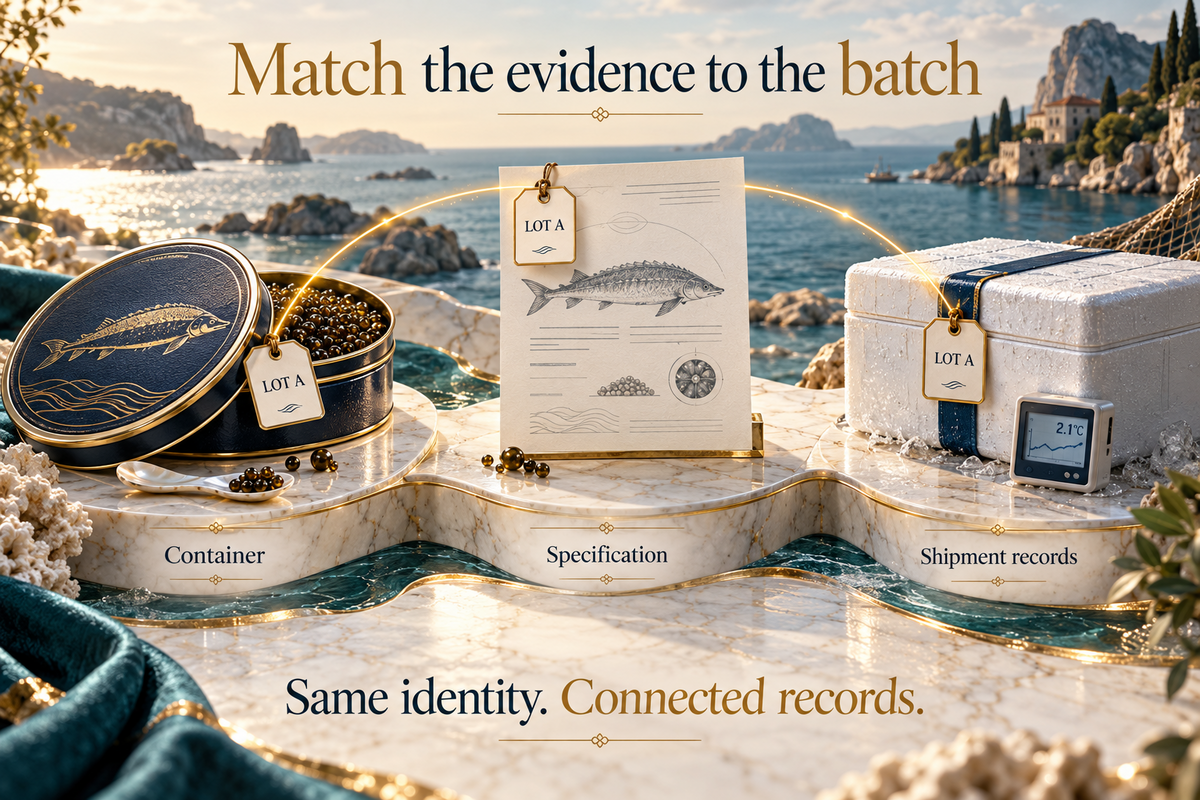
The useful question is whether the evidence describes the consignment you are receiving. A supplier’s general credentials are background information, while the purchase needs a traceable connection to the goods.
- Put the commercial name and scientific identity into the purchase specification.
- Request clear images of the actual container labels when reviewing a new supply.
- Record the lot references, pack format and quantities on the receiving documents.
- Ask for the processing description, declared ingredients and storage instructions for that product.
- Reconcile applicable trade and origin documents with the consignment details.
- Identify the operator responsible for original packing and any subsequent repacking.
- Agree in advance how substitutions, specification changes and discrepancies will be reported.
- Keep communications and approvals with the order record.
Do not assume that one document answers every question. A food-safety management certificate, an origin document and a wildlife-trade permit serve different purposes. Verify the scope of each rather than accepting a stack of paperwork as interchangeable proof. Confirm destination-specific import conditions before arranging a shipment.
For private-label supply, ask how your finished tins remain connected to the incoming batch. The brand on the lid may be yours, but the traceability chain still needs to identify the product underneath it. Iran Fish’s caviar supply page is a starting point for discussing the required specification and documentation.
What to Do When the Product Does Not Match
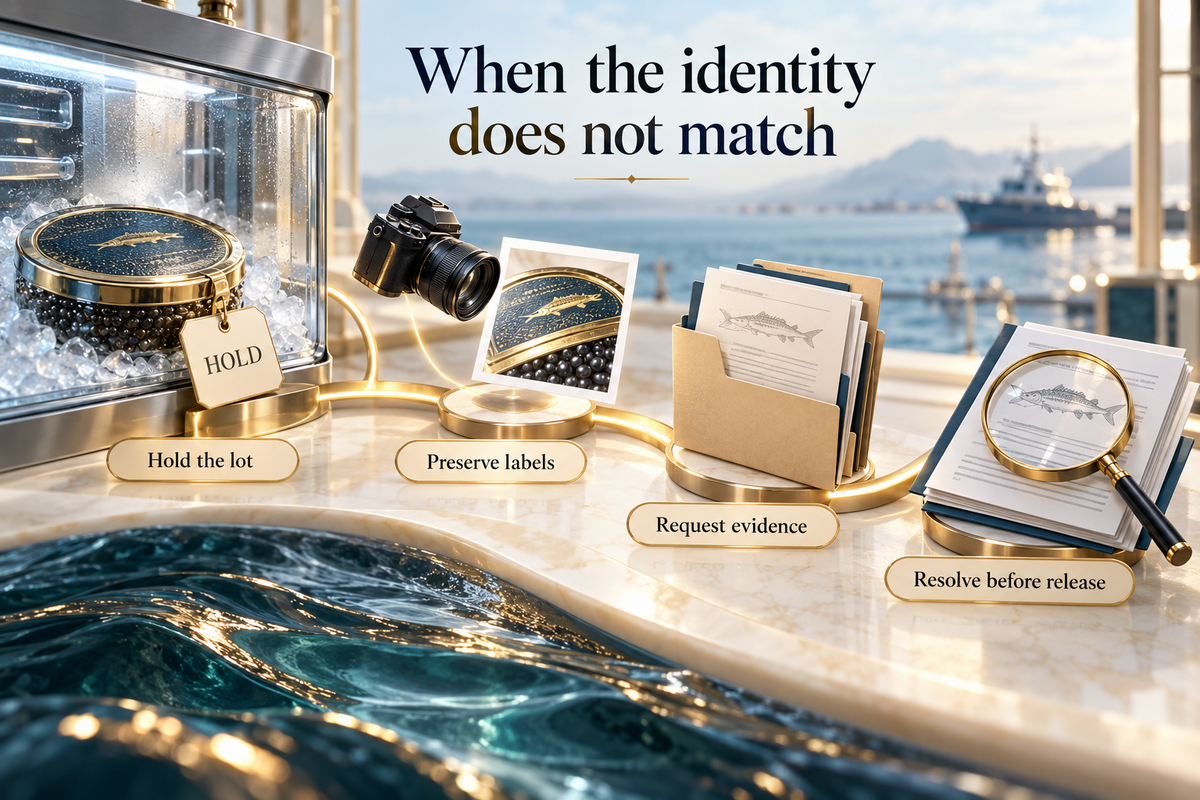
An unexplained discrepancy should trigger a controlled review. Keeping the original evidence makes that review easier for the supplier, laboratory or relevant authority.
- Segregate the affected lot and maintain its specified storage conditions.
- Photograph the unopened container, label, seal and shipping identifiers.
- Preserve the purchase specification and the documents received with the goods.
- Describe the precise mismatch, such as an undeclared hybrid or conflicting lot reference.
- Request a written explanation tied to that lot.
- Agree a sampling procedure before opening additional containers for testing.
- Release, return or otherwise resolve the stock only after the issue has been assessed through the appropriate process.
Avoid accusing a supplier solely because a tin looks different from an online image. Equally, do not accept a verbal reassurance where the declared identity remains inconsistent. The objective is a documented decision about the product, not a visual guessing contest.
Frequently Asked Questions
These questions address common points of confusion when choosing or receiving caviar. For a specific consignment, use its own specification and records.
Is farmed caviar real caviar?
Yes, roe from farmed sturgeon can be genuine sturgeon caviar. Farming describes how the fish was raised. It does not remove the need to identify the species, declare the product accurately and maintain traceability.
Is salmon or trout roe fake caviar?
Not when honestly sold as salmon or trout roe under the applicable labelling rules. It becomes an identity problem if the seller represents it as sturgeon caviar. Check the product description rather than judging by the word “roe” alone.
Can you identify real caviar from its colour?
No. Colour can help flag an unexpected product, but natural variation and manufactured imitations prevent it from proving identity. Compare the description, ingredients and records before drawing a conclusion.
Does a CITES label prove that caviar is fresh?
No. Traceability and trade information do not establish the current condition of a perishable food. Freshness and suitability also depend on the product’s processing, date marking, packaging and handling history.
Can DNA testing prove where caviar was produced?
Species identification and geographical origin are different questions. Ask the laboratory exactly what its method can establish, especially for hybrids or processed products. A species result alone does not demonstrate the country in which a fish was raised.
Request Batch-Specific Caviar Details From Iran Fish
Before confirming supply, define the species, processing format, packaging and destination requirements your business needs.
Review the Beluga caviar offering and ask which product and supporting records apply to your proposed order.
Contact Iran Fish about your caviar requirements with your destination, intended use and traceability checklist so the discussion starts with a clear specification.