


Malossol Caviar Meaning: What Light Salting Tells Buyers

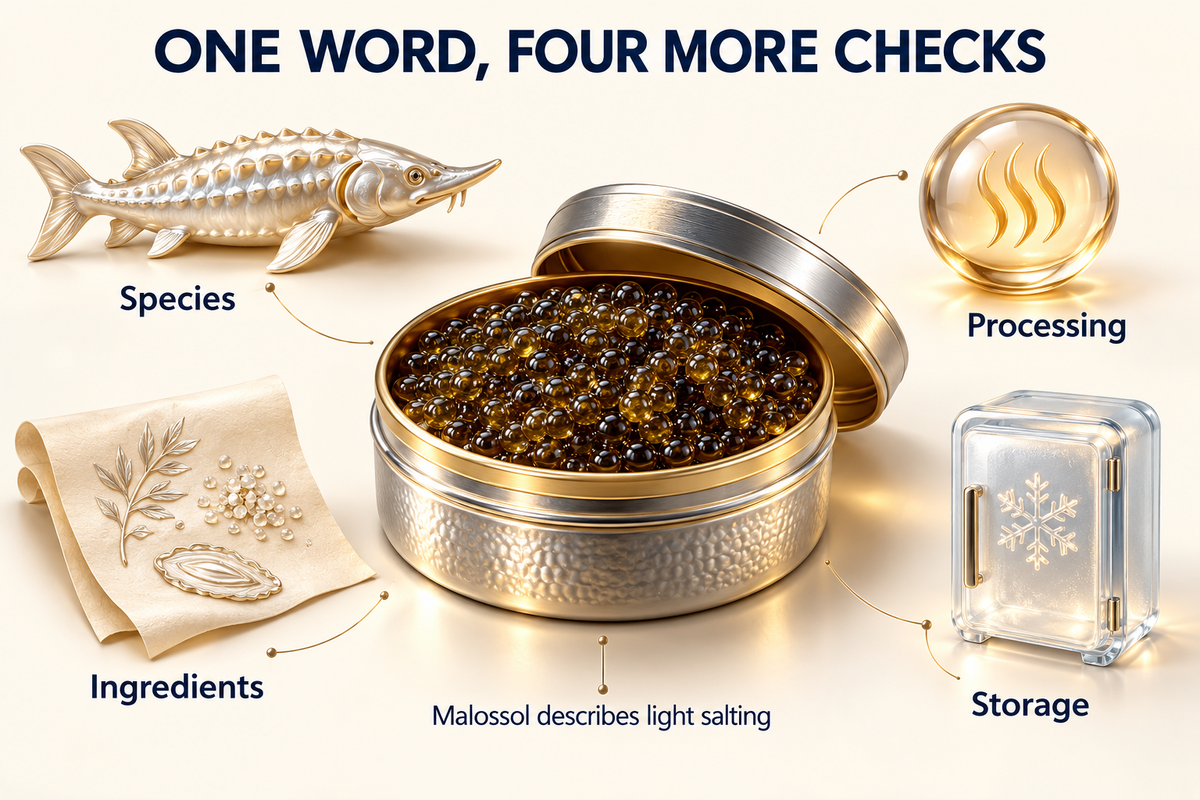
Malossol caviar meaning is straightforward: “malossol” means “little salt” in Russian and describes lightly salted caviar. It does not identify the sturgeon species, prove a quality grade or confirm that the roe is unpasteurized. For a buying decision, check the declared salt content, ingredients, processing status and storage instructions together. The word helps describe the product; the specification tells you what you are actually ordering.
| Buyer question | Practical answer |
|---|---|
| What does malossol mean? | Lightly salted; it describes the salting approach. |
| Is it a sturgeon species? | No. Species information must be stated separately. |
| Does it guarantee a particular salt percentage? | Do not assume an exact figure; request the supplier’s specification and measurement basis. |
| Must it be unpasteurized? | No. Light salting and pasteurization are separate attributes. |
| Does it mean preservative-free? | No. Read the complete ingredient declaration. |
| Can it be stored without refrigeration? | The word gives no such permission; follow the product’s storage label. |
| What should a wholesale buyer confirm? | Species, salt specification, processing status, lot identity, shelf life and cold-chain arrangements. |

Malossol Caviar Meaning: What the Word Actually Describes
The Russian roots refer to a small amount of salt. In caviar language, malossol signals a light cure intended to let the roe’s character remain noticeable. It is a description of how the product is prepared, not the name of a fish. A supplier can describe Beluga, Osetra or another sturgeon caviar as malossol while identifying the species separately.
That distinction matters when comparing listings. “Beluga” answers an identity question; “malossol” answers a salting question. Neither word, on its own, gives a complete account of ingredients, processing, packaging or handling. Treating one attractive term as a complete specification makes it easy to compare products that are materially different.
Commercial explanations also attach different salt figures to the term. For example, Caviar Foodie’s malossol explanation describes a ceiling and its preferred salting range, while Eichinger’s producer guide describes its own lightly salted style. Those descriptions help explain trade usage. They do not establish the exact formulation of a tin from another producer.
What Salt Does to Caviar Flavor, Texture and Preservation
Light salting is a production choice with sensory and handling consequences. The useful question is how the finished product performs, rather than whether the label uses a familiar word.
Flavor: keeping the roe’s character visible
Salt contributes seasoning, and its balance affects how the roe is experienced. In a lightly salted preparation, the buyer is usually looking for a clear caviar character rather than an overpowering salty finish. A tasting note should describe what is actually present, such as a marine impression, a rounded finish or an unwanted harsh edge.
Do not write the tasting result before opening the sample. Species, batch and preparation also matter, so a malossol label should not be taken as a promise that every product will taste buttery, nutty or identical to a previous delivery.
Texture: more than a single “pop”
Salt also influences the grain during curing. Buyers should assess separation, membrane feel, how the grains release their contents and whether the texture suits the intended service. A tin can be visually attractive while behaving differently on a spoon from the sample used to approve the order.
Record texture separately from salinity. “Firm grains” and “too salty for our menu” describe different observations and lead to different questions for the supplier.
Preservation: one part of the control system
Salting contributes to preservation, but the word malossol is not evidence that a food-safety control has been met. The relevant information is the actual formulation and the producer’s documented handling requirements.
As a buyer, avoid converting “lightly salted” into an assumption that the product can tolerate a broken cold chain. Any change in storage expectations should come from the producer’s specification, not from a tasting impression or a general description of caviar.
Does Malossol Have a Fixed Salt Percentage?
For procurement, the safest answer is to ask for the declared specification instead of supplying your own cut-off. The commercial sources above use different numerical descriptions, and the term alone does not tell you whether a figure refers to salt added during preparation or salt measured in the finished product. Even where a destination market imposes requirements, a marketing word cannot replace checking the applicable product rules.
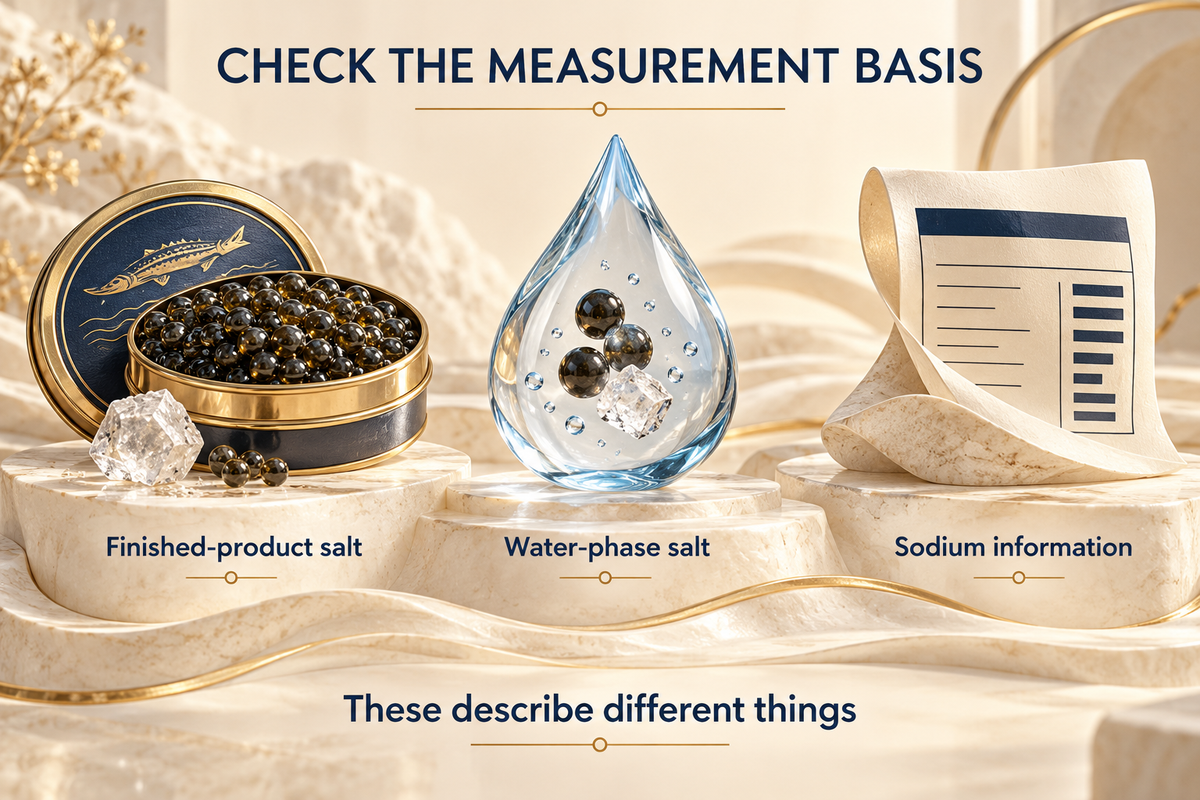
A further distinction is the measurement basis. Salt as a proportion of the whole product differs from water-phase salt, which concerns salt in the product’s aqueous portion. The FDA’s discussion of water-phase salt in fish products explains why moisture and salt measurements matter together. A buyer should not treat a finished-product salt value as an interchangeable process-control value.
Nutrition information answers another question. Sodium on a nutrition panel is not a declaration of the curing method, nor does “lightly salted” automatically establish a regulated low-sodium claim. If sodium information is important to the intended customer, request the appropriate nutrition declaration rather than translating malossol into a health claim.
| Information requested | What it describes | How buyers should use it |
|---|---|---|
| Finished-product salt content | Salt measured on the stated whole-product basis | Compare formulations only when the basis is consistent. |
| Water-phase salt | Salt concentration considered with the water portion | Have technical staff assess it within the relevant process controls. |
| Salt addition during preparation | The producer’s formulation or curing input | Do not assume it is the same as a finished-product test result. |
| Sodium declaration | Nutrition information on the stated serving or weight basis | Use it for nutrition questions, not species or processing identity. |
What Malossol Does Not Tell You About a Tin
A malossol label can be useful without answering every buying question. Keep these attributes separate when preparing an enquiry or checking a delivery.
- Species: obtain the declared identity instead of treating malossol as a variety of sturgeon.
- Origin: confirm the stated source and supporting records; the Russian word does not establish where the roe was produced.
- Grade: ask what the supplier’s grade means, including any agreed grain or sensory criteria.
- Ingredients: check the full declaration, including any permitted preservatives, rather than assuming the recipe contains only roe and salt.
- Processing: request an explicit pasteurized or unpasteurized declaration.
- Maturation: ask how the supplied product is described and compare an appropriate sample rather than inferring age from the label.
- Shelf life: obtain the date, storage conditions and opened-container instructions for the actual product.
- Traceability: verify the lot and the corresponding shipment documentation.
The practical result is a more useful specification: a named caviar, from an identified source, with an agreed formulation and processing status. The term malossol then becomes one clear part of that description.
Can Malossol Caviar Be Pasteurized?
Yes. The terms describe separate things: malossol concerns salting, while pasteurization concerns processing. Petrossian’s comparison of fresh malossol and pasteurized caviar explicitly notes that lightly salted caviar can also be pasteurized. It is therefore misleading to present the two terms as mutually exclusive categories.
For buyers, the distinction affects what needs to be confirmed. If your menu requires unpasteurized roe, write that requirement explicitly. If a different processing format is acceptable, ask the supplier to identify it and provide the corresponding storage and shelf-life information. Neither choice should be inferred from a glass jar, a metal tin or a premium-looking label.
Pasteurization should also not be confused with commercial sterilization. The FDA’s seafood pasteurization guidance distinguishes refrigerated or frozen pasteurized fishery products from shelf-stable products produced through retorting. For this article’s buying question, the important point is simple: malossol is not a storage category, and pasteurized is not automatic permission for ambient storage.
How to Read a Malossol Caviar Label and Specification
Start with the label, then request any missing information in the product specification. The aim is to make the sample, the order and the delivered batch refer to the same agreed product.
Identity and origin
Look for the caviar’s declared species and the producer or packing information. If the supplier uses a common trade name, ask for the associated species identity and any clarification needed for the destination market. A common name should help identify the product, rather than obscure what is in the container.
For traded sturgeon caviar, ask for the relevant traceability and trade documentation. The CITES glossary’s caviar-labelling references explain the connection between caviar identification and the Convention’s labelling framework. Applicable requirements depend on the transaction and destination; an attractive front label is not a substitute for checking the relevant records.
Ingredients and processing
Read the ingredient list alongside the process declaration. “Malossol” does not answer whether the producer uses a preservative, nor whether the packed product has undergone heat treatment. Ask about both attributes in plain language.
If the specification lists a salt figure, confirm its basis and whether it is a target, a permitted range or a measured result. This makes differences between samples easier to interpret and prevents an apparent discrepancy from being dismissed without explanation.
Lot-level storage information
Check that the lot identity and date information can be linked to the supplied containers. Obtain the declared storage conditions and instructions after opening, then confirm how much usable shelf life is expected to remain on arrival.
Where documentation is incomplete, ask for clarification before approving the lot. A general brochure may explain the product range, but it does not establish the history or remaining life of a specific shipment.
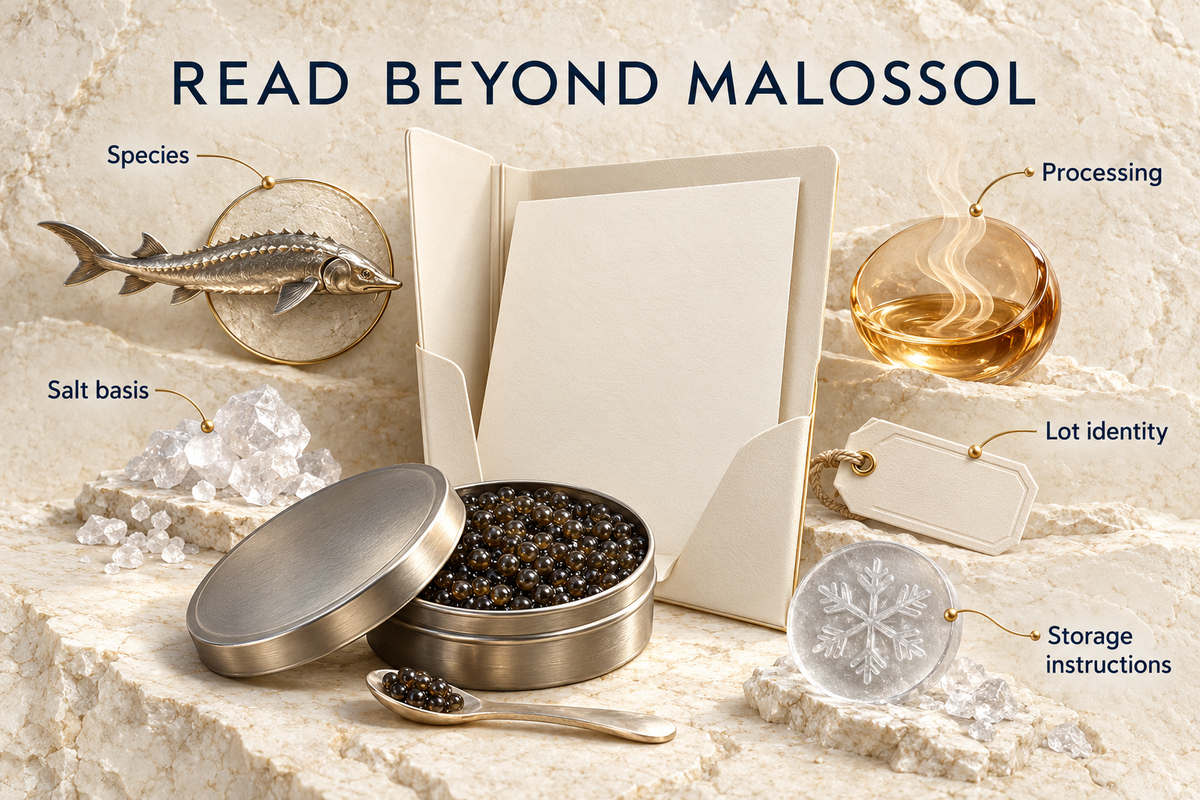
| Label or specification field | Buyer action |
|---|---|
| Species and product name | Match them to the enquiry, sample and order. |
| Ingredients and processing status | Check both; do not infer either from “malossol.” |
| Salt specification and basis | Compare like-for-like declarations. |
| Lot and producer information | Link the containers to the supplied records. |
| Storage and date instructions | Plan receipt, storage and use around the actual product. |
| Trade and origin documents | Confirm the requirements for the intended destination with the responsible parties. |
How to Compare Malossol Samples Fairly
A useful sample assessment separates the product’s identity from the tasting result. Decide what you are comparing before interpreting the differences.
- Match the species and declared grade wherever possible; otherwise record those differences as part of the assessment.
- Confirm the processing status and salt specification for each sample.
- Note the storage history and stage of the declared shelf life rather than comparing an undocumented sample with a recently packed one.
- Taste a small plain portion before adding accompaniments, following the product’s handling instructions.
- Describe aroma, perceived salinity, grain separation, membrane feel and finish independently.
- Check how the sample behaves in the intended dish or chilled service arrangement.
- Record the lot, assessment conditions and observations so another team member can understand the result.
- Keep sensory approval separate from documentary and food-safety acceptance.
For example, if one sample feels firmer, first check whether species, processing or grade differs. If a sample tastes saltier, check the declaration and testing basis before deciding that the malossol description is wrong. A structured comparison produces a clearer supplier conversation than “this one seems less premium.”
Storage and Serving: Why Light Salting Still Needs Care
The storage label takes priority over general advice about malossol caviar. Plan handling around the supplied format and its documented conditions.
Before opening
Keep the container under the stated storage conditions and protect its seal. For commercial deliveries, agree how the required cold chain will be maintained through transport, receipt and storage. If monitoring information is supplied, check it against the agreed acceptance criteria.
Do not treat chilled packaging alone as proof of the whole journey. An intact container and a satisfactory temperature check at arrival answer different questions from a complete transit record.
After opening
Follow the producer’s opened-container instructions, use clean utensils and record the opening time where required by your operation. Do not carry the original unopened expiry assumption over to an opened tin.
If storage history is uncertain or the container appears compromised, stop and seek the appropriate supplier or food-safety review. Tasting is not a way to establish that a doubtful product is safe.
During service
Serve in a way that protects both handling conditions and the intended sensory experience. Keep the working portion small enough for the planned service, and return unused stock to its specified storage arrangement without unnecessary exposure.
The FDA’s seafood handling advice supports keeping chilled seafood cold and preventing cross-contamination. For susceptible consumers, follow relevant public-health guidance; a light cure should not be described as equivalent to cooking.
Questions to Ask Before a Wholesale Malossol Order
An enquiry should explain what the caviar needs to do in your business. Give the supplier enough context to propose a suitable product and identify any point requiring confirmation.
- Which species, grade and processing formats are currently available for the destination?
- What salt specification is declared, and on what measurement basis?
- What does the complete ingredient declaration show?
- Can the supplied sample represent the formulation and grade proposed for the order?
- What storage conditions and opened-container instructions apply?
- What remaining shelf life is expected at delivery, and how will it be confirmed?
- What transport, receipt and temperature-monitoring arrangements can be agreed?
- Which origin, traceability and trade records will accompany the shipment?
- What should the receiving team do if a seal, label or monitoring record does not meet the agreed conditions?
For a product-specific discussion, use Iran Fish’s caviar supply information as the starting point. Confirm the actual format and documentation for your enquiry rather than assuming that every listed species is supplied under an identical salt or processing specification.
Frequently Asked Questions About Malossol Caviar
These questions address the distinctions most likely to affect a purchase. The answers should be checked against the specification of the product being supplied.
Is malossol a type of sturgeon?
No. It describes light salting. Beluga, Osetra and other species names identify the roe separately. A complete product description should state identity as well as salting and processing attributes.
Does malossol mean the caviar contains no preservatives?
No. Some producers use the term for products containing only roe and salt, but that is not a declaration covering every brand. Read the ingredient list and ask the supplier about any unclear ingredient or formulation statement.
Is malossol caviar always unpasteurized?
No. A lightly salted product can also undergo pasteurization. If unpasteurized caviar is required for a tasting or menu, make that a separate written requirement rather than relying on the malossol label.
Does malossol mean low sodium?
Not automatically. Light salting is a production description, whereas a nutrition claim must meet the relevant rules and be supported by appropriate information. Request the product’s sodium declaration if that matters to your customer or menu.
How long does malossol caviar last after opening?
There is no single period established by the word malossol. Follow the supplier’s opened-container instructions, storage conditions and applicable food-service controls. If those instructions are missing, obtain them before planning service or accepting a shipment.
Discuss Your Malossol Caviar Requirements With Iran Fish
Explore Iran Fish’s caviar supply options and identify the species, packaging and intended use relevant to your enquiry.
If your specification calls for Beluga, review the Beluga caviar product information and request confirmation of the available salt and processing format.
Contact Iran Fish with your destination, planned use and delivery requirements so the product specification and supporting documents can be discussed before an order is agreed.