


Caviar Grades Explained: How to Compare Quality Claims


Caviar grades explained simply: a grade describes a supplier’s selection of roe, commonly using grain size, appearance, texture and flavour. Names such as Royal or Imperial do not provide a dependable comparison across brands without their definitions. Compare the same species and processing format, request written specifications, and assess a representative sample. Traceability and cold-chain handling need separate checks, whatever the grade says.
| What you are comparing | What it tells you | What to check before choosing |
|---|---|---|
| Grade name | The supplier’s commercial selection | The written criteria behind that name |
| Species or hybrid | The fish identity | Scientific identification and supporting traceability |
| Grain size and uniformity | The physical selection | A stated size description and representative sample |
| Colour and gloss | Appearance of that selection | Species-appropriate variation under consistent lighting |
| Texture, aroma and flavour | The eating profile | A sample assessed under comparable conditions |
| Processing format | How the product was prepared | Ingredients, heat-treatment status and handling instructions |
| Delivery condition | Whether the shipment meets the agreement | Seal, lot details, dates and temperature records where specified |
Caviar Grades Explained: What a Grade Can Tell You
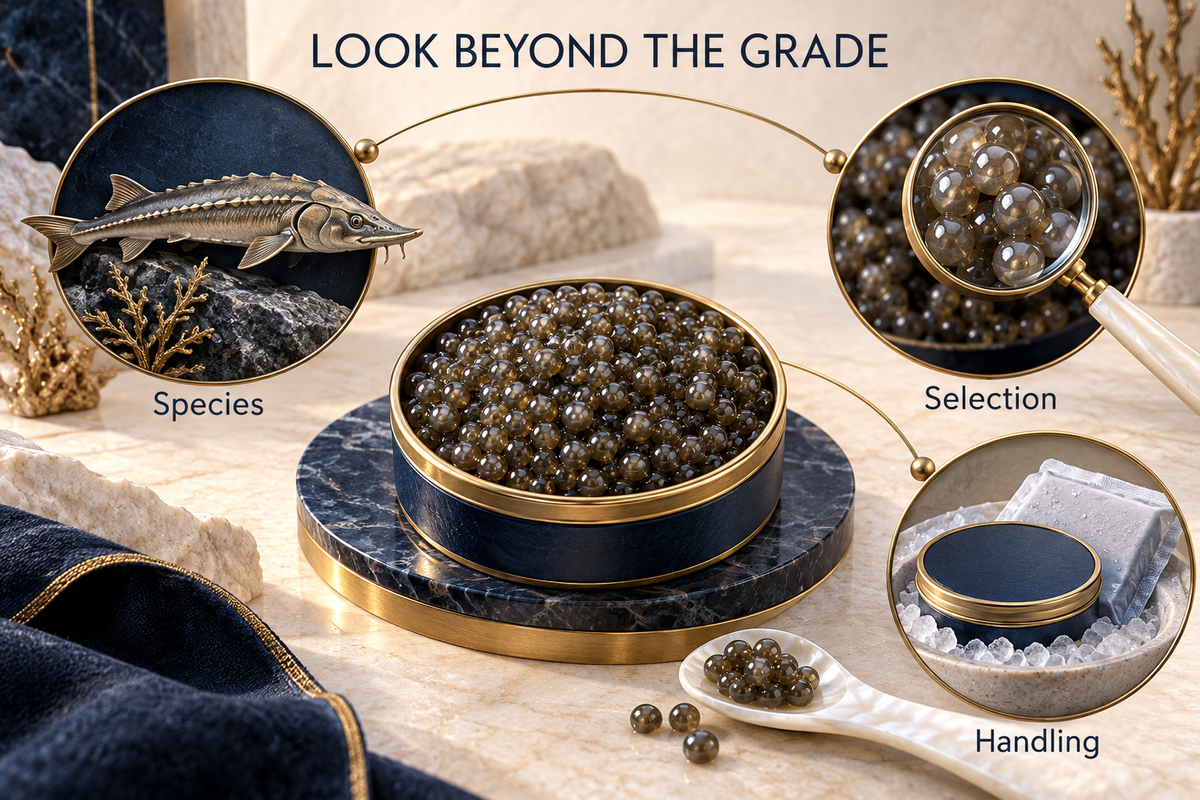
Grading is useful when it separates products according to defined characteristics. Within a supplier’s range, it may distinguish a selection with larger grains, a particular colour or a more consistent appearance. The practical question is what changes between the selections, not which name sounds most impressive.
Do not assume that Grade 1 from one producer is interchangeable with Grade 1 from another. Commercial labels need to be read alongside the producer’s own criteria, the species and the specific lot. A grade without those details leaves too much open to interpretation, particularly when an importer, retailer and restaurant must all describe the same product consistently.
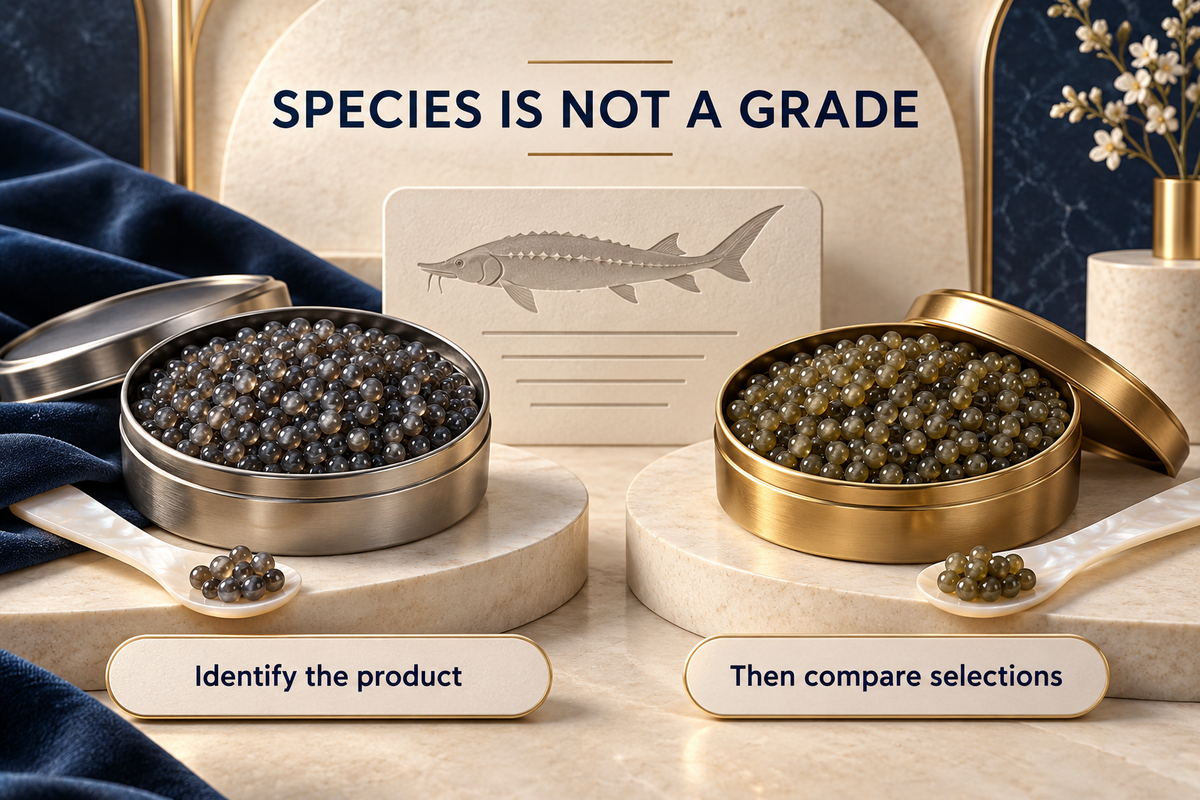
Start by identifying the product, then the selection within it. A species name answers which fish produced the roe; a grade describes how a supplier has sorted or positioned that roe. A processing description answers another question again. Keeping these categories separate makes comparisons clearer and prevents a commercial tier from being mistaken for proof of identity, freshness or legal sourcing.
Grade 1, Grade 2, Royal and Imperial: Translate the Names
These names are useful starting points for questions, not complete specifications. Ask the supplier to explain the difference within its own range before comparing another brand.
Grade 1 and Grade 2
Some suppliers use these terms for differences in grain integrity, uniformity, appearance or texture. The exact selection criteria must come from that supplier. Do not invent a universal bead diameter, colour or defect allowance for either grade.
A product described as Grade 2 is not automatically spoiled or unsuitable. It may have a different visual selection or a texture that serves a particular application. Food safety, identity and conformity to the agreed specification remain requirements for every selection.
Royal, Imperial, Supreme and Premium
Treat these as commercial tier names unless the supplier identifies a specific applicable scheme. Ask whether the distinction concerns size, colour, sensory profile, scarcity of the selection or another defined attribute. The same word can describe different products in different catalogues.
For example, “Imperial” alone does not tell you whether two tins contain the same species or hybrid. It also does not establish that the product has been pasteurized, harvested recently or held correctly throughout distribution.
Classic and house selections
An everyday or house selection can still be the right product for consistent service. Ask for the same clarity you would request for a named top tier. A modest label backed by a precise description is easier to assess than an elaborate name with no measurable distinction.
The Physical and Sensory Traits Worth Comparing
Assess several characteristics together rather than making one trait the entire definition of quality. Record what you observe before deciding whether you prefer it.
Grain size and uniformity
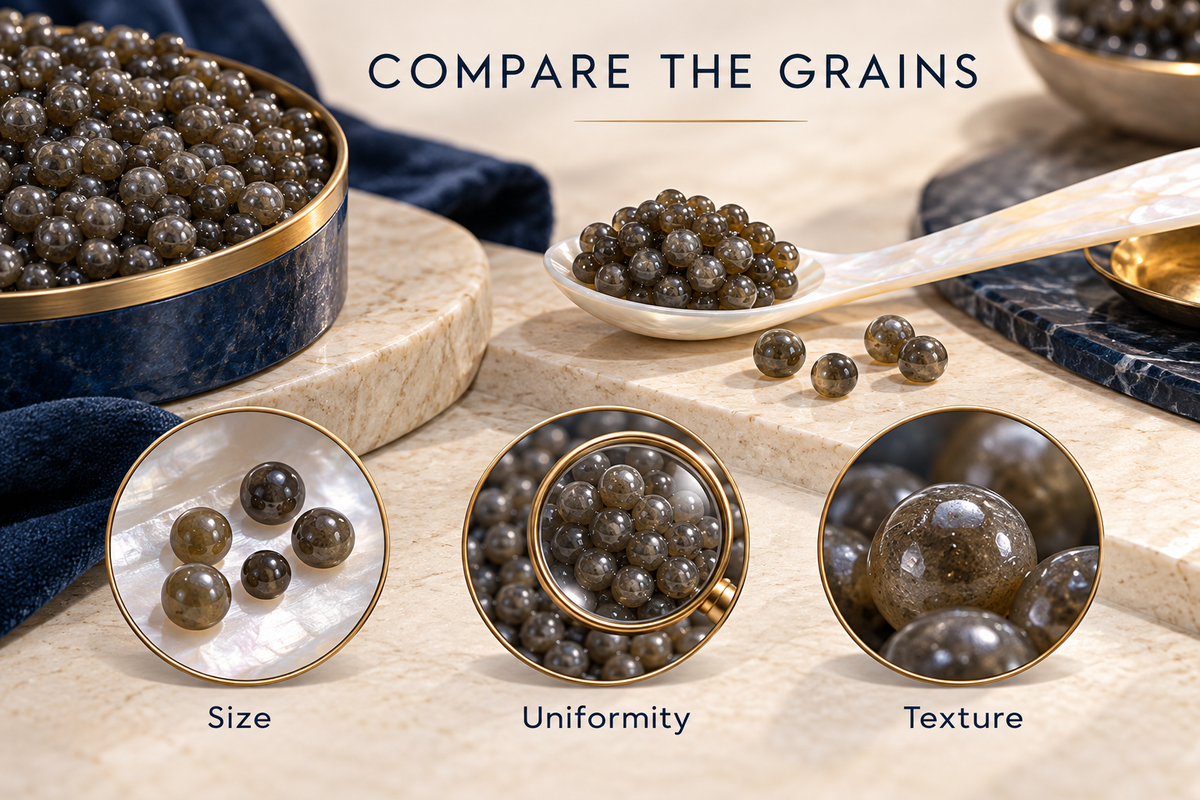
Grain size affects the visual impression and the experience of a serving. Compare size within an identified product rather than treating all sturgeon roe as one category. Ask whether the specification describes a minimum, a typical range or an average, and how the supplier assesses it.
Uniformity is a separate question. A tin can contain relatively large grains but an uneven mix of sizes. For neat garnishing, that distinction may matter more than a single impressive measurement. If a size requirement is important to the purchase, agree on its meaning before approving the sample.
Colour, gloss and shape
Observe the overall colour and the variation within the sample under consistent light. A golden appearance is not a universal guarantee of better flavour, and dark roe is not automatically a lower selection. Photographs can help describe appearance but should not be the only acceptance evidence.
Look at whether grains retain their expected form and how the surface catches the light. A supplier’s images may use lighting that makes colour or shine look different from the delivered tin. Request representative photographs and assess the actual product without assuming that gloss proves freshness.
Firmness, membrane feel and grain separation
The useful question is how the grains behave in the intended service. They may feel tender, yielding or relatively firm; an extremely resistant membrane is not automatically a benefit. Notice whether grains separate readily and retain their form during gentle portioning.
Record excessive breakage, clumping or free liquid when these differ from the agreed product description. Avoid aggressive stirring or pressing during assessment because the assessment itself can damage the sample. A handling problem should not become a mistaken conclusion about the original selection.
Aroma, flavour and salt balance
Describe aroma and flavour in plain language that your team understands. Notes might include mild marine character, a creamy impression, a nutty association or a more pronounced saline finish. These are observations to test in the sample, not flavours guaranteed by a grade name.
Saltiness should be judged alongside the overall profile and intended pairing. It does not reveal the measured salt content by itself. If the formulation matters to your specification, obtain the ingredient declaration and the supplier’s relevant analytical information rather than guessing a percentage from taste.
Maturity and the limits of a visual inspection
The UF/IFAS explanation of sturgeon caviar describes how egg development and membrane structure affect firmness, appearance and texture. Maturation matters, but a buyer cannot reliably determine a fish’s age or the ideal harvest stage from the colour of a finished tin.
Use the sample to assess the finished product and ask the producer about production controls where relevant. Do not translate an attractive appearance into an unsupported claim about age, husbandry or harvest timing.
Species and Product Format Are Separate Decisions
Compare the grade within a clearly identified product rather than ranking every caviar by one visual standard. Product names and preparation formats need their own checks.
Beluga, Ossetra, Sevruga and Baerii
These names refer to different sturgeon identities or commercial groupings, not consecutive quality levels. Request scientific identification, particularly where trade names have alternative spellings or broader commercial usage. A hybrid should be identified as a hybrid rather than assumed to be a pure species because of a familiar name.
If you are evaluating Beluga caviar for commercial supply, begin with the species identity and current lot description. Then compare the supplier’s selections within that product. Do not use the visual expectations of another species as an automatic pass-or-fail test.
Granular and pressed products
Granular caviar is assessed partly on the presentation of individual grains. Pressed caviar is a different format with a different texture and serving role. Comparing both solely by how freely the eggs separate misses the purpose of the pressed product.
State the required format before discussing a grade. The same principle applies when comparing traditional granular products with roe made using different harvest or processing methods: identify the product first, then assess the relevant characteristics.
Why Processing, Maturation and Handling Change the Result
A grade name cannot explain everything that happened before the tin reached you. Ingredients, salting, processing, maturation and storage can all influence the finished experience. Keep these details in the specification so that a change in process does not arrive disguised as an equivalent grade.
Malossol is a salting description rather than a species or a complete grade. It does not answer whether a product received heat treatment. The guide to malossol caviar meaning explains why the salting description needs to be read alongside the rest of the product information. Ask separately about pasteurization and the declared ingredients.
Storage and transport also need their own evidence. A selection approved at dispatch can arrive in a different condition if handling departs from the agreed instructions. Follow the product-specific storage and opened-pack directions; a generic recommendation for another caviar is not a substitute. Neither an impressive grade nor a pleasant aroma validates the cold chain or establishes microbiological safety.
How to Compare Supplier Samples Fairly
A useful comparison controls avoidable differences in presentation. The FAO-hosted guide to sensory assessment distinguishes objective descriptions from personal liking, a helpful principle when evaluating supplier samples.
- Identify each sample by species or hybrid, supplier, lot and processing format before interpreting differences.
- Confirm that every sample is suitable for assessment and has been handled according to its instructions. Do not taste a sample with unresolved safety or handling concerns.
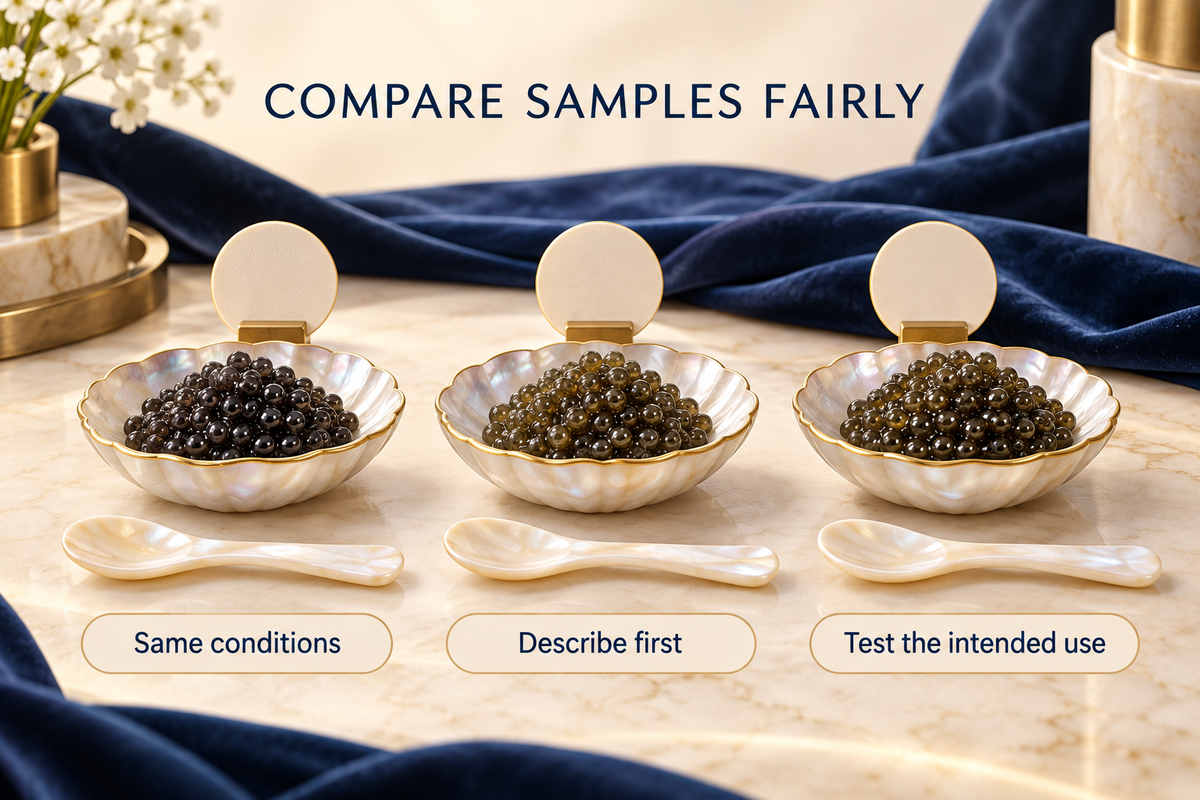
- Use comparable serving conditions, clean utensils and neutral surroundings. Strong accompaniments can make it harder to compare the roe itself.
- Describe grain appearance, separation, texture, aroma and flavour before writing a preference. “Firm membrane” is more useful than “better” if the team has not agreed what it needs.
- Consider a blind comparison to reduce the influence of packaging and tier names. Keep the identity record so observations can be traced back accurately.
- Try the preferred sample in the actual intended dish or presentation after assessing it on its own. A pleasing plain sample may behave differently in service.
- Ask whether the sample represents stock currently available for supply. Retain its lot details and the agreed written description for the purchasing record.
Do not turn a small informal tasting into a claimed scientific ranking. Its purpose is to identify a suitable product and a clear specification, not to prove that one species or country always produces superior caviar.
Turn a Grade Claim into a Product Specification
Written details make the commercial name useful throughout the supply chain. Agree on what the supplier will deliver and what evidence will accompany it.
- Identify the species or hybrid and the product’s declared origin.
- Record the supplier’s grade name together with its actual selection criteria.
- Describe the required grain appearance, size declaration, texture and sensory profile without pretending preferences are universal rules.
- Confirm ingredients, processing status, pack format and the handling instructions for sealed and opened containers.
- Request current label examples, lot information and relevant traceability documents.
- Agree on remaining shelf-life requirements at receipt, using the actual product’s dates and validated instructions.
- Establish how a changed lot, proposed substitution or non-conforming delivery will be reviewed before it enters service.
| Claim on an offer | Clarification to request | Useful acceptance evidence |
|---|---|---|
| Imperial selection | What distinguishes it from the supplier’s other tiers? | Written criteria and representative sample |
| Large grains | Is the description a minimum, range or average? | Agreed measurement description and sample |
| Golden appearance | What natural variation is expected? | Representative images and physical assessment |
| Firm texture | How does the membrane yield during service? | Comparable sample assessment |
| Consistent supply | How are lot changes communicated? | Lot records and an agreed substitution process |
| Traceable product | How are containers linked to documentation? | Matching label, lot and supporting records |
Keep food safety and legal documentation separate from the sensory description. A tasting preference cannot replace the evidence required for importing, handling or selling the product.
Match the Selection to Its Intended Use
Choose the product around the result your team needs to deliver. A tier that suits a visual showcase may not be the most appropriate selection for every service.
- Plain caviar service: assess the complete aroma, texture and finish because the roe carries the presentation.
- Fine garnishing: consider consistent grain appearance, gentle portioning and how the roe sits on the dish.
- Catering: check pack formats, portioning workflow and the instructions that fit the planned service.
- Retail: ensure that the customer-facing name matches the product description and available documentation.
- Repeat wholesale supply: prioritise an agreed specification, lot communication and a workable receiving procedure.
These are selection considerations, not a fixed hierarchy of grades. Test the intended use rather than relying on a label to predict every outcome.
Check the Delivery against the Approved Sample
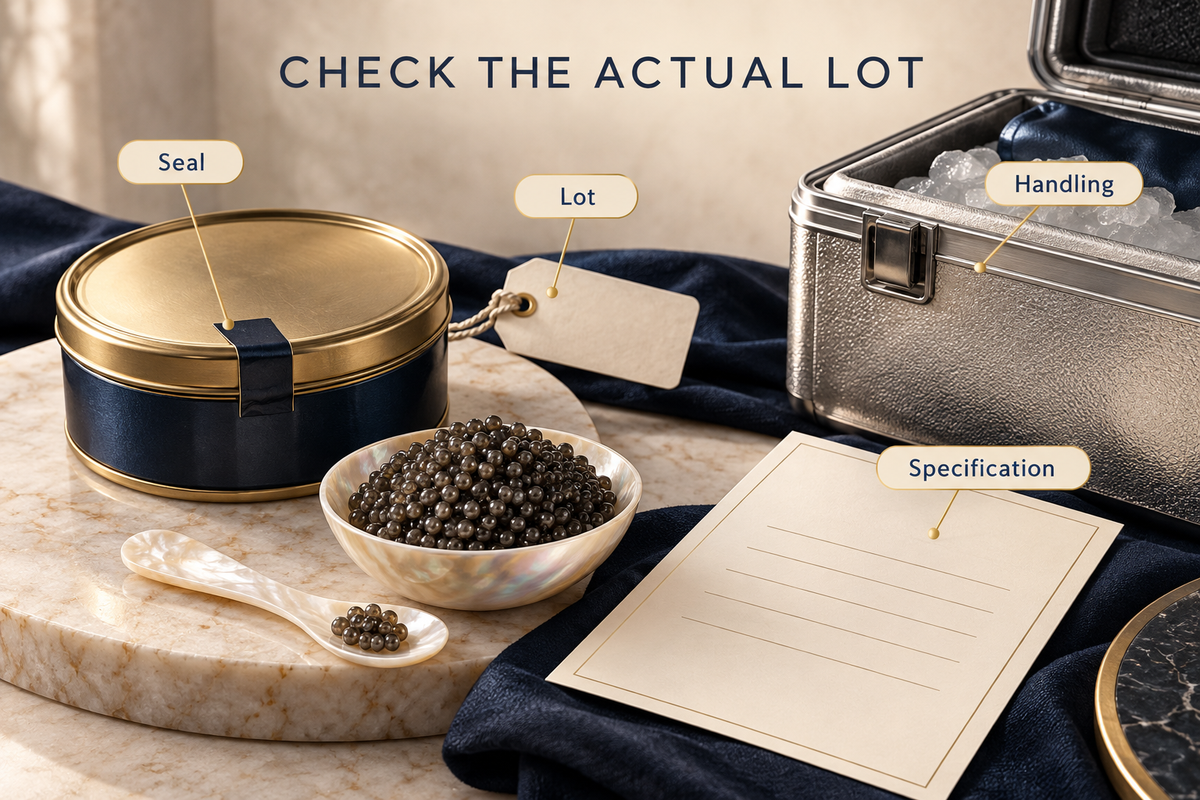
Begin with the unopened shipment. Check container condition, seals, label details, lot references and the required dates. Review temperature information when it forms part of the delivery agreement, and transfer accepted stock into the specified storage promptly. Keep the connection between the shipment and its records intact.
Assess a representative container under your receiving procedure and compare it with the agreed description. Investigate unexpected differences rather than immediately relabelling them as normal grade variation. Retained sample notes are most helpful when they describe actual traits rather than a vague impression such as “excellent quality.”
If there are damaged containers, broken seals, unexplained lot changes or unresolved handling concerns, hold the affected stock out of service while the issue is assessed. The FDA’s seafood handling guidance reinforces the importance of safe handling; the supplier’s specific instructions and your applicable food-business procedures determine the appropriate next step for the product.
Frequently Asked Questions
These questions address common ambiguities in caviar grade descriptions. Use the answers to frame a more precise conversation with the supplier.
Is Grade 1 caviar always better than Grade 2?
Not for every intended use, and not as a reliable comparison across suppliers. Ask what each tier means within the supplier’s range, assess the relevant sample and choose against your agreed requirements. Safety and traceability still need separate verification.
Is Imperial caviar better than Royal caviar?
There is no dependable cross-brand answer from the names alone. A supplier may define a clear difference in its own catalogue, but you need that definition and the product identity before comparing the selections.
Do larger caviar eggs mean higher quality?
Larger grains may suit a particular presentation, but size is only one consideration. Compare the identified species and selection, then assess integrity, uniformity, texture and flavour. A size requirement should be written clearly if it affects acceptance.
Does golden caviar taste better than black caviar?
Colour alone does not establish flavour preference. Assess the actual sample under consistent conditions and check the species and selection details. Do not treat a colour name as a universal quality grade.
Can I judge caviar quality from a photograph?
A photograph can help show colour, grain appearance and presentation, but it cannot establish aroma, flavour, membrane feel, handling history or safety. Use representative images alongside specifications, sample assessment and the relevant records.
Discuss Your Caviar Specification with Iran Fish
Use the Iran Fish caviar supply page to begin a product discussion based on your intended use, destination and pack requirements.
Ask for the current species or hybrid identification, the definition behind the offered grade, a representative sample description, processing details and the supporting lot documentation. Confirm availability and shipment requirements for the actual order.
Contact Iran Fish about your caviar specification so the selection can be assessed against a clear brief before you approve it for your business.