


Salmon Grading System: Size, Colour and Quality Standards


A salmon grading system separates size, visible quality, flesh colour and processing specification. Superior, Ordinary and Production describe quality categories in Norwegian trade; they do not replace weight classes, trim definitions or food-safety controls. For a reliable order, agree the product’s weight basis, defect tolerances, colour-assessment method, skin and bone status, then document how representative lots will be inspected and accepted.
| Grading element | What it tells you | What to specify |
|---|---|---|
| Size | Weight or dimensions of a defined product | Product form, units, range and tolerance |
| External quality | Condition and visible defects | Grade definition and acceptable defects |
| Flesh colour | Appearance against an agreed reference | Reference tool, location and assessment conditions |
| Fillet quality | Texture, gaping, bruising and other defects | Inspection method and acceptance limits |
| Trim | Material removed during processing | Bones, fins, belly, tail and skin requirements |
| Frozen condition | Packaging and product condition at receipt | Temperature records, dehydration and seal checks |
| Safety and compliance | Suitability for the intended market and use | Process controls and required documentation |
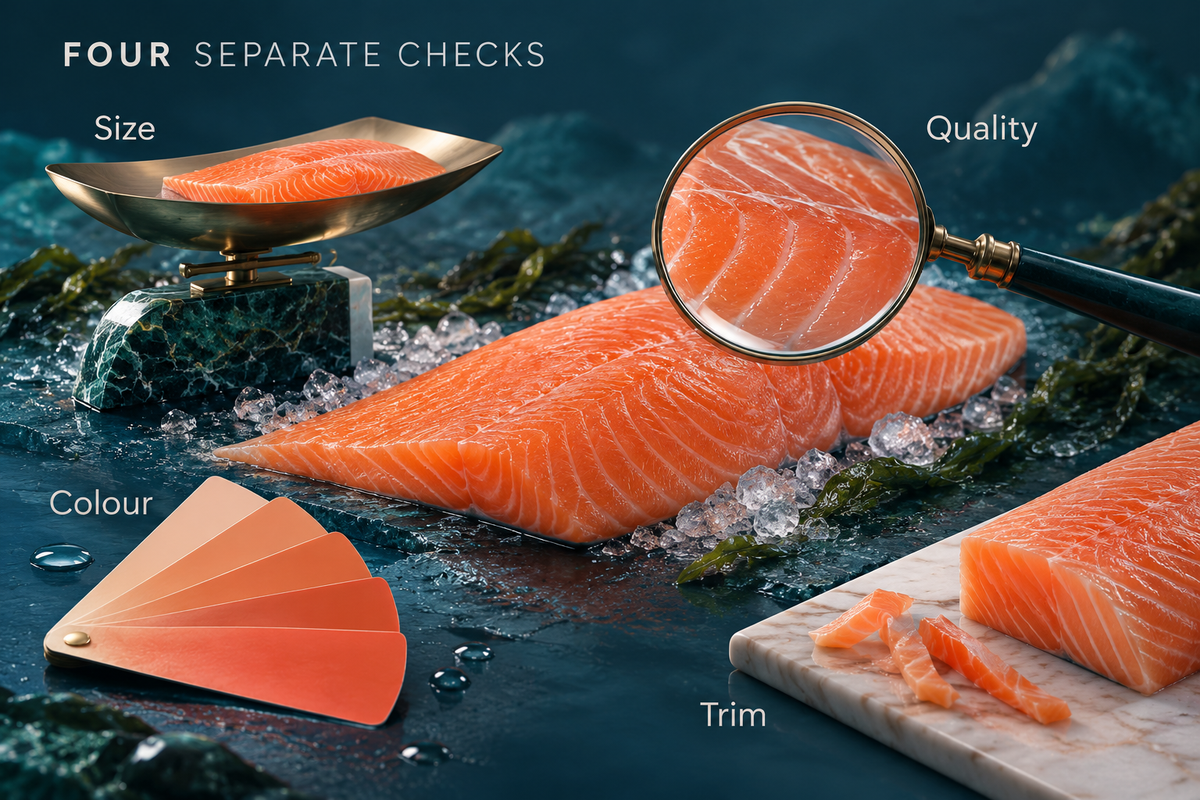
How the Salmon Grading System Works
Salmon is not graded on one universal scale that answers every purchasing question. A whole fish can meet an external appearance grade while its fillet still needs assessment for colour, gaping and bruising. Similarly, a fillet can match a weight range without meeting the buyer’s bone-removal or trim requirement. Define each characteristic separately so that a single positive result does not hide an unrelated defect.
Different organisations and suppliers use different terminology. Norwegian quality categories are useful in their commercial context, while a producer may also use its own fillet grade, size bands and processing definitions. A claim such as premium salmon means little unless it points to written, measurable criteria. Ask which standard or supplier specification governs the product and retain the version agreed for the order.
The grading specification should also identify the point of assessment. Quality at packing, quality after frozen storage and quality after controlled thawing are related but different observations. A photograph of a fresh fillet does not establish the condition of the frozen lot that will arrive. Decide which checks happen at origin and which happen at destination, and make the records traceable to the same batch.
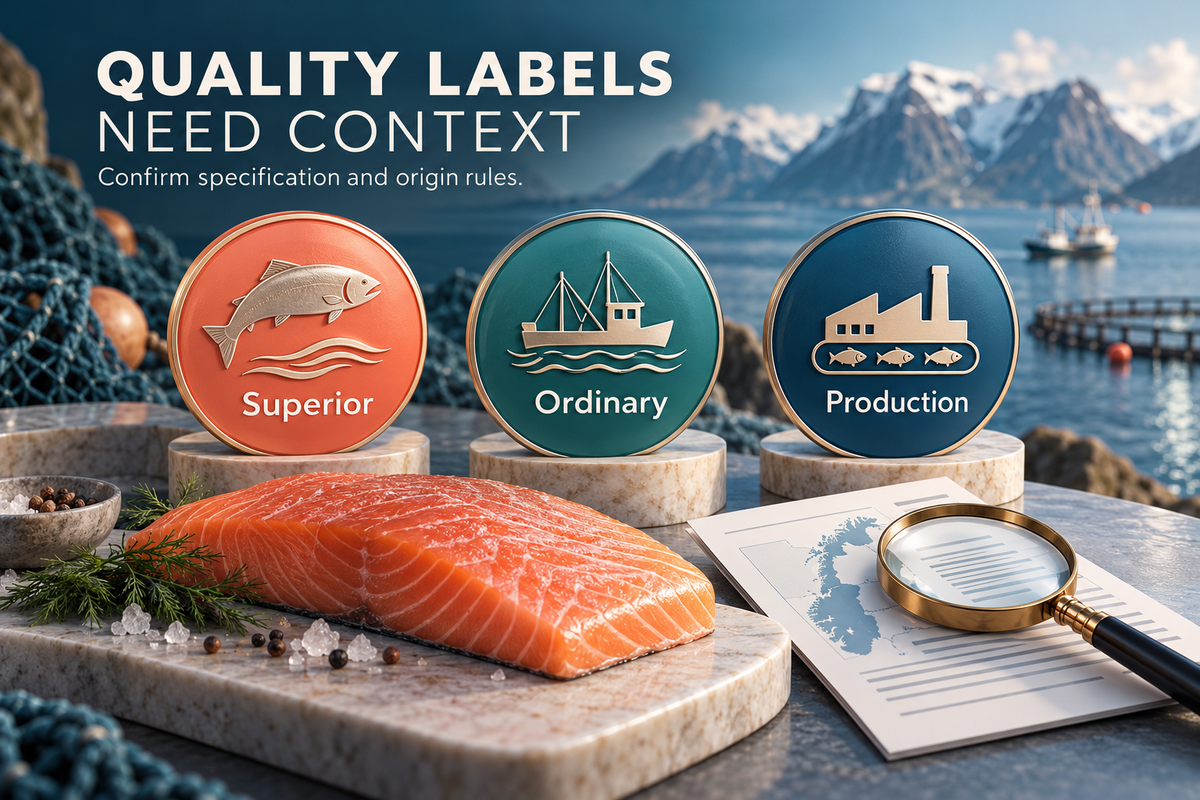
Superior, Ordinary and Production: What the Grades Mean
These labels are commonly discussed for Norwegian farmed salmon, especially whole-fish appearance. Their practical meaning must be tied to the applicable specification and origin rules, rather than treated as a worldwide food-safety ranking.
Superior
Superior generally describes fish with normal shape and an appearance free from significant external defects. It is commonly sought for whole-fish presentation and programmes where visible condition is important.
That description does not guarantee every fillet attribute. The buyer still needs to agree flesh colour, blood-spot tolerance, gaping, texture and the required processing form. Ask whether inspection takes place before or after gutting and how any concealed defects are handled.
The word superior also cannot establish suitability for raw consumption. Quality appearance and hazard control need separate evidence. If the fish is intended for a specific process, state that use before approving the supply specification.
Ordinary
Ordinary typically allows minor visible departures from the superior appearance specification. These may affect presentation without automatically deciding whether the material meets a particular processing programme.
Do not accept an undefined statement that defects are minor. Identify the permitted type, location and extent in the contract, with approved examples where helpful. Whole-fish skin blemishes and defects in the edible fillet should not be grouped together without explanation.
A processor may be able to remove some affected areas, but that must be confirmed for the actual fish and process. Agree whether the supplier corrects the defect before dispatch and how the finished product will then be inspected.
Production and origin-specific restrictions
Production is a category associated with more pronounced defects and material requiring appropriate correction or processing. It should not be described simply as fish that is always safe and freely exportable.
For Norwegian supply, the Norwegian Food Safety Authority’s rules on farmed fish with defects state that specified defects must be corrected before the fish leaves Norway. The authority also describes restrictions on fish whose defects cannot be corrected. These are origin-specific requirements, not a universal definition for every supplier using the word production.
Confirm the finished product’s legal status, corrective processing and inspection records before ordering. The final product specification should describe what is actually supplied, rather than relying on the raw-material category to answer all compliance questions.
Size Grades: Define the Product and Weight Basis
A size band is meaningful only when everyone is weighing the same product. Specify the form, measurement stage and treatment of packaging and glaze before comparing supplier offers.
Whole-fish weight
Round fish, head-on gutted fish and head-off gutted fish are different weight bases. HOG means head-on gutted, but other abbreviations should be written out because usage can vary between suppliers.
If a supplier lists a kilogram band, ask whether it refers to each individual fish, an average or a nominal commercial class. Confirm boundary treatment and the tolerance for fish outside the band. Also establish whether mixed sizes can appear in the same carton.
Fillet size
A fillet range should identify the weight of an individual fillet and its trim condition. A skinless, closely trimmed fillet cannot be compared directly with a less-trimmed skin-on fillet simply because both originated from the same whole-fish size.
Dimensions can matter where the fillet feeds an automated portioning line or a fixed retail tray. Request length and thickness criteria when needed, rather than assuming weight alone defines the geometry. The site’s salmon fillet cuts guide explains related commercial forms.
Portions and tolerances
Specify the target weight range, allowable variation and whether the requirement applies to each piece or a batch average. Agree how the inspector will assess that variation under the applicable net-quantity rules.
Portion location also affects shape. A tail portion and centre portion can weigh the same while having different thickness and presentation. State whether mixed locations are acceptable and whether the supplier sorts portions by dimensions as well as weight.
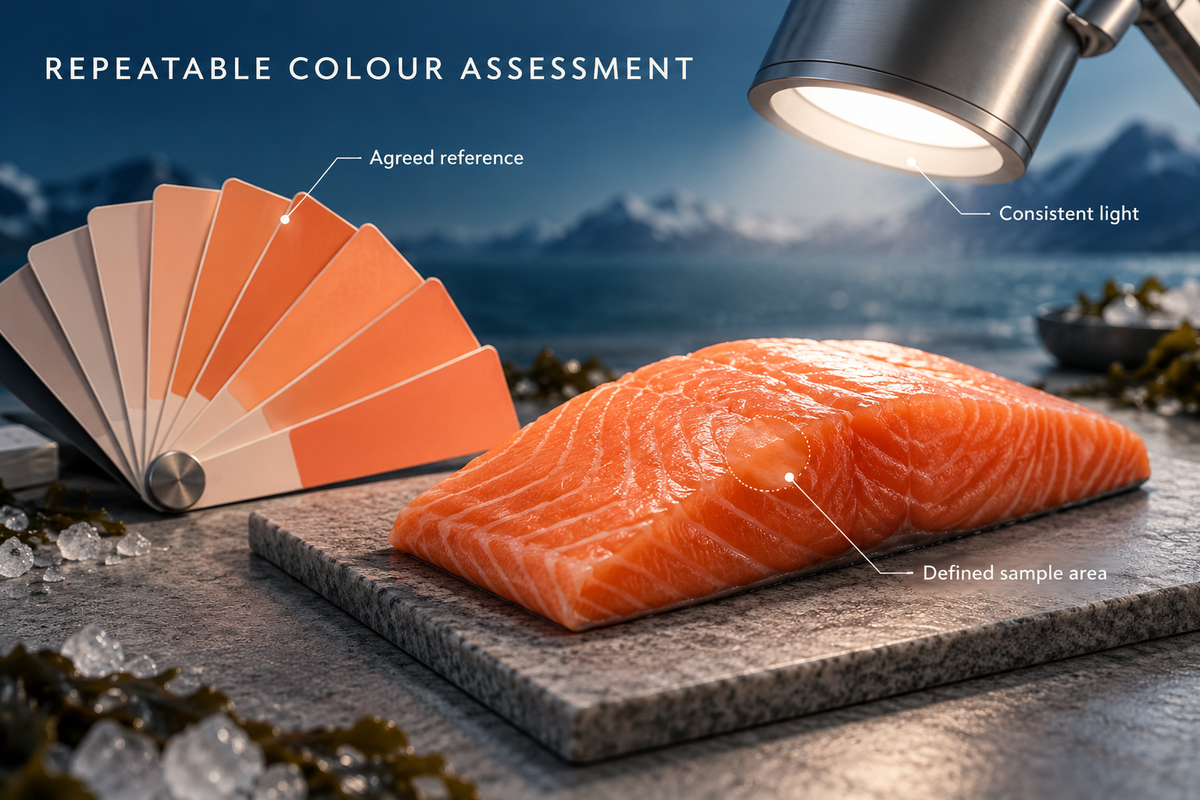
Colour Grading: Use a Reference and a Repeatable Method
Salmon flesh colour needs an agreed reference rather than an impression such as bright orange. The manufacturer’s SalmoFan measurement guidance explains how assessment conditions, background and observer consistency affect readings. It also states that colour preferences vary by buyer and application. A colour score is therefore a purchasing criterion, not a universal freshness or safety threshold.
Agree the measurement location, product condition and lighting. A thawed sample, fresh fillet and phone photograph may not be directly comparable. Use representative areas rather than selecting the most attractive point, and decide how differences between belly and back will be recorded. Keep reference tools clean, protected and suitable for continued use according to their manufacturer’s instructions.
Write the required colour range and within-fillet consistency into the specification only after sample approval. Do not apply one producer’s published minimum to the entire industry. Natural variation between species also matters: pale-fleshed Chinook should not be rejected solely because a colour requirement intended for a different product was assumed to apply.

Assess Flesh, Skin and Handling Defects
Visible inspection should use defined categories and repeatable conditions. The table below identifies follow-up questions; it does not turn an observation into a diagnosis of safety or cause.
| Observation | What it may affect | Follow-up |
|---|---|---|
| Skin damage or deformity | Whole-fish presentation | Compare with the agreed grade and origin rules |
| Bruises or blood spots | Fillet appearance and usable material | Record location, extent and permitted trimming |
| Gaping | Fillet integrity and portioning | Assess representative samples under the agreed method |
| Unusual odour after controlled thawing | Product acceptability | Hold the lot for assessment under the quality procedure |
| Dehydrated surface | Appearance and texture | Inspect packaging and storage history |
| Loose vacuum or damaged seal | Package performance | Investigate seal integrity and handling conditions |
| Remaining bones | Specification compliance | Check the agreed bone definition and inspection method |
Whole-fish defects
Inspect body shape, skin, wounds and handling damage against the defined grade. Record whether defects are isolated or repeated throughout the sampled lot, and photograph them with enough context to show their size and location.
Whole-fish inspection does not expose every flesh defect. If fillet quality is central to the contract, include a suitable destructive or processing-based sample check, agreed in advance with the supplier.
Fillet defects
Check texture, gaping, bruising, blood spots, trim and bones under a consistent procedure. Decide whether defect criteria are expressed by extent, location, severity or affected units. Avoid vague requirements such as no major defects unless examples or definitions make them usable.
The Codex standard for quick-frozen fish fillets includes sensory and physical examination provisions. Use an applicable standard and trained assessors where required, while maintaining the buyer’s separate product specification.
Frozen-product defects
Packaging can conceal dehydration, damaged surfaces or uneven product presentation. Inspect the frozen pack first and use controlled thawing where necessary to assess the flesh. Keep these observations separate from temperature-record review.
Large ice deposits or sticking pieces may justify investigation, but they do not establish a precise thawing history on their own. Record the evidence and obtain the supplier’s storage and handling records before assigning a cause.
Trim Grades and Bone Status Need Their Own Specification
Trim describes what processing has removed: bones, fins, belly material, fat, tail sections or skin, according to the supplier’s definition. It is separate from quality grade. More extensive trimming does not correct every underlying problem with texture, handling or storage, and it is not proof of better raw material.
Letters such as A to E are common, but their exact content should not be assumed. For example, Mowi’s fillet guide describes particular pre-rigor specifications and pin-bone options, while other suppliers publish different definitions. Ask for the current technical sheet and write out the required features instead of relying on a letter alone.
Specify skin-on, skinless or deep-skinned separately, along with pin-bone-in or pin-bone-out. If deep skinning includes removal of brown muscle, say so explicitly. Approve a reference sample or detailed photograph and confirm that the same description appears on the finished product records.
Agree a Sampling and Lot-Acceptance Procedure
An approved sample shows an agreed product, but it does not prove that every future shipment matches it. Establish a lot-based inspection procedure before dispatch so that both sides know what evidence supports acceptance.
- Define the lot by species, production batch and processing specification.
- Agree a sampling plan appropriate to the product and applicable requirements.
- Select samples across the lot rather than using only presentation pieces.
- Identify checks at packing, dispatch and receipt.
- Record the instruments, assessment conditions and inspector responsible.
- Separate visual-quality results from food-safety and document review.
- Define acceptance, hold, rejection and corrective-action procedures.
- Retain photographs and results linked to carton and batch identifiers.
| Contract criterion | Inspection record |
|---|---|
| Correct product and size | Identity, form and measured weights |
| Required colour | Reference, assessment conditions and readings |
| Defined defect tolerance | Defect category and observations |
| Required trim and bone status | Physical examination results |
| Frozen pack compliance | Seal checks, net-weight checks and temperature records |
| Traceable shipment | Matching lot identifiers and supporting documents |
Agree what happens if the sample passes but receipt checks fail. Preserve the affected lot’s identity, report the evidence promptly and follow the approved quality procedure instead of mixing disputed stock into routine supply.
Frequently Asked Questions
These answers separate common grading terms from the evidence needed for a purchase. The contract and applicable origin or destination rules remain essential.
Is there one international salmon grading system?
No single commercial label defines size, colour, defects, trim and safety for every supplier. Identify the standard or producer specification being used and agree each required characteristic separately.
Does Superior salmon mean it is safe to eat raw?
No. Superior is a quality description in its commercial context. Raw-use suitability requires appropriate hazard controls and supporting documentation; appearance grade does not establish those controls.
What does a salmon size grade measure?
It usually describes a weight band, but you must confirm the product form and measurement basis. Round fish, gutted fish, trimmed fillets and portions are not interchangeable weight categories.
Is a higher SalmoFan reading always better?
No. Colour preference depends on the product, buyer and application. Agree a reference and assessment method; colour alone does not establish freshness, texture or food safety.
Is Trim E automatically pin bone-out?
Do not assume so. Trim definitions vary, and bone removal should be stated explicitly. Request the supplier’s technical sheet and confirm the actual finished product rather than relying only on the letter.
Request a Product Specification from Iran Fish
Use Iran Fish’s salmon-trout supply page to discuss the product available for your programme.
Send your required size, colour, visible-quality criteria, trim, skin and bone status, together with your destination and intended use.
Ask for confirmed species identity, a representative sample and an agreed inspection specification for the shipment.