

Salmon Trout Farming: Production, Quality and Export Supply

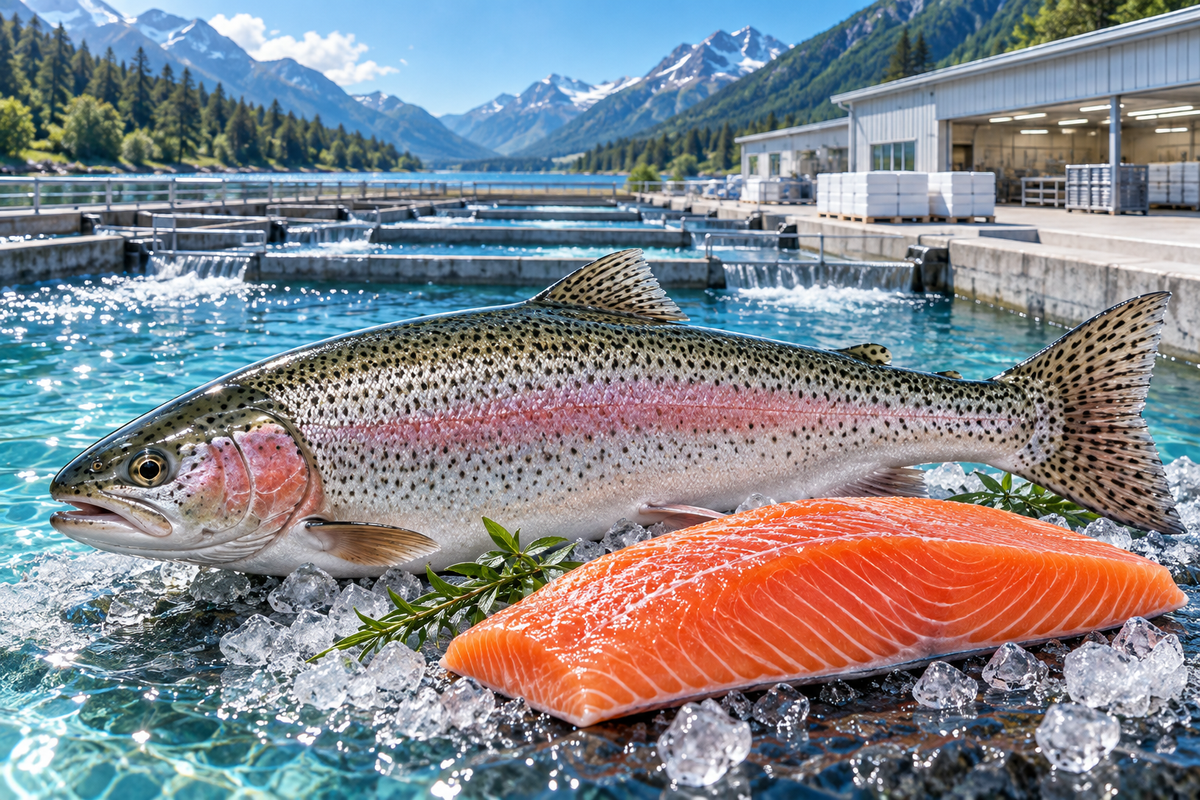
Salmon trout farming commonly refers to raising rainbow trout sold with pink or orange flesh, rather than farming Atlantic salmon. Export quality depends on healthy stock, suitable water, controlled feeding, careful harvesting and verified processing. Buyers should confirm the scientific species, product format, farm-to-batch traceability and destination requirements before ordering. Flesh colour alone cannot establish species, freshness or safety, and a farm’s production capacity does not guarantee an export-ready shipment.
| Topic | Practical answer for buyers |
|---|---|
| Species | Confirm the scientific name; rainbow trout is Oncorhynchus mykiss, not Atlantic salmon |
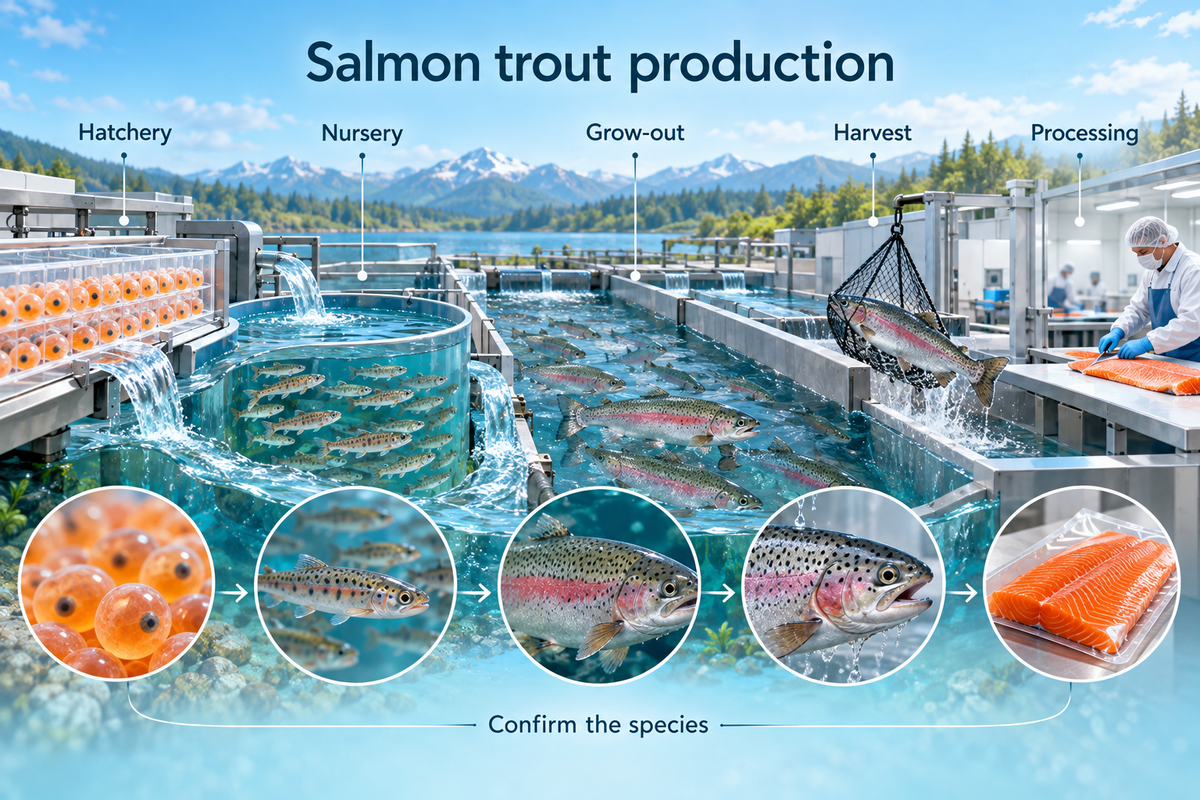
| Production cycle | Hatchery stock moves through nursery and grow-out before a planned harvest |
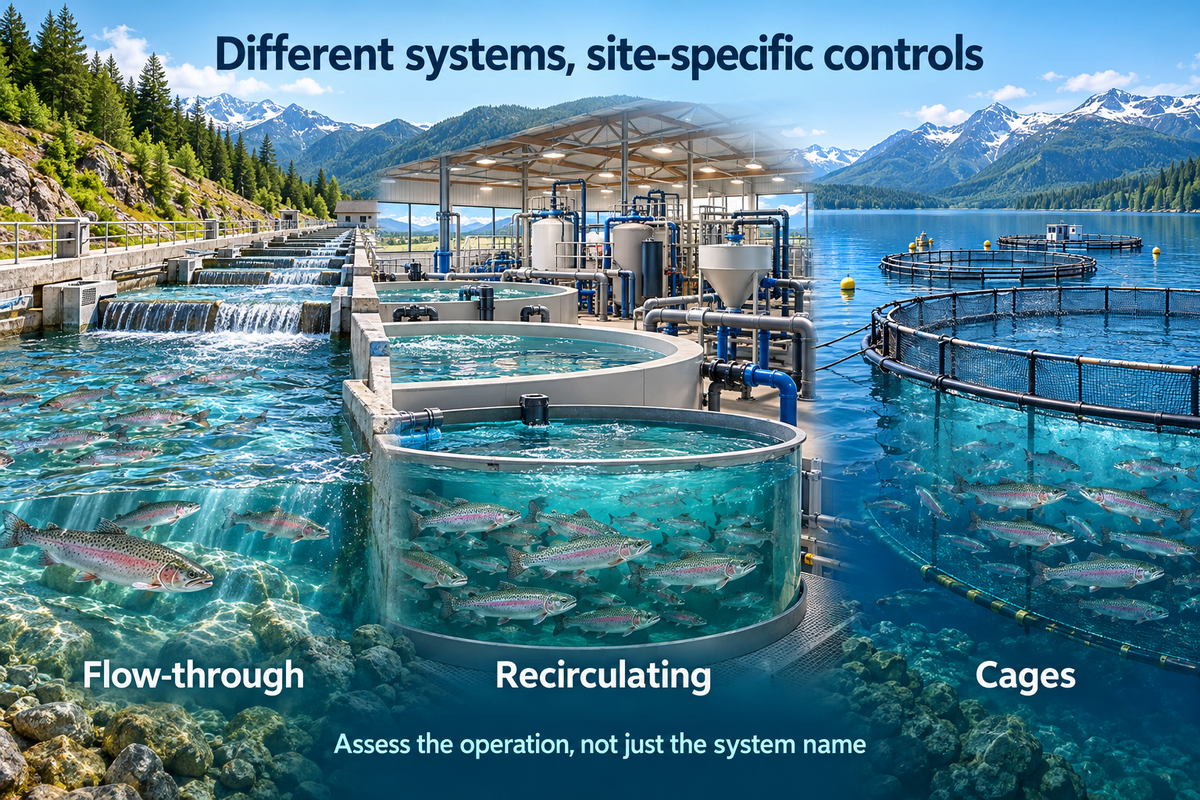
| Farming system | Flow-through, recirculating and cage systems need controls suited to the site |
| Water and feed | Review monitoring and feeding records rather than relying on photographs |
| Flesh colour | Dietary pigments can influence colour; assess colour separately from identity and freshness |
| Health and welfare | Request relevant stock-health, treatment and harvest-handling evidence |
| Finished product | Agree cut, grading, bone status, packaging, net fish weight and intended use |
| Export readiness | Match batch records, relevant testing and destination-specific documents |
| Supply reliability | Confirm available stock, planned production and the route to the receiving facility |
What Salmon Trout Farming Actually Produces
“Salmon trout” is a commercial description whose meaning must be clarified for the transaction. In many supply contexts it describes rainbow trout with salmon-like flesh colour. Rainbow trout and Atlantic salmon belong to the same fish family, but they are different species. A product’s appearance or shared fillet format does not make them interchangeable.
The FAO rainbow trout species profile identifies rainbow trout as Oncorhynchus mykiss and describes both freshwater and marine production settings. Atlantic salmon is Salmo salar. Ask the supplier to put the scientific name on the specification and ensure the commercial name is suitable for the destination market. This is especially important when translated product descriptions use “salmon” loosely.
For purchasing, distinguish the species from its format and farming location. A pink trout fillet can be an appropriate product for a restaurant or processor that wants trout, but it should not be presented as a different species. Explore the Iran Fish salmon trout range and request the exact identity of the proposed supply before comparing it with Atlantic or Pacific salmon products.
From Hatchery to Harvest: The Production Cycle
Production begins long before the fish reaches a processing line. A useful supplier assessment follows the stock from its hatchery origin to the finished batch rather than looking only at harvest-day conditions.
Hatchery and juvenile supply
Commercial trout production uses hatchery-origin eggs or juveniles, with sourcing and handling arrangements appropriate to the operation. The hatchery stage needs suitable incubation conditions and records that connect stock to its source.
Buyers do not need to manage egg incubation themselves, but they can ask how the farm verifies incoming stock identity and health. The answer should explain what records are retained and how the stock is identified after transfer, rather than simply describing the hatchery as modern.
Nursery and grow-out
Young fish move through nursery and grow-out stages as their size and production needs change. Stock management brings together feeding, water monitoring, fish condition and grading. Transfers should remain visible in the farm records.
An export buyer should ask whether the required size range is available from the planned harvest. A farm’s total biomass is not the same as the quantity ready for a particular product specification. A fillet order also depends on the processor’s ability to convert the available fish into the agreed finished format.
Harvest scheduling
There is no single reliable growth period for every farm and target size. Stock, water conditions, feeding and the required harvest specification all influence the schedule. Avoid treating a generic farming timeline as a guaranteed dispatch date.
Request a production plan tied to the order: expected harvest window, required grading, processing slot and proposed shipment. This turns a biological production cycle into a reviewable supply commitment without pretending every batch develops at the same rate.
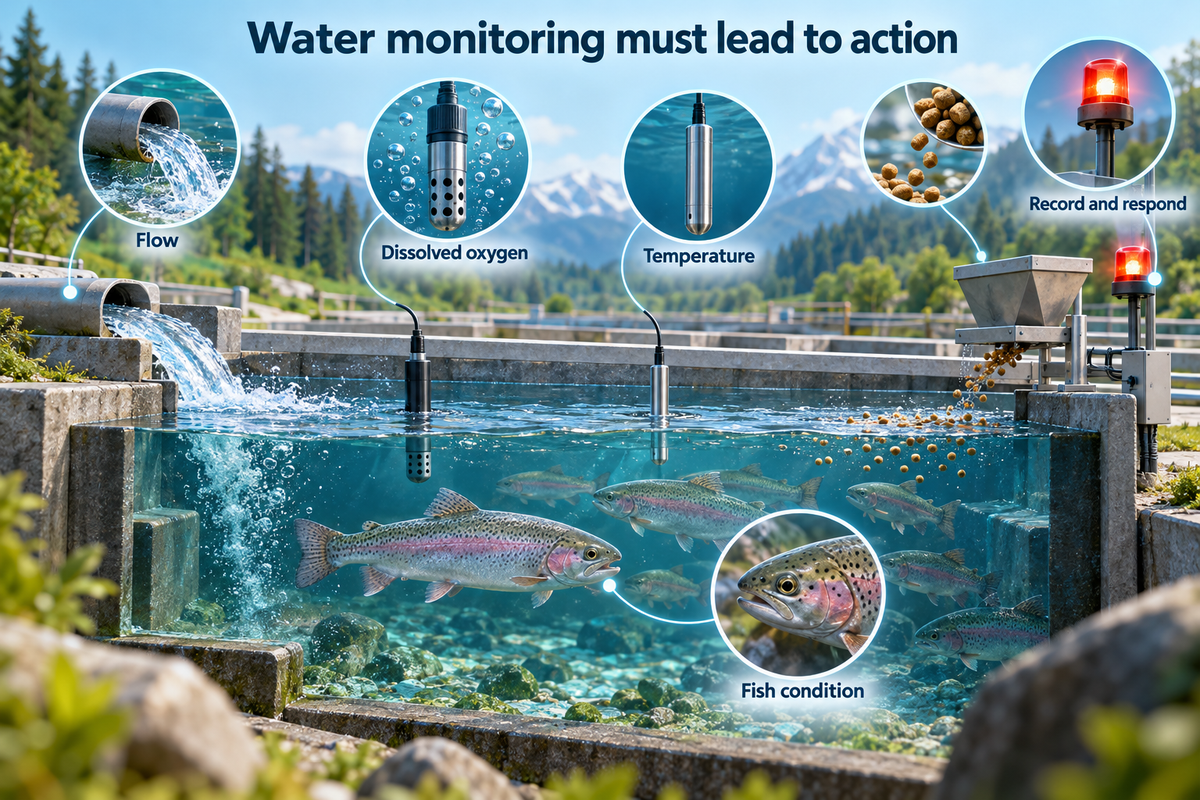
Farming Systems and Water Quality
A system name tells you how fish are held, not how well the farm is operated. Review the actual monitoring, response procedures and site conditions behind the description.
Flow-through farms
Flow-through operations depend on an incoming water supply passing through the production units. Their suitability is linked to the water available through the year, its condition and how discharge is managed.
Ask how the farm monitors incoming and outgoing water, responds to changing flow and documents interruptions. A photograph of clear water captures a moment; monitoring records show whether the operation can maintain suitable conditions across the production cycle. The FAO small-scale rainbow trout farming guide discusses farm planning and environmental protection alongside routine production.
Recirculating systems
Recirculating aquaculture systems treat and reuse water within a designed production system. Their operation depends on functioning treatment, circulation and monitoring equipment rather than on the label “closed system” alone.
Ask the operator to explain its treatment arrangement, alarm response and backup provisions. For a buyer, the relevant point is whether the proposed source is managed and documented appropriately, not whether one technology is universally superior. An impressive installation still needs an effective operating team.
Cage production
Trout may also be raised in cages in suitable water bodies. These sites require attention to the surrounding water, fish condition, containment and the production practices applicable to their location.
Confirm the actual farm location and production method for the batch. Do not assume all salmon trout is freshwater-farmed or that every cage-grown trout follows an Atlantic salmon production model. Site-specific evidence is more useful than a broad category claim.
| Farming system | Evidence to request | Question the evidence should answer |
|---|---|---|
| Flow-through | Water monitoring, interruption procedures and discharge information | How does the farm respond when its incoming supply changes? |
| Recirculating | Treatment arrangements, alarms, operating records and backup provisions | How are system faults detected and managed? |
| Cages | Site identification, water monitoring, containment and stock records | How is this particular site managed and the batch identified? |
Monitoring that supports management
Dissolved oxygen and water temperature affect fish production, while other water parameters need assessment according to the system. The FAO discussion of aeration and oxygenation explains that oxygen requirements vary with factors such as fish size, temperature and activity.
A buyer’s check should focus on how measurements trigger action. Ask about instrument checks, records, alarm escalation and the response to abnormal readings. Generic online limits should not replace a farm-specific operating plan prepared by qualified personnel.
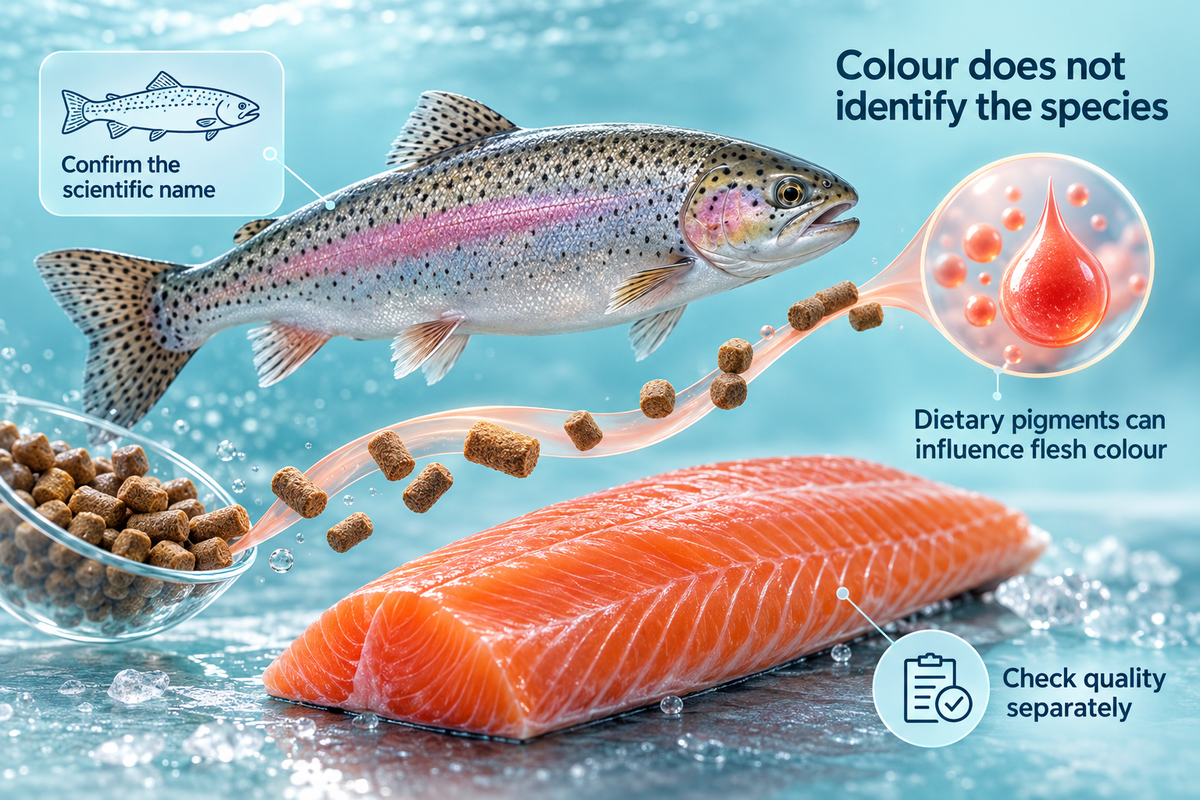
Feed, Flesh Colour and Product Consistency
Feeding affects the fish and the production environment. For export buyers, the most useful questions concern suitability, traceability and whether the finished product can consistently meet the agreed specification.
Nutrition and feeding control
Trout feed must suit the species and life stage. Feeding management should respond to stock size and conditions while limiting avoidable waste. The FAO salmonid feeding discussion connects feeding practices with feed utilisation and water-quality concerns.
Request identification of the feed used for the supplied stock and the records needed to trace it. A feed conversion figure can help describe performance only when its definition, period and stock coverage are clear. It does not independently establish fish welfare, residue compliance or finished-product quality.
Why the flesh can be pink
Carotenoid pigments in the diet can influence salmonid flesh colour. The EFSA assessment of astaxanthin for salmon and trout explains its pigmenting function. Colour influenced by feed is different from adding a colour treatment to the finished fillet.
Do not describe pink flesh as proof that trout is Atlantic salmon, or as a reliable freshness test. Ask about the feed and any relevant product treatment declarations. If colour consistency matters, agree how the finished product will be assessed instead of relying on a photograph edited for marketing.
Consistency means more than colour
A useful order specification considers size distribution, preparation and pack presentation together. Discuss whether the supplier can maintain the required grading across the planned quantity, and how non-conforming fish or finished portions are separated.
Sample approval can help define expectations, but the sample should represent the supplied product. Keep a record of its species, preparation and assessment conditions so it remains meaningful when production begins.
Fish Health, Biosecurity and Responsible Farming
Healthy-looking fish in a promotional image do not replace production evidence. Ask how the farm manages prevention, records problems and obtains qualified advice when treatment is needed.
- Stock sourcing: identify the source and relevant health information for incoming fish.
- Biosecurity: review how access, equipment, movements and cleaning are managed.
- Monitoring: ask how behaviour, feeding, condition and mortality observations are recorded and escalated.
- Veterinary oversight: establish who assesses health problems and authorises any necessary treatment.
- Treatment records: retain the substance, affected stock, treatment dates and required withdrawal information where applicable.
- Welfare: ask how handling, crowding, transport and harvesting are assessed and controlled.
- Environmental management: review relevant discharge, waste, feed-sourcing and containment evidence.
- Certification: verify the named site, validity, applicable scope and product coverage of any claim.
The ASC Farm Standard framework covers environmental stewardship, animal welfare, farm management and social issues. It provides a useful reference for understanding responsible-farming topics; mentioning the framework does not mean Iran Fish or a particular supplying farm holds ASC certification.
A claim such as “antibiotic-free” requires a clear definition and evidence. Distinguish no use during a specified period, compliance with residue requirements and a particular testing result. They are different statements. Do not infer one from another or treat a single laboratory result as a complete history of the farm.
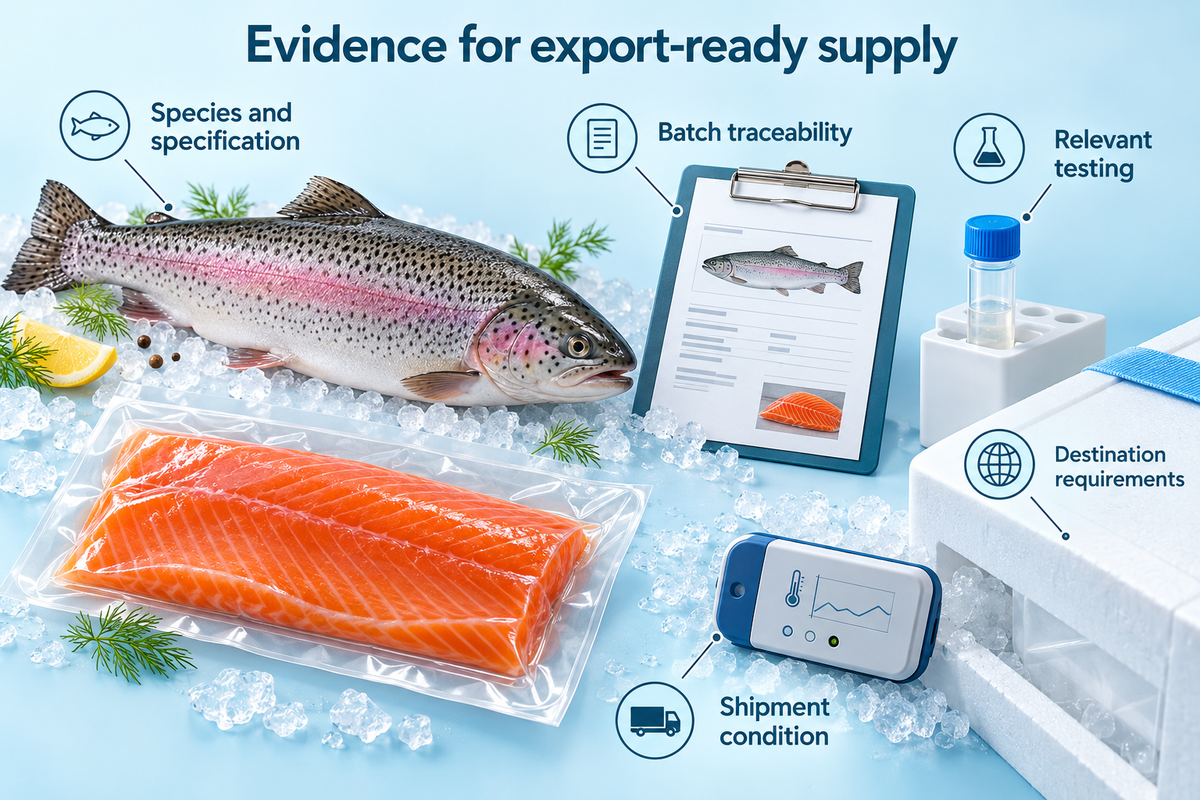
Harvesting and Processing for Export Quality
Farm management establishes the starting material, but harvesting and processing determine what reaches the carton. Buyers should assess this connection rather than treating farm quality and factory quality as separate promises.
Harvest handling and chilling
Harvest procedures should address fish welfare and limit avoidable damage. The plan should connect the harvest to appropriate processing and temperature-controlled handling, with records of the relevant times and conditions.
Ask who is responsible for the fish between the farm and processor. If these are separate businesses, the transfer needs its own identification and acceptance checks. The buyer should be able to follow the batch across that boundary without losing its source history.
Processing checks
Whole gutted fish, fillets and portions have different preparation requirements. Agree how the processor checks visible defects, trim, residual bones, skin status and size. If the required bone status cannot be guaranteed by a general description, define the inspection and acceptance method.
Gaps between muscle segments, uneven cutting, bruising and poor presentation can affect commercial suitability. Record how such defects will be judged for the intended use. A portion for further processing may have different acceptance criteria from a retail fillet, but both need a written specification.
Freezing and packing
For frozen supply, request a suitable, verified freezing process and protective packaging. The package must protect the product while keeping its batch identity visible through storage and shipment.
Confirm whether the product was frozen directly after its initial processing or underwent another processing sequence. Request the relevant history and validated shelf-life information rather than assuming all frozen formats are identical. For product protection and pack choices, the Iran Fish frozen fish packaging guide provides additional purchasing checks.
Choose the Right Salmon Trout Product Specification
Choose the product around the operation that will receive it. A wholesaler selling whole fish, a restaurant preparing fillets and a processor cutting portions may need different formats from the same species.
- Scientific species and the commercial name permitted for the intended market.
- Farm origin and production method, with processing location listed separately.
- Whole, gutted, headed and gutted, fillet, steak or portion format.
- Size range and the basis used for grading the product.
- Skin, trim and bone requirements with agreed acceptance criteria.
- Fresh or frozen condition and the disclosed processing history.
- Packaging materials, individual pack format and carton configuration.
- Agreed glaze, net fish weight and any declared ingredients or treatments.
- Storage conditions and the minimum remaining shelf life required at arrival.
- Intended use, delivery destination and batch documentation requirements.
| Product format | Specify before approval |
|---|---|
| Whole gutted trout | Head status, preparation, fish-weight grading and packing arrangement |
| Fillet | Skin status, trim, bone requirements, grading and individual protection |
| Steak | Cut definition, size variation, bone presentation and pack configuration |
| Portion | Target portion specification, tolerance, shape and skin/bone requirements |
| Further-processed product | Ingredients, process, intended use and handling instructions appropriate to that product |
The Iran Fish rainbow trout page is another relevant starting point for discussing a defined trout order. Confirm current formats and availability directly rather than assuming every listed presentation is ready for immediate shipment.
The purchase agreement should also define what happens if the proposed batch differs from the approved specification. Require agreement before changing the species, origin, cut or other material characteristic. A similar-looking substitute is not automatically acceptable.
Traceability, Testing and Destination Requirements
Farmed production creates records that can support the finished product’s identity and suitability. The buyer needs evidence connected to the supplied batch, not an unrelated collection of certificates.
Follow the batch through transformations
Ask how stock identification links to harvest, raw-material receipt, processing and finished-product lots. When fish from different sources are combined, the records should preserve the source information needed to identify affected product.
Match labels with the packing list and relevant official documents. The scientific name, product description, quantities, dates and establishment information should be consistent. Repacking or cutting must not break the relationship between the original material and its final cartons.
Select testing for the actual risk
Testing requirements depend on the product, source and destination. Ask what the analysis covers, how the sample was selected, which batch it represents and whether the laboratory and method meet the relevant requirement.
The FDA chapter on aquaculture drugs explains the importance of controls addressing drug use and residues in aquaculture products. A report for one substance or one lot should not be presented as proof of compliance for every possible contaminant or future shipment.
| Evidence | What it can establish | What it cannot establish alone |
|---|---|---|
| Farm records | Source and recorded production history | Finished-product conformity after processing |
| Treatment records | Documented use and relevant withdrawal information | Every residue result in the final product |
| Laboratory report | Results for the identified sample and tested parameters | The status of untested lots or hazards |
| Processing records | The batch’s preparation and recorded controls | Destination import permission |
| Shipment temperature records | Conditions recorded during the monitored journey | The complete history before monitoring began |
| Scoped certificate | Certification of the named activity or site | Certification of every supplier and product in the chain |
Confirm export readiness before dispatch
Check destination requirements with the responsible importer and importing authority. Species, origin, product type and establishment status may affect the required approvals and documents. Do not assume a shipment can enter every market because another buyer previously imported a different product.
Prepare the required certificates and consignment information early enough to resolve discrepancies before dispatch. A readable carton label, a complete batch history and suitable cold-chain arrangements support the shipment, but they do not replace official eligibility requirements.
Assess Production Capacity and Supply Reliability
Ask whether the proposed order will come from existing stock or a scheduled harvest. Confirm the quantity available in the required grading and product format, then connect it to a processing and delivery plan. A farm’s annual output does not show how much of your specification can be supplied in a particular week.
Discuss foreseeable interruptions and how changes will be communicated. Water conditions, stock health, processing availability and transport arrangements can affect the plan. Agree which changes require approval and what evidence would accompany an alternative batch or source. Continuity should preserve the product specification and traceability.
Assess the supplier’s ability to answer specific questions clearly. A practical response identifies the product, available evidence and matters still awaiting confirmation. General assurances about premium quality are less useful than a specification, representative sample, batch documentation and a realistic shipment proposal.
Frequently Asked Questions
These questions address common misunderstandings about production and export supply. Individual farm conditions and market requirements still need to be confirmed for the proposed order.
Is salmon trout the same fish as Atlantic salmon?
No. In many trading contexts, salmon trout means rainbow trout with pink or orange flesh. Rainbow trout is Oncorhynchus mykiss; Atlantic salmon is Salmo salar. Confirm the scientific name and appropriate market label.
Is salmon trout always farmed in freshwater?
No. Rainbow trout production can include freshwater systems and suitable cage production in other environments. Ask for the actual farm location and production method rather than inferring them from the product name.
Why is farmed trout flesh pink or orange?
Dietary carotenoids can influence flesh colour. That colour does not change the species and does not prove freshness or safety. Agree colour requirements separately from identification and other quality checks.
How long does salmon trout take to reach harvest size?
There is no single period that applies to every order. The stock, conditions, feeding and target size influence the schedule. Ask for the supplier’s current harvest plan and the quantity expected to meet your grading.
What should an importer request before ordering salmon trout?
Request the scientific species, origin, format, grading, packaging, intended-use specification and relevant batch evidence. Confirm destination eligibility and required documents before dispatch, and establish the inspection and acceptance procedure for arrival.
Discuss Your Salmon Trout Requirements with Iran Fish
Define the trout product your business needs: species, format, size grading, packaging, destination and delivery window. Include the intended use so preparation and handling requirements can be discussed accurately.
Browse the Iran Fish farmed-fish products and request confirmation of current stock or planned production. Ask for the evidence relevant to the proposed batch and importing market.
Contact Iran Fish about your salmon trout requirements to discuss availability, product specifications and the next information needed to assess your order.