


CITES Caviar Labels: How to Read Species, Origin and Batch Codes


CITES caviar labels identify the declared species, source, country of origin, relevant year, plant and lot. Read the whole code: the year can refer to harvest or repackaging, while a repacker’s country is separate from the origin field. Match the container to supporting records before accepting a shipment. A plausible code alone does not establish authenticity, eating quality, food safety or permission to import into a particular market.
| Label detail | What it means | Practical buyer check |
|---|---|---|
| Species code | The declared sturgeon or paddlefish identity | Match it to the scientific name and any hybrid declaration |
| Source letter | The declared CITES source category | Check the category against supporting records |
| Origin country | The declared CITES country of origin | Read it separately from a repacker’s country |
| Year | Harvest for an original label, or repackaging for a repacked label | Establish which event it describes; check food dates separately |
| Plant code | The processing or repackaging facility identifier | Confirm the facility details and its role |
| Lot reference | The link to the operator’s tracking records | Reconcile it with the shipment documents |
| Non-reusable label and package | Container-level identification and evidence of opening | Inspect legibility, damage and the sealing arrangement |
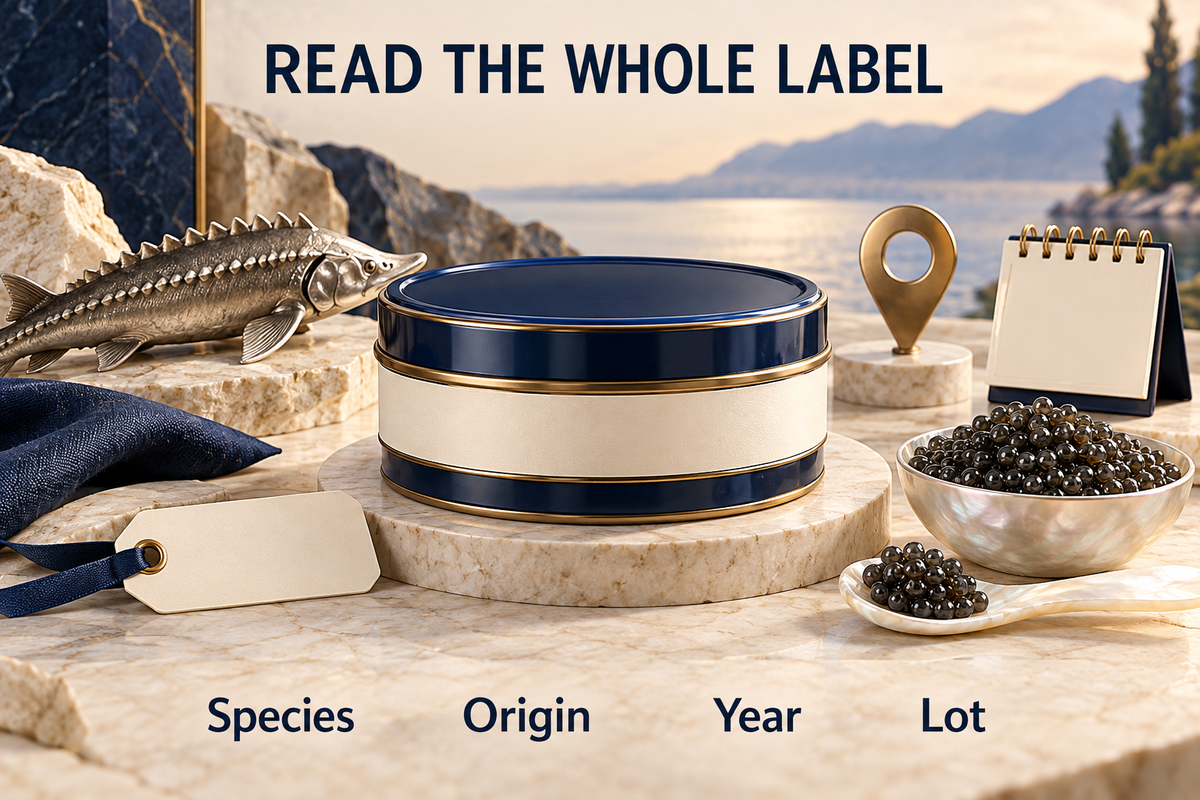
CITES Caviar Labels: Read the Fields in Context
CITES is the Convention on International Trade in Endangered Species of Wild Fauna and Flora. Its caviar labelling framework concerns sturgeon and paddlefish products within its scope. It is a traceability system, not a culinary scoring system. Do not confuse its species and source codes with the supplier’s commercial tier or tasting notes.
Identify whether you are looking at an original processing label or a label applied after repackaging. That distinction changes how you interpret the year and facility information. The current U.S. caviar labelling provisions set out both cases and provide a useful, explicit national reference for the differences.
For an actual international order, use the current rules of the countries involved. National implementation, species restrictions and shipment procedures need to be checked for the proposed route. Reading a label correctly is one part of that work; it is not the same as obtaining a decision from the relevant CITES Management Authority.
Identify the Species and Any Hybrid
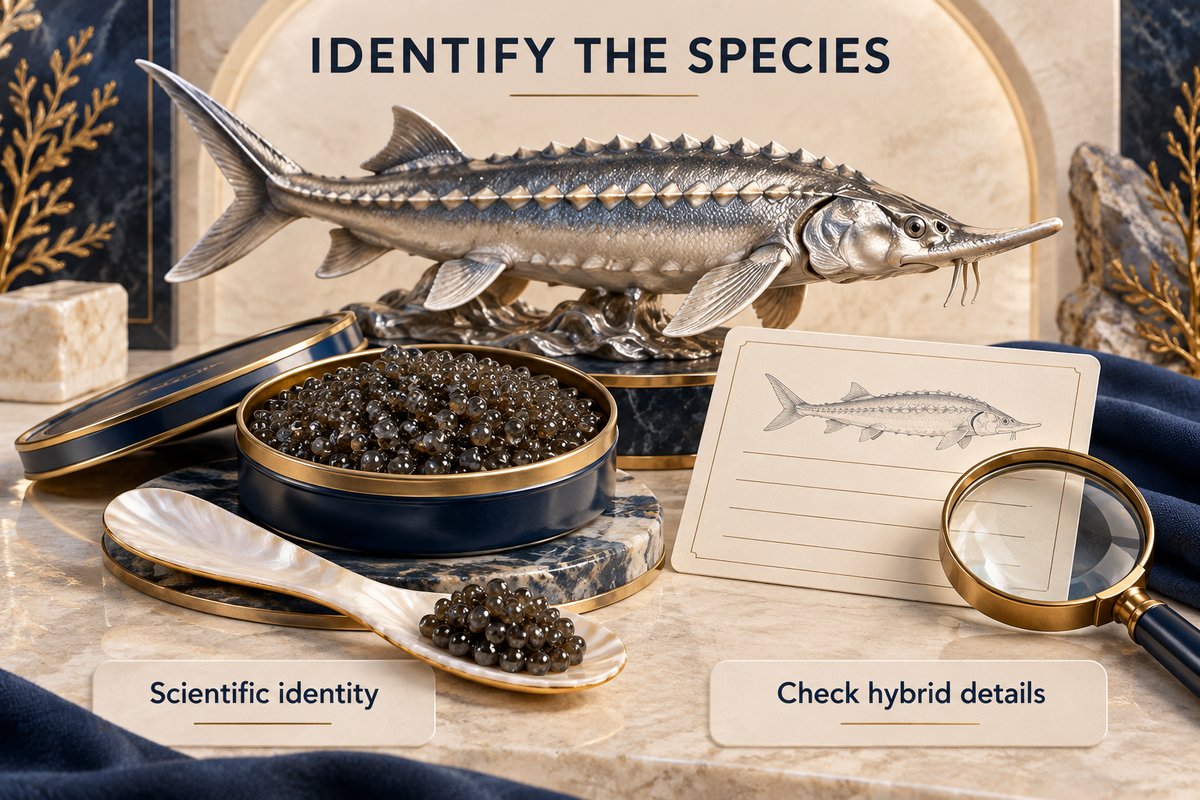
Start with the species field rather than the attractive name on the lid. A commercial description should be consistent with the scientific identity behind the code.
Common species-code examples
The U.S. Fish and Wildlife Service’s caviar labelling bulletin includes the following standard examples. The bulletin is an older explanatory document; use its code examples alongside current shipment requirements rather than treating it as a complete current import guide.
| Code | Scientific identity | Common description |
|---|---|---|
| HUS | Huso huso | Beluga |
| GUE | Acipenser gueldenstaedtii | Russian sturgeon; commonly associated with Ossetra |
| PER | Acipenser persicus | Persian sturgeon |
| BAE | Acipenser baerii | Siberian sturgeon |
| STE | Acipenser stellatus | Stellate sturgeon; Sevruga |
| TRA | Acipenser transmontanus | White sturgeon |
| DAU | Huso dauricus | Kaluga |
| SCH | Acipenser schrencki | Amur sturgeon |
This is a reference selection, not a complete list of permitted products or species for any destination. A correctly recognised code does not establish that the proposed trade is allowed.
Hybrids and ambiguous trade names
A hybrid species field combines parental codes with an “x.” Ask the supplier to provide the complete scientific identification, and have the ordering convention checked against the applicable official requirements. Do not infer parentage from a shortened product name.
For example, an offer using a familiar Beluga-related trade name should not automatically be read as pure Huso huso. When evaluating Beluga caviar supply, confirm the actual species declaration for the offered lot before comparing it with another product.
Decode the Source Letter without Overreading It
The source letter describes a regulatory source category. It is not a quality grade or a complete sustainability assessment.
C: captive-bred source
“C” indicates captive-bred origin under the relevant CITES definition. The commercial word “farmed” is less precise: ask for the formal source declaration rather than assuming every product associated with aquaculture necessarily belongs in category C.
W: wild source
“W” indicates wild origin. It is not permission to trade that particular product. If it appears on an offer, the current species, origin, quota or restriction position and destination rules need appropriate verification before an order proceeds.
F: born in captivity, a distinct category
“F” concerns animals born in captivity that do not meet the CITES definition of bred in captivity, and their parts or derivatives. The CITES glossary’s source-code definitions distinguish this category from C. Do not expand the letter into an unsupported claim about farming practices or replace it with a more convenient description in your records.
Separate Country of Origin from Repackaging Country
The origin field uses a two-letter country code. Familiar examples include IR for Iran, CN for China, IT for Italy, FR for France and DE for Germany. Read the field in its proper position rather than treating every country abbreviation on the package as the origin of the roe.
Repackaging can introduce another country reference through the repackaging facility identifier. That does not replace the separately declared CITES origin. A tin distributed by a business in one country can carry roe with a different origin, and the repackaging location should not be allowed to blur that distinction in the commercial description.
Ask the supplier to explain the declared origin using the supporting CITES records. Where fish, roe or stock have moved between countries, do not try to settle the legal origin from a brand address, a heritage claim or a casual statement about where the tin was filled. The useful purchasing record identifies the declared origin, the relevant facility and the documents connecting them.
Read Harvest and Repackaging Years Correctly
An original processing label identifies the harvest year; a repacked label identifies the repackaging year. Establish which label you have before using the year in a product discussion. A recent repackaging year does not, by itself, identify when the roe was harvested.
Keep that year separate from the food’s date marking and storage directions. It is not a use-by date, a best-before date or an opened-pack instruction. You cannot calculate remaining shelf life from a CITES year alone, and repackaging should not be treated as proof that the product’s usable life has restarted.
For purchasing and service planning, request the actual harvest information where relevant, packing or repacking details, the applicable food date and the handling instructions. If the offer and container appear to describe different events, resolve the wording before accepting the stock. Avoid converting an unexplained year into a freshness claim on your own product page.
Connect the Plant Code and Lot to the Records
The facility identifier and lot reference connect a container to an operator’s record trail. They need to be interpreted together rather than treated as decorative serial numbers.
Processing and repackaging facilities
The processing facility identifies the initial packaging operation; a repackaging facility identifies an operation that transfers caviar into new primary containers. Ask which role the facility on your tin performed and request the corresponding registration details.
Use the CITES register of caviar exporters and processing or repackaging plants as a verification route, with the relevant authority where needed. Do not assume that a public listing alone establishes the validity of a particular shipment or that an inaccessible search result means the operator is unregistered.
Lot numbers and document references
A lot reference belongs to the operator’s tracking system. It is not necessarily an individual serial number unique to one retail tin, and its length alone does not establish validity.
In the U.S. provisions, certain re-export labels may use the CITES document number under which the caviar was imported in place of a lot number. Ask what the reference represents rather than automatically treating every final field as a new production batch.

Compare an Original Label with a Repacked Label
The patterns below explain the reading sequence. Bracketed text is a placeholder, not a valid plant registration, real lot number or example certificate.
Original processing pattern
HUS / C / IR / [harvest year] / [processing plant] / [lot]
Read this as declared Beluga, captive-bred source and Iranian origin, followed by the harvest year, processing facility and lot reference. The identity examples are illustrative; no actual supplier or shipment is being authenticated.
When reviewing an offer, ask for a photograph of the real, complete label and the matching records. Do not use this pattern to manufacture a label or to guess the missing part of a damaged code.
Repacked pattern
HUS / C / IR / [repackaging year] / DE-[repacking plant] / [lot or permitted document reference]
Here the example keeps IR in the origin field while DE identifies the country associated with the example repacker. The year describes repackaging. The plant text remains an obvious placeholder, not a claimed registration.
Reconcile the actual label against the applicable requirements and source documents. These simplified patterns explain the distinction; they do not cover every authorised national label design or special circumstance.
Inspect the Container and Its Tamper Evidence
The primary container is the receptacle directly contacting the caviar, such as a tin or jar. An outer carton does not replace the need to check the individual primary containers under the applicable labelling rules.
- Read the full code and photograph it clearly without opening the tin solely to inspect a label.
- Check whether the label is legible, complete and associated with the correct container.
- Look for damage, alteration or signs that a label has been lifted or transferred.
- Inspect the sealing arrangement and any visible evidence of opening.
- If the label does not itself seal the container, check the separate tamper-evident packaging rather than assuming that every compliant design must look identical.
- Preserve the original container and records if a discrepancy needs investigation.
A label design is not a universal visual template. Typography, colour or an elaborate hologram should not be used as your only authenticity test.
Verify the Shipment before Dispatch and at Receipt
Build a record that links the offered product, its containers and the actual shipment. The checklist below is a practical purchasing workflow, not an additional legal certification scheme.
- Before approving the order, obtain the full species or hybrid description, source category, declared origin, label example and facility details.
- Confirm the intended destination and route. Ask the appropriate authorities or qualified trade advisers to establish current permissions and restrictions for that actual product.
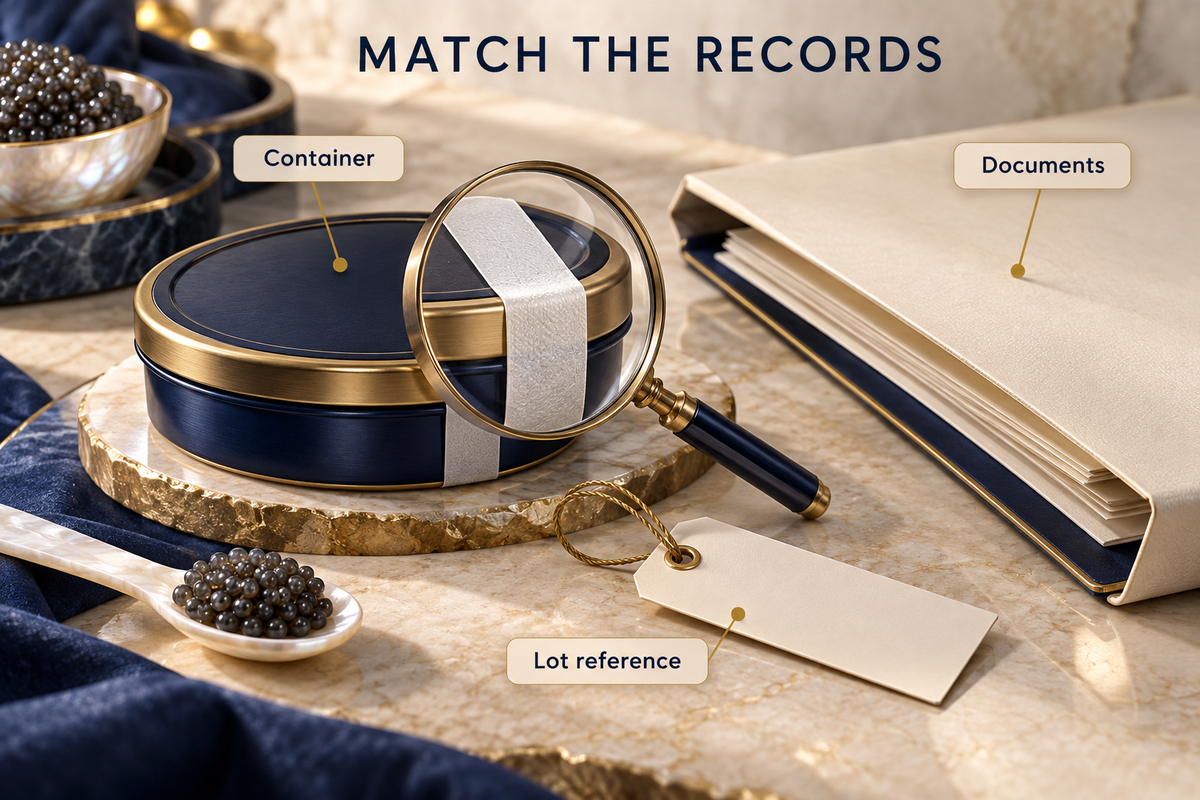
- Request the relevant shipment documentation and a clear explanation of how the container references connect to it. Do not accept an unrelated certificate as evidence for the lot being offered.
- Compare the product description, code fields, quantities and lot or document references. Follow up on unexplained differences before dispatch.
- At receipt, record the supplier, delivery reference, container details, lot information and condition. Review handling evidence separately under your receiving procedure.
- Keep records connected when stock is allocated to retail, catering or another customer. An internal stock code should supplement the supplier’s traceability reference rather than erase it.
- If a problem appears, separate the affected stock and request clarification supported by the original records. Do not correct a CITES label yourself to make the documents appear consistent.
| What you find | Appropriate next step |
|---|---|
| Unreadable or partly obscured code | Obtain a clear, complete label record and resolve the issue before acceptance |
| Species name and code disagree | Hold the identity question open and seek documented clarification |
| Origin differs from the offer | Establish whether the offer confused origin with repackaging; reconcile the records |
| Recent year on a repacked tin | Request the harvest information and check the separate food dates |
| Unexplained lot or plant reference | Ask the operator to connect it to the relevant tracking and shipment records |
| Damaged seal or suspected transfer | Keep the affected container out of service while it is assessed |
The UK government’s current CITES permit guidance is one example of why route-specific checks matter: permission from one authority does not guarantee that another country will issue its corresponding permission. A label should never be presented as automatic worldwide market access.
What the Code Cannot Prove
A plausible code is not a laboratory identification of what is inside the tin. It records a declaration that needs to connect to a credible supply chain. Visual inspection and matching paperwork are useful checks, but they do not eliminate every possibility of substitution or fraud.
The code also does not grade flavour, grain size or texture. Royal, Imperial and similar selection names need the supplier’s own definition and a representative product assessment. Keep those commercial claims separate from species and traceability information when comparing offers or writing a customer-facing description.
Finally, the label does not validate the cold chain, establish microbiological safety or prove a product is suitable for a particular storage period. Check ingredients, processing information, food dates and product-specific instructions separately. Good traceability allows a problem to be investigated; it does not make every other quality and handling check unnecessary.
Frequently Asked Questions
These questions address common mistakes when reading a tin or reviewing an offer. For a live shipment, confirm the applicable requirements with the relevant authority.
What does HUS mean on a caviar label?
HUS is the standard species code for Huso huso, commonly called Beluga. It identifies the declared species, not its commercial grade, freshness or permission to enter every destination market.
Does C mean the caviar is certified premium quality?
No. C is a CITES source category for captive-bred origin. It does not rate the eating quality or serve as a complete independent certification of the producer’s practices.
Is the country on the repacking code the caviar’s origin?
Not necessarily. Read the separate origin field. A repackaging facility can be in another country, so both country references may appear for different reasons. Ask for the records if the commercial description is ambiguous.
Is the year on the CITES label the expiry year?
No. Its meaning depends on whether the label relates to harvest or repackaging. The food’s date marking and storage instructions need separate checks; the CITES year cannot supply that information by itself.
What should I do if a CITES label is missing or damaged?
Do not assume the product is acceptable because the lid looks genuine. Keep the affected stock separate, preserve the packaging and ask the supplier for documented clarification. Have unresolved compliance questions assessed before importing, selling or using it.
Ask Iran Fish for Product and Traceability Details
Start with the Iran Fish caviar supply information and explain the product, pack format and destination you are considering.
Request the current species or hybrid declaration, source category, declared origin, complete label details and the supporting documentation available for the proposed shipment. Check these against your destination requirements before approving dispatch.
Contact Iran Fish with your caviar sourcing brief to discuss current availability and the information needed for a traceable order.