


Pasteurized vs Unpasteurized Caviar: Texture, Storage and Intended Use


Pasteurized vs unpasteurized caviar is a comparison of processing, not species or salt level. Pasteurized caviar receives a controlled heat treatment that can extend unopened shelf life and alter texture or aroma. Unpasteurized caviar has not undergone that treatment. Either may be lightly salted. Choose using a matched sample, the product’s storage label and your intended service; do not assume that pasteurized caviar is shelf-stable or risk-free.
| Decision point | Pasteurized caviar | Unpasteurized caviar |
|---|---|---|
| Processing | Receives a controlled pasteurization treatment. | Does not receive that treatment. |
| Texture | Heat can change membrane feel and grain firmness; assess the product. | Retains the texture of its unpasteurized preparation; species and grade still matter. |
| Taste and aroma | Heat can affect the sensory profile; a sample is more useful than a blanket judgement. | Often selected for a fresh tasting profile, but quality is still product-specific. |
| Unopened shelf life | May be longer when supported by the producer’s validated process and storage conditions. | Use the producer’s declared shelf life and storage requirements. |
| Refrigeration | Required where stated; pasteurization alone does not establish shelf stability. | Follow the declared cold-chain conditions. |
| After opening | Follow the opened-container instructions; the unopened expiry is not a new opened shelf life. | Follow the opened-container instructions and appropriate handling controls. |
| Best buying approach | Match the format to the planned use and documented handling capability. | Match the format to the planned use and documented handling capability. |
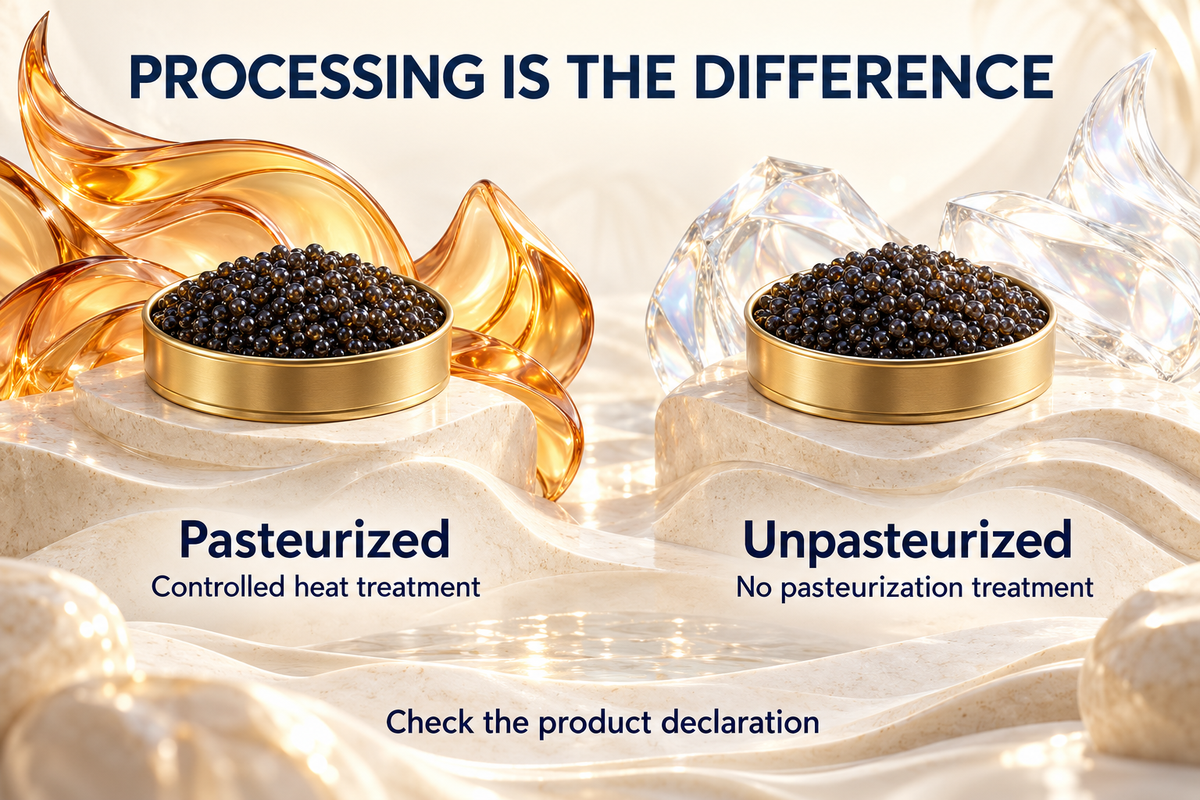
Pasteurized vs Unpasteurized Caviar: The Processing Difference
The processing declaration helps explain how the product has been prepared for distribution. It does not replace the other parts of a caviar specification.
What unpasteurized means
Unpasteurized caviar has not received the pasteurization treatment being compared here. It can still have been salted, packed and matured as part of its preparation. “Unpasteurized” therefore does not mean untouched roe, and “fresh” is not a complete processing description.
For an enquiry, ask the supplier to state the format explicitly. If a product is described only as fresh, premium or traditionally prepared, request the missing process information rather than deciding what those words must mean.
What pasteurization means
In this context, pasteurization is a controlled heat treatment applied to the caviar product. The producer needs a process appropriate to the food, packaging and hazards being controlled. A general temperature mentioned in a consumer article is not a complete process specification.
The FDA’s seafood heat-process guidance describes pasteurization as a treatment targeting relevant pathogenic bacteria and distinguishes it from other heat processes. Buyers should ask for confirmation of the declared treatment rather than trying to reproduce a commercial process from an online description.
Why pasteurization is not commercial sterilization
Commercial sterilization and pasteurization are different processing categories. The FDA guidance distinguishes retorted, shelf-stable fishery products from pasteurized products distributed under refrigeration or freezing.
For a buyer, the consequence is practical: a sealed jar is not evidence that its contents can sit on an unrefrigerated shelf. Check the actual storage declaration. If shelf stability is part of your procurement requirement, request specific supporting confirmation instead of accepting the word pasteurized as proof.
How Heat Treatment Can Change Texture, Taste and Aroma
Heat treatment can influence the eating experience, but it does not produce one identical result across all caviar. Use the processing declaration to frame a sample assessment, rather than to replace it.
Grain firmness and membrane feel
A buyer may notice a difference in firmness, how the grains separate or how their membranes feel during tasting. In Petrossian’s discussion of pasteurization and sensory qualities, heat treatment is associated with a sometimes firmer texture and changes in aroma. These are useful tendencies, not a guarantee that every pasteurized tin will behave alike.
Avoid reducing texture to “good pop” or “bad pop.” Record whether the grains remain distinct, how they feel on the spoon and how they perform in the planned dish. The preferred result depends on what your customer expects.
Flavor and aroma
Compare perceived salinity, aroma, finish and any unwanted notes as separate observations. If a sample seems less aromatic, that is an observation to investigate, not enough information to identify pasteurization as the cause.
A meaningful comparison also considers ingredients, species, grade, maturation and storage history. A buyer who compares unrelated products may be assessing several differences at once without realising it.
Variation between products
The word pasteurized does not assign a fixed quality grade. Likewise, unpasteurized does not guarantee excellent handling, an appropriate species or a sensory profile suited to your menu.
For repeat purchasing, define the product you approved and keep the sample records. When a replacement is proposed, ask which attributes have changed. A different species or formulation should not be presented as a direct processing-only substitute unless the distinction is clearly explained.
Malossol and Pasteurization Are Separate Specifications
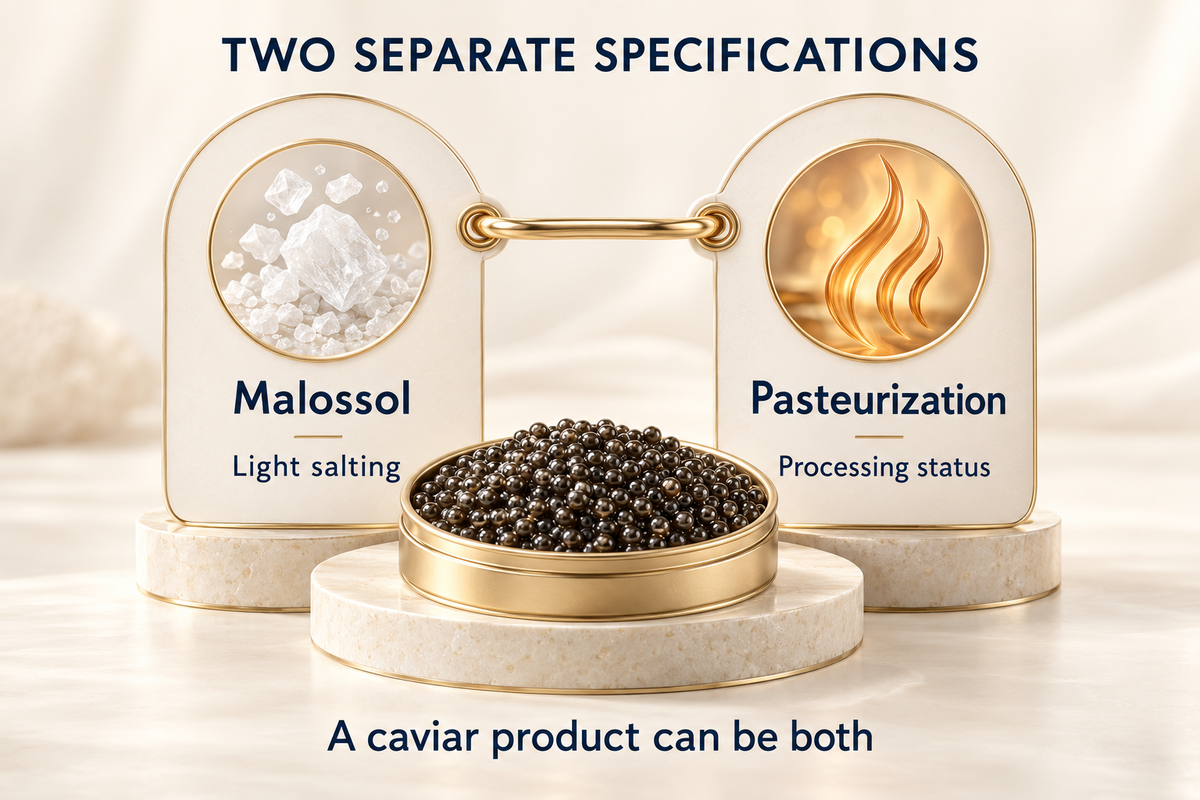
Malossol concerns light salting. Pasteurization concerns processing. A product can be both, so asking whether caviar is “malossol or pasteurized” leaves the supplier with an ambiguous question. Request the salt specification and heat-treatment status separately.
The same separation applies to ingredients. Neither the presence nor absence of pasteurization establishes that a product is preservative-free. Read the complete declaration, and check any formulation requirement relevant to the intended customer or destination.
A concise buying description should identify the species, grade, ingredients, salt specification, processing status and packaging. Adding the required storage conditions and expected delivery timing then turns that description into something the receiving and service teams can use. It is a better basis for approval than relying on a single front-label term.
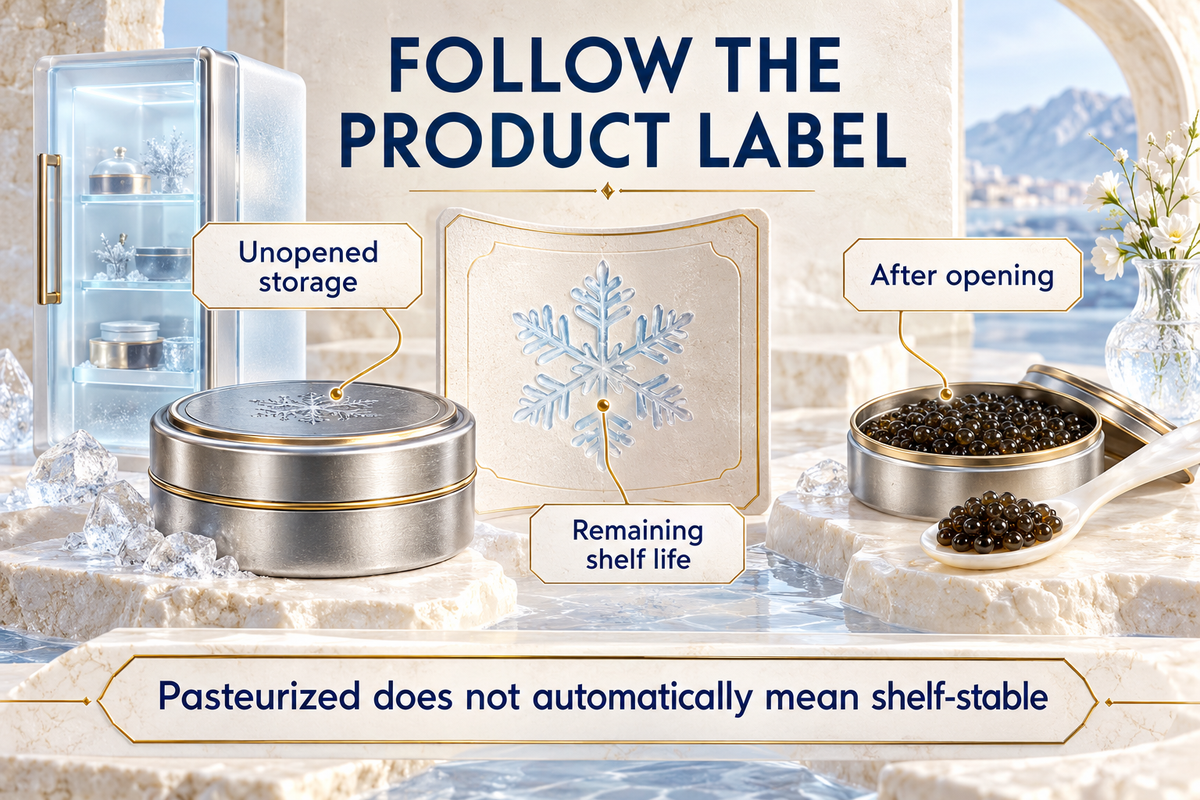
Storage and Shelf Life: Compare the Label, Not a Generic Number
Shelf-life statements apply to a particular product under stated conditions. Before comparing formats, establish what the producer’s declaration covers.
Unopened storage
Pasteurization can support a longer unopened life, but only the actual declaration tells you what applies to a particular pack. Ask for the required storage conditions, date information and any instructions that affect transport or warehousing.
For both formats, keep the product within its stated conditions. A longer date does not create permission to ignore the label, and a cold container at delivery does not explain every part of the previous journey.
Handling after opening
Opening changes the handling situation. Follow the producer’s instructions for the opened product, use clean utensils and record the opening details where your operation requires them.
Do not give pasteurized caviar a longer opened life merely because its unopened date was longer. If the supplier provides different opened instructions for different products, keep those instructions attached to the correct stock item.
Remaining shelf life on arrival
Total shelf life and usable time after delivery are different purchasing questions. A product with a longer declared life may still arrive too close to its date for your planned turnover.
Agree the expected remaining life at receipt, then allow for internal distribution and service. For imported stock, ask how the proposed transit plan fits that requirement before the order is confirmed.
Freezing and thawing
Do not assume that freezing is permitted for every caviar format, or that it leaves texture unchanged. Ask whether the supplier approves it for the supplied product and what instructions apply.
If the product has already been frozen, make that part of the specification and sample comparison. Storage history should be visible in the buyer’s decision rather than discovered after a different texture appears at service.
| Situation | Appropriate action |
|---|---|
| Label requires refrigerated storage | Maintain the stated cold chain, whether pasteurized or unpasteurized. |
| Opened-container instructions are missing | Obtain them before planning service or setting an internal use period. |
| Delivery leaves too little usable life | Resolve the delivery specification before accepting it for the planned use. |
| Temperature history is uncertain | Hold the lot for review against agreed criteria; do not clear it by tasting. |
| Freezing is being considered | Obtain product-specific approval and instructions. |
| Shelf-stable supply is required | Request explicit process and storage confirmation; do not infer it from packaging. |
What Pasteurization Changes About Food Safety
Pasteurization is a control step, not a statement that all hazards and handling responsibilities disappear. Ask the supplier how the declared product is controlled, and make sure the storage information is consistent with its intended distribution. The FDA’s seafood hazard-control framework explains why processors assess hazards and select appropriate controls for the specific product.
Handling after processing also matters. The FDA’s guidance on contamination after pasteurization addresses the introduction of pathogens after the treatment. For a receiving or service team, this reinforces the need to protect packaging integrity, maintain the declared conditions and use appropriate hygiene after opening. Neither a pleasant smell nor a successful taste test is a microbiological clearance.
Do not advertise pasteurized caviar as universally safe for pregnancy or every vulnerable consumer. The FDA’s seafood advice for susceptible groups identifies pregnant people, older adults and people with weakened immune systems among those requiring particular care with seafood. Follow the applicable public-health advice and seek suitable professional guidance for a specific consumer question, rather than converting a processing label into a blanket assurance.
Choosing Caviar for Tasting, Retail and Food Service
Start with the occasion and your handling capability. The following are buying considerations, rather than fixed rules assigning one format to every customer.
Tasting-led service
If the main purpose is a plain caviar tasting, approve the sensory profile with a representative sample. Unpasteurized products are often sought for this use, but the actual species, grade and handling history still need to match your requirement.
A pasteurized option should not be rejected without assessment if it meets the intended experience. Decide through the sample and specification, rather than treating a processing word as a complete verdict on quality.
Chilled retail and distribution
For retail stock, consider the date on arrival, anticipated turnover, pack format and clarity of customer instructions. A longer unopened life can be useful only if the conditions supporting it are maintained.
Compare the proposed product with your storage and distribution arrangements. If a supply route cannot reliably meet a product’s conditions, changing the wording on the listing will not solve the mismatch.
Catering and professional service
Caterers and restaurants should connect product selection to delivery timing, the amount opened during service and the way portions will be handled. Avoid making the storage plan depend on a generic claim about pasteurized products lasting longer.
Assess the caviar in the intended dish as well as plain. If using it as a garnish, consider how contact with warm components affects the planned presentation and service timing. Keep the supplier’s handling instructions visible to the team preparing the food.
| Intended use | What to prioritise | What not to assume |
|---|---|---|
| Plain tasting | Representative sample, grain texture and aroma | That processing status alone predicts the best taste. |
| Chilled retail | Clear label, remaining life and reliable storage | That a glass jar is automatically shelf-stable. |
| Restaurant service | Portioning, opened handling and menu suitability | That the unopened expiry applies after opening. |
| Catering or events | Delivery timing and controlled chilled service | That pasteurization compensates for uncontrolled exposure. |
| International distribution | Product specification, documentation and transit plan | That every destination accepts every species or format under the same conditions. |
How to Compare Samples Without Confusing Species With Processing
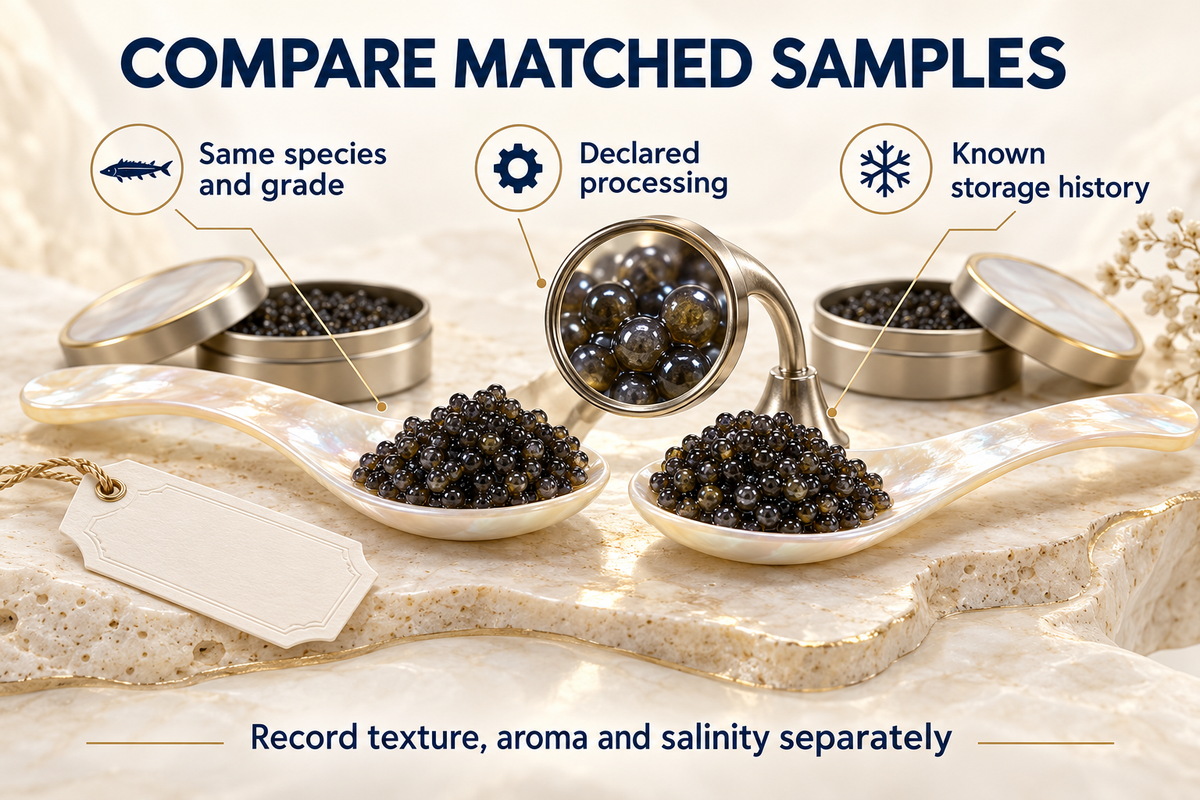
A processing comparison is most useful when the other important variables are controlled or clearly recorded. If matching products are unavailable, describe the assessment as a comparison of the supplied products rather than a test of pasteurization alone.
- Compare the same declared species and a similar grade where possible.
- Obtain the processing declaration for both samples.
- Check salt specification, ingredients and any relevant formulation differences.
- Record lot details, date information and known storage history.
- Assess samples at comparable stages of their declared life and under appropriate handling conditions.
- Taste plain first, then test the intended presentation without overpowering accompaniments.
- Record aroma, salinity, membrane feel, grain separation and finish separately.
- Keep sensory acceptance distinct from documentary and food-safety acceptance.
If only the unpasteurized sample has a species declaration, the comparison is incomplete before tasting starts. If both identities match but the formulations differ, discuss that difference with the supplier before attributing the result entirely to heat treatment.

Reading the Label and Supplier Documentation
The useful documents are those that describe the product you will actually receive. Ask for clarification whenever the label, specification and order appear to refer to different formats.
- Processing declaration: request an explicit pasteurized or unpasteurized statement, rather than relying on “fresh” or “traditional.”
- Ingredients: check the full declaration and any agreed restrictions.
- Storage conditions: confirm the required conditions during transit, warehousing and use.
- Shelf life: distinguish the unopened date, expected remaining life on arrival and opened-container instructions.
- Lot identity: ensure the supplied containers can be matched to the records.
- Packaging: identify the actual format and how seal integrity will be checked.
- Origin and species: confirm the identity relevant to the enquiry and destination.
- Supporting documentation: ask what records can demonstrate the declared process and the suitability of the proposed shipment.
- Trade requirements: confirm destination-specific requirements with the responsible importer and authorities rather than assuming a single global route.
For relevant commercial information, review Iran Fish’s caviar export and supply page. Use it to begin a product enquiry; confirm the particular processing format and current availability before treating it as an agreed specification.
Receiving, Opening and Serving: A Practical Handling Workflow
Agree the receiving checks before the shipment arrives. Clear responsibilities are more useful than discovering missing instructions when the caviar is already needed for service.
Receiving and hold decisions
Match the delivery to the order, inspect the packaging and check the available temperature and date information. Keep a record of the lot and any discrepancy that requires supplier review.
If a seal is damaged, the declaration is unclear or conditions fall outside the agreed criteria, segregate the affected stock and request a documented decision from the responsible team. Do not taste a doubtful product to decide whether it should be released.
Opening and chilled handling
Open only the stock needed for the planned service, using clean equipment and the appropriate storage arrangement. Record opening details according to your operation’s procedure and retain the product identity with the opened container.
Keep different products distinguishable. A pasteurized tin and an unpasteurized tin may have different instructions, so a single general sticker for “all caviar” can conceal important information.
Clean service and unused portions
Keep serving utensils and the working area clean, and protect ready-to-eat caviar from contact with raw seafood or contaminated equipment. The FDA seafood-handling guidance supports separation and appropriate chilled service.
Handle unused portions according to the product instructions and your food-safety procedure. Do not reset an opened use period by moving the caviar into a new container or by mixing it with a newly opened batch.
Frequently Asked Questions About Pasteurized and Unpasteurized Caviar
These questions address common points of confusion in product listings and enquiries. The final decision should use the supplied product’s documented information.
Is pasteurized caviar the same as cooked caviar?
Pasteurization is a controlled processing treatment, rather than a description of a cooked dish. Ask the supplier to identify the process. Do not use the word cooked as a substitute for checking heat-treatment status, storage instructions and intended use.
Does pasteurized caviar need refrigeration?
Often it does, and you must follow the product label. Pasteurization alone does not establish shelf stability. If ambient storage is required, obtain explicit confirmation that the particular product and process support it.
Can malossol caviar also be pasteurized?
Yes. Light salting and pasteurization describe independent attributes. Request both the salt specification and the processing declaration if those details affect your buying decision.
Is unpasteurized caviar always better for taste?
No universal ranking follows from the term. Species, formulation, grade, maturation and handling influence the supplied product. For a tasting-led purchase, compare representative samples and choose the profile that meets the intended experience.
Can I identify pasteurized caviar by a glass jar or metal tin?
No. Packaging material is not a reliable processing declaration. Read the label and request the specification. A container’s appearance also does not establish its permitted storage conditions or the product’s remaining shelf life.
Confirm the Right Caviar Format With Iran Fish
Review Iran Fish’s caviar supply information and describe the tasting, retail or food-service use you are planning.
If Beluga is part of your requirement, explore the Beluga caviar information and ask which processing and packaging formats are currently available for your destination.
Contact Iran Fish with the species, processing preference, delivery timing and storage requirements so the appropriate specification and shipment documentation can be discussed together.