


Salmon Processing Methods: Whole, Fillet, Portion and Steak

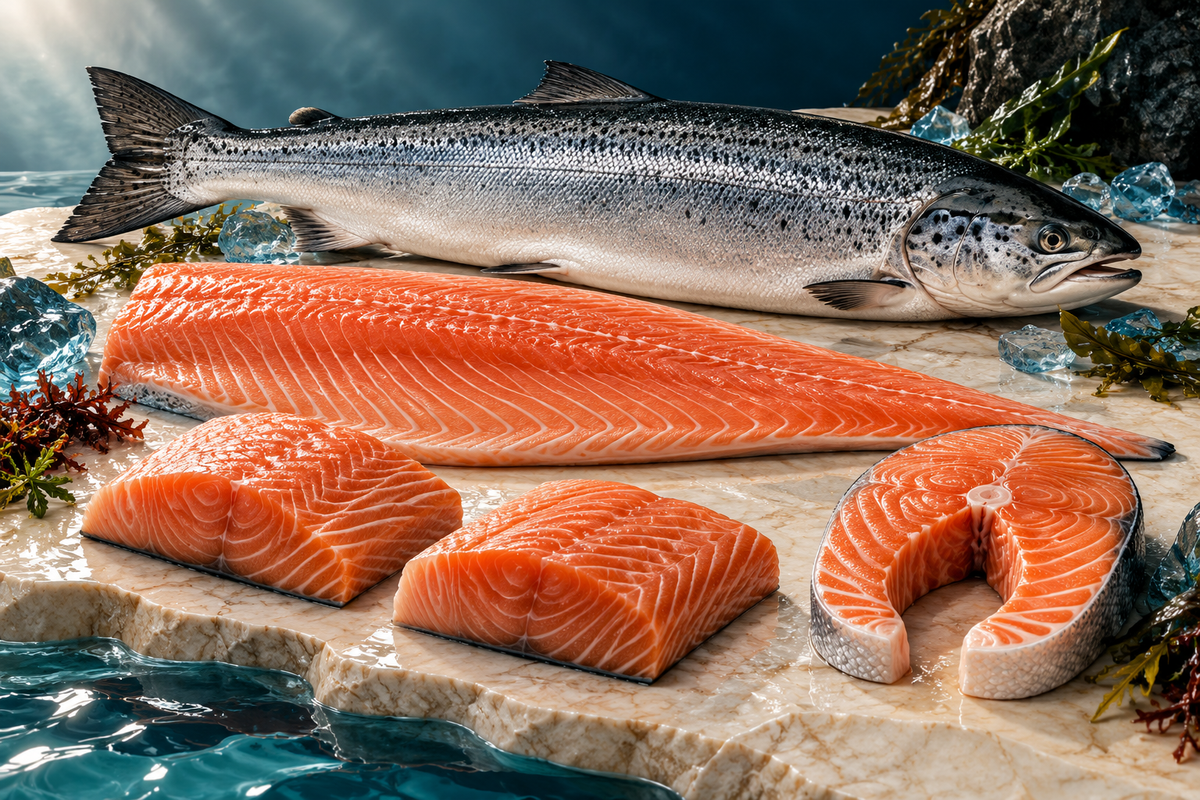
Salmon processing methods produce whole or gutted fish, fillets, portions and steaks, with separate choices for trim, skin and bone removal. Choose the form that fits your customer’s preparation or production line, then specify dimensions, weight tolerances, freezing and packaging. A portion is usually cut from a fillet; a steak is a cross-sectional cut that commonly retains bone. Processing terminology alone does not establish quality or suitability for raw consumption.
| Product or step | What it means | What the buyer must confirm |
|---|---|---|
| Round fish | Fish before gutting and dressing | Required handling and product condition |
| Head-on gutted | Viscera removed with head retained | Cleaning, size basis and included parts |
| Head-off gutted | Head and viscera removed | Tail and fin treatment, weight basis |
| Fillet | A side separated from the main skeleton | Trim, skin, pin bones and dimensions |
| Portion | A piece cut to a target size or weight | Cut location, thickness and tolerance |
| Steak | A cross-sectional cut through the fish | Bone status, thickness and presentation |
| Freezing | Preservation process for the specified product | Method and completed product condition |
| Packaging | Protection and identification after or around processing | Materials, seals, net quantity and instructions |
| Safety controls | Management of hazards for the intended use | Process-specific records and compliance |
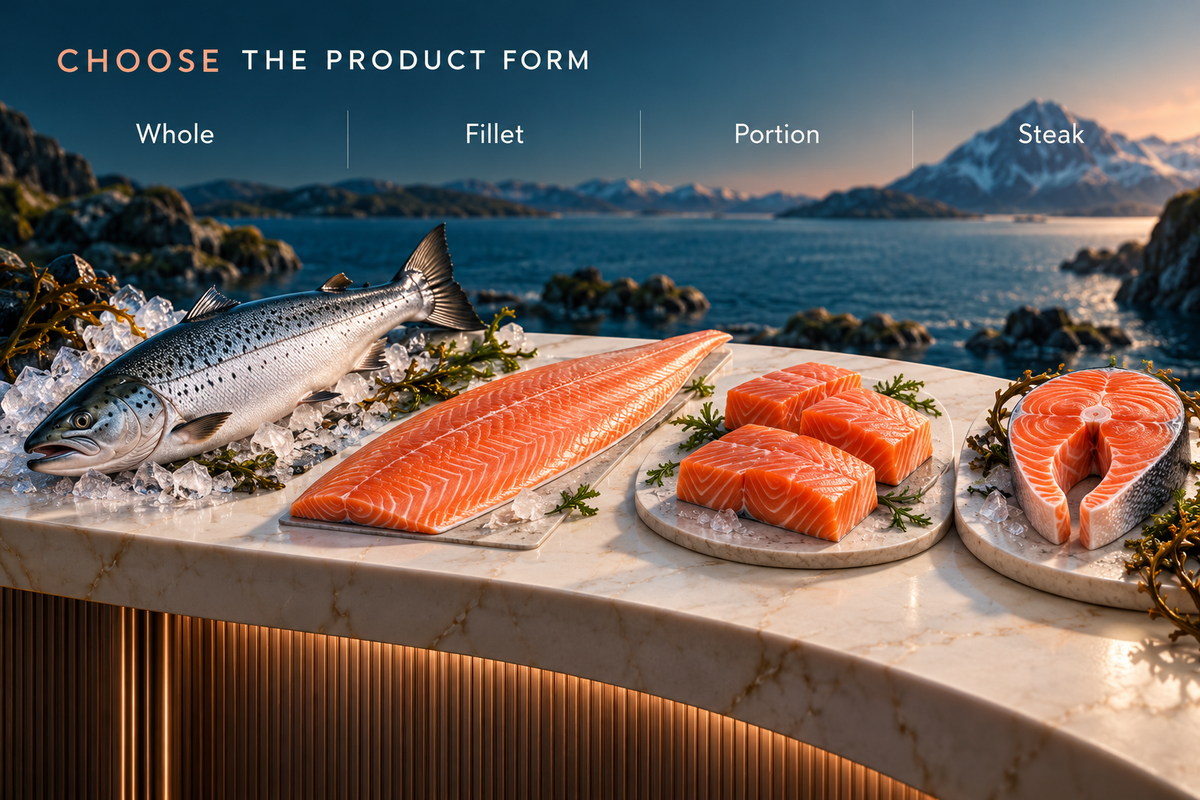
Salmon Processing Methods: Compare the Main Product Forms
Product form determines what processing remains after delivery. Agree a plain-language description as well as any abbreviation so that the buyer, processor and receiving team expect the same fish.
Whole and gutted fish
Round fish retains the viscera, while gutted fish has undergone removal of the internal organs. HOG commonly means head-on gutted; head-off gutted is a different form, and further dressing may remove additional parts.
Specify whether the head, tail and fins are retained and how the cavity is cleaned. Do not assume that an abbreviation includes every operation. The purchase specification should identify the finished state and the weight basis used for sizing.
Whole or gutted fish can suit customers that perform their own cutting or use several parts of the fish. Confirm that the receiving operation has the appropriate facilities, handling controls and processing capacity for the supplied form.
Fillets
A fillet is a side of the fish separated from the main skeleton. It can be supplied with different levels of trimming, with or without skin, and with pin bones retained or removed.
Fillets give downstream processors flexibility to produce loins, portions, strips or other shapes. That flexibility depends on the actual dimensions and integrity of the flesh, so assess gaping, damage and usable shape alongside weight.
A skinless label does not by itself mean pin bone-out, and a trim letter does not answer every processing question. Use a technical sheet that states the required features independently. Iran Fish’s salmon fillet cuts guide provides related cut terminology.
Portions
Portions are pieces prepared to a target weight, size or shape. They can be cut from different locations along a fillet, with resulting differences in thickness and presentation.
For a regular foodservice or retail programme, agree whether mixed locations are acceptable. Specify skin, pin-bone status, target range and any dimensional requirements relevant to cooking, trays or production equipment.
Approve representative pieces from normal production rather than only the most uniform centre cuts. Ask whether the processor sorts portions by size and location, and how out-of-specification pieces are segregated.
Steaks
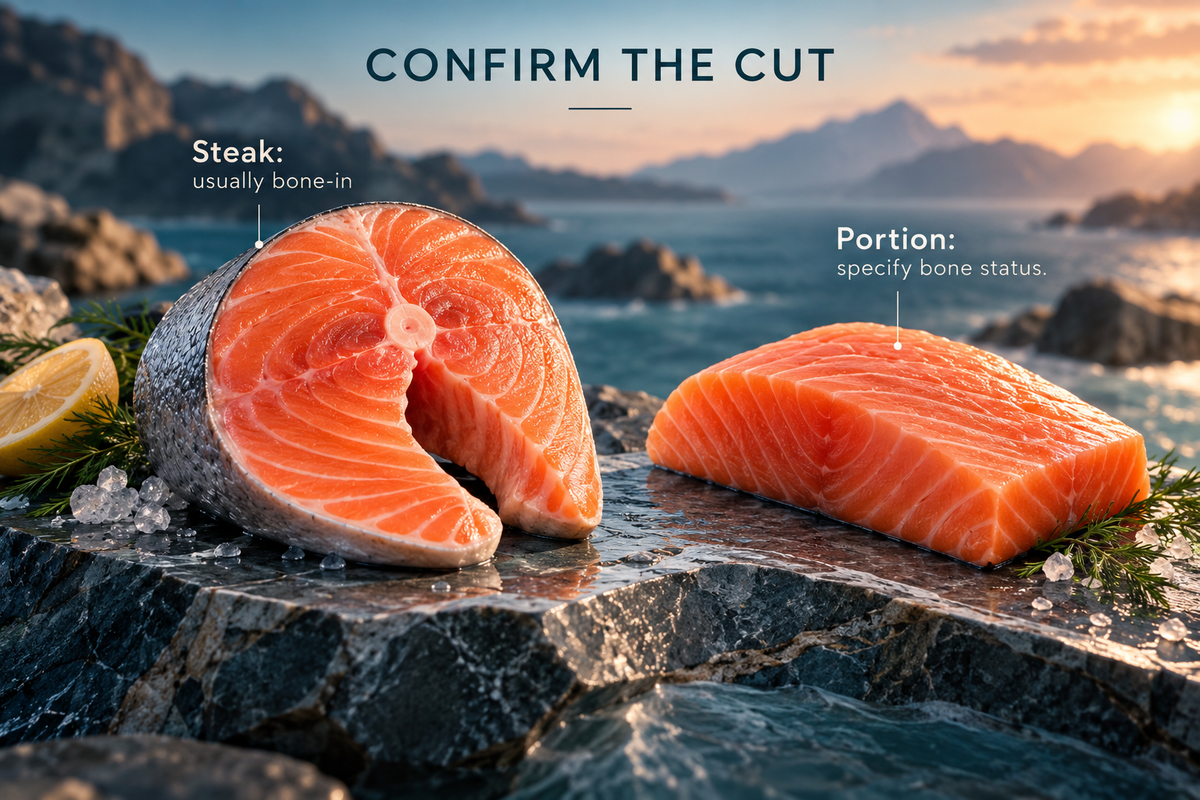
A steak is a cross-sectional cut through the fish, commonly including the backbone and other bones. It is not simply another name for a boneless portion cut from a fillet.
Specify thickness, size, bone status and the treatment of the cavity and skin. Whole-fish variation can affect the shape of successive steaks, so agree the range of presentations acceptable in a carton.
Bone-in cuts need suitable packaging and clear product descriptions. If the customer expects a boneless product, request that requirement explicitly and confirm the actual process rather than interpreting the word steak as a guarantee.
Receiving, Gutting and Chilled Handling Set the Foundation
Processing begins with raw-material approval. Check species identity, origin, lot records, product condition and the relevant handling history before the fish enters the line. The processor’s hazard assessment should determine required controls and checks; visual appearance is only one part of that assessment.
Gutting, cleaning and any bleeding operation need a controlled process that limits contamination and unnecessary damage. Tools, surfaces, water and personnel practices must be suitable for food processing. The FAO discussion of fish processing operations describes how operations such as gutting, washing and filleting fit together; their implementation must still match the actual species and approved plant procedures.
Maintain the specified chilled conditions and minimise uncontrolled delays between steps. Timing around rigor can affect cutting and flesh behaviour, so a processor should validate the approach used for its product rather than claim one schedule suits every fish. Record relevant handling and process information so that later texture or gaping problems can be investigated against the lot history.
Filleting, Trimming, Skinning and Deboning
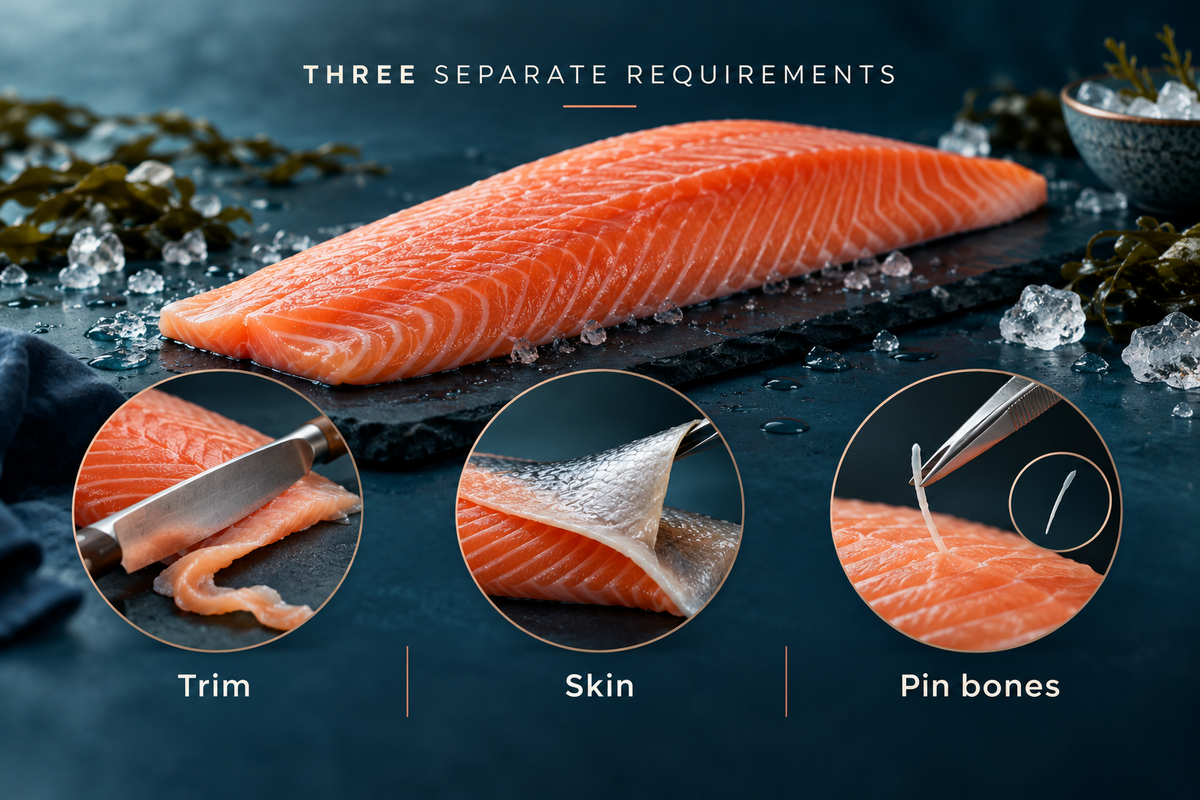
These operations define the usable product more precisely than the word fillet alone. Confirm each requirement in writing and assess the finished result under an agreed inspection procedure.
Filleting and trim
Filleting separates the sides from the main skeleton; subsequent trimming removes material according to the customer’s specification. This may address belly bones, fins, collar material, belly edges, fat or tail sections, depending on the product.
Trim letters are useful shorthand but not universal definitions. The Mowi fillet guide publishes its own trim and pre-rigor specifications, while Neerlandia’s salmon range describes another set of finished products. Use the supplying processor’s current technical sheet, not a table copied from an unrelated producer.
Agree which features are retained or removed, and what condition is acceptable along the trimmed edges. A closely trimmed fillet can still have poor texture or handling damage; processing extent and raw-material quality remain separate checks.
Skinning and deep skinning
Skin-on fillets retain the skin and may need a separate scaling specification. Skinless fillets have the skin removed, but the amount of underlying tissue left on the flesh can vary with the process.
Deep skinning can include removal of additional tissue, such as the brown muscle layer, according to the agreed definition. Specify the intended appearance and retained tissue rather than assuming the term means the same thing for all suppliers.
Inspect the finished surface for damage and unnecessary flesh removal. Approve a representative sample, especially where the product must fit a particular display format or processing line.
Pin-bone removal
Removing the backbone during filleting does not necessarily remove pin bones. State pin-bone-in or pin-bone-out independently of skin status and trim letter.
The processor should use an appropriate removal and verification procedure. Confirm how remaining bones are checked and what acceptance criteria apply, rather than interpreting a marketing term as an absolute guarantee about every piece.
Pin-bone removal may interact with processing timing and flesh integrity. Assess the final product for gaping and damage as well as bone status. The aim is a product that meets both the bone specification and the intended presentation requirements.
| Processing choice | Written requirement |
|---|---|
| Trim | Parts removed, retained material and edge condition |
| Skin-on | Skin and scaling requirements |
| Skinless | Surface condition and retained underlying tissue |
| Deep-skinned | Definition of tissue removal and approved appearance |
| Pin bone-out | Removal process, verification and acceptance criteria |
| Fillet size | Weight basis, dimensions and tolerance |

Portion Cutting: Specify Weight, Thickness and Cut Location
Portion weight is important, but it does not determine shape. The thick centre of a fillet and the tapering tail can produce pieces with the same weight and different dimensions. If uniform preparation or tray presentation is required, include thickness and cut-location rules alongside the weight range.
Agree whether portions are cut to a target weight, a dimensional template or a combination of both. State whether tolerances apply to each piece or the batch average, subject to applicable net-quantity rules. Confirm how the processor measures compliance and handles pieces outside the agreed range.
Approved photos help communicate presentation, but they should accompany measurable requirements. Evaluate normal production from the intended raw-material size and process, including pieces at the acceptable limits. If the customer needs only centre cuts, state that requirement rather than assuming all portions will come from the same part of the fillet.
Steaks and Bone-In Cuts Need Different Instructions
Steak cutting crosses the fish body rather than following the fillet. It can retain backbone and other bones and may produce a different presentation depending on location. Specify whether the order allows mixed steak positions and what thickness variation is acceptable.
Bone-in products need clear descriptions for downstream handling and customer communication. Check that sharp features do not compromise the primary pack and that the approved packaging works with the actual cut. A pouch suitable for a boneless fillet may need different protection when used for steaks.
If a market uses steak loosely for a boneless piece, remove the ambiguity before ordering. Request a written cut description, representative photograph and sample. The finished product’s anatomy and bone status should govern the specification, not a translation of the trade name alone.
Freezing and Packaging Follow the Product Specification
Freezing can be applied to whole fish, fillets, portions or steaks, but the process needs to be validated for the actual size and form. A completed quick-freezing process is more than placing fish in a cold room. The Codex quick-frozen fillet standard addresses the finished product’s thermal-centre condition and storage instructions; confirm the standard and requirements applicable to the supplied form.
Specify the freezing format separately from the pack. IQF means pieces are frozen individually, while IVP means individual vacuum packaging. Glazing is another protective treatment, and its weight must not be confused with net fish quantity. The site’s frozen salmon buying guide helps organise these distinctions in a purchasing enquiry.
Packaging must protect the product through the agreed route and communicate the correct handling instructions. Vacuum packaging requires reduced-oxygen hazard controls and an appropriate thawing procedure. Do not assume that ordinary freezing, close trimming or vacuum packing establishes suitability for raw or undercooked consumption.
Measure Yield and Plan Suitable Uses for By-Products
Processing yield depends on the raw fish, product definition and actual operation. Use comparable measurements and plan each secondary stream according to its identity, condition and permitted use.
Comparable yield measurements
Define the starting material and finished product before calculating yield. For example, a measurement starting from round fish is not directly comparable with one starting from gutted fish, and a skin-on fillet is not the same output as a deep-skinned portion.
For a defined batch, yield is the measured finished-product mass divided by the measured input mass on the agreed basis. Specify the weighing stage, treatment of water and ice, and which product streams are included. Do not present a universal yield percentage without data from the relevant process.
Trim and frames
Trimmings, bellies, collars, frames and heads can have different potential uses. Some may be suitable for further food processing when handled under the appropriate controls, while others may enter permitted non-food streams.
Do not group all removed material under one quality label. Identify each stream, its bone and tissue content, storage conditions and intended destination. A processor’s useful secondary product is another buyer’s unsuitable raw material if the specification is unclear.
Separate handling requirements
Secondary products need traceability, hygienic handling and appropriate temperature control. Their acceptability depends on condition and lawful use, not simply on having originated from edible fish.
Roe, where relevant, also needs its own specification and process controls. Keep streams identified and segregated so that a change in use or condition does not create confusion in production records or shipment documentation.
Define Quality, Safety and Receiving Checks
A complete processing order describes the finished fish and the evidence needed to accept it. Confirm these points before the line produces the shipment, then use the same specification for receiving checks.
- Verify commercial and scientific names, origin and production method.
- Describe the cut and included or removed parts.
- Specify trim, skin and pin-bone status separately.
- Agree weight, thickness, dimensions and permitted variation.
- Define visible-defect criteria, including gaping, bruising and blood spots.
- Confirm freezing, primary pack, glaze and net-weight requirements.
- Identify intended use and the applicable food-safety controls.
- Agree sampling, lot acceptance and corrective-action procedures.
- Require matching lot identifiers across labels and records.
- Record the handling and temperature evidence needed at receipt.
| Acceptance area | Receiving check |
|---|---|
| Identity | Product and records match the agreed species |
| Cut | Included parts and shape match the specification |
| Bones and skin | Physical inspection against the agreed requirements |
| Weight and dimensions | Measurements using the approved basis |
| Flesh quality | Representative examination under defined conditions |
| Packaging | Integrity, label and net-quantity checks |
| Handling | Temperature and process-record review |
The FDA seafood hazards guidance addresses hazards by product and process. Use appropriate technical review for raw-use, smoked or other specialised products rather than relying on appearance checks to answer food-safety questions.
Frequently Asked Questions
These questions clarify the forms most often requested by commercial buyers. The finished product description should still be confirmed with the supplying processor.
What is the difference between a salmon fillet and a portion?
A fillet is a side of the fish separated from the main skeleton. A portion is a smaller piece prepared to a target weight or size, usually cut from a fillet. Both need separate skin, bone and trim specifications.
Are salmon steaks usually boneless?
Steaks are commonly cross-sectional, bone-in cuts. Confirm the actual product because some markets use the name differently. If boneless fish is required, state that explicitly and approve a sample.
Does skinless salmon mean pin bone-out?
No. Skin removal and pin-bone removal are different operations. Specify and inspect them independently, including the supplier’s verification procedure for remaining bones.
Do all suppliers use the same Trim A to E definitions?
No. Trim letters are commercial shorthand with supplier-specific details. Request the current technical sheet and write out the required bones, fins, belly, tail, skin and tissue treatment.
Which processing method gives the highest yield?
The answer depends on the input fish and what counts as the finished product. Compare measured results on the same starting-weight basis and product definition. A less-trimmed product retaining more material is not equivalent to a closely trimmed portion.
Send Your Processing Requirements to Iran Fish
Visit Iran Fish’s salmon-trout product page to discuss the currently available product and processing options.
Send the required cut, weight range, dimensions, skin and bone status, packing format, destination and intended use.
Ask the team to confirm species identity and the written finished-product specification, with a representative sample where needed.