

Prawns vs Shrimp: What the Names Actually Tell Seafood Buyers

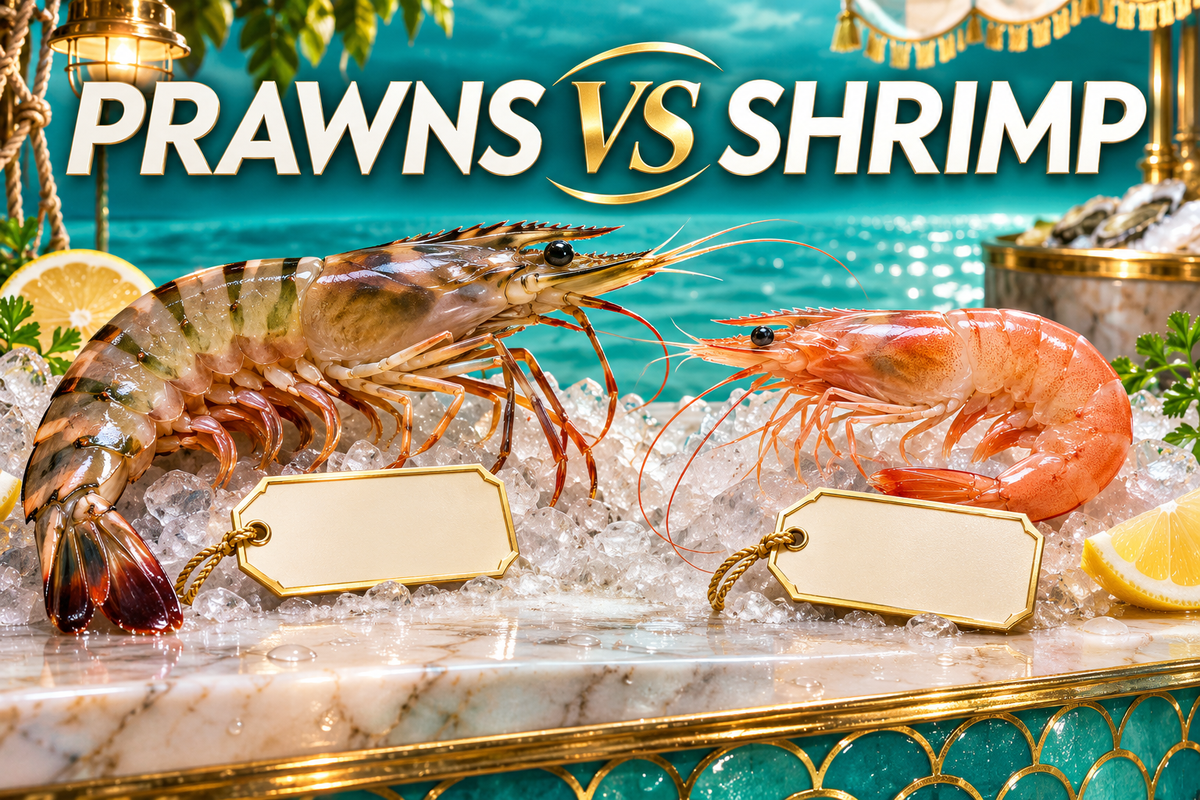
Prawns vs shrimp is a naming question before it is a buying specification. The words vary across regions and do not reliably establish species, size, flavour, source or processing state. Ask for the scientific name, count with its unit, raw or cooked state and head/shell format. Then match those details to the dish. Iran Fish lists Vannamei Shrimp; use the species and product form, rather than the headline name, when discussing an order.
| Buyer question | Direct answer | Required specification |
|---|---|---|
| Are the words interchangeable? | In everyday markets they are used differently across regions | Scientific species name |
| Does prawn always mean larger? | No | Count with unit and product form |
| Is shrimp always marine and prawn always freshwater? | No | Species and origin |
| Can one replace the other in a recipe? | Yes when size, form and cooking state match the dish | Count, shell/head state, raw/cooked state |
| Does one word guarantee quality? | No | Handling, storage, processing and documented product details |

Are prawns and shrimp the same?
No single common-name rule settles every product. Biologists distinguish groups by anatomy, while cooks and markets use “prawn” and “shrimp” in ways that shift with place and tradition. The Biological descriptions of prawns and shrimps describes a biological distinction in gill and limb anatomy and explains why the everyday terms lack a universally accepted public definition.
Do not take a market sign as a laboratory identification. A seller in one country can call an animal shrimp that a menu in another country calls prawn. The useful label is a documented species paired with origin and product form. Two cartons sold as “prawns” can differ sharply in count, head and shell status, freezing method and preparation state; two cartons with different headline names can serve nearly identical uses.
The choice becomes easier when you stop asking which word is more prestigious. For Types of Prawns, the practical variables are species, size, format and the dish. Start there, then decide whether the common name is appropriate to your destination market and customer-facing menu.
Read more: Types of Prawns: A Practical Guide to Species and Cooking Uses.
Why do common names vary by market?
Use the scientific name when accuracy matters. Common names grow from local culinary language, trade conventions and translations, not one global rule that follows every shipment.
Regional speech shapes menus
“Prawn” is familiar on many Australian and British menus; “shrimp” is common in North American English. That usage does not change the animal in the carton. A restaurant can adapt its menu vocabulary to its diners while its purchasing sheet retains the same species and product form. Keep the menu name and the receiving specification as two separate fields.
Biology does not fit a marketing slogan
Gill and leg structure are biological distinctions. They are not easy to assess from a peeled, frozen pack, and they are not a reliable shortcut for cooking instructions. The Species-based sourcing guidance addresses both names in the context of species and sourcing. Read the species statement on a product document rather than guessing from the size of a peeled tail.
A buyer needs traceable terms
Ask a supplier to put the scientific name next to the market name on the specification. Do the same for raw/cooked, head/shell state, count and storage condition. When a menu says “king prawns,” the procurement record must still specify what arrives. A vague common name lets a substitution appear harmless even when the delivered format changes the prep workload.
Read more: Shrimp Grading System: Counts, Sizes and Commercial Standards.
Do size and habitat identify a prawn?
No. A large shrimp is not automatically a prawn, and a small prawn does not become a shrimp by crossing a commercial size threshold. “Jumbo” and “king” are selling descriptions; ask for a numerical count and unit before using either one to plan a serving. A count per kilogram and a count per pound describe different numbers of animals for the same carton weight.
Do not assume that all prawns live in freshwater and all shrimp live in the sea. Species in both groups occur in different environments, and casual product names do not reliably identify habitat. A giant freshwater prawn, Macrobrachium rosenbergii, is a specific species, not proof that every product called prawn is freshwater. Check the declared species and origin.
Even a count needs context. Head-on shell-on product and peeled meat have different edible yields, so a count stated without form does not answer how much prepared flesh reaches the plate. Compare two samples only after confirming their count unit, processing form and preparation state. The name “prawn” cannot answer any of those questions.
Read more: Shrimp With Head On: 7 Checks Before Cooking or Serving.
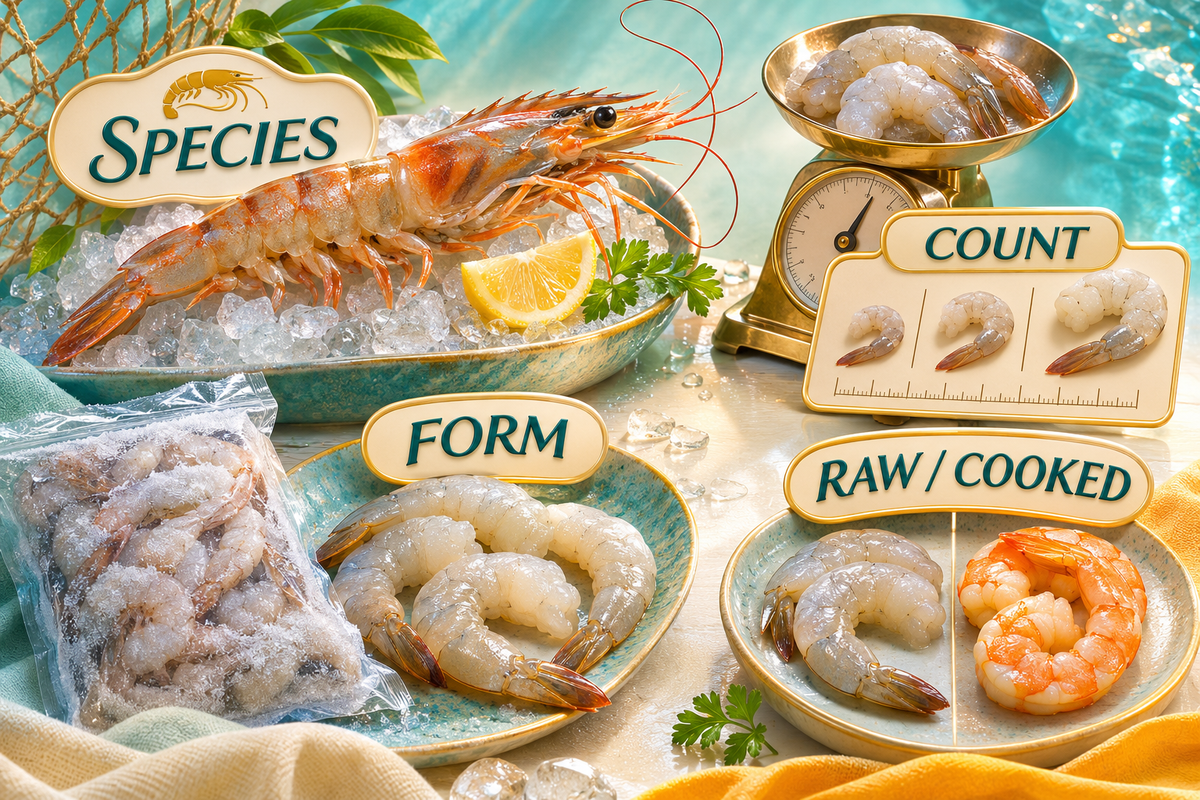
Which details matter more than the name?
Match the product document to the cooking and serving job. The name in the recipe is only the starting point.
| Detail | Why it matters | Example of a useful request |
|---|---|---|
| Scientific species name | Avoids common-name ambiguity | “State the Latin name on the specification.” |
| Count and count unit | Controls portion and cook consistency | “Give the count per kilogram for this head-on form.” |
| Head and shell | Changes prep and presentation | “Raw, peeled, deveined, tail-off.” |
| Raw or cooked | Changes handling and heat | “Confirm precooked ready-to-eat versus raw.” |
| Frozen format and glaze | Changes separation and water in pan | “Confirm individually frozen versus block-frozen.” |
| Origin and handling | Makes sourcing and cold chain clear | “State origin and storage instructions.” |
Appearance on the plate
Use head-on shell-on pieces when the visual presentation calls for a whole prawn and the guests can handle it. Use peeled pieces for pasta, a rice bowl or a buffet served with forks. Do not buy whole product merely because the photograph looks impressive if service will require staff to peel every piece before plating.
Raw and cooked state
A precooked prawn and a raw prawn cannot take the same heat schedule. For a cold dish, confirm the product is cooked and ready to eat. For a seared dish, specify the raw form and cook through. The FDA seafood safety guide provides the handling rules that remain relevant whichever common name appears on the carton.
Size without guesswork
Review the Shrimp Grading System before ordering. Count unit, size range and product form should travel together in a quotation. If two shipments have different counts, cook and plate them as different products instead of assuming the recipe word “shrimp” erases the difference.
Read more: Frozen Shrimp Shelf Life: Storage Rules and Guide.
What should a seafood buyer request?
Send one unambiguous request, then check the response against it. Do not approve a sample on the strength of the name alone.
- State the scientific species, or ask the supplier to supply it in writing alongside the market name.
- Specify wild or farmed, origin and the handling document relevant to your destination.
- Specify raw or cooked, head-on/headless, shell-on/peeled, deveined or not, and tail-on/tail-off.
- Specify the count with its unit and confirm whether the grade applies before or after processing.
- Specify whether the product is individually frozen or block-frozen and how it is packed.
- Check a received sample against those exact fields, then cook it using the intended dish method.
Here is a practical written request: “Supply raw Litopenaeus vannamei, peeled and deveined, tail-off, individually frozen, with count per kilogram and glaze details stated on the product sheet, for a pasta service.” This is a model specification, not a claim that Iran Fish currently offers that exact combination. For a whole grilled presentation, change the form to head-on shell-on and verify that the size and portion still fit the plate.
At receipt, keep the approved sample sheet next to the delivered label. Read the lot information, raw or cooked declaration, size unit and shell format before the kitchen breaks the seal. If one field differs, resolve it before the ingredient enters service. A carton of the same species but a different shell format changes prep time and edible yield; a carton marked precooked changes the cooking route entirely. This receiving check is the most practical answer to the naming ambiguity.
Can you swap prawns for shrimp in a recipe?
Yes, when the substitution matches size, form and cooking state. Do not swap by name alone.
A straightforward swap
A recipe calling for medium peeled raw shrimp can use a comparable peeled raw prawn of similar size. Follow the visual doneness cue for the actual product, not the original recipe’s exact minute count. Drain frozen product after safe thawing so the pan browns rather than steams.
A conflicting-criteria example
Suppose a dish calls for small peeled shrimp folded through pasta, but the buyer can obtain only large head-on prawns. Both names sit in the same broad recipe family; the formats do not. Peeling the large prawns changes the serving count and prep work, while cooking them whole leaves shells in a fork-only dish. Choose a smaller peeled product or redesign the dish as whole-prawn pasta with clear serving expectations. The decision rests on the guest experience and cook consistency.
Keep the label in charge of safety
Frozen products can arrive raw or precooked. Thaw and handle each according to its own pack; do not copy a raw-prawn cooking schedule for cooked seafood. Check the thickest piece of a raw batch for an opaque, firm finish. Common names tell you nothing about whether a product is ready to eat.
Read more: Vannamei Shrimp Market: Demand, Supply and Buying Trends.
How does Iran Fish describe its shrimp range?
Start with the company’s product page rather than inferring the offer from an article title. Iran Fish lists Vannamei Shrimp and describes farmed and wild shrimp on its main site. The exact processing form, count and pack for an intended order need to be agreed in the product specification.
The wording used on a consumer menu can still say prawns where that reads naturally to the destination audience. On the commercial document, retain the species and grade. This separation prevents an editor’s choice of word from becoming an accidental substitution instruction to procurement.
Do not claim first-hand inspection, a personal export record or a verified batch outcome merely because the site markets seafood. A concrete technical detail that improves a purchase order is more useful than an invented account of handling a shipment. Record what you asked for and what the supplied specification actually states.
Frequently asked questions
These five answers clarify terminology without pretending that a name can replace a product sheet. Use the scientific name and declared format for any exact order.
Is a prawn just a large shrimp?
No. Size alone does not define the name. Ask for species and count with a unit.
Are all prawns freshwater animals?
No. Habitat cannot be determined from the common word. Check the scientific name and origin.
Do shrimp and prawns taste different?
Do not expect one uniform taste from either word. Species, handling, freshness, size and cooking method influence the result; compare actual samples of stated products.
Can I use shrimp in a prawn recipe?
Yes, if the substitute has the right size, shell format and raw/cooked state. Change the cooking check to match the actual piece.
Which name should a supplier put on a specification?
Include the market name appropriate to the buyer, plus the scientific species name, origin, count unit and product form. The latter fields make the order repeatable.
Ask for a precise seafood specification
Give the intended dish, species, count unit, shell format and processing state before discussing a substitute. That is how to turn a vague “prawns vs shrimp” question into a reproducible order.
Explore Vannamei Shrimp and the Shrimp Grading System for product context.
Contact Iran Fish with your requested specification.